Physical Address
304 North Cardinal St.
Dorchester Center, MA 02124
Physical Address
304 North Cardinal St.
Dorchester Center, MA 02124

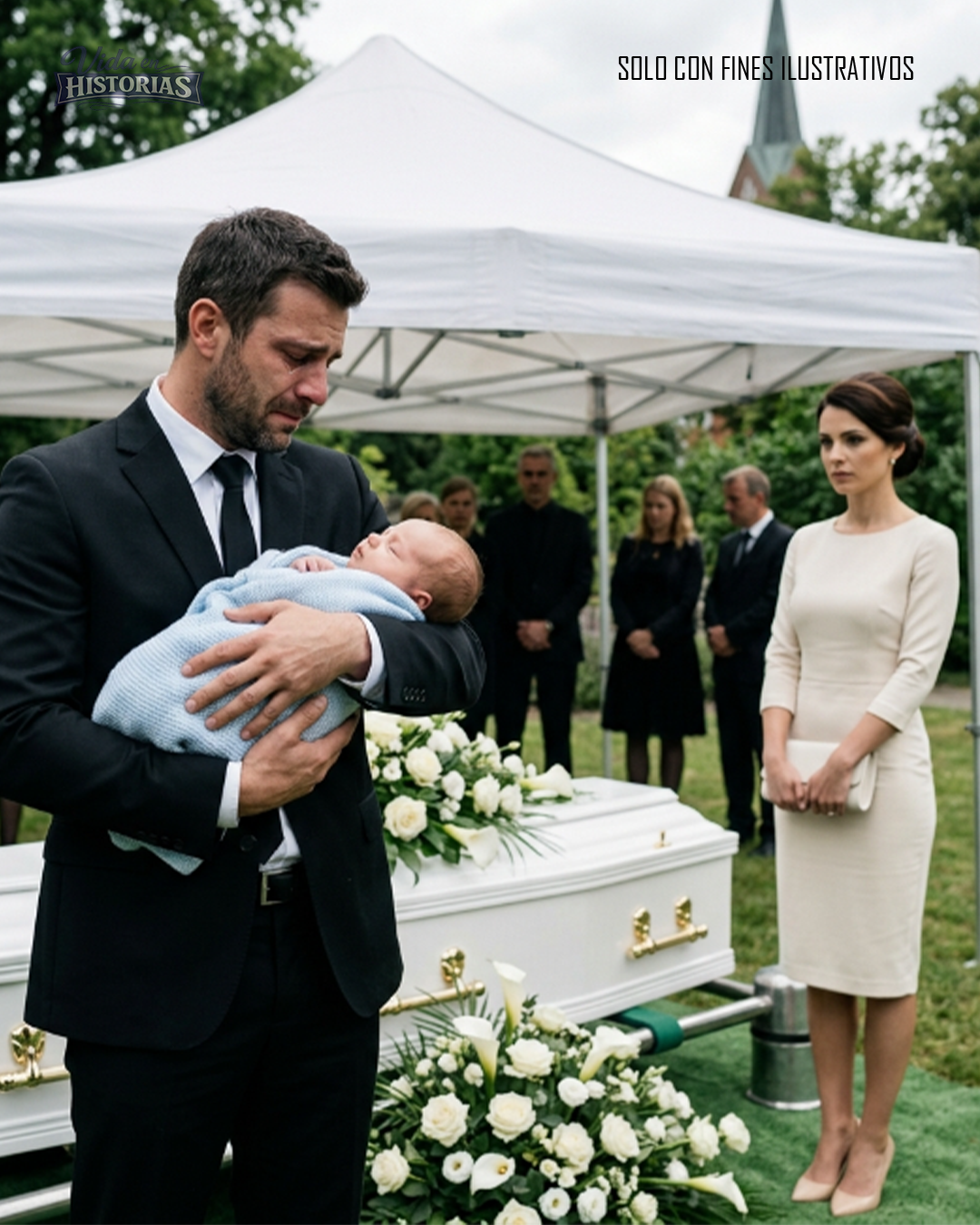
**My name is Carlos Navarro and I can still point to the exact moment my life split in two: before and after seven words spoken beside my mother’s coffin.**
My wife looked me in the eyes right in the middle of the funeral and said, with a calmness that hurt more than a scream:
“I married beneath myself. It’s over.”
She didn’t whisper it. She didn’t tremble. She didn’t cry. She said it like someone reading a bill they had already decided not to pay. Then she carefully folded the mass booklet, left it on the pew beside me, and walked out of the church while the priest continued praying for my mother’s soul.
My mother, Doña Mercedes Navarro, the woman who cleaned hospital floors for nineteen years so I could study engineering. The woman who repeated to me every night when I was a child: “A man who abandons his family in the darkest hour is no man at all.”
And there she was, ten steps ahead, inside a simple wooden coffin. And Jimena chose exactly that moment to leave me.
Not the day before. Not the week after. That moment.
As if she had calculated it. As if she knew I would be too broken to run after her.
She was right.
I stood there with my son Emiliano, barely six months old, pressed against my chest. He had been born six weeks premature and still carried that stubborn fragility of children who come into the world fighting to stay. I felt his small heart beating against mine as I stared at the empty space beside me.
I didn’t cry. I didn’t say her name. I just held my son tighter, looked up at my mother’s coffin, and made a silent decision that no one in that church heard.
I was done too.
People think the end of a marriage is the slammed door, the cruel phrase, the dramatic exit. No one talks about what comes after. No one asks what happens on a Tuesday at two in the morning, when a premature baby won’t stop crying, formula spills over the black funeral suit, your mother has just died, and the house still smells like the perfume of the woman who left.
That was my life for four months.
Emiliano woke up every three hours. I went to work with red eyes, rushed home, prepared bottles, sterilized nipples, checked for fever, washed clothes, and slept in fits and starts in a chair. My friend Francisco showed up three weeks after the funeral. He stood in the doorway, looking at the formula cans, the pile of unfolded laundry, and the feeding schedule taped to the refrigerator.
“Where’s Jimena?” he asked.
“She left.”
He looked at me in silence for a couple of seconds.
“What do you need help with?”
He didn’t say “I’m sorry.” He didn’t say “how awful.” He didn’t offer pretty phrases. He grabbed the car seat manual I had been trying to figure out for two days and sat down to assemble it on the living room floor. That day I understood who my real people were. Not the ones with the right words. The ones who take the manual and solve things with you.
The day after Jimena left, her mother, Graciela Robles, arrived. She didn’t come to ask about Emiliano. She didn’t come to apologize. She came to pick up her daughter’s clothes.
She moved through my mother’s house as if she were reclaiming belongings that should never have left her side. I watched her from the bedroom doorway with Emiliano in my arms, still in my pajamas, while she folded dresses with more tenderness than she had ever shown me in three years of marriage.
“Graciela,” I finally said. “Your daughter left a six-month-old baby here. My mother died yesterday.”
She turned slowly, as if she had been waiting for hours for her turn to speak.
“My daughter wasn’t born to be a woman of sacrifices, Carlos. She married you thinking you would go far. But you’re still exactly in the same place.”
She picked up the suitcase.
“Be grateful she left you the child. It’s more than you deserve.”
And she left.
I stood motionless, with my son breathing against my chest and those words stabbing into me like a sentence: you’re still exactly in the same place.
It wasn’t the abandonment that built me. It wasn’t the humiliation at the funeral, nor the empty side of the bed, nor the exhaustion of the early mornings. It was those words.
For five years, every alarm at five in the morning rang with Graciela’s voice behind it. Every certification exam I took. Every technical report delivered at midnight. Every specialization course done online while Emiliano slept. Every Saturday site visit. Every saving.
Her contempt was the most expensive fuel I ever used in my life, and I never paid her a single cent for it.
Jimena had suffered after Emiliano’s birth. I found out too late. The distance in her eyes, the way she held the baby as if he were borrowed, the fierce exhaustion that turned her into another person. Today I know what to call it: postpartum depression. No one detected it because she insisted she was fine and I wanted to believe her because I needed to believe she was.
In the middle of everything, Darío Salvatierra reappeared — a real estate businessman from a well-known family in Monterrey. New car, impeccable suits, quick answers, the confidence of a finished man. He didn’t pursue Jimena openly. He was smarter than that. He simply became available at exactly the right moment. When Jimena’s father’s business collapsed, when shame settled into our apartment like a third tenant, Darío represented what I was still trying to build.
And Jimena, exhausted, sick, with her mother whispering poison every week, chose the finished product instead of the blueprint.
Three years later, I received a handwritten letter.
I recognized the handwriting immediately. She had always written beautifully, with round and careful strokes. I opened it in the kitchen while Emiliano slept. I read scattered phrases: “I was drowning and I didn’t know how to tell you… David wasn’t what I thought… I know I hurt you… please let me see Emiliano.”
I didn’t cry. I didn’t tremble. I folded the letter, walked to the stove, lit the fire, and held it over the flame until it turned to ash.
I watched it burn with the same face one makes when watching a paid bill burn.
The next morning I called my lawyer.
“She hasn’t asked for custody yet,” he told me.
“She will,” I replied. “I want to be ready when she tries.”
I had already learned something: people who leave always come back when they imagine you are still in the same place they left you. And I planned to be in a completely different place.
Emiliano was six years old when he asked me the question I had been rehearsing the answer to for two years.
It was nighttime. I was tucking him in and he looked at me with that quiet seriousness I don’t know where he inherited from.
“Dad, why doesn’t my mom live with us?”
I sat on the edge of the bed.
“Because sometimes moms and dads love their children from different houses.”
He thought for a moment.
“Did she leave because of me?”
There it was. The real question.
I had practiced that answer in silence, in front of the bathroom mirror, months earlier.
“No, son. Never. Your mom left because of adult decisions that had nothing to do with you. You are the best thing that has happened in this house. You always will be.”
He nodded, as if the truth, spoken without trembling, was enough. He closed his eyes. I went into the bathroom, closed the door, sat on the edge of the tub, and covered my face with my hands for exactly four minutes. Then I washed up, came out, and finished washing the dishes.
No one saw that part. It wasn’t necessary.
The rest of my life became structure. Work, home, son. I slowly renovated my mother’s house, without absurd debts, without showing off anything. I turned her room into a study. I made the kitchen bright. I painted Emiliano’s room light blue. When he drew, he always made me big, smiling, standing in front of tall buildings.
Five years after the funeral, I was already directing infrastructure projects in Querétaro, Monterrey, and Guadalajara. One day a sector magazine published a profile about me: “Carlos Navarro, the engineer who rebuilds without making noise.” Francisco framed the article without asking and showed it to half the world. One of those people made sure it reached Jimena.
I found out three weeks later, when Emiliano said from the back seat of the car, with that innocent cruelty only children have:
“Mom cried when she saw your photo, Dad.”
I kept driving.
“Oh?”
“She said you looked different.”
I gripped the steering wheel.
“Different how?”
He looked out the window.
“Happy.”
I had earned four certifications, closed million-peso contracts, worked at dawn, swallowed entire years of exhaustion and discipline. And my son summarized it all in one word.
Happy.
Jimena appeared one morning at the exit of Emiliano’s school. She was standing by the gate, trying to pretend she wasn’t waiting for anyone. She looked tired in that way no expensive clothes can hide.
She took a step toward me.
“Carlos…”
“The teacher’s name is Mrs. Villarreal,” I said before she could continue. “He gets out at two-thirty.”
I got back in the car and left. I wasn’t cold out of hatred. I was cold because I had spent five years building a life with no door for her return.
Months later came the custody hearing.
Graciela was sitting next to Jimena, rigid as always, with her chin high, as if age had taught her nothing. My lawyer placed a thick folder on the table: medical records signed by me, school enrollments signed by me, vaccines, pediatric reports, psychological reports confirming Emiliano’s healthy and stable development. There was also a drawing my son had made that same week. It showed a house, a tree, and me in front of a huge building. At the bottom, in his small, careful handwriting, he had written: “My dad builds things that don’t fall down.”
Jimena’s lawyer argued that her departure had occurred in the context of untreated postpartum depression, that she deserved a real opportunity to rebuild the bond with her son. My lawyer responded with a phrase I still remember:
“My client does not oppose visitation. He opposes uprooting a child from the only stable home he has known to satisfy adult guilt.”
The judge remained silent for a long time. Then she looked at the drawing. Then she looked at Jimena.
I looked at her too.
For the first time in many years, I didn’t see the arrogant woman from the funeral or the wife who chose to leave. I saw a tired woman, broken by mistakes she could no longer undo, watching the life she had missed while her mother, beside her, finally seemed to run out of words.
The ruling was clear: primary custody to me, progressive visitation for Jimena, supervised at first and then expanded according to Emiliano’s adaptation.
I won, yes. But I didn’t feel triumph. I felt something else. Something calmer. As if after so many years, reality had finally been put in writing.
Jimena began attending visits consistently. At first, Emiliano was polite but distant. Then he started telling her things about school. Later he showed her drawings. Sometimes he waited for her with a careful mix of hope and caution, as children do when they want to trust but have learned to approach slowly.
One December, she went secretly to the school nativity play. She sat in the back and cried silently watching Emiliano, dressed in an oversized coat, deliver his lines with a clarity that left my chest trembling. She didn’t approach at the end. She left before the lights came on.
I knew she had been there because the teacher told me afterward.
That image haunted me for several days: the mother who stayed in the back, watching her son become everything she hadn’t seen grow, and who chose to leave again before being seen.
I didn’t tell Emiliano. There are pains that don’t belong to a child.
I forgave her one Thursday afternoon, in a parking lot, under the rain.
There was no music. There was no cinematic lighting. Just water hitting the pavement and the distant hum of an engine. She had been fulfilling every visit, every schedule, every rule for four months. I was leaving the visitation center holding Emiliano’s hand when she called me.
“Carlos.”
I stopped, but I didn’t turn around immediately.
“I know I don’t owe you anything,” she said. “I know I have no right to ask you for anything. I’m not looking for another chance. I just need to say it once. I’m sorry.”
Then I turned.
I looked at her for a long time. At that woman who had folded a funeral booklet like origami and left me beside my mother’s coffin. At the woman whose mother told me I would never go anywhere. At the woman who one day chose the shine and discovered too late that not everything that glitters holds.
And I only answered this:
“I know.”
Not “it’s okay.” Not “I forgive you so we can start over.” Just: I know.
Because the truth is I had known for years. I knew it in the bathroom with my face in my hands. I knew it with every alarm at five in the morning. I knew it when I watched her letter turn to ash. I knew it when I heard my son say I looked happy.
I got in the car. Emiliano, from the back, waved goodbye to her through the window. A small, clean gesture, without resentment.
She waved back, crying.
I drove away without looking in the rearview mirror.
Some men forgive out loud so the person who hurt them can hear it. I forgave in silence so I could stop carrying it.
Today Emiliano is seven years old. He speaks clearly, laughs loudly, builds impossible towers with blocks and says that when he grows up he wants to build bridges “that never fall down.” Jimena is now part of his life in a different way — limited, careful, but real. She never re-entered mine as a wife. That place remained closed forever. And yet, the ending was happy, even if not in the way I imagined happiness when I was young.
Because I understood something my mother knew better than anyone: a man’s true character is not revealed on his best days, but in what he builds on his worst ones.
I built a home. I built a future. I built a son who can greet his mother without poison in his soul, even when he would have reasons not to.
And I believe, sincerely, that Doña Mercedes Navarro would be proud of that.
