Physical Address
304 North Cardinal St.
Dorchester Center, MA 02124
Physical Address
304 North Cardinal St.
Dorchester Center, MA 02124

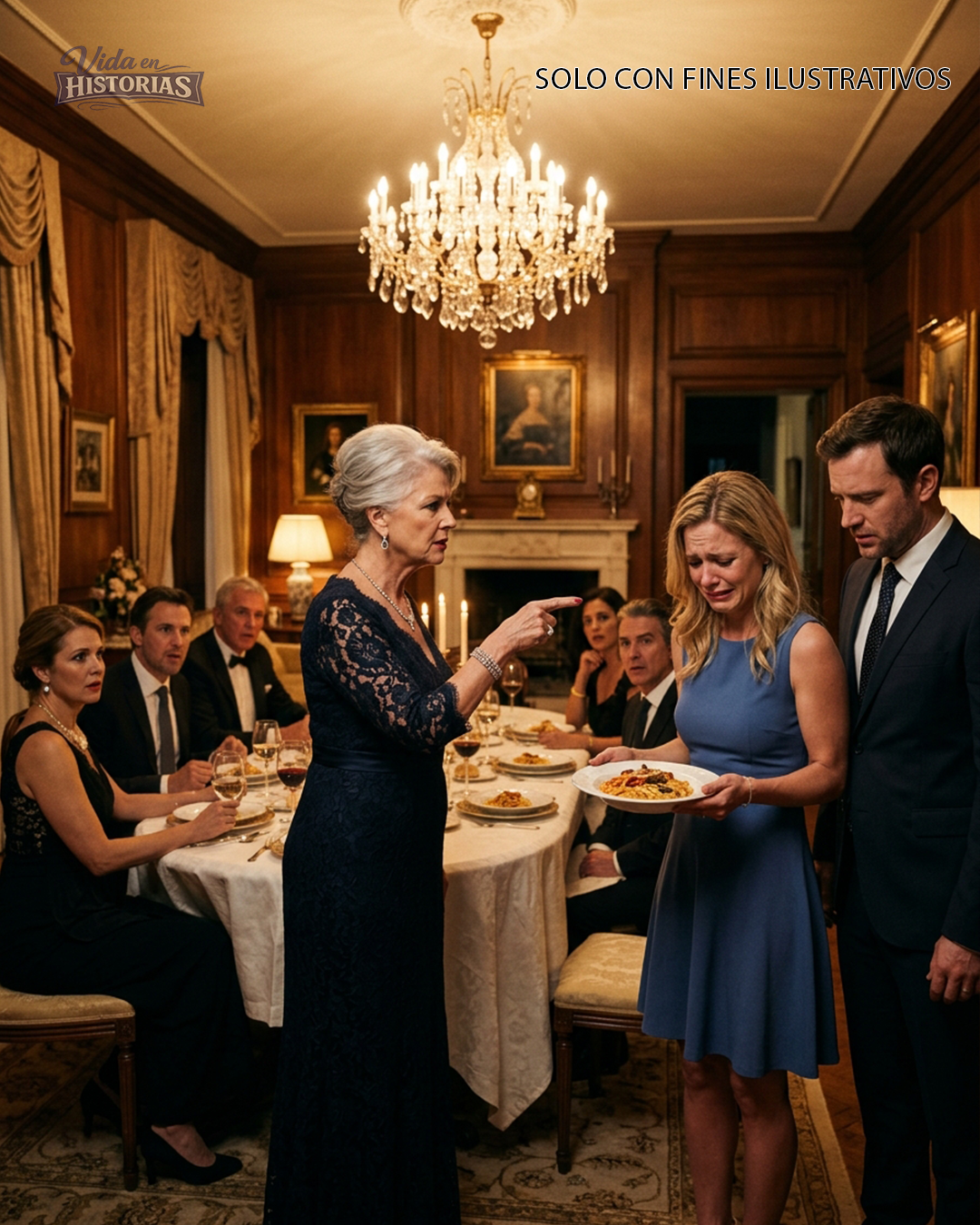
My mother-in-law placed a plate in my hands and pointed to the kitchen.
“Daughters-in-law don’t carry the blood of this family. You eat there.”
My husband smiled as if the cake hadn’t just smelled like betrayal.
The living room was filled with gold balloons, neatly folded napkins, and cousins who had come just to take pictures by the cake table. Hanging on the main wall was a large photo of my husband, Daniel, as a child, being hugged by his mother as if she had created the world with her own hands. Below it, on a white tablecloth, were the gifts, bottles, flowers, and a candle with the number thirty-five, waiting to be lit.
I was holding a tray of red rice that was still burning hot through the glass.
Nobody moved at first.
Not because they hadn’t heard. Of course they heard. Aunt Gloria left her fork dangling near her mouth. A cousin lowered his cell phone just a few inches, as if he wanted to keep recording but not so blatantly. Daniel’s sister pretended to arrange the glasses, though her eyes went straight to my face.
Daniel was two steps away from me.
Only two.
Close enough to see my fingers tightening around the tray. Close enough to notice I was wearing the blue dress he’d told me looked nice on. Close enough to say, “Mom, don’t talk like that.”
But he didn’t say it.
He let out a small, nervous laugh, the kind men use when they don’t want to choose between their wife and the comfort of remaining a son. He glanced at the guests, then at his mother, then at me. He dabbed the corner of his mouth with his napkin, even though there was nothing there.
“Love… don’t take it personally,” she murmured.
That’s what hurt me the most.
Not my mother-in-law’s phrase. By then, I already knew her elegant way of cutting you off. Elena never raised her voice if she could humiliate you with a clean smile. She never said “I hate you” if she could say “in this family we have our traditions.” She never closed a door on you if she could leave it open so everyone could see you standing outside.
What hurt me was Daniel’s laughter.
That cowardly laugh that tried to turn my shame into a misunderstanding.
I had arrived at that house three hours earlier to help, because Elena called me early with the sweet voice she used when she needed something.
“Mariana, my dear, could you come earlier? You know how it is, one person can’t do everything.”
Daughter.
He only called me that when he wanted me to cook, clean, pick up chairs, or pretend I wasn’t listening to his comments. When we had visitors, I became “the girl Daniel brought home” again. When he talked about surnames, inheritances, or “the Rivera blood,” my name vanished from his lips as if it stained his teeth.
Even so, I went.
Because it was my husband’s birthday. Because a part of me still believed that if I helped enough, if I kept quiet enough, if I smiled enough, one day they would stop treating me like a guest in my own marriage.
I peeled potatoes in that kitchen. I washed dishes I hadn’t used. I put the flowers in vases. I arranged the chairs for the uncles who were always asking me when I was going to get pregnant, as if my body were something on the menu. And when Elena complained that the cake hadn’t arrived on time, I went to pick it up without mentioning that my heel was hurting me.
Nobody saw that.
Or maybe they did see it and that’s why they thought it was normal to send me to eat next to the refrigerator.
The kitchen was at the back, separated from the living room by a narrow archway. From there you could see the main table, but you didn’t belong there. It was the place from which hot dishes, damp cloths, and tired women emerged. Elena understood the weight of that gesture. It wasn’t a whim. It was a boundary.
—Doña Elena—I said, and my voice came out calmer than I felt—, I am Daniel’s wife.
She barely raised her eyebrows. She was wearing a cream-colored dress, pearls around her neck, and that expensive perfume that always arrived before her. On her right hand gleamed an antique family ring, the same one she once showed me, saying, “These kinds of things are inherited among Rivera women.”
He never asked me if I wanted to inherit it. He just wanted me to understand that it wasn’t my right.
—That’s precisely why you should know your place—he replied.
A small murmur ran through the family. It wasn’t a scandal. It was worse. It was that cowardly discomfort of people who know something is wrong, but prefer to keep chewing rather than get involved.
I looked at Daniel.
He looked down at his plate.
At that moment, I remembered another table. A smaller one. The first Christmas after we were married. Elena served me on a different plate, a chipped one, saying that “the porcelain ones were from the family set.” Daniel squeezed my knee under the table and whispered, “Leave her alone, that’s just how she is.” I believed him. Or I wanted to believe him. Because you don’t get married thinking you’ll have to defend your dignity against the man who promised to take care of you.
Then came the guest room incident. The family photos where they asked me to take the picture instead of being in it. The time Elena said, in front of her friends, that I was “good at managing what little I have,” as if my humble origins were some endearing flaw.
I collected those humiliations like someone who keeps receipts in a box.
And boy, did he know how to keep receipts.
The tray was burning my hands, but I didn’t let go. On the table, among the bottles and gifts, was my black purse. Inside was a bank folder, carefully folded, the blue stamp still visible in the corner. I didn’t plan to take it out that night. I had come to celebrate Daniel, not to show anything off. I had promised to keep quiet because he had asked me to.
“My mom can’t know yet,” she told me two months ago, her eyes red. “She’d have a heart attack if she found out we almost lost the house.”
The house.
That same house where they were now sending me to eat in the kitchen.
The house Elena proudly displayed as the Rivera family heirloom. The house where every brick seemed to carry a surname, a history, and a sense of pride. The house the bank almost foreclosed on because of a debt Daniel hid until he couldn’t sleep anymore. The house I saved by using my savings, selling the small plot of land my father left me, and signing an agreement no one in that room had bothered to read.
Elena took a step towards me and picked up the porcelain plate that I had placed next to Daniel’s seat.
“That seat is for my sister,” she said. “You can eat later.”
Daniel barely got up from his chair.
For a second I thought he was finally going to speak.
But he only managed one glass and said, almost jokingly:
—Mom, it’s my birthday.
As if the problem was that she was ruining his party, not that he was breaking up with his wife in front of everyone.
I felt something close up inside me. It wasn’t anger yet. It was a cold, clean calm, the kind that doesn’t scream because it’s already made up its mind.
I placed the tray on the table. The thud wasn’t loud, but the spoons rattled. Aunt Gloria lowered her gaze. Daniel’s sister stopped pretending with the glasses. Elena clenched her jaw, annoyed that I had disturbed her perfect scene.
“Sorry,” I said.
Daniel let out a sigh of relief, as if my apology were just another napkin he could wipe over the stain.
But I wasn’t apologizing for having taken up a space.
I put my hand in my bag.
I touched the bank folder.
And before taking it out, I looked at my husband one last time to give him the chance that he hadn’t given me.
Daniel understood my look before his mother understood my movement.
I saw it in her neck, in the way the skin tightened beneath her jaw. The glass she was holding hovered over the table, tilted slightly, and a drop of wine fell onto the white tablecloth like a small, perfect stain, impossible to hide.
—Mariana—he said in a low voice.
It wasn’t a strong warning. It was worse. It was a plea.
Elena turned towards him.
-What’s happening?
Daniel did not answer.
And in that brief crack, in that exact second when my husband pleaded with my eyes to save him again from the fire he himself had started, I knew that my marriage hadn’t broken down because of his mother’s words. It had broken down because of all the silences he kept so as not to upset her.
I took out the folder.
I didn’t lift it up like a trophy. I didn’t throw it on the table. I didn’t shout. I just placed it next to the cake, among the gold cutlery and the napkins I had folded myself that afternoon. The bank’s blue seal was visible in the warm light of the dining room.
Elena frowned.
-What’s that?
“A document,” I replied.
“We’re not going to talk about papers here,” she said, regaining her domestic tone. “We’re celebrating my son.”
His son.
I was always her son when she wanted pride. My husband when she needed help. The man of the house when something needed signing. My husband when they asked me for patience.
Daniel slowly put down the glass.
—Mariana, please.
Aunt Gloria no longer had her fork in her hand. She had placed it on the plate so carefully that the metal barely made a sound. Daniel’s sister, Patricia, stood by the glasses, a bottle of mineral water in her hand. Her expression had changed. It was no longer curiosity. It was calculation.
“Please what?” I asked.
Daniel looked around. There were his uncles, his cousins, two of Elena’s close neighbors, Daniel’s godfather, and even the family accountant, Mr. Armando, sitting near the window with a napkin on his lap. That detail mattered to me later. At that moment, I only saw many faces pretending not to have lived off my patience.
“It’s not the right time,” said Daniel.
Elena straightened her back.
—Exactly. It’s not the time. Put that away and behave yourself.
I placed my fingers on the folder.
—They just told me to eat in the kitchen in front of their whole family. Was that the right time?
Elena smiled, but her smile was no longer comfortable.
—Don’t exaggerate. Nobody sent you there like you were a servant.
The word remained suspended, even though she hadn’t said it first.
The cousin with the cell phone finally put it down. Not out of respect. Out of fear that something bigger than gossip had been recorded.
—You yourself said that the daughters-in-law do not carry the blood of this family—I said.
—And it’s true—Elena replied. —Family takes care of its own.
I chuckled softly. Not out of mockery. Out of exhaustion.
—How curious that you say that.
Daniel closed his eyes.
That was the first visible crack. Not in me. In him.
Elena noticed it.
“Daniel,” he said, “what’s going on?”
He ran a hand over his face. That gesture instantly transported me back two months, to our kitchen, at three in the morning. Daniel was sitting there with the same hand on his forehead, the bank statements open, a crumpled letter from the bank lying on the table, and his voice cracking as he said, “I didn’t want to worry you.”
I didn’t want to worry.
As if the bank had waited silently out of consideration for my nerves. As if interest payments stopped out of love. As if a mortgaged house could be saved through shame.
I remembered the cold light from the open refrigerator. The unsweetened coffee. Daniel crying silently because he had taken out loans to “help” his mother with repairs, overdue payments, and expenses she called family emergencies. I remembered him swearing to me that Elena didn’t know how serious the situation was, that he was the only one who had mishandled things, that the house was weeks away from foreclosure.
And I remembered my land.
A small piece of land on the outskirts, the only thing my dad left me besides his old watch and a phrase he used to repeat to me when I was a child: “My daughter, never put your dignity where they only allow you to stand.”
I sold that land in four days.
Not because the Rivera house mattered more to me than my father’s memory. I sold it because Daniel was my husband, because I believed that marriage meant carrying together what was too heavy for one of us, because I thought that one day, when it was all over, he would look his mother in the eye and say, “Respect Mariana. Without her, this house would no longer exist.”
That day never came.
Elena reached for the folder.
—Give it to me.
I pulled it away before I could touch it.
Her eyes hardened.
—You’re in my house.
I looked at her.
—Not completely.
The dining room breathed a different air.
It wasn’t absolute silence. Houses are never truly silent. You could hear the hum of the refrigerator in the background, the distant rumble of a car passing by on the street, the candle on the cake burning a little more. But the voices, the clinking of silverware, and the laughter faded away, as if something invisible had entered through the front door.
The accountant Armando left the napkin on the table.
“What do you mean, not completely?” Patricia asked.
Daniel shook his head, almost imperceptibly.
—Mariana…
—No—I told him—. Not anymore.
Elena let out a dry chuckle.
—Just look at that. Now you’re coming to claim ownership because you married my son.
—I didn’t come to claim anything.
—Then save your documents.
“I came to be with my husband on his birthday,” I replied. “I came to cook, to serve, to smile, to say nothing. That’s what I came to do.”
Aunt Gloria looked down at her hands.
—And I did —I continued—. Until you decided to remind me, in front of everyone, that I don’t belong to this family.
Elena crossed her arms.
—Because you don’t belong. Don’t confuse marriage with blood.
The phrase made Daniel shrink back in his chair.
I opened the folder.
The first page wasn’t the complete receipt. It was a partial debt settlement letter, with bank letterhead, date, loan number, and property name. I had highlighted a few lines, not because I planned to show them, but because the lawyer told me to always keep clear copies.
I put it on the table.
Elena didn’t look at her immediately. First, she looked at Daniel. Mothers like her don’t need to read to know when a child has hidden something from them. She saw it in his breathing, in his tight mouth, in that guilt that no longer fit beneath his white shirt.
“What did you do?” he asked.
Daniel swallowed hard.
—Mom, I was going to tell you…
The room moved without moving. The bodies barely leaned forward. Curiosity triumphed over politeness. The cousin who had put his cell phone down reached back up, but Patricia punched him in the arm and he put it away.
“What were you going to tell me?” Elena insisted.
Mr. Armando put on his glasses.
—Elena —he said, with a caution that caught my attention—, perhaps it would be best to talk in private.
Elena turned towards him.
—Did you know?
Armando did not answer quickly.
And that’s when I realized I wasn’t the only one keeping receipts.
Patricia left the water bottle on the table.
—Mom, what debt are they talking about?
“No debts,” Elena said too quickly.
Daniel lifted his face.
—Yes, there was a debt.
The word “there was” fell on the table heavier than any insult.
Elena looked at him as if he had just betrayed her, not me.
—Daniel.
“The house was at risk,” he said, his voice barely steady. “The bank had already sent the final warnings.”
A murmur rippled through the guests. Not one of pure surprise, but of recognition. Some might have heard something. Others were simply confirming suspicions. Families that boast too much rarely fool everyone; they only force everyone to pretend.
Elena slammed her palm against the table.
—That’s a lie!
The candle on the cake flickered.
“It’s not a lie,” I said.
I slid the sheet to the center.
Elena finally took it. Her eyes dropped to the letters, but her face didn’t change immediately. She resisted. She wanted to remain composed in front of everyone. Only her thumb trembled, the finger where the old Rivera ring gleamed.
“This proves nothing,” he said.
—Prove the payment—I replied.
—What do I pay?
—The one who prevented the bank from initiating the final process.
Patricia put a hand to her chest.
—Who paid?
Daniel closed his eyes again.
No one looked at me first. They looked at Daniel. Then at Elena. Then at the accountant. It was difficult for them to accept the possibility that the woman they had just sent to eat in the kitchen could be sitting at the center of the whole story.
Armando cleared his throat.
—The transfer came from an account in Mariana’s name.
Elena slowly raised her face.
The pearl at her neck moved with her breath. For the first time all night, her elegance seemed like a poorly fastened costume.
—That can’t be.
—Yes, you can—I said.
Daniel whispered:
—Mariana sold her father’s land.
The phrase touched me in a place I hadn’t yet allowed to be touched.
My dad’s land.
Not “a piece of land.” Not “a small property.” My father had worked for thirty years driving an old truck to buy those few square meters of land. He said that one day I could build a place there with bougainvillea. I never told Daniel how much it hurt me to sell it. I didn’t want my sacrifice to become a weapon. I didn’t want to bring it up in every argument. But I also never imagined that the woman who benefited from that sacrifice would point me toward the kitchen as if I had arrived begging for scraps.
Aunt Gloria covered her mouth.
—Oh, Mariana…
Elena folded the sheet of paper.
—Don’t make a big deal out of it. If my son asked you for help, that’s between husband and wife.
There it was.
The exact change.
When the debt was shameful, it was a “private matter.” When the house was respectable, it was “family property.” When my money supported her, it was “wife’s help.” When I wanted a seat at the table, it was “blood.”
“No,” I said. “It’s not between husband and wife when you humiliate me in public using a house that my money helped save.”
Daniel opened his eyes.
—Mariana, it wasn’t like that…
I looked at him.
—Wasn’t that how it was?
He remained silent.
—Tell me in front of everyone—I continued—. Was the house at risk or not?
-Yeah.
—Did you ask me not to tell your mom anything?
-Yeah.
—Did I sell my dad’s land to cover the urgent expenses?
Daniel clenched his jaw.
-Yeah.
—And even knowing that, you laughed when she told me to go eat in the kitchen?
The question didn’t need an answer.
The whole room had her in its face.
Daniel lowered his gaze, and this time no one could pretend it was shyness. It was guilt.
Elena placed the sheet on the table as if it burned her.
—Enough. This woman is manipulating everything. Daniel, tell her to shut up.
He didn’t call me “your wife.” He didn’t call me “Mariana.” He called me “this woman,” as if naming me somehow granted him too much humanity.
Daniel looked at her. I saw a small, belated struggle cross his face. Part of him wanted to obey, as always. Another part, perhaps the part that had cried in my kitchen, finally understood that you can’t demand a ransom and then hide the person who pulled you from the water.
“Mom,” she said, “Mariana isn’t lying.”
Elena blinked.
Aunt Gloria let out a very low sigh.
For a moment, I thought that sentence would bring me some relief. That hearing Daniel speak the truth, even if it was late, would mend some of the brokenness.
He didn’t.
Because there are truths that, when they arrive too late, no longer save. They only confirm the cost of silence.
Elena turned towards me with a colder fury.
—And what do you want? Applause? For everyone to thank you because you did what a wife should do?
I felt my fingers close around the edge of the folder.
—I don’t want applause.
—So, what do you want?
I looked at the seat she had taken from me. The porcelain plate. The folded napkin. The cake with the lit candles waiting for a song that no one dared to start anymore.
“I wanted respect,” I said. “But I understand now that you don’t ask for it where it’s handed out as a prize.”
Patricia approached the table and picked up the sheet of paper. She read it quickly. Her face changed when she saw the amount.
“Mom,” she murmured, “this is a lot of money.”
Elena snatched it away.
—You stay out of it.
—But Mariana paid for this…
“He didn’t pay anything he won’t get back somehow!” Elena shouted.
The first loud voice of the night.
That’s where his control broke down.
And when a woman like Elena loses her composure, she doesn’t become humble. She becomes dangerous.
“She was definitely planning this,” he said, pointing at me again. “That’s why she kept the documents. That’s why she played the martyr. To throw our help in our faces and keep something for herself.”
Mr. Armando stood up.
—Elena, be careful what you say.
She turned towards him.
—You shut up. You’ve done enough by hiding this from me.
Armando took a deep breath.
—I warned Daniel that they needed to sort out the situation.
—Were you aware of the debt?
—I knew there were serious delays.
—And you didn’t tell me?
The accountant looked at her with a weary sadness.
—Elena, you did know there were delays.
The room started moving again without moving.
Daniel jerked his head up.
-That?
Elena remained still.
It wasn’t just any pause. It was a pause with a story.
Armando removed the glasses and held them in one hand.
—I sent you account statements for months. You replied to some emails.
Elena looked pale under her makeup.
—That was something else.
Daniel stood up.
—What do you mean you answered emails?
Patricia put her hand to her mouth.
-Mother…
Elena tried to regain ground.
“I had no reason to worry them. Besides, your father always said that household matters were handled by the family.”
“Dad has been dead for six years,” said Daniel.
The mention of his father made the large portrait on the wall seem to gaze out from another era. A serious man in a dark suit, embracing the boy Daniel had once been. The entire house was built around that image: the Riveras united, respectable, solid. But beneath that photograph were cracks that the paint couldn’t conceal.
“Don’t change the subject,” Elena said.
“You knew,” Daniel insisted.
—I knew there were movements, not that you were making a drama out of it.
—The house was going to be lost!
“And it didn’t get lost,” Elena replied, pointing at me without looking at me. “Thanks to your wife deciding to get involved.”
That sentence completely exposed her.
It wasn’t ignorance.
It was convenience.
He finally looked at me, but no longer with outright contempt. Now there was fear mixed in. Fear not of me, but of what my file might reveal to his people.
—Mariana —he said, changing his tone—, it didn’t have to come to this.
I almost smiled.
He called me by my name when the room began to believe me.
“No,” I replied. “It wasn’t necessary. With just one word from Daniel, it wasn’t necessary. With an apology from him, it wasn’t necessary. With just letting me sit at the table like a person, it wasn’t necessary.”
Daniel took a step towards me.
-Forgive me.
I looked at him.
I had waited for that word for years. I imagined it in many scenarios. After an awkward meal. In the car on the way home. In our bed, when he hugged me and said his mom “didn’t mean it by any means.” I thought that if he ever actually said it, maybe I would cry.
I didn’t cry.
The word was too small for the size of the wound.
“Don’t ask me for forgiveness so I’ll keep the folder,” I said.
He opened his mouth, but he had no defense.
Elena moved closer.
—Very good. Everyone has heard. You helped. Thank you. Happy now? We can have dinner now.
The nonchalance with which he tried to close the matter was almost admirable. As if a truth could be gathered up with dirty dishes. As if the debt, the humiliation, and my father’s land were uncomfortable but fleeting topics, like a spilled glass.
“We’re not finished,” I said.
I took out the second sheet.
That was the one Daniel didn’t expect.
I knew because his face changed before everyone else’s.
The first page talked about payment.
The second one was about the conditions.
When I sold the land, I didn’t hand over the money blindly. I wanted to at first. I wanted to believe that it was enough to transfer the money, hug my husband, and move on. But the lawyer who helped me with the sale, an old friend of my father’s, stopped me.
“Mariana,” he told me, “it’s one thing to help. It’s another thing to disappear from the history of your own sacrifice.”
That’s why a private agreement was made. That’s why the payment was recorded as an extraordinary contribution for debt repayment, with the right to recognition and reimbursement if the property was sold, refinanced, or transferred. Daniel signed. Armando reviewed it. And Elena, although she claimed not to know, had received a copy of the bank notification where my name appeared as the source of the payment.
I was not the sole owner of the house.
But she wasn’t the intruder with nothing that she wanted to portray either.
I put the second sheet on the table.
—This is what I really wanted to avoid showing.
Armando looked at the document and nodded slowly.
Elena saw him nod. That gesture enraged her more than my words.
“What is that?” Patricia asked.
“An agreement,” Armando said. “Mariana didn’t give the money away.”
Daniel ran both hands through his hair.
—I was going to pay you…
“When?” I asked.
I didn’t say it sarcastically. I said it with an almost bureaucratic sadness.
Daniel did not answer.
Elena took the sheet, half-read it, and let out a forced laugh.
—This is not fair.
—Yes, okay —Armando said.
—You are not a lawyer.
—No. But I can read a signature.
Patricia leaned towards the document.
—That’s your signature, Daniel.
Daniel looked at his sister.
-Yeah.
—And did Mom get a copy?
Elena slammed her fist on the table again.
—I didn’t receive anything!
Armando took out his cell phone.
That’s where the midpoint happened, though no one called it that. Up until then, the story seemed to be me against Elena. The humiliated daughter-in-law showing she had helped. But when Armando unlocked his phone and looked for an email, the fight stopped being just about my dignity.
It started because of an older lie.
—Elena —he said—, don’t make me.
She looked at him with an icy warning.
—Armando.
There was a history between them. Not romantic. Not secret in that cheap sense. It was a history of accounts, favors, signed documents, and truths kept hidden out of decency. He had worked with the family since Daniel’s father was alive. He had seen what was said in public and what was paid for in private.
Armando turned the cell phone towards Daniel.
—Your mother received the notices. Here is the forwarded email. And here is the reply.
Daniel picked up the phone.
Her eyes scanned the screen. Patricia moved closer to her side. Elena didn’t move, but her breathing became audible.
“What does it say?” Aunt Gloria asked.
Daniel read silently.
Then he put the phone down.
—Mom… you knew that Mariana paid.
Elena closed her lips.
The entire room seemed to change seats, though no one stood up. Those who had been looking at me with pity began to look at her carefully. The cousins stopped being curious and became witnesses. The neighbor who had arrived with a gift wrapped in gold paper picked up her purse from the floor and placed it on her lap, as if preparing to leave a house that had just lost its luster.
“You knew,” Daniel repeated. “And yet you treated her like that.”
Elena did not respond immediately.
When he did, his voice came out lower.
—I did what I had to do to protect my family.
“Protect her from what?” Patricia asked. “From Mariana?”
Elena looked at me.
—That someone from outside believed they could buy a place here.
I felt something strange. Not surprise. Clarity.
That was the heart of the matter.
My poverty didn’t bother her. Not entirely. What bothered her was that my sacrifice left her indebted to me. It bothered her that the girl she could have sent to the kitchen had something she needed. It bothered her that the Rivera house hadn’t been built on blood, but on the land of a man she never invited to that table.
“I didn’t buy a place,” I said. “I tried to save one that I thought was mine too.”
Daniel looked at me with a shame he could no longer use to protect himself.
“It was,” he said.
I shook my head slowly.
—No, Daniel. He never was. I was just inside while I was serving.
The phrase landed harder than the folder.
Aunt Gloria finally got up. She walked slowly over to me and put a hand on my arm. She didn’t say much. She just said:
—Forgive me, daughter. I should have spoken up sooner.
That “daughter” didn’t sound like Elena’s in the morning. She didn’t come with a to-do list. She was late, yes, but she came with genuine shame.
Elena looked at her indignantly.
—Gloria, don’t get involved.
“I’m intervening because I heard you,” Aunt Gloria replied. “And because I stayed silent. That was wrong too.”
The aunt’s voice wasn’t loud, but it stirred something. One of the uncles muttered that Elena had gone too far. A cousin said no one deserved that. Daniel’s godfather left his drink unfinished. It wasn’t a heroic rebellion. It was more awkward than that: it was people trying to shake off the guilt just when it wasn’t so difficult anymore.
Elena saw it.
He saw that the room he had always controlled was beginning to withdraw its obedience from him.
Then he did the only thing left for him to do.
He attacked my marriage.
“Daniel,” he said, “if you allow your wife to expose your mother in my own house, don’t expect everything to be the same tomorrow.”
Daniel remained still.
I waited.
A foolish part of me still hoped.
Not because I wanted to stay. Not anymore. But I wanted to know what kind of man would be left standing at the end of all this. The boy in the photo. The cowardly husband. The son trained to obey. Or someone new, even if he arrived late.
Daniel looked at his mother.
—Mom, you humiliated her.
Elena put a hand to her chest, theatrically but hurt.
—I gave you this house.
“No,” he said, his voice breaking. “Dad left us this house. You put it in debt. I hid it. And Mariana saved it.”
Elena took a half step back.
It was the first time in years that I heard Daniel say a complete sentence against his mother.
He didn’t give me anything back.
But the atmosphere changed.
Patricia began to cry silently. Not just for me. For the image of the family falling apart. For that photograph on the wall where they had all learned to live inside a fairy tale.
“What else don’t we know?” he asked Elena.
Elena ignored her.
—Daniel, come here.
He didn’t move.
“Come here,” he repeated, more forcefully.
Daniel looked at the cake, the candles dripping wax onto the frosting, the untouched gifts, the tray of rice cooling. Then he looked at me.
—Mariana, let’s go home.
He said it as if there was still a shared house waiting for us.
I closed the folder.
-No.
Her face opened in panic.
—We can talk.
“Yes,” I said. “But not tonight, and not so I can go back under the rug.”
Elena took advantage.
—Look at her. She got what she wanted. To make you look like trash in front of everyone.
I breathed.
There was a part of me that wanted to respond with everything I had. To tell him that it was despicable to take advantage of a woman’s money and then deny her a meal. That it was despicable to raise a child to confuse loyalty with cowardice. That it was despicable to use the word “family” as a lock.
But I didn’t say it.
My dad always said that not all truths need volume.
I put the papers in the folder, but left a copy of the receipt on the table. Then I took out my cell phone.
Daniel took a step towards me.
—Who are you going to call?
—To my lawyer.
Elena burst out laughing.
—Your lawyer?
—The same one who prepared the agreement.
Armando lowered his gaze, as if confirming without speaking.
—Mariana, don’t do this here —Daniel said.
“Not here?” I asked. “Here they sent me to the kitchen. Here they told me I wasn’t family. Here you laughed.”
Daniel ran out of breath.
I checked.
I didn’t use the speakerphone. I didn’t need to put on a show. It was enough that they could hear my part.
“Attorney Herrera,” I said when he answered, “good evening. Sorry for the late hour. Yes. Exactly what you said could happen did happen.”
Elena glared at me with hatred.
“Yes,” I continued. “I want to proceed with the formal notification. And I also want to review the division of assets and the reimbursement under the agreement.”
Daniel closed his eyes.
Patricia sat down slowly.
The lawyer spoke on the other end. I listened. I nodded. I looked at the table. I looked at the kitchen. I looked at the chair I hadn’t been allowed to sit in.
“Tomorrow morning is fine,” I said. “No, I’m not in danger. I just realized.”
I hung up.
Nobody spoke for several seconds.
Then Daniel said my name, but this time it sounded different. Not as a warning. Not as a plea to shut up. Like someone watching a door close and barely understanding that he himself had locked it.
—Mariana.
“Daniel, I need you to hear this once,” I said. “I’m not going to destroy you. I didn’t come here to take anyone’s house tonight. I didn’t come here to humiliate your mother for pleasure. I came to a dinner party wearing a blue dress and with a cake I picked up because she asked me to.”
He swallowed.
-I know.
—No. You don’t know. Because if you did, you wouldn’t have let them put me in the kitchen.
Elena murmured something, but Patricia stopped her.
—Mom, that’s enough.
That “already” weighed more heavily on him coming from his daughter than any of my documents.
The party dissolved without warning. First, the neighbor left with the golden gift, saying she was running late. Then an uncle hurriedly searched for his keys. The cousin with the cell phone went out to the patio pretending to make a call. The women gathered bags. The men avoided looking Elena in the eye. No one wanted to be the last witness.
Daniel’s birthday didn’t end with cake.
It ended with full plates, extinguished candles, and a family learning that shame is also inherited when no one stops it.
I walked towards the kitchen.
Daniel became alarmed.
-What are you doing?
I didn’t answer.
I went into the room where they wanted me to eat alone. There were the dishcloths, the pots, the apron Elena had left on a chair. There were still glasses to be washed on the sink. My reflection appeared split in the dark window: the blue dress, the tired eyes, the firm mouth.
I took my coat from the back of a chair.
I also took a small paper napkin I had used earlier to jot down the things we still needed: ice, bread, candles, soda. My handwriting was there, neat, useful, invisible. I folded it and put it in my bag next to the folder.
I don’t know why I did it.
Perhaps because I needed to remember that I didn’t arrive that night with a fight. I arrived with a shopping list.
When I returned to the living room, there were only a few guests left. Aunt Gloria was waiting for me near the door.
“Do you want me to come with you?” he asked.
—Thanks, but no.
He squeezed my hand.
—Your dad would be proud.
That was the first time I almost cried.
Not for Daniel. Not for Elena. For my father and his land. For the bougainvilleas I never planted. For the daughter he wanted to leave safe and who ended up paying a debt so another family could continue to call themselves honorable.
Daniel followed me to the entrance.
—Don’t leave like that.
I stopped.
—How do you want me to leave?
He didn’t answer.
Behind him, Elena stood rigidly by the table, the antique ring gleaming under the lamp. She no longer looked like the queen of the house. She looked like a woman surrounded by expensive things that couldn’t protect her.
“We can fix it,” Daniel said.
—Which part?
-Us.
I looked at him with sad tenderness. Because I had loved him. A lot. I loved him on good days, through tough times, in bed when we talked about having children, on lazy Sundays watching movies. I loved him even when I started to feel alone by his side. But love wasn’t a chair that someone could take away from me every time his mother came home.
“You didn’t want to fix it,” I told him. “You wanted me to just put up with it better.”
Daniel cried then. A quick, embarrassed tear. I didn’t do anything to wipe it away.
—I didn’t know how to deal with her.
-I know.
—She’s always been like that.
—I know that too.
—Then understand me.
I shook my head at that.
—Understanding you is what kept me sitting on the edge for years. I can no longer use your story to justify my hurt.
He opened his mouth. He closed it.
I left.
The night air was cool. Outside, the golden balloons they’d placed at the entrance moved in the breeze, bumping against each other with a sad, plastic sound. My car was at the end of the street. I walked slowly, not because I wanted someone to catch me, but because my heels hurt, and for the first time all night I didn’t have to pretend they didn’t.
When I got to the car, I received a message from Daniel.
“Please don’t do anything until we talk.”
I read it.
Then I turned off the screen.
The next day, at nine o’clock sharp, Mr. Herrera sent the notification.
It wasn’t a scandalous lawsuit. There were no police patrols. There were no shouts in the street. Real justice, the kind that doesn’t exist in movies, usually begins with boring documents and proper stamps.
I formally requested recognition of my contribution, the reimbursement plan, and the protection of my rights under the signed agreement. I also initiated the separation process. Not for the house. Not for revenge. For my health.
Daniel came to see me three days later.
She arrived at my apartment wearing the same white shirt from the party, or maybe one just like it. She had dark circles under her eyes. In her hands she carried a bag with some of my things that had been left at her mother’s house: a sweater, a recipe book, a phone charger, a pair of earrings.
“My mom wants to talk to you,” she said.
I didn’t invite him in.
—To apologize?
Daniel looked at the floor.
—He’s very ill.
—That doesn’t answer.
—He doesn’t know how to apologize.
—Then it’s not ready.
It hurt him. I saw it. Before, that pain would have made me soften my words. I would have poured coffee. I would have said, “Well, I understand it’s difficult.” But I no longer wanted to be an emotional translator for people who hurt me in crystal-clear language.
Daniel took a small box out of his pocket.
The Rivera family’s old ring.
—He asked me to give you this.
I looked at the box without touching it.
-Because?
—He says that… that maybe you earned it.
I felt a bitter laugh rise in my throat, but I didn’t let it out.
You earned it.
As if my dignity were an employee of the month medal. As if selling my father’s land, enduring years of contempt, and standing with a hot tray in front of guests were an entrance exam.
“Give it back to him,” I said.
Daniel looked up.
—Mariana…
—Tell him I don’t want to inherit a ring from a family that denied me a plate.
He closed his fingers around the box.
—I’m trying to fix it.
—No, Daniel. You’re trying to make it hurt less after having allowed it.
He stood at the door for a long time. Then he nodded.
—Don’t you love me anymore?
The question was unfair because it sought a simple answer for a slow death.
“Yes, I loved you,” I said. “And that’s why it took me so long to leave.”
I said no more.
He understood.
The following weeks were strange. The story didn’t go viral on social media because I didn’t post it. I didn’t need applause from strangers. But families have their own newspapers: aunts, neighbors, phone calls, messages that begin with “I don’t want to get involved, but…”
I learned that several guests stopped visiting Elena for a while. I learned that Patricia argued with her for days. I learned that Armando quit keeping the accounts because, he said, he no longer wanted to be a wall between lies and consequences.
I also learned that Elena tried to tell a different version of events.
That I had exaggerated. That I had planned everything. That I wanted money from the beginning. That young people no longer respected hierarchies. That modern daughters-in-law wanted to be in charge.
But the copy of the receipt on the table did its job.
He didn’t shout. He didn’t insult. He didn’t cry.
He simply existed.
And sometimes a quiet piece of paper exposes more lies than an entire scene.
Daniel made the first repayment two months later. It came with a handwritten letter. I didn’t open it that day. I left it on my desk next to my dad’s clock. When I finally read it, I found his apologies more sincere than the ones he’d offered that night. He acknowledged his cowardice. He admitted that he’d used me as a financial shield and abandoned me as his wife. He admitted that he didn’t know who he was without his mother’s approval.
I cried a little.
Then I put the letter away.
I didn’t go back.
My dad’s land was beyond repair. That was the hardest part for me to accept. Some losses can’t be covered by deposits. But with the refund money, I started something else. Small. My own. I rented a modest space and opened a catering service with recipes I’d learned from my mother and others I invented myself. On the first day, I put a pot of bougainvillea in the entrance.
It wasn’t a house.
But it was a place where nobody sent me to the kitchen as punishment, because the kitchen was mine.
Months later, Aunt Gloria arrived at the shop. She was wearing a simple dress and her hair was neatly styled.
“I don’t know if I can come in,” he said from the doorway.
—Yes, you can.
He sat down by the window. He ordered coffee and red rice.
When he tasted the first bite, his eyes welled up with tears.
“It was the same one from that night,” he murmured.
-Yeah.
He put down the spoon.
—Elena sold the house.
I felt no joy.
That surprised me. I thought I would feel a brilliant satisfaction, something akin to revenge. But what I felt was weariness and a kind of serene closure. The Rivera house, that big word they had used as a wall, turned out to be a property with debt, papers, buyers, and a price.
Nothing else.
“Daniel told me they paid you what was missing,” he added.
I nodded.
-Yeah.
—Elena has not been the same since.
I looked at the bougainvillea at the entrance, swaying in the breeze.
-Me neither.
Aunt Gloria lowered her head.
—That’s not always a bad thing.
I didn’t answer, but I barely smiled.
Before leaving, he placed an envelope on the table. I thought it was money, but it wasn’t. It was an old photograph. My father appeared young, sitting at a table at a neighborhood party, holding a plate. On the back, in Aunt Gloria’s handwriting, it said: “Your father always sat where he was respected.”
I stared at that sentence long after she left.
That was my true end.
Not the document. Not the separation. Not the refund. Not Elena’s social fall or Daniel’s belated shame.
My final understanding was that belonging doesn’t mean enduring until someone makes room for you. Belonging is being able to breathe without asking permission. It’s sitting down without anyone measuring your blood. It’s eating at a table where your story isn’t used against you.
Sometimes justice doesn’t come with shouting.
Sometimes she arrives like a woman leaving someone else’s house with a folder in her bag, a tired heart and the quiet certainty that she will never again mistake a kitchen for a sentence.
