Physical Address
304 North Cardinal St.
Dorchester Center, MA 02124
Physical Address
304 North Cardinal St.
Dorchester Center, MA 02124

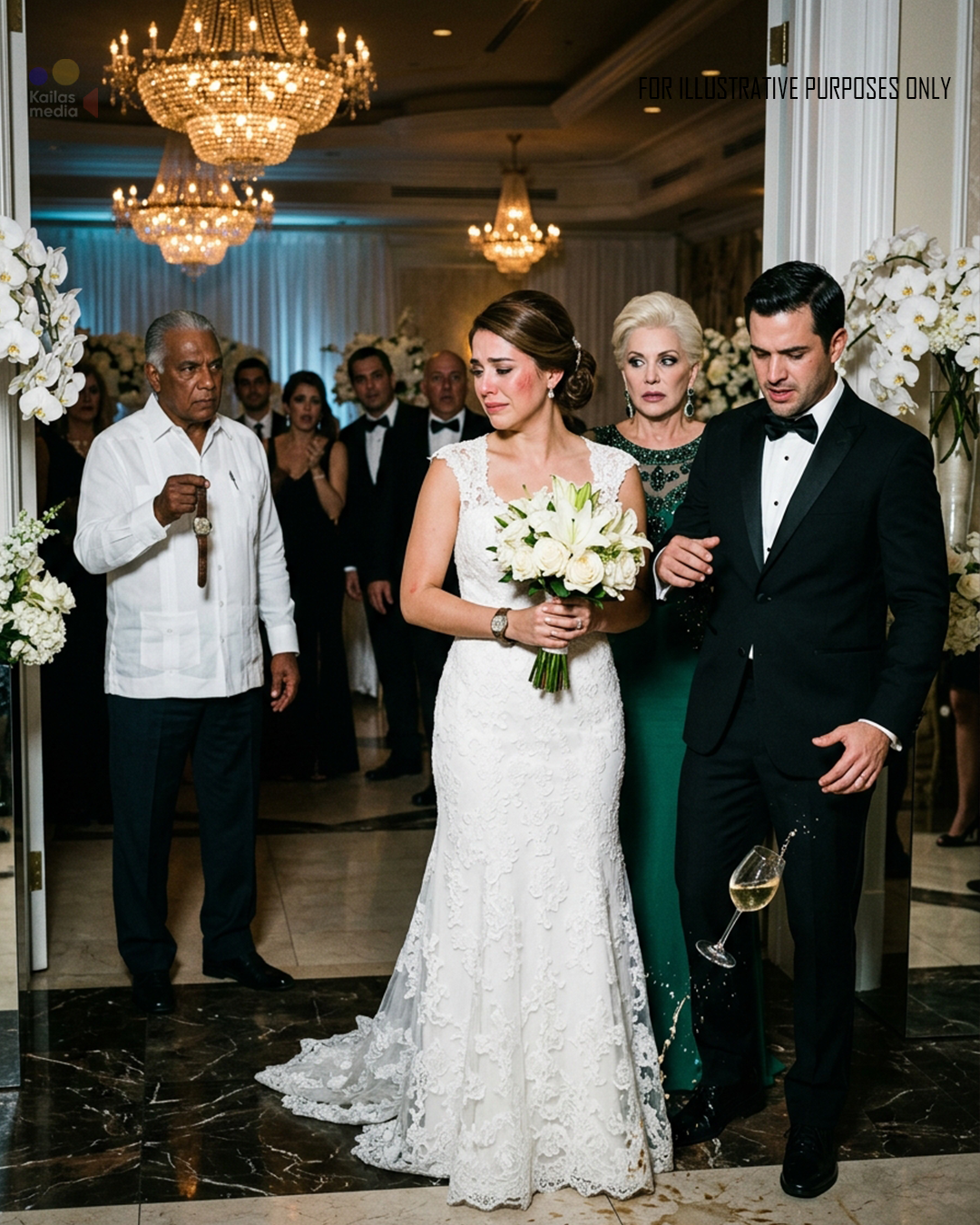
The sound was so sharp, so violent, that for a second I thought one of the cut-glass goblets had shattered on the marble floor of the living room. But no. The sharp, burning sensation that shot across the left side of my face confirmed the brutal truth.
Mauricio, the man who just two hours ago had sworn eternal love and protection to me in front of the cathedral altar, had just slapped me across the face.
The impact took me by surprise. My ankles buckled, and the delicate white strappy sandals I’d spent so much money on slipped clumsily on the polished dance floor. I had to take an awkward step back, gritting my teeth and digging my nails into the stems of my bouquet of white roses to keep from ending up on my knees in front of the three hundred guests from Monterrey’s elite.
The entire room fell into a deathly silence. Even the soft murmur of the string quartet playing in the corner faded away, leaving only the buzzing in my ears and the echo of my now-husband’s ragged breathing.
“I told you to take that filth off, Valeria,” Mauricio hissed. His voice wasn’t a shout, it was a stifled growl, heavy with a shame that made my stomach churn. “This is the most important day for my family. My father’s business partners are here, the governors are here, and you insist on embarrassing us by wearing that cheap flea market piece on your wrist!”
Instinctively, I brought my free hand to my flushed cheek, but my other hand, the one holding the bouquet, closed around my left wrist. There rested an old watch. Its leather strap was worn, the crystal slightly scratched, and the face dull with age. It clashed terribly with the imported silk and French lace of my dress. I knew it. But it was the only memento I had left of my grandfather, the man who broke his back working in the fields so I could go to university. The man who taught me the value of dignity.
Dignity that, at this moment, was being trampled on in front of hundreds of curious eyes.
“It’s my grandfather’s watch,” I replied, my voice trembling, tasting blood on the inside of my lip. “I told you, Mauricio. I told you I’d walk down the aisle with it.”
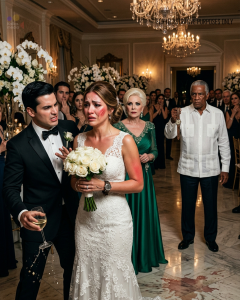
Mauricio made an impatient gesture, clenching his fists. I could see the terror in his eyes, not because he had hurt me, but because of what people would say. It was always like that. During our year-long courtship, I ignored the signs. I believed his love was stronger than the suffocating snobbery of his social circle. I was a fool.
Before I could utter another word, the unmistakable sound of heels echoed, drawing closer to us. It was Doña Carmela. My mother-in-law.
She wore an emerald dress that cost more than my mother had earned in ten years. Her platinum blonde hair was perfectly styled, and an icy smile played across her face. She moved with the grace of a snake stalking its prey, stopping right beside me. With chilling delicacy, she tucked away a strand of hair that had come loose from my updo from the force of the blow.
To anyone watching from afar, we looked like a mother comforting her nervous daughter-in-law.
But then, she leaned in. Her perfume, an overwhelming mix of roses and old money, flooded my nostrils before her lips almost brushed my ear.
“Listen to me carefully, you starving wretch,” Carmela whispered, her voice so sharp it almost cut me. “Mauricio did you a favor by rescuing you from poverty. We played at a fairytale wedding because my stupid son took a fancy to your sad eyes, but I make the rules here.”
My breath caught in my throat. I tried to take a step back, but her diamond-encrusted fingers dug into my arm like claws.
“From the second you signed that paper and entered my family, you lost any right to decide,” she continued, that damn smile for the cameras still plastered on her face. “Take off that piece of junk watch right now and give it to the waiters to throw away. And don’t even dream, Valeria… don’t even dream of raising your head in my house. You were born to look at the ground.”
The pain of Mauricio’s slap was nothing compared to the humiliation that burned in my chest. Hot, treacherous tears began to flow. I looked at Mauricio, searching for a trace of the man I had fallen in love with. A hint of guilt, of defense. But he simply looked away toward the main table, taking a glass of red wine offered to him by a waiter, cowardly and subservient to his mother’s shadow.
She was alone. Completely alone in a sea of silk, diamonds, and contempt.
I made a move to unbuckle the leather strap. The lump in my throat was so tight it could barely breathe. I was going to give in. I was going to betray my grandfather’s memory for a marriage that was already dead before dinner was even served.
But then, the heavy sound of the main oak doors opening wide echoed throughout the hall.
It wasn’t a discreet movement. It was a sharp knock that echoed through the vaults of the place. The heads of the three hundred guests turned in unison toward the entrance.
There, under the arch decorated with thousands of white orchids, stood a man.
He wasn’t wearing a tuxedo. He wasn’t wearing patent leather shoes. He was wearing an impeccable linen guayabera, dark dress pants, and his hair, completely silver, was slicked back. There was a hardness in his face, etched with the wrinkles of someone who had lived a thousand lives, and an authority in his dark eyes that made the temperature in the room plummet.
Doña Carmela loosened her grip on my arm. I felt her whole body tense up next to mine.
The man began walking down the central corridor, ignoring the astonished stares. His steps were slow and heavy, echoing against the marble. No security guard dared to stop him. There was an aura of absolute power around him that suffocated the air.
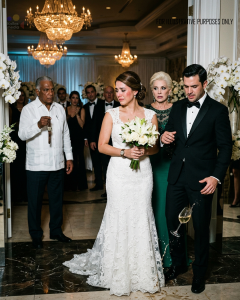
He stopped two meters away from us. His eyes scanned my face, lingering on the red mark that was beginning to swell on my cheek, then moved to my trembling bouquet, and finally, fixed on the worn watch on my left wrist.
A heavy, dark silence fell upon us.
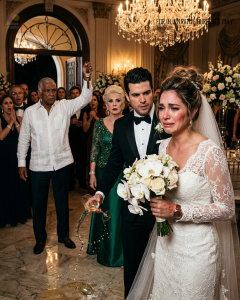
Slowly, without taking his eyes off Doña Carmela, the gray-haired man raised his right arm. With his thick fingers, he unfastened the leather strap from his own wrist.
It was an old watch. The strap was worn, the crystal was slightly scratched, and the dial was dull.
Exactly identical to mine.
Doña Carmela’s smile froze. The little color she had in her cheeks vanished in an instant, leaving her as pale as a corpse. Her lips trembled, but no sound escaped her. On my other side, a crystalline sound startled us all.
Mauricio had dropped his glass. The crystal shattered on the floor, staining his expensive patent leather shoes with wine that looked like fresh blood.
The man lowered his hand, holding the old watch, and with a hoarse voice that seemed to shake the foundations of the place, he uttered words that changed my life forever.
“No one…” said the man, staring intently at Carmela, “…raises a hand against my blood.”
The echo of the broken glass seemed to hang in the air conditioning of the living room. The thick, dark red wine trickled down the polished marble, staining the tips of Mauricio’s patent leather shoes. It looked like blood.
The silver-haired man in the linen guayabera still stood before us, his worn watch dangling from his thick fingers. His eyes, dark and sharp as flint, didn’t blink. They were fixed on Doña Carmela, who seemed to have stopped breathing.
“Don Hernán…” Mauricio stammered. His voice, which a minute ago had been a whip against me, was now the whimper of a terrified child. “Godfather, I… this isn’t…”
“Shut up, you idiot,” the old man interrupted. He didn’t shout. He didn’t need to. The low, raspy tone was enough to make Mauricio lower his head like a beaten dog.
I was paralyzed. The burning sensation on my left cheek throbbed in time with my racing heart, but the confusion was even stronger. Don Hernán? Of course I’d heard that name. Hernán Garza. The untouchable patriarch of Monterrey. The man who financed political campaigns, who owned half of the state’s construction companies, and, most importantly, the majority shareholder in Mauricio’s father’s business holding company.
But what on earth was I doing with a watch just like my grandfather’s? Why had he called me “his blood”?
Carmela was the first to try to salvage the situation. She swallowed hard, forcing the blood back into her pale face, and forced a smile that seemed to physically hurt her.
“Don Hernán, what an unexpected surprise,” she said, taking a cautious step toward him, completely ignoring me. “We weren’t expecting you until dessert. The boys are nervous, you know how these wedding things are, the tension… Mauricio was just trying to make Valeria understand our family’s protocol…”
Don Hernán didn’t even look at her. He walked right past her, forcing Carmela to step aside to avoid bumping into him, and stopped right in front of me.
Up close, his face was a map of scars and deep wrinkles. He smelled of expensive tobacco and wood. Slowly, he raised a hand. Instinctively, I closed my eyes and flinched, bracing for another blow. The trauma of the last few minutes had left my nerves shattered.
But there was no blow. Instead, I felt his rough, warm fingers part the lock of hair that covered my flushed cheek. His touch was strangely gentle.
“Does it hurt, girl?” he asked me, and for the first time, I saw a crack in his iron facade. There was a deep sadness in his eyes.
I opened my mouth to reply, but only a stifled sob escaped. I nodded, clutching my shattered bouquet to my chest.
Don Hernán lowered his gaze to my left wrist. He took my hand, ignoring the astonished stares of the three hundred guests who didn’t dare even murmur. His thumbs caressed the scratched crystal of the old watch.
“Joaquín…” the old man whispered. The word sounded like a prayer. “Your grandfather was Joaquín Morales. The mechanic from the Independencia neighborhood.”
“Yes…” I managed to say, my voice trembling. “He died three years ago.”
Don Hernán closed his eyes for an interminable second. When he opened them, they were glassy.
“That man whom Mrs. Cárdenas’s widow just called ‘starving,’” Don Hernán said, slowly turning his head toward Carmela, raising his voice enough for the first few rows of tables to hear, “saved my life forty years ago. When I was a nobody. When I crossed the desert with broken shoes and a bullet in my shoulder. Joaquín hid me in his workshop. He nursed me back to health. And when the federales came looking for me, he gave them his money, his savings, everything he had, so they would let me go.”
The silence in the hall was absolute. You could hear the buzzing of the wedding photographers’ video cameras; they had lowered their lenses but were still recording audio.
“He gave me his watch,” Hernán continued, raising his own wrist to show the old, worn object, “because he said a man should always know the time so he’s never late. I swore I’d come back and build him a palace. But Joaquín was proud. He never accepted my money. He only made me swear to one thing: that if his family ever needed me, I would be there for them. Joaquín and I cut our palms. We mingled our blood.”
Carmela looked like she was about to faint. She clung to the edge of the main table. Mauricio was as white as a sheet of paper, looking at his mother for help, but she was just as terrified as he was.
Don Hernán turned towards Mauricio.
“And you, you worthless piece of trash,” she spat out the words in disgust, “you dare raise your hand to my brother’s granddaughter. In public. Over a watch worth more than your entire fake and miserable family lineage.”
“Godfather, I swear, I didn’t know…” Mauricio took a step toward me, his hands trembling, trying to grab my arm. “My love, Valeria, forgive me, I was stupid, it’s the pressure of the event…”
I felt a violent nausea. The man who had slapped me across the face five minutes ago was now calling me “my love” just because the most powerful man in the city was backing me up. I felt disgusted. A deep, visceral disgust.
I took a step back, moving away from him.
“Don’t touch me,” I said. My voice sounded firmer than I expected. I tore the veil from my head, feeling the pins tugging at my scalp, and let it fall to the floor, right onto the pool of wine.
“Valeria, for God’s sake, don’t make a scene,” Carmela hissed, regaining a fraction of her venom. “We’re in a family, problems are solved at home. Don’t ruin the wedding.”
“The wedding is already ruined, ma’am,” I replied, looking her in the eye. For the first time since I met her, I didn’t lower my head. “And you were right. It was a mistake to enter your family.”
I turned towards Don Hernán.
—Take me away from here, please— I asked him.
Don Hernán nodded, offering me his arm like a true gentleman.
“Let’s go, girl. Your grandfather would never forgive you for staying in this viper’s nest. My lawyers will see to this farce tomorrow. And as for you two…” She looked at Mauricio and Carmela. “On Monday, I’m withdrawing all my funds from the holding company. You’re finished.”
A murmur erupted in the room. It was as if a beehive had been kicked. Mauricio put his hands to his head, letting out a stifled cry of despair. He knew what that meant: utter bankruptcy.
I started walking toward the exit, arm in arm with Don Hernán. My white sandals made firm contact with the ground. With each step, I felt a ton of weight lift from my shoulders. I was free. My soul ached from the betrayal of the man I thought I loved, but I was safe.
We were halfway down the corridor, under the orchids that now seemed grotesque to me, when Mauricio’s voice echoed behind me, laden with desperate cruelty.
“Go away!” Mauricio shouted, his voice cracking with panic. “Get out of here with him, Valeria! If you cross that door, I’ll have your mother taken off life support tomorrow!”
I froze to the ground. The air escaped from my lungs.
I pulled my arm away from Don Hernán and turned slowly. Mauricio was standing next to his mother. Carmela no longer looked terrified. Upon hearing her son’s words, a twisted, almost demonic smile spread across her lips, stained with red lipstick.
“What did you say?” I whispered, feeling the ground open up beneath my feet.
Mauricio wiped the sweat from his forehead with the sleeve of his designer suit, breathing heavily. His eyes were bloodshot.
“You heard me,” he said, taking a step forward, his sickly arrogance resurfacing. “The specialty clinic where your mother receives her dialysis treatment. The machine that keeps her alive. Guess who the majority owner of that hospital is, Valeria?”
Carmela crossed her arms over her chest, savoring my terror.
“We did, my dear,” my mother-in-law purred. “I personally signed the admission papers as your guarantor. If you annul this marriage, if you leave us ruined… I’ll withdraw my signature tonight. Let’s see which second-rate public hospital you take her to die in.”
Don Hernán tensed his jaw and took a step forward. “I’ll pay for any treatment. I’ll transfer her to the best hospital in Houston if necessary.”
But Carmela let out a dry, humorless laugh. “Don’t be naive, Don Hernán. I know Doña Elena’s condition. Her kidneys have failed. The doctors said so on Tuesday: if they move her from that bed, if they interrupt the cycle of the machine she’s connected to for more than two hours… she’ll have a heart attack. She won’t survive a transfer, not even to the corner store.”
I looked at Mauricio. The man who had bought me flowers, who had cried with me when my mother was diagnosed. It had all been a trap. A gilded cage designed to ensnare me and hold me at his mercy.
I was trapped.
The pain in my cheek was nothing. Absolutely nothing, compared to how my soul was breaking at that very moment.
Mauricio extended his hand towards me, with a smile that chilled my blood.
“So come here, my love,” she said, in a soft, chilling tone. “Lift your veil, smile for the photographers, and let’s dance our waltz. And you… you’re going to apologize to my mother for upsetting her.”
I stood in the middle of the hallway. I looked at Don Hernán, whose eyes reflected a furious helplessness. I looked at my grandfather’s watch on my wrist. And then I looked at the open doors of the living room, which led to the street, to freedom.
I knew that if I took one more step towards that door, I would be signing my mother’s death warrant.
The newlyweds’ first dance should be the most romantic moment of a wedding, but for me it was a descent straight into the ninth circle of hell. Mauricio grabbed me by the waist with a force that took my breath away, while his other hand forced my fingers to intertwine with his. His hand was sweaty and cold. He made me walk to the center of the dance floor, right over the invisible remains of the wine glass he himself had smashed on the floor minutes before.
“Smile, Valeria,” he hissed in my ear, his tone meant to be affectionate for the guests, but to me it felt like a razor’s edge. “If I see one more tear, I swear I’ll make the call. And you know I’m not playing around. My mother already has her cell phone in her hand.”
I swallowed, tasting the metallic tang of blood in my mouth. My jaw ached, my soul ached, and above all, my heart ached at the sight of Don Hernán standing at the side of the road. The old lion’s fists were clenched, and his gaze held a powerlessness that tore me apart. He wanted to get me out of there, he wanted to burn the world down for me, but we both knew that my mother, Doña Elena’s, life hung by a thread held by the Cárdenas family, their fingers laden with expensive rings.
The orchestra began to play a sweet melody, a classic Mexican ballad that I used to love but now sounded like a funeral. We danced under the spotlights. The guests, those who just moments before had been speechless with horror, began to applaud out of habit, driven by that social hypocrisy so typical of us, where it’s better to pretend nothing happened than to face a real scandal.
“That’s it, my queen,” Mauricio murmured, turning me around. His face was inches from mine. His breath smelled of alcohol and victory. “That’s how I want you. Submissive. Quiet. If you behave, we’ll let you go see your boss at the hospital tomorrow. But only if you behave.”
“You’re a monster,” I whispered, barely moving my lips, maintaining the mask of happiness they had imposed on me.
“I’m the master of your life, which is different,” he replied, squeezing me tighter. “And Don Hernán had better leave soon. His presence makes me nervous, and when I’m nervous, I make mistakes. Mistakes that could cost your ailing mother dearly.”
The waltz ended. Mauricio kissed my cheek—right over the bruise that his mother’s makeup had barely managed to cover—and the room erupted in applause. It was the most humiliating moment of my life.
Two hours later, when the party was in full swing and the tequila was flowing like a river among the businessmen and politicians, I managed to slip away to the restrooms. I locked myself in a stall, sat on the toilet seat, and buried my face in my hands. The wedding dress felt like it weighed a hundred kilos. I felt dirty, bought, like just another piece of furniture in the Cárdenas mansion.
Suddenly, I heard the bathroom door open. Heavy, expensive heels clicked on the tile floor.
—I know you’re there, Valeria. Come out now.
It was Doña Carmela. Her voice was like shaved ice. I left the cubicle with my head held high, even though inside I was falling apart. She was standing in front of the mirror, reapplying her blood-red lipstick, so perfect, so flawless, so empty.
“What do you want now?” I asked, looking at her through the mirror.
“Let me give you a reality check, kid,” she said, closing her makeup case with a sharp click. “Don’t think that just because old Garza showed up here with that watch story you’ve won. Hernán is powerful, yes, but he doesn’t know the halls of my hospital. He doesn’t know what medications your mother is on.”
“Don Hernán is no joke,” I replied angrily. “He’s a man of honor, something this family doesn’t even know the meaning of.”
Carmela let out a dry laugh, one of those that doesn’t reach your eyes. She came closer to me and grabbed my chin tightly, forcing me to look at her. Her eyes were two wells of ambition.
“Honor doesn’t pay for dialysis machines, Valeria. Honor doesn’t buy the time your mother needs for a transplant that will never come. Listen carefully: you’re going to be the perfect wife. You’re going to convince Hernán Garza that you’re happy, that the slap was just a drunken misunderstanding. If he withdraws his investments, my family loses money, and if we lose money, your mother loses her bed in the intensive care unit. Is that clear, or do I need to spell it out for you?”
He let go of my face with contempt. I felt like I couldn’t breathe. They were mobsters in suits.
“Why are you doing this to me?” I asked, my voice breaking. “If you hate me so much, why did you insist that I marry Mauricio?”
Carmela looked me up and down, as if I were a stain on the floor.
“Because my son is an idiot who’s become obsessed with you, and because we need the good image a ‘country girl’ gives our foundation. Besides”—she smiled with pure malice—”it amuses me to see you trying to be someone you’re not. But remember: you’re a Morales. Your grandfather was a mechanic, and your mother is a burden. Never forget where you come from.”
She left the bathroom, leaving me with the scent of her expensive perfume and the feeling that I was trapped with no way out. But what she didn’t know was that Don Hernán was waiting for her at the bathroom entrance.
I didn’t hear what they said in that hallway, but when I returned to the main table, Don Hernán was gone. My heart sank. Had he abandoned me? Had he realized it wasn’t worth fighting the Cárdenas family over a mere waitress who thought she was a princess?
Mauricio was drunk, shouting, and toasting with his friends. He ignored me for a while, which was a relief. But then, a waiter came over to bring me a glass of water. As he placed it on the table, he slipped a small folded piece of paper under the plate.
With my heart pounding, I waited until no one was looking and opened it under the table.
“You are not alone, my own flesh and blood. Tomorrow at 8 a.m., a nurse named Rosa will pick you up at the hospital. I trust her completely. Do as she says without question. Trust your grandfather’s watch. Joaquín never left us alone.”
Tears welled up in my eyes again, but this time they were tears of hope. I tucked the paper into my cleavage. I had to endure one more night. Just one more night in that house that now felt like a prison.
The wedding night was a nightmare of silence and fear. Mauricio, in his drunken state, fell asleep on the sofa in the hotel suite, shouting insults at me before losing consciousness. I spent the night awake, sitting in a chair, staring at my grandfather’s clock and praying to all the saints.
At seven in the morning, I got dressed in the first thing I found: some old jeans and a simple blouse I had packed in my “emergency” bag. I didn’t put on makeup. I didn’t want to be the Cárdenas’s doll anymore.
I left the hotel unannounced. The family’s bodyguards were dozing in the hallway, but I managed to slip past them using the service exit, a tactic I learned when I worked as a waitress.
I arrived at San Jude Tadeo Hospital at 7:55 a.m. The building was imposing, cold, one of those places where money decides who lives and who dies. At reception, the employees looked at me with disdain when they saw my simple clothes, unaware that yesterday I was the woman who had appeared on the front pages of the local newspapers dressed in white.
“I’m looking for Nurse Rosa,” I said, trying to keep my voice from trembling.
“The head nurse is busy, come back later,” the woman replied without even looking up from her computer.
—Tell him I have a message from Don Hernán—I declared.
The woman looked up abruptly. Her demeanor changed in an instant. She dialed an extension, and a few minutes later, a woman in her fifties, with a kind but firm face, appeared in the hallway. When she saw me, her eyes filled with a compassion that almost made me falter.
“Valeria Morales?” he asked in a low voice.
-Yeah.
—Come with me, daughter. We don’t have much time. Doña Carmela gave orders to restrict your visits starting at nine in the morning.
We walked through the sterile corridors. My mother was on the fourth floor, bed 412. As I entered the room, the rhythmic, metallic sound of the dialysis machine hit me like a hammer blow. There she was, my warrior, Doña Elena. She was pale, her skin almost transparent, connected to dozens of wires.
I approached and took her hand. It was cold.
“Mom… I’m here,” I whispered, kissing her fingers.
Nurse Rosa locked the door and approached us. She took a tablet out of her pocket and checked some files.
—Valeria, listen carefully because we don’t have much time. Don Hernán asked me to review your mother’s actual medical history.
“The real one? What do you mean?” I asked, feeling a chill run down my spine.
Rosa sighed, glancing nervously towards the door.
“The Cárdenas have been lying to you. They told everyone your mother is in critical condition and untransferable to keep you under their control. But look at this”—she showed me the screen—”Your mother’s urea and creatinine levels have been stable for two weeks now. Dr. Mendoza, who’s on Doña Carmela’s payroll, has been falsifying the daily reports to make you think she’s going to die if you don’t pay the hospital bill.”
I froze. The walls seemed to close in on me.
—Are you telling me that my mother can be transferred?
“Your mother needs the transplant, that’s true,” Rosa said, taking me by the shoulders, “but she’s not going to die from being moved ten kilometers. In fact, the treatment she’s getting here is the bare minimum. They’re just keeping her ‘alive’ long enough to be useful as a bargaining chip. Don Hernán already has a high-tech private ambulance waiting at the back of the hospital. We can get her out right now to one of his clinics in Houston.”
“But how? Carmela’s guards will arrive in half an hour,” I said, panicking.
At that moment, my grandfather’s watch on my wrist began to vibrate. It wasn’t a mechanical vibration; it was the sound of my own racing pulse. “Trust the watch,” the note read.
“Rosa, help me. Let’s do it now,” I said, wiping away my tears with determination.
We started disconnecting the secondary monitors, leaving only those vital for the transfer. But just as we were about to move the stretcher, there was a violent bang on the door.
—Valeria! I know you’re in there, you damn cat!
It was Mauricio’s voice. He was furious, and from the sound of his footsteps, he wasn’t alone.
“Open the door or I’ll break it down! Rosa, if you’re helping her, I swear you’ll never work in this country again!” Mauricio shouted from the hallway.
I looked at Rosa. She was pale. I looked at my mother, who was beginning to open her eyes, confused by the noise.
—Rosa, take my mom out through the freight elevator, the one that leads to the loading dock—I told her, feeling a strength I didn’t know I had. —I’ll distract them.
“But Valeria, they’re going to hurt you…” Rosa said, frightened.
“I don’t care. My grandfather used to say you have to know when to fight. And this is my fight. Go away!”
Rosa nodded, pushing the gurney with astonishing speed toward the inner door that connected to the service corridor. My mother looked at me for a second, with those tired eyes I loved so much, and squeezed my hand before disappearing down the dark corridor.
I was left alone in the empty room, staring at the unmade bed and the dangling wires. I went to the door and unlocked it.
Mauricio entered like a wild animal, followed by two security men and, behind them, Doña Carmela, with an expression of fury that made her look like an unearthed corpse.
“Where is she?” Mauricio roared, grabbing my shoulders and shaking me. “Where the hell is your mother?”
“Far from you,” I replied, smiling contemptuously, even though I felt like my heart was going to jump out of my chest.
Doña Carmela approached me, slowly, dangerously. She slapped me so hard that I fell to the floor, hitting my head on the nightstand. I saw stars, but I didn’t scream.
“You think you’re so clever, don’t you?” Carmela hissed, leaning over me. “She can’t have gotten far. Search the entire hospital! Block off the exits!”
“It’s late, ma’am,” I said, getting up with difficulty and leaning against the empty bed. Blood was starting to trickle down my forehead. “Don Hernán already has her.”
Mauricio pulled out his cell phone, desperate, dialing hospital security. But then, all the screens in the room, the remaining heart rate monitors, and even the television on the wall, turned on at the same time.
It wasn’t a medical report. It was a video.
The screen displayed an image of Doña Carmela’s office. She and Dr. Mendoza were clearly visible, talking. The audio was crystal clear.
“Mendoza, make sure that woman doesn’t get any better. If Valeria starts acting rebellious, tell her her kidneys are failing again. I need that woman to be scared. The deal with Garza depends on her being the perfect wife.”
Carmela’s face turned ashen gray. Mauricio dropped his cell phone, which smashed against the floor.
“That… that’s illegal…” Carmela stammered, staring at the screen as if she were seeing a ghost.
“It’s not just illegal, Carmela,” a voice said from the room’s loudspeaker. It was Don Hernán’s voice, calm and powerful. “It’s the end of your empire. That video is being broadcast live on Mexico’s most important news site. All of Monterrey is seeing who the Cárdenas really are.”
I burst out laughing, a laugh that came from deep within me, as I wiped the blood from my forehead.
But my triumph was short-lived. Mauricio, completely out of control, pulled something from his jacket pocket. It wasn’t a cell phone. It was a small syringe filled with a clear liquid.
“If I fall, you’re coming with me, Valeria,” he shouted, lunging at me with wild eyes.
I felt the prick in my arm before I could react. The world started spinning. Mauricio’s face distorted, becoming a blurry smear.
“Mauricio, no!” I heard Carmela’s shout in the distance, but it was too late.
My body felt heavy, as if it were filled with lead. I fell to the floor, feeling the cold marble against my skin. The last thing I saw was my grandfather’s clock. The hands seemed to stop.
“Grandpa…” I whispered before the darkness swallowed me completely.
Outside, police sirens were beginning to wail, but I could no longer hear them. I had won my mother’s freedom, but the price, perhaps, was my own life.
Waking up wasn’t like in the movies. There was no slow blink or heavenly light at the end of the tunnel. It was more like someone had pulled me out of a pit of boiling tar, my lungs burning and my head heavy, as if my skull were filled with stones. The smell of antiseptic and cheap gardenias—the signature scent of luxury hospitals trying to mask the smell of death—hit my nostrils.
I tried to move my left arm, but something was preventing me. I heard the metallic clinking of handcuffs against the bed rail.
—Don’t strain yourself, Valeria. It’s for your own good.
That voice. It wasn’t Mauricio’s. It was a woman’s voice, but it wasn’t Carmela’s. I opened my eyes with a superhuman effort. The ceiling was white, immaculate. To my right, seated in a cream-colored leather armchair, was a woman who couldn’t have been more than thirty. She wore a navy blue pantsuit that screamed “high-class lawyer” and held a tablet with a coldness that sent shivers down my spine.
“Who… who are you?” My voice sounded like I had swallowed broken glass.
“I’m Attorney Estrada, from the Cárdenas family’s legal team,” she said, without looking up. “You’re in a private mental health clinic, under observation for a violent psychotic episode. You tried to kidnap your mother and attacked your husband with a syringe you stole from a nurse.”
I froze. The lie was so perfect, so well-constructed, that for a second I doubted my own memories. Had Carmela’s blow driven me mad? Had Mauricio not injected me? But the pain in my arm, the prick that still burned under my skin, brought me back to reality.
“Lies…” I whispered, trying to struggle with the wife. “He injected me. Mauricio drugged me in front of everyone… Don Hernán… Don Hernán saw everything.”
The lawyer finally looked up. Her eyes were gray, devoid of any trace of humanity.
“Don Hernán? Mr. Garza suffered an unfortunate cardiovascular event last night, shortly after leaving the party. He’s in a coma at the General Hospital. There are no witnesses, Valeria. Only you, a girl of humble origins with a history of emotional instability, and the honorable members of the Cárdenas family who tried to help you.”
I felt like the world was crashing down on me. Don Hernán… it couldn’t be. He was my only way out, my only shield. If they had taken him out of the picture, I was dead.
“And my mom?” I asked, panic closing in my throat. “Where’s my mom?”
Ms. Estrada shrugged, returning to her tablet.
—In the charity ward of the state hospital. Without his dialysis treatment. Doña Carmela withdrew her financial support this morning. She says she can no longer finance the family of a woman who tried to destroy her son.
A cry of rage and pain rose in my throat, but it ended in a stifled sob. I was chained, drugged, and alone. The Cárdenas hadn’t just beaten me; they were erasing me from existence.
Two days passed. Or maybe it was three. In that place, time was measured by the rounds of the nurses who injected me with “sedatives” every time I tried to speak. I felt like a plant, watching the movement of the leaves of a tree outside my window, the only trace of freedom I had left.
But the Cárdenas family had made a mistake. A small mistake, born of their own pride.
They thought that because I was a “small-town waitress,” I didn’t know how to observe. They thought my grandfather’s watch, which was now kept in a safe in the reception area, was just a piece of sentimental junk. But my grandfather Joaquín always said that men like the Cárdenas are like old engines: they shine on the outside, but inside they’re full of leaks that they try to plug with cheap grease.
On the third night, my bedroom door opened silently. It wasn’t the nurse on duty. It was Rosa, the head nurse from the previous hospital, the one Don Hernán had assigned me. She was dressed in civilian clothes, wearing a cap and a face mask.
“Shut up, Valeria. Don’t say anything,” he whispered, approaching the bed.
With astonishing speed, he pulled out a key and unlocked the handcuffs that secured me to the bed. My hands were numb, but adrenaline began to course through my veins.
“Rosa… I was told that Don Hernán is in a coma…” I said, sitting up with difficulty.
“It’s a lie. They tried to poison him, yes, but the old man is tougher than nails. He’s hiding out on one of his properties in Saltillo, pulling strings. The general hospital is a smokescreen to make the Cárdenas family lower their guard.”
I burst into tears of pure relief, but Rosa covered my mouth.
“There’s no time. Your mother is safe. Don Hernán sent her to Houston yesterday on a private plane before Carmela could touch her. The document that lawyer read to you was fake. It’s all been psychological torture to get you to sign the annulment and a document admitting that the whole video was staged.”
I stood up, unsteadily. Rosa helped me put on some comfortable shoes and a dark sweatshirt.
“We have to leave now. The Cárdenas family is responsible for security here, but the guard at the back gate owes Don Hernán a huge favor.”
We walked through the shadowed corridors. Every shadow seemed like Mauricio’s face, every noise made me jump. We reached the laundry and exited through the loading dock. The cool night air hit my face like a blessing. There, in a dark, unassuming sedan, a young man, about twenty-five years old, was waiting for us, with a serious face and a scar on his eyebrow.
“This is Beto, Don Hernán’s nephew,” Rosa said. “He’ll take you to the safe house.”
I got in the car and we sped away. I looked out the window at the luxury apartment complex in San Pedro Garza García, where my tormentors lived. For a second, I felt the urge to run away, to go to Houston with my mom and never come back. But then, the scrape of metal against my wrist reminded me of something.
“Rosa… my watch. It’s at the clinic,” I said, feeling a pit in my stomach.
“No, Valeria. Look,” Rosa said, taking my grandfather’s old watch out of her bag. It was a little dirty, but intact. “The guard recovered it.”
I picked up the watch and, purely on instinct, stroked the back. My grandfather always said that watch held a secret, but I always thought it was a metaphor for time. However, when I touched the small raised mark, I felt something strange. A click.
The back cover opened slightly. Inside, folded in a piece of almost transparent onion skin paper, was a series of numbers and an address in an old neighborhood of Monterrey.
“What is this?” I whispered.
Beto, who was driving, looked in the rearview mirror.
“Don Hernán told me that if you found that, he should take you straight there. It’s a safety deposit box in a bank that closed years ago, but whose vault is still operating under another name. Joaquín and Hernán stored something there forty years ago. Something that not even the Cárdenas family knows exists.”
We arrived at the address at dawn. It was a gray, peeling building in an area of auto repair shops and grain warehouses. Nothing like the gilded castles where Carmela moved about.
We entered with a key that Don Hernán had given Beto. The air smelled of dust and old paper. An old man who could barely walk guided us to the safe deposit boxes in the basement.
“Box 704,” the man said.
When I opened it, I didn’t find gold or jewelry. I found an old leather folder and an audio cassette. I opened the folder. They were property documents. Deeds.
My heart stopped when I read the name of the main property: “El Pedregal de Santa Catarina” .
“It can’t be…” I said, feeling my legs give way.
“What’s wrong, Valeria?” Rosa asked.
—This land… is where the Cárdenas family’s main factory is built. The one that generates 80% of their fortune. According to these documents… the original owner wasn’t Mauricio’s father. It was my grandfather, Joaquín Morales.
“Your grandfather?” Beto approached, incredulous.
“It says here that the land was loaned to the Cárdenas family under a 40-year lease agreement, in exchange for a lifetime pension that was never paid,” I continued reading, tears blurring my vision. “The contract expired two months ago. The day Mauricio proposed to me.”
It all clicked into place with lightning force. Mauricio wasn’t “obsessed” with me. It wasn’t a rich kid’s whim. They realized the contract was expiring and that Joaquín’s granddaughter was the only legal heir. The wedding wasn’t for love, not even for appearances. It was a desperate attempt to marry the owner of the land they were standing on so I could never claim ownership. They wanted to legally tie me down so their empire wouldn’t collapse.
The slap, the humiliation, Carmela’s contempt… it was all a tactic to break my spirit and make me accept what they said, without asking questions, without reviewing old papers.
“They’re thieves,” I said, clenching my fist over the deeds. “They sold me a fairy tale to steal what my grandfather built with his own hands.”
“There’s more,” Beto said, pointing at the cassette.
We put it on an old tape recorder that was on a desk. At first there was only static, then the voice of a young man, with a very strong northern accent.
“Joaquín, brother, if you’re hearing this, it’s because I’m no longer here. Be careful with the Cárdenas family. They’re not what they seem. Old man Cárdenas doesn’t just want the land. He’s the one who sabotaged your truck’s brakes the day of your son’s accident. I saw it. I was there…”
The recording cut off. The silence that followed was deafening.
My father. The “accident” that took his life when I was a child, the one that forced my mother to work double shifts and neglect her health until her kidneys failed… was not an accident.
The Cárdenas family had killed my father to try to force my grandfather to surrender and hand over the land. And since Joaquín refused, they waited. They waited decades for me to grow up to finish the job.
I got up slowly. I no longer felt fear. The effect of the drugs had completely disappeared, replaced by a cold, crystalline fury that coursed through my body.
“Beto,” I said, looking at him with a determination that made him take a step back. “Where is Don Hernán?”
—At the house in Saltillo, like I told you.
“Take me to him. We have to prepare the final performance. The Cárdenas family thinks they have me locked up in a clinic. They think I’m defeated. Well, we’re going to give them the surprise of their lives at tomorrow’s shareholders’ meeting.”
The next day, the Cárdenas corporate building was surrounded by press. The hospital scandal had subsided somewhat thanks to Carmela’s bribes to the media, but investors were nervous.
I entered through the VIP parking lot in Don Hernán’s car, protected by four armed men. I was wearing the wedding dress they had forced me to wear, but I had cut off the sleeves and the train. Now it looked like white armor. The bruise on my cheek was already a deep purple, and I made no attempt to hide it.
We went up to the 40th floor. The boardroom was packed. Mauricio was at the head of the table, wearing a smoky gray suit, trying to look calm, though he was compulsively biting his nails. Carmela was beside him, elegant as always, flashing fake smiles at the bankers.
“As you know,” Mauricio was saying, his voice trembling, “my wife Valeria has suffered a nervous breakdown and won’t be able to join us. She has delegated all her rights to the family properties to me so that I can manage the company’s crisis…”
“That’s a lie,” I said, opening the double doors with a force that made everyone jump out of their seats.
The silence was absolute. Mauricio turned livid, as if he had seen a dead body. Carmela stood up so quickly that she knocked over her chair.
“Valeria? What are you doing here?” Mauricio stammered. “You should be… you should be resting.”
“I should be drugged up in your dive bar, right, Mauricio?” I walked to the table, throwing the leather folder onto the glass. “Shareholders, I regret to inform you that this company is operating illegally. This factory, this building, and 60% of the Cárdenas family’s assets are built on land that doesn’t belong to them.”
Carmela tried to laugh, but a squawk came out. “Don’t pay any attention to her, she’s crazy, she escaped from the hospital… Security!”
“The guards aren’t coming in, Carmela,” said a voice from the hallway.
Don Hernán entered the room, walking with a cane but with his back straighter than ever. Two agents from the Attorney General’s Office were by his side.
“Mrs. Cárdenas, Mr. Mauricio Cárdenas,” said the lead agent, “you are under arrest for procedural fraud, falsification of documents, unlawful deprivation of liberty and…” He looked at Valeria with almost solemn respect, “conspiracy to commit homicide.”
Mauricio tried to run for the emergency exit, but Beto tackled him to the ground before he could take three steps. Carmela, in a final act of arrogance, sat back in her chair and crossed her arms.
“They have no proof of anything,” she spat. “It’s one cat’s word against mine.”
“We have the cassette, Carmela,” I said, moving closer to her, our faces just inches apart. “We have the original contract. And we have Rosa, the nurse who saw me being drugged. But above all…”
I took off my grandfather’s watch and put it on the table in front of her.
—I have time on my side. Yours has run out.
As the feds handcuffed Mauricio, he began to scream, crying like the coward he always was, begging for my forgiveness, saying his mother had forced him to do it all. Carmela didn’t even look at him; she looked at him with the same disgust she looked at me with.
But just when I thought it was all over, Carmela looked me in the eyes with a smile that chilled me to the bone.
“Do you think you won, Valeria?” he whispered as they lifted her from her chair. “Check your phone. I gave an order ten minutes ago. If I don’t leave this meeting, your mother won’t make it to Houston alive. It doesn’t matter where Hernán Garza hides her… my reach is much longer than you can imagine.”
I felt my heart stop. Don Hernán turned pale and pulled out his phone, dialing frantically.
“Valeria!” Mauricio shouted from the ground. “Tell them to drop the charges! Tell them it was a mistake, or my mother will kill her!”
I stood in the middle of the luxurious hall, surrounded by police and investors, with triumph in my hands and the bitter taste of death in my mouth.
Don Hernán’s phone started ringing. We all froze. He put it on speakerphone with a trembling hand.
“Hello?” Hernán said.
On the other side, there was only static, then a gunshot. A single shot that echoed through the speakers in the boardroom.
“No!” I shouted, falling to my knees.
But then, a different voice came from the phone. A calm, firm, and very familiar voice.
—Valeria? Daughter? Are you there?
She was my mom.
“Mom? What happened? Are you okay?” I asked, sobbing in terror.
—Yes, my love. A man tried to break into the room here in Houston, but… the man who’s taking care of me, Don Hernán’s friend, was faster. I’m safe, daughter. It’s all over now.
I looked at Carmela. Her face, for the first time, showed utter defeat. The hatred emanating from her was almost palpable.
I got up from the floor, wiped my tears, and walked over to Mauricio, who was still crying on the floor. I bent down and ripped off the wedding ring he had forced on me. I dropped it into his open mouth.
—Swallow it, Mauricio. It’s the only thing you have left.
I left the room without looking back, arm in arm with Don Hernán. As we descended into the lobby, the photographers’ flashes began to go off. But I no longer covered my face. I raised my head, showed my bruise and my old watch, and walked straight toward my new life.
However, when I got to the car, Rosa handed me an envelope that had just arrived at the corporate reception. It had no return address. It only said: “For the new owner . ”
I opened it carefully. Inside was an old photograph of my father and grandfather smiling in the mechanic’s workshop. And on the back, written in an elegant script I didn’t recognize, it said:
“The game has only just begun, Valeria. The Cárdenas were just pawns. Welcome to the big leagues.”
I looked around, but all I saw was the noisy city traffic and people hurrying by. Someone else was watching me. Someone much more dangerous than Carmela.
The flashes of the press outside the corporate headquarters were like a burst of gunfire. Journalists shouted questions, pushed each other, and held their microphones wide, searching for a statement from the “Iron Bride,” the woman who in less than an hour had dismantled an empire that had believed itself untouchable. But I heard nothing. The ringing in my ears was the echo of my mother’s voice on the phone. She was alive.
Don Hernán escorted me to his armored truck, shielding me with his body as if I were his own daughter. Inside, the silence of the black leather interior felt like a tomb. I looked at my hands; they still bore traces of dried blood from the hospital and dust from the old warehouse. The Cárdenas ring was missing from my fingers, and finally, my skin felt clean.
“It’s not over, Valeria,” said Don Hernán, watching out the window as the police took Mauricio away in a patrol car. “Carmela is a wounded beast. And a wounded beast is when it spits the most venom.”
“They can’t do anything to me now, Don Hernán,” I replied, clutching the unsigned envelope to my chest. “My mother is in Houston, the land is mine, and they’re going to jail. What else can happen?”
Don Hernán sighed, a weary sound that betrayed his eighty years. “Money can be recovered, land can be bought. But hatred… hatred is inherited, young lady. And that envelope you have there worries me more than all the Cárdenas’ bank accounts.”
We arrived at one of Don Hernán’s private residences, a stone fortress with private security high above the Chipinque area. There, after a hot shower that did little to warm me to the bone, I opened the envelope again. The photo of my father and grandfather gazed at me with a happiness that seemed otherworldly. Who had it? Who had sent it at the very moment of my victory?
I spent the night awake, but this time it wasn’t out of fear. It was out of rage over the lost years. I read every document in the leather folder. My grandfather Joaquín wasn’t just the owner of the land; he had designed the foundations of the industrial processes that made the Cárdenas family rich. His patents, his ideas, his sweat… everything was stolen. And my father, Arturo Morales, was about to report it all when his truck’s brakes failed on the highway to Saltillo.
The next morning, I dressed in a black pantsuit that Don Hernán had sent me. I was no longer the waitress in the white dress. I was the owner of Morales & Garza Industries . I had an appointment I couldn’t postpone: a visit to the Topo Chico prison.
The smell of prison clings to your clothes and your soul. It’s a mixture of sweat, cheap bleach, and despair. I walked through the gray corridors, ignoring the whistles and noises from the cells, until I reached the visiting area.
Mauricio sat behind the glass. Nothing remained of the arrogant man who slapped me at the wedding. His designer suit had been replaced by an oversized orange uniform. He had deep dark circles under his eyes, and his hands trembled so much he could barely hold the receiver.
“Valeria… thank you for coming,” he stammered, pressing his hand against the glass. “Please, get me out of here. My mother… she forced me, you know that. I love you, Valeria. Everything I did was to protect us, to make sure we had everything we needed…”
“Protect us?” I laughed, a bitter laugh that echoed in the receiver. “Mauricio, you drugged me. You threatened to kill my mother. You beat me in front of hundreds of people. Is that love?”
“It was the pressure!” she shouted, banging on the glass. The guards tensed. “My mother told me that if I didn’t marry you and get your signature, we’d lose everything. I didn’t know about your father, I swear on my life. She told me it was an accident…”
“Don’t mention my father,” I said, with a coldness that surprised even myself. “I’ve come to tell you that the annulment of the marriage has already been granted. You’re not just a criminal, you’re a stranger to me now. And tomorrow, the bulldozers are going to start demolishing your family’s mansion. It’s Morales land, and I don’t want a single stone bearing your name on my property.”
Mauricio broke down, weeping pathetically, begging for money, for a lawyer, for a pardon that was never coming. I hung up the phone without feeling even a shred of pity.
But the main event was in the next room.
Doña Carmela was waiting for me in a private cell, thanks to what little influence she had left. She was sitting in a metal chair, back straight, her hair impeccably styled despite the circumstances. She wasn’t wearing an orange uniform; she had on a silk robe that someone had smuggled in. When she saw me enter, she didn’t show a trace of shame. She looked at me with the same superiority she had shown me at the altar.
“You’ve come here to gloat, haven’t you, cat?” she said in a silken voice.
“I’ve come looking for answers,” I replied, sitting down across from her. “Why did you kill my father, Carmela? The land wasn’t enough for you, was it?”
Carmela let out a laugh that chilled me to the bone. She leaned forward, and for a moment, I saw the real monster that lived behind that social mask.
“Your father was a fool, just like old Joaquín. But Arturo… Arturo had something Joaquín didn’t. Arturo was beautiful. And he was brilliant. I loved him, Valeria. Before your mother, that insignificant, colorless woman, came into his life, Arturo was mine. We were going to unite our families, we were going to own all of Mexico.”
I was speechless. The secret was darker than I imagined.
“But he rejected me,” Carmela continued, her eyes blazing with an old hatred. “He preferred a baker’s daughter. He humiliated me. And when I tried to buy the land from him to save our business, he dared to tell me he’d rather burn it down than let a woman like me touch it. So I pulled the reins. It wasn’t just about the money, my dear. It was because if it wasn’t mine, it wouldn’t be anyone’s.”
“You’re crazy,” I whispered, feeling nauseous.
“Maybe. But a crazy woman who still has very powerful friends”—Carmela smiled, and I saw a glimmer of triumph in her eyes—”Did you like the photo, Valeria?”
I was stunned. “Did you send the envelope? But you’re locked up…”
“I have people out there who owe me their lives. That photo is just the beginning. Do you think Hernán Garza is your savior? Do you think he’s a saint?” He laughed again. “Ask him why he and Joaquín had a falling out thirty years ago. Ask him where he was the night your father died.”
“I don’t believe a word you say,” I said, getting up from my chair.
“Don’t believe me. But look in the safe again. There’s a second fund your waitress fingers missed. Look for the name ‘Project Phoenix.’ And then you’ll know that in this world, Valeria, there are no heroes. There are only people who steal more than others.”
I left the prison with the world spinning. The Monterrey sun was scorching, but I felt like I was walking on ice.
I arrived at Don Hernán’s office unannounced. I found him reviewing some blueprints for the new factory. When he saw me, his protective grandfatherly smile vanished.
—Valeria, what’s wrong? You look like a ghost.
“I went to see Carmela,” I said, tossing my grandfather’s watch onto his desk. “She says you know more than you’re letting on. She says to look into ‘Project Phoenix.’ What’s that, Don Hernán? And why did you and Joaquín stop speaking for decades?”
Don Hernán slumped into his chair. His face seemed to age ten years in an instant. The powerful man, the patriarch of the city, suddenly looked small and frightened.
“Joaquín and I… we had a difference of opinion about how to use the land,” she said hoarsely. “He wanted cooperatives, he wanted the workers to be owners. I wanted progress, industry, power. The Cárdenas approached me first, Valeria. They offered me a deal.”
“Did you help them?” I shouted, feeling the last pillar of my life crumble. “Did you help the Cárdenas rob us?”
“I didn’t know they were going to kill him!” Don Hernán slammed his fist on the desk. “When Arturo died, I realized what kind of monsters they were. That’s why I distanced myself. That’s why I put the watch away. I spent the last thirty years waiting for the moment to destroy the Cárdenas from within. I used you, Valeria. I used you to wash away my guilt.”
I felt like I was dying. I was surrounded by traitors. Mauricio used me for money, Carmela out of hatred, and Don Hernán out of guilt. They had all played with me like I was a piece on a chessboard.
“Get out,” I told him, in a voice I didn’t recognize. “I never want to see you again. I don’t want your money, I don’t want your lawyers. I’m going to Houston with my mother. Keep your business and your guilt.”
“Valeria, there are people out there who aren’t finished with you,” Don Hernán warned, reaching for my arm. “The Cárdenas family had associates… people who don’t make the news. ‘Project Phoenix’ isn’t just a property; it’s a money laundering network involving people from the capital. If you leave now, you’ll be an easy target.”
“I’d rather die fighting alone than live protected by a liar,” I replied.
I ran out of the building, tears blurring my vision. I drove aimlessly until I found myself in the old quarter, in front of the bodega where we found the papers. I needed to be where my grandfather had been. I needed to feel something real.
But when I got out of the car, I realized I wasn’t alone. A black sedan was parked half a block away. Two men in dark suits got out. They weren’t police officers. They weren’t Don Hernán’s security detail.
I started running toward the cellar door, but they were faster. One of them grabbed me by the hair and threw me against the brick wall. The impact knocked the wind out of me.
“Mrs. Carmela sends her regards,” the man said, pulling out a knife. “She says if she can’t have the land, nobody will.”
I fought back tooth and nail. I gouged the first man’s eyes and kicked the second in the shin. I managed to get into the cellar and close the heavy metal door, but they started banging on it. I was trapped.
I reached for my cell phone, but I had dropped it during the struggle. I was alone in the darkness of the warehouse, surrounded by metal crates and the ghost of my grandfather.
Suddenly, I remembered Carmela’s words: “Look in the safe again. There’s a second fund.”
I went to register 704. My hands bleeding from the blows, I searched at the bottom of the metal drawer. My fingers touched a small tab. I pulled with all my might.
A secret compartment opened. Inside there were no papers. There was a USB drive and an old photograph of my father… but this time, he was with a man who wasn’t Don Hernán. It was a man with a burned face, a man I thought was dead.
“Dad?” I whispered, looking at the date on the photo: 2024.
The cellar door gave way with a metallic clang. The men entered, their knives gleaming in the gloom.
“The game’s over, little girl,” said the one who seemed to be the leader. “Give us what you found.”
I pressed myself against the wall, clutching the USB drive like a grenade. I was ready to die. But then, the sound of a burst of gunfire shattered the silence. The two men immediately collapsed to the ground.
A figure emerged from the shadows at the back of the cellar. It wasn’t Don Hernán. It wasn’t the police. It was the man from the photograph. The man with the scarred face, but with the same dark, deep eyes as my father.
“Nobody touches my daughter,” the man said, putting the gun back in his waistband.
I gasped. The world stopped. My father hadn’t died in that accident. They had hidden him away. They had kept him in the shadows for twenty years while I grew up in poverty.
“Dad?” I said, my voice breaking.
“Hello, Valeria,” he replied, slowly approaching. His voice echoed my earliest memories. “Forgive me for taking so long. But the Phoenix always has to wait for the fire to finish burning everything before it can be reborn.”
I fainted in his arms, while in the distance, the sound of sirens announced that the final chapter of this nightmare was about to begin. The truth was far more dangerous than lies, and now, with my father back from the dead, Monterrey was truly going to burn.
The smell of gunpowder and dampness in the cellar mingled with the scent of my own childhood. That aroma of motor grease, tobacco, and bar soap that always emanated from my father. I stood there, trembling, my eyes fixed on the man who held me. His hands, once strong and smooth, were now covered in a map of grafted skin and keloid scars that climbed his neck, disappearing beneath his jaw.
“It can’t be…” I managed to say, as the air returned to my lungs in painful bursts. “My mom and I buried you, Dad. We mourned you over a closed box that weighed as if it were full of stones.”
Arturo Morales clenched his jaw. His eyes, the same ones I saw in the mirror every morning, filled with an anguish that no scar could hide.
“What they buried were remains the Cárdenas planted so no one would ask questions,” his voice was like the scraping of sandpaper. “The accident was real, Valeria. The truck went into the ravine and exploded. I managed to get out through the window before the fire engulfed me, but I was mangled. Someone picked me up before Carmela’s men arrived to finish me off.”
“Who?” I asked, stepping back a little to get a better look at him.
“Carmela’s younger brother. The only one with a conscience in that family of vipers,” Arturo sighed heavily. “He hid me, paid for my surgeries in secret. He told me that if I came back, Carmela would kill you both. They forced me to choose between being a dead father or an absent father so that you could breathe.”
My chest ached. The Cárdenas’ betrayal knew no bounds. They didn’t just steal our inheritance and my mother’s health; they stole twenty years of kisses, dinners, and goodnight hugs. They stole life itself.
“Don Hernán… he knew,” I said, remembering his guilty face. “He knew you were alive.”
“Hernán was my contact all these years,” Arturo admitted, lowering his gaze. “He financed ‘Project Phoenix.’ It wasn’t just a money laundering network for the Cárdenas, Valeria. It was the name of my operation to monitor them, to gather every piece of evidence, every inflated invoice, every bribe to judges. Hernán wanted to clear his conscience by helping me destroy them, but he was afraid that if you found out, you’d act impulsively and ruin everything.”
“You let me marry that monster!” I screamed, pounding on his chest in anger. “You let me take that slap! You left me alone at that wedding table while you played spy games!”
My father let me hit him. He didn’t move. He took each blow with the resignation of someone who knows he deserves it and more. When my strength finally gave out and I collapsed against his chest, he hugged me with a force that made me feel, for the first time in my adult life, that I could stop fighting.
“We had to wait for them to make the final legal mistake,” he whispered into my hair. “And they did. By marrying you to steal your land, they opened the door to a federal audit they can’t stop. The USB drive you’re holding is the final nail in their coffin. It contains the accounts of the shell companies Carmela uses to launder money for politicians in the capital.”
Two days later, Monterrey awoke to a storm that seemed intent on washing away all the city’s filth. The operation was flawless. News of Arturo Morales’s return, “the dead man who came back to collect,” spread like wildfire through WhatsApp groups and morning news programs.
There were no lawyers left who wanted to defend the Cárdenas family. Their accounts were frozen, and their “powerful friends” had turned their backs on them as soon as Carmela’s confession video and the data from the USB drive became public.
I was at the police station, sitting behind reinforced glass. On the other side, Carmela Cárdenas was no longer wearing silk. She was wearing the gray uniform of detainees awaiting trial. Her hair, once perfect, was dull and disheveled. But her eyes… her eyes still dripped the same venom.
“Are you happy now, Valeria?” he asked me, his voice thick with rage. “You’ve destroyed my son. Mauricio won’t last a week in there. They’ll break him.”
“Mauricio broke down on his own the day he decided my grandfather’s money was worth more than his own dignity,” I replied with a calmness that frightened me. “And you… you didn’t lose because of me, Carmela. You lost because you thought humble people have no memory. But my grandfather’s clock never stopped ticking. And your time is up.”
Carmela approached the glass, pressing her haggard face against it. “Your father is going to leave you alone again, child. A man who hides in the shadows for twenty years doesn’t know how to live in the light. Enjoy your victory while it lasts, because the Morales name is stained with the same blood as mine.”
“The difference,” I said, getting up from the chair, “is that it’s my blood that put the handcuffs on you.”
I left without looking back. My father was waiting for me in the hallway. He wore a low cap to hide his scars, but he walked with a firmness that commanded respect.
“Are you ready?” he asked me.
-List.
The trip to Houston was the longest of my life. Don Hernán lent us his private plane again, but this time he wasn’t with us. He had retired to his ranch, leaving behind a letter of resignation from his empire and a massive donation to the dialysis foundation that now bore my grandfather Joaquín’s name.
We arrived at the Houston hospital at dusk. My mother’s room was filled with flowers. Rosa, the nurse, greeted us with a smile and tears in her eyes.
“She’s awake,” he told us. “The doctors say the transplant was a complete success. Her body accepted the organ as if it had always been hers.”
I went in first. My mother, Elena, was sitting on the bed, looking out the window. She looked radiant, with a color in her cheeks I hadn’t seen since I was a child. When she saw me, she opened her arms.
“Valeria… my brave girl,” he said, hugging me. “They told me everything. Don Hernán explained about the wedding, about the trial… Forgive me for being a burden to you.”
“You were never a burden, Mom,” I said, kissing her hands. “You were my driving force. And now… now there’s someone who wants to see you. Someone who couldn’t come before because they were making sure the world was safe for us.”
I stepped aside. My father slowly entered the room. He took off his cap, revealing his wounded face, his raw truth.
The silence that followed was the densest and most beautiful I have ever experienced. My mother brought her hands to her mouth, her eyes widened, and a muffled cry, a mixture of terror and pure joy, escaped her throat.
“Arturo?” she whispered, as if uttering his name would make the vision vanish.
“I’m back, Elena,” my father said, his voice breaking. “Late, but I’m back.”
I left the room to give them privacy. I stood on the hospital balcony, looking at the lights of Houston. I touched my cheek; the mark from Mauricio’s slap was gone, but the memory of that pain was what kept me awake.
I took my grandfather’s watch out of my pocket. It was no longer scratched; Don Hernán had arranged for it to be polished and restored. The dial gleamed in the moonlight.
We had won. The Cárdenas family was behind bars, my mother had a second chance at life, and my father had returned from the dead. The land in Santa Catarina would now be a decent housing complex for workers, just as my grandfather Joaquín had always dreamed.
But the last sentence of the anonymous note remained etched in my mind: “Welcome to the big leagues . ”
I knew that the life of luxury and power that was now rightfully mine would come with new enemies, with new traps. But I was no longer the frightened waitress who let herself be humiliated by an elitist mother-in-law. Now I was the heir to a lineage of men and women who did not bow before fire.
I put the watch on my left wrist and adjusted it. The ticking was firm, steady, real.
Sometimes, to be able to lift your head, you first have to learn to survive the blow that tries to crush you. And I didn’t just survive; I became the fire that consumed my tormentors.
I closed my eyes and, for the first time in many years, slept without fear. The time of pain was over. Now it was time for justice.
END!
