Physical Address
304 North Cardinal St.
Dorchester Center, MA 02124
Physical Address
304 North Cardinal St.
Dorchester Center, MA 02124


Valerie lifted her champagne glass and smiled.
“Perfect timing,” she said. “You can pay now.”
Nine faces turned toward me, and my son looked away.
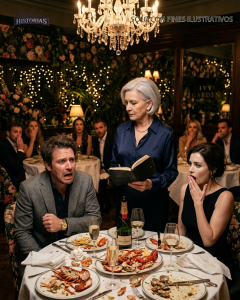
For one second, all I heard was the soft clink of silverware in the back room of Ivy Garden and the blood rushing in my ears. The table in front of me looked like a crime scene dressed in white linen. Lobster shells cracked open and abandoned. Steak plates smeared with sauce. Empty champagne bottles leaning beside half-melted desserts. Napkins crushed into careless little balls, as if the people who had used them had never once wondered who would clean up the mess.
I stood there in my navy blouse with my brown purse tucked under my arm, still holding the text message that had brought me there.
Anniversary dinner. 8:30. Ivy Garden. Don’t miss it, mother-in-law.
Valerie had sent it three days earlier with a little heart emoji, which should have warned me more than it did. My daughter-in-law was never sweet unless sweetness could be used as a weapon.
My son Sebastian sat beside her in a gray jacket I had paid to have tailored after he got promoted. He did not smile when he saw me. He did not stand. He did not say, Mom, you made it. He just rubbed the stem of his wineglass with his thumb and stared at the destroyed table as if it had become suddenly fascinating.
“Sebastian,” I said quietly.
His eyes came up, tired and embarrassed, but not surprised.
That was the part that hurt.
Valerie leaned back in her chair. Her black dress caught the warm brass light, and her hair was pinned in that effortless way that cost money and patience. Her mother, Patricia, sat at the far end in fake pearls and satisfaction. Valerie’s sister Rachel covered a smile with her fingers. Two other guests I barely knew watched me with the hungry curiosity people reserve for public humiliation.
“You’re late,” Valerie said.
I held up my phone. “You told me 8:30.”
Patricia sighed loudly. “Eleanor, please. Don’t make a scene.”
“I’m not making one.”
“Then pay the bill and sit down,” Valerie said. “We already finished, obviously.”
A waiter appeared beside me with the black leather folder held in both hands. His face was professionally blank, but his eyes were kind. I had seen that look before from people trapped between manners and cruelty.
I opened the folder.
$3,400.
For champagne, lobster, steak, truffle sides, imported wine, desserts, service charges, and a few little luxuries nobody at that table would have ordered if they had expected to pay for them themselves.
I looked at the number for a long moment.
Then I looked at my son.
“Did you know?” I asked.
Sebastian swallowed. “Mom, it’s just dinner.”
“No,” I said. “It’s a bill.”
Valerie laughed softly. “There she goes. Always dramatic.”
I am sixty-eight years old. My name is Eleanor Robles, and I spent nearly forty years as a senior accountant in Manhattan. I have seen men in expensive suits sweat through their collars over missing receipts. I have seen partners lie with perfect smiles until a column of numbers exposed them. I know the difference between a mistake and a pattern.
This was not a mistake.
This was a pattern wearing lipstick.
For three years, Valerie had treated me like a wallet with gray hair. First it was small things. A forgotten lunch bill. A “temporary” loan for a decorator. A request to help with Sebastian’s car payment because they were “between accounts.” Then bigger things. Fifteen thousand dollars toward their apartment renovation. Twelve thousand for a business course Valerie quit after six weeks. Seven thousand when Patricia “fell behind” on property taxes for a house she did not even live in.
Every time, Sebastian said the same thing.
Please, Mom. Just this once.
And every time, I wrote it down.
Dates. Amounts. Promises. Excuses. Exact words.
Because numbers remember what family pretends to forget.
Valerie slid the bill toward me with two polished fingers. “You always say family helps family.”
A few people chuckled.
I closed the folder and placed it flat on the table.
Then I raised my hand.
Not toward the waiter.
Toward the dining room.
“Rodrigo,” I called. “Could you come here for a moment?”
The change was immediate.
Valerie’s smile froze.
Sebastian’s head snapped up.
From near the archway, the manager turned. Rodrigo Santillan wore a navy suit and walked with the calm authority of a man who knew every inch of the room because he had earned it. He crossed toward us quickly, his expression warm but cautious.
“Mrs. Robles,” he said. “Is everything all right?”
The room went quieter around us.
Valerie blinked. “You know her?”
Rodrigo glanced at her, then back at me. “Of course.”
I opened my purse and removed the small black notebook I had carried for months. The corners were softened from use. A plain notebook. Nothing dramatic. Nothing expensive. Just paper, ink, and memory.
Sebastian stared at it like it was a gun.
“Before we discuss this bill,” I said, “I’d like to clarify the reservation.”
Rodrigo’s face tightened. “The reservation was for six o’clock.”
Patricia stopped smiling.
Valerie’s fingers curled around her champagne flute.
“And the message I received,” I said, holding up my phone, “said eight thirty.”
Rodrigo looked at the screen. He did not speak for a moment. Then he turned toward the waiter. “Please bring me the original booking notes.”
Valerie sat forward. “This is ridiculous.”
“No,” I said. “Ridiculous was assuming I’d be too embarrassed to ask questions.”
Sebastian’s lips parted, but no words came out.
I opened the notebook.
The first page had his name on it.
Sebastian Robles — Personal Loans.
The second page had Valerie’s.
The third had Patricia’s.
I did not raise my voice. I did not need to. Everyone at that table leaned in anyway.
“March 4,” I read. “Eight thousand dollars for a security deposit. Never repaid. April 18, three thousand for Valerie’s credit card because she said the bank made an error. May 2, Valerie told Sebastian in my kitchen that my Brooklyn house was ‘too much space for one old woman.’ May 9, Patricia suggested transferring the deed into Sebastian’s name before I became ‘confused.’”
Rachel’s smile disappeared completely.
Valerie’s face went pale under her makeup.
Sebastian whispered, “Mom.”
I looked at him, and for the first time that night, he looked like the little boy who used to run into my arms with scraped knees and absolute trust.
But he was not little anymore.
And I was done bleeding quietly so he could avoid choosing.
Rodrigo returned with a printed reservation note. He placed it beside the bill.
Six o’clock arrival. Nine guests. Anniversary dinner. Bill to be handled by late-arriving mother.
The table went silent.
I looked at Valerie.
Then at my son.
“The champagne is not the bill you should be worried about,” I said.
And when I turned the next page of my notebook, Sebastian finally understood that I had not come late.
I had arrived exactly on time.
For several seconds, no one moved.
The restaurant kept breathing around us. Somewhere beyond the archway, a woman laughed at another table, light and unaware. A server poured wine with a soft glug-glug-glug. Silverware touched porcelain. Normal life continued just ten feet away, while at our table, every face had gone still under the weight of paper.
Valerie recovered first. She always did. She had the kind of beauty that could turn quickly into injury when cornered.
“You’re humiliating us,” she said.
I looked at the table. Empty plates. Empty bottles. A $3,400 bill placed neatly beside a printed note proving I had been set up.
“No,” I said. “You planned a humiliation. I brought documentation.”
Patricia pushed back her chair. “I don’t know what kind of little performance this is, Eleanor, but dragging private family matters into a restaurant is beneath you.”
“Private?” I repeated.
The word had a bitter taste.
For years, that was the word they used whenever they wanted me quiet. Private meant I should hand over money without asking questions. Private meant I should not tell my sister why I suddenly could not join her on a trip to Vermont because I had helped Sebastian again. Private meant I should listen while Valerie joked at brunch that my house “still smelled like the seventies” and smile because making a scene would embarrass my son.
Private meant their behavior stayed hidden, and my pain stayed useful.
I turned one page.
“August 12,” I read. “Valerie asked me to co-sign a loan for a boutique interior design business. No business plan provided. When I declined, she told Sebastian I didn’t believe in his marriage.”
Valerie’s eyes narrowed. “That is not what happened.”
Sebastian rubbed his forehead.
“It is exactly what happened,” I said. “You were standing near my kitchen sink. You had taken off your shoes and left them in the hallway, and you were drinking wine from the blue glass my late husband bought me in Santa Fe. You said, ‘Your mother wants us small because she likes being needed.’”
A muscle moved in Sebastian’s jaw.
I turned another page.
“September 3. Sebastian called me at 11:47 p.m. He said Valerie was crying because their rent check would bounce. I transferred four thousand dollars the next morning. Valerie posted photographs from a spa weekend in the Berkshires two days later.”
Rachel looked down at her lap.
One of the guests I barely knew, a man with silver cufflinks and a flushed face, shifted as if he wished the floor would open and excuse him.
Valerie laughed, but the sound had lost its polish. “So now you’ve been stalking my social media?”
“You tagged the spa,” I said.
A tiny sound escaped one of the younger women at the table. Not quite a laugh. Not quite a gasp. Something in between.
Valerie heard it. Her cheeks reddened.
Sebastian finally spoke. “Mom, maybe we should talk about this outside.”
I looked at him carefully.
His voice was soft. Pleading. The same voice he used when he wanted me to rescue him from the consequences of letting Valerie take the wheel of his life. And for one painful second, my body almost obeyed. I was still his mother. That does not stop being true because a child becomes a grown man in a gray jacket with cowardice sitting on his shoulders.
But then I remembered the text.
Anniversary dinner. 8:30.
I remembered walking through the restaurant alone, my purse under my arm, thinking maybe I had misread the time. I remembered my son not standing.
“No,” I said. “We have talked privately for three years. Tonight, you chose the room.”
Rodrigo stood beside me without interrupting. That was the kind of man he was. Present, calm, careful. He knew that dignity sometimes meant not rescuing someone too quickly, especially when they had finally decided to rescue themselves.
Valerie looked at him. “Are you seriously allowing this?”
Rodrigo’s face remained professional. “Mrs. Robles is a valued guest.”
“A valued guest?” Valerie snapped. “We spent thousands here tonight.”
“Yes,” Rodrigo said. “On a reservation note stating that someone else would be handed the bill after dinner.”
His voice was not loud, but it carried.
Patricia turned toward him. “That note was a joke.”
Rodrigo picked it up gently. “It was submitted through the private dining request form.”
Patricia’s mouth opened, then closed.
Valerie reached for her champagne glass, realized it was empty, and set it down too hard. The small clack made Sebastian flinch.
I watched that flinch. Not because I enjoyed it. I did not. I had loved this boy through fevers and spelling tests and heartbreak and college rejection letters. I had sat on the bathroom floor with him when his father died and he was twenty-six but sounded twelve. I had held his hand while we picked out the casket. I knew his goodness. I knew his softness.
But softness without spine can still become cruelty.
Especially when it stands beside cruelty and calls itself peace.
I turned another page.
“October 28. Patricia suggested selling my Brooklyn house and moving me into a retirement community in New Jersey. She said it would be ‘easier on everyone.’ I had not asked for help. I had not missed payments. I had not expressed any desire to move.”
Patricia sat up straight. “I was concerned.”
“You were interested.”
Her fake pearls trembled against her throat.
The house had been mine for thirty-one years. A narrow brownstone with stubborn pipes, scuffed stairs, a kitchen window facing a row of little back gardens, and a front stoop where my husband, Miguel, used to drink coffee on Sunday mornings. We bought it when the block was still uneven around the edges, when relatives told us Brooklyn was too risky and too far from the life we thought we were building.
Miguel fixed the banister himself. Badly, at first. Then better. Sebastian learned to ride a bike in front of that house, wobbling between parked cars while I pretended not to be terrified. Every Christmas, Miguel hung one crooked wreath on the door and refused to replace it because, he said, perfection was bad luck.
After he died, that house became both shelter and ache.
Valerie saw square footage.
Patricia saw equity.
Sebastian saw conflict and looked away.
“I never wanted your house,” Valerie said.
I did not answer immediately. I opened the back pocket of the notebook and removed a folded sheet of paper.
That was when her face changed for real.
Not embarrassment. Not annoyance. Fear.
She recognized the paper.
I unfolded it and placed it on the table beside the reservation note. The paper had been printed from an email attachment I had not been meant to see. It was a draft document sent by a real estate attorney, forwarded by mistake to a shared family email thread during one of Valerie’s frantic attempts to coordinate “financial planning.”
Sebastian stared at it. “What is that?”
I looked at him.
“You really don’t know?”
He shook his head once, barely.
That was the midpoint of the evening. The moment the room shifted again, but this time not toward me.
Toward Valerie.
The first shift had been surprise that I was not helpless. The second was recognition that Sebastian had not known everything.
And that made the air sharper.
I slid the paper toward him.
“It is a draft quitclaim deed,” I said. “Prepared with my address. My parcel number. Your name listed as future transferee.”
Sebastian’s face drained.
Valerie stood so quickly her chair scraped backward.
“That was preliminary,” she said. “It was never used.”
Patricia grabbed her napkin. “Valerie.”
But the word came too late.
Sebastian turned to his wife. “Preliminary?”
Valerie looked from him to me, calculating. I could almost see the machinery behind her eyes.
“Your mother was overwhelmed,” she said. “We talked about options.”
“We?” Sebastian asked.
“You were stressed,” she said. “I was trying to protect us.”
“No,” he said, louder now. “Did you contact an attorney about my mother’s house?”
Valerie’s lips parted.
For three years, I had watched her use his guilt like a leash. She knew which wounds to press. His fear of failing as a husband. His shame over asking me for money. His childhood need to keep peace after his father died, as if any raised voice could break what was left of us.
But now he was looking at a paper with his mother’s home reduced to a transfer.
Something old and decent woke in him, late but visible.
“Did you?” he asked.
Valerie’s voice dropped. “Sebastian, don’t do this in front of everyone.”
I almost laughed, but it would have sounded too sad.
Rodrigo stepped slightly closer to the table. Not threatening. Just enough to remind everyone that this was still his room, and no one would bully their way out of it.
Patricia leaned toward Sebastian. “Your wife was thinking about your future.”
“My future?” he said.
His eyes moved to me.
I had seen that look once before, when he was nine and broke a neighbor’s window with a baseball. He had denied it for nearly an hour. Then he saw the neighbor pull the ball from the bushes with his initials written on it, and his whole face collapsed under the truth.
“I didn’t know,” he said to me.
I believed him.
That was the worst part.
I believed he had not known about the deed draft. I believed he had ignored the comments, excused the loans, accepted the pressure, and let himself benefit from my exhaustion, but I believed he had not known about the paper.
There are different kinds of betrayal.
Some are deliberate.
Some are convenient.
Some happen because a person keeps choosing not to look until the damage has already learned his name.
“I know,” I said.
His eyes filled.
Valerie seized on the softness in my voice.
“See?” she said quickly. “This is a misunderstanding. Eleanor gets emotional. She writes things down and creates these little stories, and then suddenly everyone is a villain.”
I closed the notebook.
The sound was small, but it ended the sentence before she could finish.
“Valerie,” I said, “when you sent me the wrong time tonight, did you think I would cry?”
Her face hardened.
“Did you think I would pull out my credit card with everyone watching because humiliation is cheaper than confrontation?”
She said nothing.
“Did you think I would protect Sebastian from embarrassment again?”
Her eyes flicked to him.
That was answer enough.

I reached for the bill folder and opened it again. The total sat at the bottom like a dare.
“Rodrigo,” I said, “please split the bill evenly among the people who were here at six o’clock and consumed the meal.”
Valerie’s mouth dropped open. “Absolutely not.”
Rodrigo gave one nod. “Of course.”
Patricia rose halfway from her chair. “We are not paying this. She invited us.”
Valerie whipped toward her. “Mom.”
But panic had made Patricia sloppy.
Sebastian looked at Valerie. “You invited them?”
Valerie’s face twisted. “It was our anniversary dinner.”
“With your mother, your sister, two cousins, and people I barely know?” he asked. “And my mother was invited at the end to pay?”
No one answered.
A server came quietly and collected the folder. The movement was almost ceremonial. The black folder left the table, and with it went the illusion that I was still available to be used.
Valerie sat back down slowly.
Her hand trembled when she reached for her phone.
I turned to Sebastian.
“I need you to listen to me now.”
He nodded, too quickly.
“No more loans,” I said. “No more transfers. No more emergency payments. The money you received from me over the past three years is listed here. Some of it I gave because I loved you. Some of it I gave because I was pressured. I am not asking for all of it tonight.”
He looked wounded by that mercy, which told me he understood it was mercy.
“But I am asking for one thing before I ever allow you back into my home without an appointment.”
His throat moved. “Anything.”
“Honesty.”
The word settled between us.
“Not apology first,” I said. “Not excuses. Not blaming Valerie. Honesty. You knew I was being disrespected. You knew I was paying for things I should not have paid for. You knew I was being called confused, dramatic, old-fashioned, difficult. You knew I was invited late tonight, or at least you knew when I arrived that something was wrong. And you stayed seated.”
A tear slipped down his cheek.
Valerie looked disgusted by it.
That small expression told me more about their marriage than a hundred arguments could have.
Sebastian whispered, “I’m sorry.”
I felt the words strike somewhere tender, but they did not repair anything.
“I believe you are sorry right now,” I said. “I do not yet know what that will mean tomorrow.”
Rachel stood abruptly. “I’m going to pay my part.”
Valerie turned on her. “Sit down.”
Rachel shook her head. “No. This got weird.”
That broke something loose at the table.
The silver-cufflink man reached for his wallet. The younger woman beside him avoided Valerie’s eyes and pulled a credit card from a small purse. Patricia stayed frozen, red with fury. One of the cousins muttered that he had only had one glass of champagne, and Rodrigo, with devastating politeness, said itemization could be arranged.
Public power is a fragile thing.
For two hours, Valerie had held the room because everyone believed she controlled the story. She was the elegant wife. I was the late, confused mother. Sebastian was the dutiful son caught between women. The bill was a punchline.
Then the paper changed hands.
The notebook opened.
The manager knew my name.
And suddenly people began recalculating the cost of standing near her.
Valerie saw it happen. That was her punishment before any money changed hands. She watched admiration retreat from her like a tide.
She leaned toward me and lowered her voice. “You think this makes you powerful?”
“No,” I said. “It makes me finished.”
“With what?”
“With begging my own family to treat me like a person.”
Her face worked, searching for the cruelest thing left.
“You’ll die alone in that old house,” she said.
The table went dead quiet.
Sebastian stood.
Not halfway. Not uncertainly.
He stood.
“Don’t,” he said.
One word.
It was late. It was not enough. But it was real.
Valerie looked up at him, stunned that the shield had moved.
He turned to me, and the boy in his face was gone now. A man stood there, ashamed and frightened, but standing.
“Mom,” he said, “I’m leaving with you.”
I shook my head.
His expression cracked.
“No,” I said gently. “You’re leaving by yourself.”
He looked as if I had slapped him.
“You need to decide who you are when I am not there to rescue and Valerie is not there to blame.”
Valerie gave a sharp laugh. “Unbelievable. You’re turning him against his wife.”
I picked up my notebook and slipped it back into my purse.
“No,” I said. “I am returning him to himself. What he does from there is his responsibility.”
Rodrigo came back with three servers and a new set of folders. They moved with quiet efficiency, placing individual bills in front of each guest. No drama. No raised voices. Just mathematics, the most unsentimental language in the world.
Patricia stared at her total as if the paper had insulted her.
Rachel paid quickly and left without hugging Valerie.
The silver-cufflink man leaned toward Sebastian and muttered something I could not hear. Sebastian did not respond. His eyes were fixed on the table, on the empty bottles, on the mess he had let become normal.
Valerie did not touch her bill.
Instead, she looked at Rodrigo. “We will be disputing this.”
Rodrigo nodded. “You may contact our office tomorrow.”
“I know the owner,” she snapped.
For the first time that night, Rodrigo smiled.
“Yes,” he said. “So does Mrs. Robles.”
The silence that followed was almost elegant.
Valerie’s eyes moved to me.
I had not planned to say it. Not originally. Ownership had never been something I waved around. Years earlier, when Rodrigo’s mother was sick and his family restaurant was nearly gone, I helped him rebuild the accounts. Later, when he expanded and needed a private investor who would not devour him with interest, I bought a small share. Nothing glamorous. Nothing controlling. Enough to help. Enough to believe in the place.
Enough to make Valerie’s trap collapse under its own arrogance.
Sebastian stared at me. “You own part of Ivy Garden?”
“A small part,” I said.
He laughed once, but there was no humor in it. “I didn’t know.”
“There is a lot you didn’t know,” I said. “Because you stopped asking questions that were not convenient.”
He accepted that like a man accepting a sentence.
Valerie pushed her chair back. “I’m leaving.”
Rodrigo stepped aside. “Of course.”
“The bill can be sent to us.”
“No,” Rodrigo said pleasantly. “It cannot.”
Her face flushed dark.
Patricia began whispering urgently into her phone, probably moving money between accounts or calling someone to be outraged on her behalf. The table that had been built as a stage for my humiliation was now a collection of people trapped with receipts.
I suddenly felt very tired.
Not weak. Not defeated.
Just tired in the deep, old way that comes when you finally set down something heavy and realize how long you carried it.
Sebastian stepped toward me. “Can I walk you home?”
I looked at him.
Outside the restaurant windows, Brooklyn moved under streetlights and drizzle. People hurried with umbrellas. A cyclist passed with a flashing red light. Somewhere in the neighborhood, someone was unlocking a brownstone door, stepping into warmth, calling out to whoever waited inside.
“I’m taking a car,” I said.
“I’ll wait with you.”
“No.”
He stopped.
I softened my voice, because cruelty was not my goal. Boundaries do not need cruelty to stand upright.
“Sebastian, I love you. I will always love you. But tonight you do not get the comfort of being forgiven quickly.”
He closed his eyes.
“You can call me in a week,” I said. “Not tomorrow. Not with panic. Not with excuses. In a week, call me with a plan. A real one. Where you live, how you pay your own bills, what you intend to repay, and what you intend to do about your marriage. Then we will talk.”
Valerie laughed behind him. “A plan? He’s your son, not an employee.”
I looked at her one final time.
“No,” I said. “He is my son. That is why I should have required more from him sooner.”
That landed where I intended it to land. Not on her. On me.
Because I had my own ledger too.
I had called my silence patience when sometimes it was fear. I had called my giving love when sometimes it was bargaining. I had told myself Sebastian would wake up if I just absorbed one more insult, paid one more bill, smoothed over one more awful dinner.
Mothers can confuse protection with participation.
That was my debt.
And I would pay it by stopping.
Rodrigo walked me to the front himself. The hostess who had greeted me earlier looked at me with wet eyes.
“I’m sorry, Mrs. Robles,” she whispered.
“You did nothing wrong,” I said.
Rodrigo held my coat while I slipped my arms into it. “I can have someone drive you.”
“I’ve already called a car.”
He nodded. “Mercedes would have been proud of you.”
The name caught me in the ribs.
His mother had been a woman of immaculate records and quiet jokes, the kind of office worker who knew everyone’s birthday and every payroll discrepancy. When she died, Rodrigo had sent me a handwritten letter thanking me for helping them keep the restaurant. I kept it in a drawer with Miguel’s old cufflinks.
“She would have told me I waited too long,” I said.
Rodrigo smiled. “Also that.”
Outside, the air smelled like rain, exhaust, and wet stone. I stood beneath the awning with my purse against my side and watched droplets gather along the edge of the canvas before falling in silver threads.
Through the window, I could still see the back room if I turned slightly.
Valerie was standing now, furious and beautiful and smaller than she had looked an hour before. Patricia had a phone pressed to her ear. Sebastian sat alone at the table, elbows on his knees, looking at the floor.
I did not go back.
The car arrived. I got in. The driver asked if I was warm enough, and that nearly undid me.
Kindness from strangers can be dangerous after cruelty from family.
“Yes,” I said. “Thank you.”
When I reached my brownstone, I stood on the sidewalk for a moment before climbing the steps. The house looked exactly as it always had: brick darkened by rain, black railing chipped near the bottom, one porch light glowing amber. Miguel’s crooked wreath was long gone, but sometimes I still saw it there in memory, stubborn and imperfect.
Inside, the rooms were quiet.
Not empty.
Quiet.
There is a difference.
I made tea because some habits are anchors. I placed my notebook on the kitchen table and set my phone beside it. Three messages were already waiting.
One from Sebastian.
I’m sorry. I know that’s not enough.
One from Valerie.
You are a cruel, manipulative old woman.
One from an unknown number.
This is Rachel. I didn’t know they planned that. I’m sorry.
I read them all.
Then I turned the phone face down.
For the first time in years, I slept through the night.
The aftermath did not arrive like thunder. It came in paperwork, silence, and small humiliations moving in the other direction.
By noon the next day, Rodrigo told me the dinner had been paid in full across five cards and one very angry bank transfer from Patricia. Valerie had refused until the restaurant made clear that the signed private dining request and security footage would support the charge. I did not ask to see the footage. I did not need another angle of my own humiliation.
Three days later, Sebastian left Valerie.
Not dramatically. Not heroically.
He packed two suitcases while she was at Pilates and moved into a short-term rental in Queens. He sent me the address, then did not ask to come over. That restraint was the first evidence that shame had begun turning into something more useful.
A week later, he called.
I let it ring twice before answering.
“Hi, Mom,” he said.
“Hello, Sebastian.”
His voice broke on the second sentence, but he kept going. He had made a spreadsheet. That detail almost made me smile. He listed every transfer he knew about, every bill I had covered, every amount he could verify. He admitted the ones he had pretended were gifts. He admitted the ones he had called temporary while knowing he had no plan to repay them.
“I can’t pay it all back quickly,” he said. “But I can start.”
“I know.”
“I’m meeting with an attorney,” he added. “About the deed thing. About making sure nothing was filed. About the separation.”
I closed my eyes.
“Good.”
There was a long silence.

Then he said, “I saw it, Mom. I saw what she was doing. Not all at once, maybe. But enough. And I let it be easier to disappoint you than confront her.”
That was honesty.
Painful. Ugly. Late.
But honesty.
“Yes,” I said.
“I’m sorry.”
“I know.”
“I don’t expect you to forgive me now.”
“Good,” I said, and this time I did smile a little. “That means you’re listening.”
We did not become magically healed after that. Life is not a restaurant scene where one speech fixes blood ties and one exposed villain cleans the walls. Sebastian and I moved carefully. Weekly calls at first. Then coffee in public places. Then one Sunday, months later, he came to the brownstone and fixed the loose cabinet hinge Miguel had always meant to repair.
He cried in the kitchen afterward.
I let him.
Valerie sent long emails for a while. Then shorter ones. Then threats through an attorney that went nowhere because my own attorney answered with documents, dates, and the clean, merciless structure of truth. The draft deed had never been filed. My house remained mine. My accounts were secured. My will was updated.
Patricia stopped speaking to me, which improved my life immediately.
Rachel sent a holiday card.
Rodrigo banned Valerie from booking private events at Ivy Garden after she left a one-star review under a fake name and forgot that restaurants, like accountants, keep records.
The following spring, Sebastian invited me to dinner.
Not at Ivy Garden.
A small Italian place in Park Slope with paper menus and excellent bread. He arrived ten minutes early. He stood when I walked in. He did not look at his phone once.
When the bill came, he reached for it without performance.
“I’ve got this,” he said.
I watched his hand close around the folder.
Such a small thing.
Such an enormous thing.
After dinner, he walked me to a car, but did not assume he could come home with me. At the curb, he said, “I miss Dad.”
“So do I.”
“He would be ashamed of me.”
I looked at my son under the streetlight. Older than I remembered. Younger than he wanted to seem.
“Your father believed shame was only useful if it taught you what to do next,” I said.
Sebastian nodded.
Then he hugged me, carefully, as if I were not fragile but precious.
That distinction mattered.
On my sixty-ninth birthday, I had lunch at Ivy Garden.
Rodrigo gave me the side table near the window, the one I liked. There were flowers waiting, white tulips in a glass vase. Sebastian came with a small wrapped gift and a card he had clearly rewritten three times. He had been making payments for months by then. Not large ones. Consistent ones.
Valerie was gone from his life by then except in legal documents and the kind of memory that teaches a man where his weak places are.
We ordered salad, pasta, and one dessert with two spoons.
No champagne.
When Rodrigo stopped by, Sebastian stood and shook his hand.
“Thank you,” he said.
Rodrigo tilted his head. “For what?”
Sebastian looked at me. “For knowing my mother’s name when I had forgotten how to honor it.”
I looked out the window because my eyes had filled too fast.
Outside, Brooklyn moved on. Delivery trucks, schoolchildren, brownstones, rain-threatening clouds. The same city. The same life. But something in me had shifted back into place.
For years, I thought the great sorrow was that my family had handed me bills they should have carried themselves.
Money bills. Emotional bills. Silence bills. Pride bills.
But the greater sorrow was that I kept paying them because I was afraid the table would be empty if I stopped.
Now I knew better.
A table built on disrespect is already empty.
That night at Ivy Garden, I did not lose my son. I lost the arrangement that had been standing between us. I lost the role Valerie had assigned me. I lost the fear that love required self-erasure.
And in the quiet that followed, I found something I had not realized I was missing.
My own name.
My own house.
My own chair at the table.
Paid in full.
