Physical Address
304 North Cardinal St.
Dorchester Center, MA 02124
Physical Address
304 North Cardinal St.
Dorchester Center, MA 02124

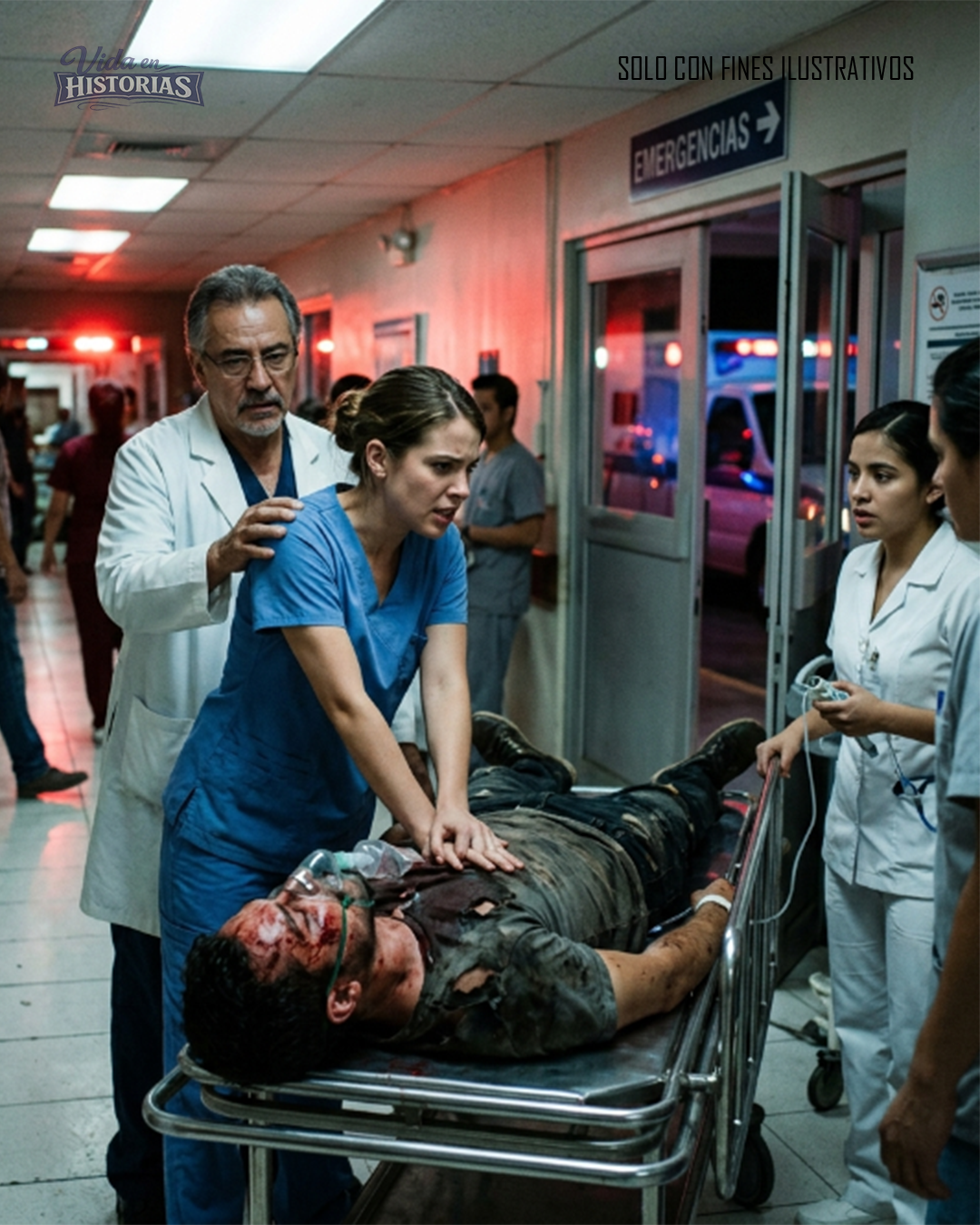
Her shift had ended at six in the morning, but Dr. Lucía Rivera felt like she had been on her feet for a lifetime.
In the small sink of the doctors’ lounge at Hospital General de San Miguel in Puebla, she took off her blood-stained coat, turned on the faucet, and let the ice-cold water hit her fingers. She was thirty-two years old, with deep dark circles under her eyes and fine hands that everyone in the surgery department admired. *Steady hands*, they said. *Hands born to save lives.*
She took out her old cellphone and called home.
“Mom? How are you feeling this morning?”
A tired voice answered from the other side — Doña Carmen.
“I’m fine, honey. Don’t worry. Sofía is already awake. She keeps asking if you’re coming home to make pancakes.”
Lucía smiled for the first time all night.
“Tell her I’m on my way. I bought milk and strawberries. We’ll have breakfast together.”
A little voice broke into the call.
“Mommy, hurry up! You promised we’d go to the park!”
“I’m coming, sweetheart.”
Lucía hung up, grabbed her worn jacket and a grocery bag. In her mind, the monitors, wounds, and screams had already faded. All she could think about was the warm kitchen at home, her mother knitting by the window, and Sofía waiting with her teddy bear for breakfast.
But the moment she walked out the hospital’s main door, the wail of an ambulance shattered the dawn.
The vehicle skidded across the wet pavement. A pale paramedic jumped out from the back.
“Doctor! Severe head trauma! He’s crashing!”
Lucía froze for a second.
She was no longer on duty. She had already handed over her shift. Her daughter was waiting for her.
But on the stretcher lay a man covered in blood, dirt, and torn clothes. He smelled of cheap alcohol, the streets, and neglect. He looked like just another homeless person — one of those invisible men who sleep under bridges, the kind most people don’t even glance at twice.
“Blood pressure,” Lucía ordered, running toward him.
“Sixty over forty. Weak breathing. He’s lost a lot of blood.”
The man’s chest stopped moving.
“Cardiac arrest!”
Lucía dropped her grocery bag. The bottle of milk shattered on the floor, mixing with the dirty water at the entrance. She no longer saw anything else. She jumped onto the stretcher and began chest compressions.
“Take him to the OR! Prepare for intubation!”
Down the hallway appeared the head of surgery, Dr. Ernesto Villalobos — a robust, elegant, and feared man. He smelled of expensive cologne and last night’s alcohol. He was still adjusting his coat, his face red with anger.
“Rivera, what the hell are you doing?”
“He’s dying. He needs surgery now.”
Villalobos didn’t even look at the patient.
“Get him out of the way. In ten minutes the State Secretary of Public Works is arriving with an acute abdomen. I want Operating Room One cleaned and fully equipped.”
Lucía stared at him in disbelief.
“Doctor, this man has internal bleeding and a cranial hematoma. If we don’t operate, he’ll die.”
“And if I lose a government official, the whole hospital will come crashing down on us,” he replied, lowering his voice. “Nobody cares about that bum.”
The young intern, Mariela, stood nearby, trembling.
Villalobos pointed at the stretcher with contempt.
“If you want to play saint so badly, take him down to the old operating room in the basement. But don’t use any main staff or supplies. And if anything goes wrong, it’s on you.”
Lucía felt a quiet rage rising in her chest.
She looked at the man. Beneath the blood and dirty beard, his heart was still fighting.
“Mariela,” Lucía said, “push the stretcher. We’re going to the basement.”
“Doctor, they’re going to fire us…”
“They’ll bury him if we don’t move.”
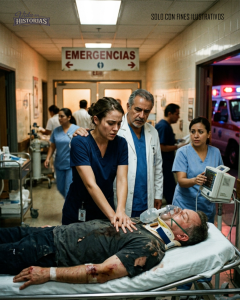
Operating Room Three had been closed for years. It smelled of dampness, old bleach, and rusted metal. The lights flickered. The instruments were outdated. There was no comfort, but there was a table, light, and willing hands.
Lucía operated for four hours.
First, she opened the abdomen and found the bleeding. She ligated vessels, cleaned the blood, and closed the wounds. Then she drained the hematoma compressing his brain. Mariela cried silently but kept passing her the instruments.
“Breathe,” Lucía whispered to the stranger. “Don’t leave. Not today.”
In the end, the monitor showed a stable rhythm.
Lucía leaned against the cold wall, exhausted.
“He’s going to live,” she whispered.
She had no idea that while she was saving the stranger, upstairs Villalobos was making the biggest mistake of his life.
The Secretary of Public Works died in the main operating room. The head of surgery, still shaky from his hangover, had cut a major vessel and couldn’t control the bleeding. When he realized his career was over, he went straight to the director’s office.
“We need a scapegoat,” he said.
They made up a story that Lucía had stolen two ampoules of an expensive coagulant called Hemostat to use on “her homeless man,” leaving the official without the medication. Villalobos forged her signature in the records, emptied the ampoules, and hid them in the doctor’s old bag.
At ten in the morning, Lucía finally arrived at her apartment.
Sofía ran to hug her.
“Mommy! Are we making pancakes?”
Lucía barely had time to kiss her hair.
A heavy knock sounded at the door.
“State Police! Open up!”
They entered with a search warrant. Villalobos followed behind, pretending to look sad.
“Lucía Rivera, you are under arrest for theft of controlled medication and involuntary manslaughter.”
“What? That’s a lie!”
An officer emptied her bag onto the table. Out fell keys, a notebook, Sofía’s little teddy bear… and two empty ampoules.
The kitchen fell silent.
Doña Carmen clutched her chest. Sofía hugged her bear, paralyzed.
Lucía looked at Villalobos.
“You put those there.”
He leaned close to her ear and whispered:
“No one will believe a poor single mother against a head of surgery.”
They put handcuffs on her in front of her daughter.
“Mommy, don’t go!” Sofía screamed, clinging to her coat.
Lucía wanted to hug her, but the police pushed her toward the door. The last thing she saw was her mother falling to her knees, pale, while the little girl screamed in the hallway.
The trial was quick and cruel.
The doctors remained silent. The nurses looked away. Mariela, threatened with losing her career, testified through tears that Lucía had asked for the medication without registering it.
Lucía didn’t insult her. She only looked at her with sadness.
“I forgive you, Mariela,” she said from the defendant’s stand. “I hope one day you can forgive yourself.”
She was sentenced to four years in prison.
In prison, Lucía stopped being a doctor and became a number. She worked in a sewing workshop until her fingers bled. The same hands that had saved lives now sewed sacks. At night she cried in silence, thinking of Sofía and her sick mother, who had sold the television and washing machine to feed the child.
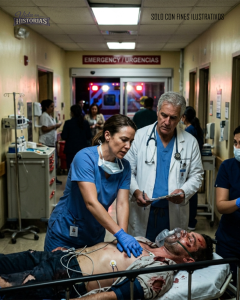
One day, an inmate named Brenda — known for being violent — suffered severe burns from steam in the workshop. No one knew what to do. Lucía ran to her.
“Don’t rip off her clothes! Cold water and clean cloth, now!”
She treated her with precision, calm, and authority. Brenda, who had previously humiliated her, cried in pain and shame.
That night she approached Lucía’s bunk and left her a cube of sugar — a treasure in prison.
“Forgive me, Doctor,” she murmured. “I didn’t know people like you still existed.”
From then on, everyone called her “the Doc.”
Months later, during a storm, the module boss suffered acute peritonitis. There was no ambulance, no way out, no time. Lucía asked permission to operate in the infirmary with old instruments, flashlights, and local anesthesia.
“If I don’t operate on her, she’ll die before dawn,” she said.
They gave her permission.
The surgery was terrible. The lights failed, the wind beat against the windows, and her injured fingers could barely feel the sutures. But Lucía closed the perforation, controlled the infection, and saved the woman.
When she woke up, the boss watched Lucía sleeping on the cold infirmary floor.
“Those hands don’t belong to a criminal,” she whispered. “I’m getting you out of here.”
Meanwhile, in a private clinic in Mexico City, the man Lucía had saved was waking up after months in a coma.
His name was Alejandro Montes.
He was not a homeless man.
He was one of the most powerful businessmen in the country, owner of a construction company and several private hospitals. His partners had tried to assassinate him, beaten him, left him lying in the street, and poured alcohol on him to make him look like a bum.
At first he remembered nothing.
Only a voice.
“Breathe. I’m not going to let you go.”
That voice accompanied him in the darkness.
When he regained his memory, he asked his head of security to investigate which doctor had saved him. He went to Hospital General de San Miguel. When Villalobos recognized him, he nearly fainted but tried to smile.
“Alejandro, what a miracle to see you alive. I operated on you personally.”
Alejandro listened in silence.
“You?” he asked.
“Four hours. It was a heroic surgery.”
Alejandro remembered the voice. It was a woman’s. Tired, firm, gentle.
“You’re lying,” he said.
He went down to the hospital basement. There an old cleaning lady, Doña Petra, dropped her mop when she saw him and began to cry.
“Holy Virgin! You’re alive!”
“Who operated on me?”
The woman crossed herself.
“Dr. Lucía Rivera. She saved you. Villalobos had sent you to die. Then they accused her of stealing medicine because the official died upstairs. It was all a setup.”
Alejandro didn’t shout. He didn’t hit anything. He simply tightened his grip on his cane.
“I want lawyers. Experts. Recordings. Witnesses. Everything.”
In three weeks, the case collapsed.
Mariela confessed. The investigator admitted he had been pressured. A new handwriting test proved the signature was forged. Hallway cameras showed Villalobos entering the changing rooms. The entire hospital, out of fear or shame, began to talk.
One morning, the prison doors opened.
Lucía walked out in her old clothes, thin and pale, still not fully understanding what was happening. Outside, Alejandro Montes was waiting for her, standing and leaning on a cane.
He took off his coat and placed it over her shoulders.
Then he took her scarred hands and bowed before them.
“Dr. Rivera,” he said, his voice breaking, “these hands gave me back my life. Forgive me for taking so long to give you back yours.”
Lucía broke down in tears.
Hours later she arrived home. She knocked on the door with trembling fingers. Doña Carmen opened it. She had aged and walked with difficulty, but when she saw her daughter she dropped the cup she was holding.
Sofía appeared behind her.
For a second she didn’t move. Then she screamed:
“Mommy!”
The little girl ran to her. Lucía fell to her knees and hugged her as if she wanted to recover all the lost days in a single embrace.
Weeks later, Villalobos was arrested in front of the entire hospital staff. Alejandro bought new equipment for the medical center and created a foundation for patients without resources. Lucía was publicly exonerated and reinstated as a surgeon.
Over time, her hands regained sensitivity. She returned to the operating room. This time, no one told her again who was worth saving.
One afternoon, from the window of her new office, Lucía saw Alejandro walking through the hospital garden with Sofía on his shoulders. The little girl was laughing, holding a new teddy bear.
Alejandro looked up and smiled.
Lucía smiled too.
She had lost months, her reputation, and almost her faith. But she had not lost the only thing that truly made her a doctor: the decision to keep being human even when the world punished her for it.
