Physical Address
304 North Cardinal St.
Dorchester Center, MA 02124
Physical Address
304 North Cardinal St.
Dorchester Center, MA 02124

PART 1
—If you really want a divorce, Mariana, you’re going to leave this house… but in a box.
That was the last thing Arturo Salcedo said to me the night I decided to die.
He didn’t shout it. He didn’t make a scene. He didn’t even raise his hand like he had done before. He said it sitting in the dining room of our house in Las Lomas, with the calm of someone ordering another shot of tequila, while I held between my fingers the divorce papers I had signed that very afternoon.
Arturo owned restaurants, construction companies, and half a dozen other businesses that society magazines portrayed as those of “exemplary entrepreneurs.” In photos, he was seen embracing governors, donating toys at Christmas, and cutting ribbons with his perfect smile. But at home, he was a different story. At home, he didn’t smile. At home, he ruled the roost.
I had been his wife for fifteen years. Fifteen years of expensive dresses, dinners with politicians, trips to Cancun, and a loneliness so profound that not even marble walls could conceal it. People said I lived like a queen. No one saw that my crown was a chain.
The first time I tried to leave him, he found me in Querétaro before dawn. The second time, he had my cousin, who helped me, beaten up. After that, I understood that Arturo wasn’t threatening out of pride. He threatened because he could carry it out.
That’s why, when I overheard a call where he told his right-hand man, Elias Navarro, that “Mariana already knew too much,” I knew I didn’t have much time left.
Then I did the only thing a desperate woman could do: I prepared my death.
For months I saved money, copied documents, recorded conversations, and got help from a doctor who owed more to the casino than to ethics. He gave me a drug that could lower my pulse and breathing to the point of being practically nonexistent for several hours. “It can really kill you,” he warned me.
—Arturo too —I replied.
On Friday night, I took the exact dose. I called emergency services, feigning chest pain, and left the door open. By the time the paramedics arrived, I was already cold, pale, and unresponsive. They pronounced me dead from cardiac arrest and took me to the morgue.
That’s when Don Manuel Rivas came in.
He was fifty years old, had worked as a forensic assistant for over two decades, and lived with his wife Teresa in a housing complex in Iztapalapa. He was an honest, tired, and poor man. Just the kind of person Arturo would never give a second glance.
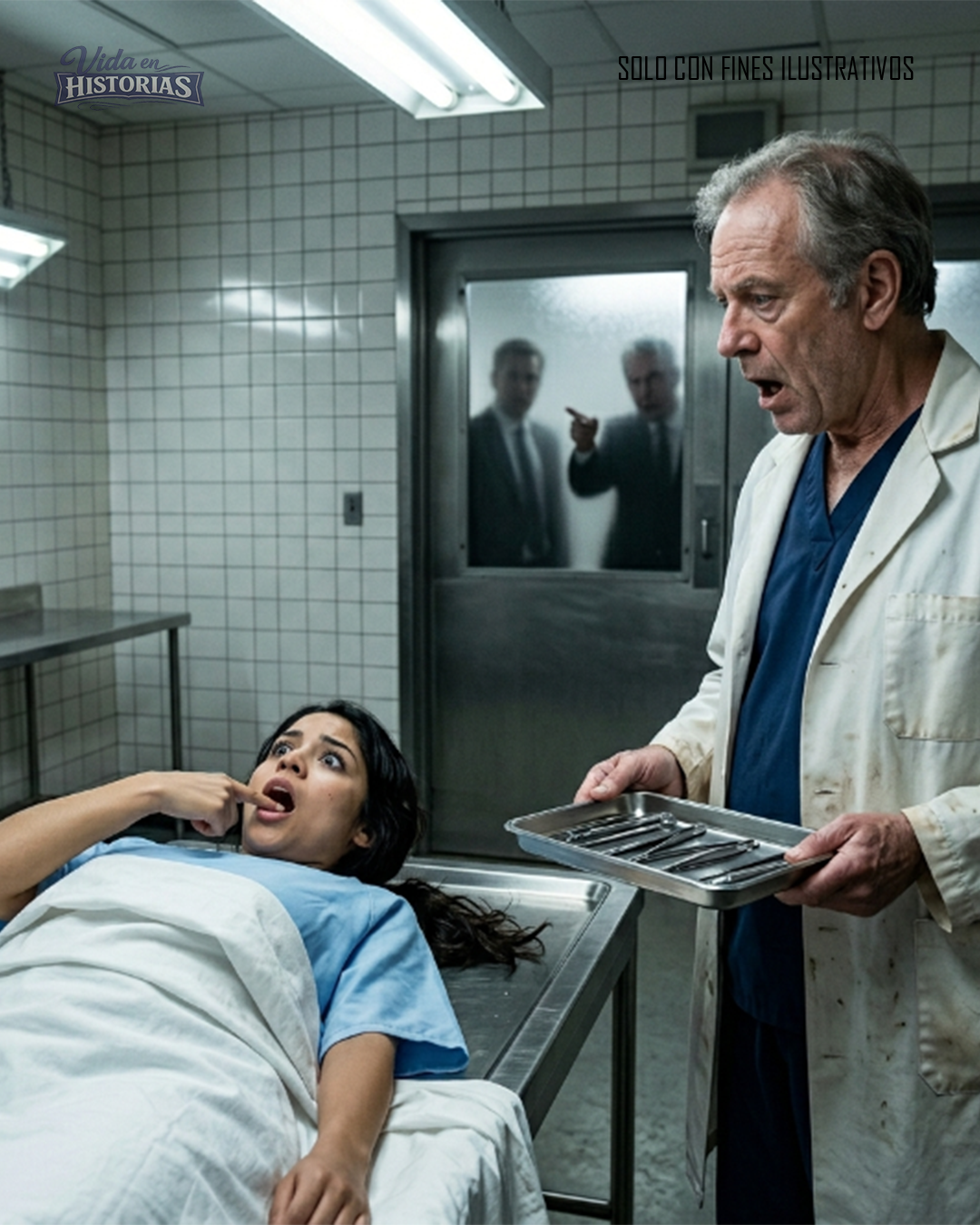
When I woke up on the metal sheet, Don Manuel almost fainted.
“Don’t scream,” I said, my throat dry. “I’m not dead. But if you don’t help me, I soon will be.”
I told her everything. I said Arturo would come the next day to identify my body and demand a quick, discreet cremation, no questions asked. I told her to accept the money, pretend to obey, and then help me leave.
“And why would I get involved in this?” he asked, trembling.
I took a sheet of paper with bank codes out of my clothes.
—Because I can pay you two million pesos. And because you know how to tell the difference between a corpse… and a woman who still wants to live.
Don Manuel thought of his wife, his daughter who hadn’t been able to afford university, the years of double shifts and worn-out shoes. Then he stared at the door of the walk-in cooler, as if his entire life were waiting on the other side for an answer.
“All right,” she finally said. “But tomorrow you’ll be dead again.”
At ten in the morning, Arturo arrived with Elías and another bodyguard. He wore an impeccable black suit and had the face of a widower who wasn’t even trying to appear sad. When he saw my body, he didn’t cry. He didn’t touch me. He only said:
—It’s her. Burn her today.
Don Manuel accepted the envelope with money. Arturo leaned slightly over me and, with a smile that only I could feel on my skin, whispered:
—You won’t escape me even if you’re dead, Mariana.
And at that moment I understood something horrible: perhaps Arturo already suspected.
I couldn’t believe what was about to happen…
PART 2
Don Manuel closed the door to the cold room and I opened my eyes suddenly.
“We need to move now,” I said.
My legs were trembling, but fear kept me awake. Don Manuel got me some old clothes from a cleaning lady: jeans, a gray sweatshirt, worn-out sneakers, and a black jacket. In the morgue bathroom, I cut my hair to shoulder length with surgical scissors. I put on sunglasses and a cap.
Mariana Salcedo, the businessman’s wife, was no longer in the mirror. Instead, there was Laura Méndez, an ordinary woman with a ticket to Guatemala and a backpack full of documents.
“Why Guatemala?” Don Manuel asked as we left through the service door.
—Because Arturo thinks my sister lives in Monterrey. I need him to look north while I run south.
The plan was simple: get to the South Bus Terminal, pick up a backpack stored at the parcel service, and take a bus to Tapachula. From there, I would cross the border with new papers. Don Manuel just had to drop me off nearby and return to the morgue to deliver an urn containing the ashes of an unclaimed body.
But simple plans are easily broken.
At the bus station, while I waited in the package line, I saw Elias Navarro by the turnstiles. He wasn’t alone. Two other men were checking faces, suitcases, and platforms. They weren’t walking like travelers. They were walking like hunters.
—Manuel —I whispered—, they found us.
He turned white.
-As?
I understood it too late. Arturo had never fully believed I was dead. Or perhaps Elias, who had always been more distrustful than his boss, saw something strange about my body, in the rush to cremate me, in Manuel’s nervousness.
I grabbed the backpack and pulled Don Manuel toward the restrooms. We left through a side door toward the taxi stand, but Elias had already spotted us.
“Mariana!” he shouted.
Everyone turned around.
Instead of running, I did the only thing that could save us: I ran towards a patrol car parked in front of the terminal.
“Help me!” I cried, sobbing. “Those men want to kidnap me. My husband threatened to kill me.”
Two police officers got out immediately. Elias stopped dead in his tracks. In a place full of cameras and witnesses, he couldn’t touch me.
They took us to the Public Prosecutor’s Office. There I told part of the truth: that Arturo Salcedo beat me, that he was involved in criminal activities, that he had ordered me to be followed. I didn’t mention my faked death. If I said that, I would end up arrested or locked up as a lunatic too.
But Arturo arrived before he could breathe.
He entered the office looking like a worried husband, carrying a folder under his arm.
“My wife needs medical help,” he said with perfectly rehearsed sadness. “For months she’s believed everyone is persecuting her.”
On the table he placed psychiatric certificates with my name on them, false diagnoses, and the signatures of bribed doctors. They said I suffered from delusions of persecution.
“That’s a lie,” I said.
Arturo looked at me with venomous tenderness.
—Mariana, love, you’re confused again.
The commander hesitated. I saw that hesitation and felt myself sinking. Then I played my last card.
—I have proof. Recordings, bank statements, photos. It’s all in a safe deposit box.
We went to the bank escorted by police. Arturo agreed to accompany us with a calmness that chilled me to the bone.
When I opened the box, I handed over the folder I had prepared over the years. The commander reviewed the documents, USB drives, and photographs. For a moment, his face changed. For a moment, I thought I had won.
But Arturo took a sheet of paper and smiled.
—Commander, check the dates. That day I was in Mérida, at a public event. There are photos. And this recording is edited. Listen to the cuts.
I was short of breath.
Some of the documents were fake. I hadn’t planted them. Arturo had planted them months before, letting me believe they were real evidence. He had orchestrated my downfall even before I escaped.
“My wife did all this to blackmail me in the divorce,” he said. “She needs treatment, not jail.”
The commander closed the folder. He no longer saw me as a victim. He saw me as a problem.
Back at the Public Prosecutor’s Office, Arturo leaned close to my ear and whispered:
—I also found the real evidence, Mariana. Tonight they’re going to disappear.
At that moment I knew there was only one person left who could help me: Don Manuel.
I took advantage of a commotion at the entrance, pushed open the side door, and ran out into the street with my heart pounding in my chest.
But as I turned the corner, I saw Elias’s black truck blocking my path.
And behind me, Arturo came out smiling, as if he had already won.
PART 3
I don’t know where I got the strength to run.
I squeezed between the tamale stands, pushed a case of soda, and crossed the avenue as car horns blared all around me. Elias was coming up behind me. Arturo wasn’t running. He never ran. He was in charge.
I hid in a pharmacy and, using a borrowed phone, dialed the number Don Manuel had given me before we parted. He answered on the second ring.
“They’re going to kill me,” I said.
—Go to the Chabacano Metro station. Platform towards Tasqueña. Don’t talk to anyone.
When I arrived, Don Manuel was with a thin man with an unkempt beard and a delivery man’s backpack. His name was Raúl, an old friend of his, a systems technician, and braver than he looked.
“I know about the tests,” Raúl said. “Manuel told me everything. But there’s something Arturo doesn’t know.”
I looked at him, not understanding.
—Last night, while you were resting at the morgue, Manuel asked me to check a memory stick he had hidden in his clothes. I made automatic copies in the cloud. If Arturo destroyed the originals, it doesn’t matter anymore.
I felt my legs giving out.
—Are the real tests still alive?
—More alive than you were yesterday —Raúl replied.
We hid in his aunt’s house in Milpa Alta. That night, amid barking dogs and the smell of damp wood, we uploaded everything: full audio recordings, videos of meetings, payments to officials, names of bribed police officers, transfers to hitmen, photographs of warehouses, and fake contracts. We didn’t just send it to the prosecutor’s office. Raúl sent it to journalists, civil organizations, and a reporter who had been investigating Arturo for years.
At six in the morning, Mexico woke up to the scandal.
“Restaurant owner linked to criminal network: audio recordings reveal threats against his wife.”
My picture was everywhere. Arturo’s was too. But no longer as a benefactor or a businessman. Now he appeared as what he had always been.
Mid-morning, the Prosecutor’s Office raided his house. They found weapons, money, documents, and hard drives. Elias tried to escape through the back, but they caught him in his underwear, jumping over a fence like a frightened rat. Arturo was arrested in front of the same cameras that had previously sought him out for elegant interviews.
As they were putting him in the patrol car, a reporter asked him about me.
Arturo, handcuffed, raised his face and said:
—My wife is sick.
But this time nobody believed him.
The recordings spoke for me. In one, his voice could be heard saying, “If Mariana opens her mouth, we’ll make her disappear like the others.” In another, Elías confirmed payments. In yet another, Arturo ordered my body to be burned “before anyone searches too much.”
Don Manuel also testified. He confessed that he helped me fake the cremation because he knew my life was in danger. At first, he feared ending up in prison, but public pressure and the evidence made it clear that his actions had prevented a femicide. People called him a hero. He simply said that he had done what anyone with a heart should do.
I entered a protection program. I couldn’t use my name for a long time. I moved far away, to a city in the southeast, near the sea, where no one asked too many questions and the evenings smelled of salt and mango.
Months later, Arturo received a lengthy sentence. Not for everything he did, because men like him always bury more than the justice system can unearth, but enough to bring him down. Elias was also convicted. Several police officers and officials lost their jobs. Some ended up in prison. Others, at least, stopped feeling untouchable.
Don Manuel received part of the money I promised him. With it, he paid for his daughter’s university education and bought a small house for Teresa. He never returned to the morgue. He opened a watch repair shop, a trade he had learned as a young man, and said that after so many years surrounded by the dead, he wanted to dedicate himself to fixing the time of the living.
For my part, I learned to sleep without hearing footsteps behind the door.
Some nights I still wake up terrified. Sometimes I dream of the cold iron, of Arturo’s face upon me, of his words piercing me like a knife: “You won’t escape me even if you’re dead.” But then I open my eyes, hear the sea in the distance, and remember that I did escape.
Not because I was brave all the time. Not because I wasn’t afraid. I escaped because I understood that a woman isn’t born to be anyone’s property.
And if this story outrages you, if you know someone trapped in a house where everyone thinks she lives like a queen while inside she is dying, don’t judge her for taking so long to leave.
Sometimes escaping isn’t about opening a door.
Sometimes escaping is returning from death.
