Physical Address
304 North Cardinal St.
Dorchester Center, MA 02124
Physical Address
304 North Cardinal St.
Dorchester Center, MA 02124

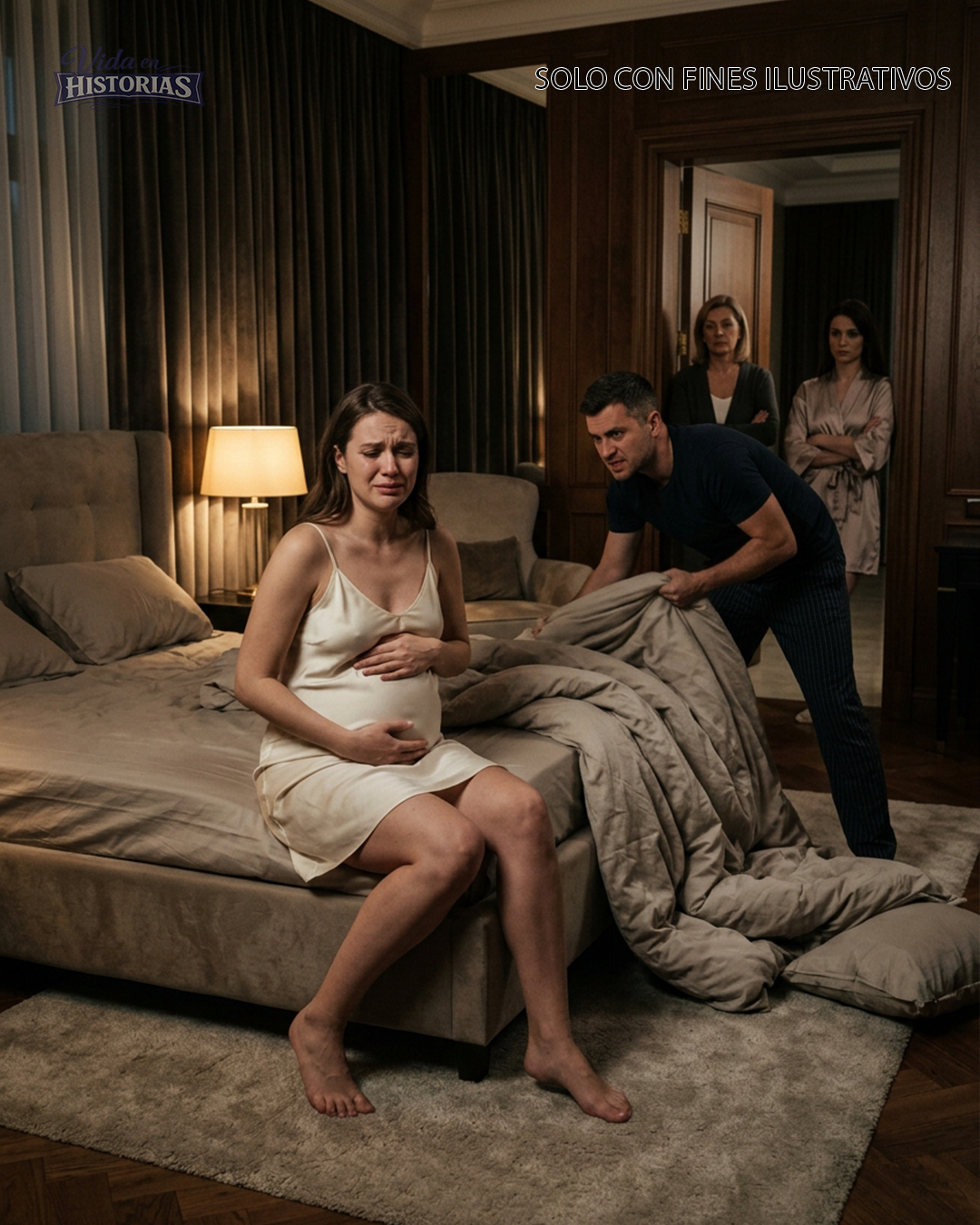
Ethan yanked the blanket off me.
—Get up. Your charade is over.
I didn’t scream.
I just pressed one hand against my six-month pregnant belly and the other on the medical bracelet I had hidden under the sheet.
The white bedroom door was still open. From the hallway, Vanessa, my sister-in-law, watched, a cup of coffee in her hand. She didn’t come in. She didn’t ask if I was in any pain. She just lowered her gaze to the bed with that elegant calm of someone who already knew too much… and still enjoyed watching everything fall apart.
Ethan lay beside the mattress, breathing heavily, the crumpled blanket clutched in his fist. The blurry photo Vanessa had sent him in the early hours of the morning still flickered on his phone: a man’s shadow emerging from the back garden gate.
“Who was it?” she asked, her voice so low it was more frightening than a scream. “Three days locked up, not letting me touch you, not looking me in the eyes… and now you want me to believe nothing happened?”
I tried to sit up, but pain shot across my face before I could hide it. My light nightgown was twisted, stuck to my skin with cold sweat. The room smelled of expensive perfume, clean sheets, and fear that had been bottled up for too long.
Downstairs, someone dropped a piece of cutlery in the kitchen.
The sound rose up the stairs as if the entire Bennett house was listening.
For two years, I had learned to keep quiet in that mansion. To smile when Eleanor, my mother-in-law, corrected my speech in front of her friends. To remain silent when Vanessa said, glass in hand, that “some women confuse marrying well with belonging.” To wait for Ethan to defend me.
He never did.
He was always late. Always busy. Always tired. Always convinced that money could buy peace, when in reality it had only bought silence.
And I, out of love or shame, remained in that silence for too long.
Now, pregnant, weak, and trembling inside a huge bedroom, I seemed smaller than ever. On the nightstand was my baby’s first ultrasound, tucked into a silver frame that Eleanor had called “too sentimental.” Next to it, almost hidden under an untouched glass of water, was the cream-colored envelope from a private clinic.
Ethan didn’t see it.
He only saw the photo.
The suspicion.
His pride was wounded.
“Vanessa was right,” he said.
Those three words hurt me more than the tug of the blanket.
Because he didn’t say “explain to me.” He didn’t say “are you okay?” He didn’t say “what did they do to you?”
She said her sister’s name as if she were the truth and I was an intruder in my own life.
I looked up. My eyes were dry, but not calm. I had no more tears left to convince a man who always needed his family’s permission to believe me.
Vanessa took a step towards the door.
“Ethan, maybe you should call the family lawyer,” she murmured, softly, perfectly. “Before this gets any more embarrassing.”
I let out a small, joyless laugh. Then I took a deep breath, because even breathing was difficult.
“Don’t call your lawyer,” I said. “Call the doctor your mother fired yesterday.”
Ethan blinked.
For the first time in three days, his anger subsided enough to let the doubt pass.
Then Eleanor appeared at the end of the hall.
Impeccable. Silk robe. Lips applied before seven in the morning. As if even a family tragedy required etiquette.
He didn’t look at me.
He looked at the envelope from the clinic on the small table.
And his hand, for just a second, trembled.
I noticed it.
Ethan too.
The entire house seemed to hold its breath.
Slowly, I reached for the cream-colored envelope. My fingers were trembling, but my voice came out firm.
—The man in the photo was not my lover, Ethan.
Vanessa placed the cup on a console table too carefully.
I pulled a folded sheet of paper from the envelope. It had dark stains in one corner and a doctor’s signature at the bottom. It wasn’t a love letter. It wasn’t proof of infidelity. It was something much worse for them: it was a test.
I looked at my husband, not with fear, but with a calmness he didn’t know I possessed.
—He was the only one who came to warn me about what your family did with my treatment.
Ethan looked down at the paper just as Eleanor said, too quickly:
—Don’t read that.
The phrase didn’t sound like an order.
It sounded like fear.
Ethan’s hand hung suspended mid-air. Outside, the sprinklers continued to swirl over the perfect lawn, tracing circles of water on grass that no one ever trod upon. Inside, the Bennett family had just lost something more important than their composure.
I had lost control of the scene.
“What does that mean?” Ethan asked, looking at his mother.
Eleanor raised her chin. I knew that gesture. I’d seen it at dinners, at charity events, in photographs where her surname was worth more than any truth. It was her way of making anyone feel small without lifting a finger.
“It means your wife is confused,” he said. “She’s pregnant, upset, and clearly being influenced by someone else.”
I watched as Ethan listened. Not as he looked at me, but as he waited for his mother to put the world back together for him. That had always been the cruelest part. Eleanor didn’t need to shout. She just needed to speak first.
“I’m not confused,” I replied.
My voice came out low, but the room received it fully.
Vanessa crossed her arms in the doorway.
—Charlotte, please. You’ve already made enough of a fuss over a photo.
“It wasn’t because of the photo,” I said. “It was because of the capsules.”
There, something changed.
Vanessa stopped smiling.
Ethan frowned.
—Which capsules?
I looked at the nightstand. Next to the untouched glass of water was the bottle of prenatal vitamins, with its gold label, sent by Eleanor two weeks ago. The lid was perfectly sealed. No one would have suspected a thing.
It looked expensive.
Harmless.
Like everything that hurt inside that house.
“The ones your mother insisted I take,” I said. “The ones that, according to her, were better than the ones prescribed by my doctor.”
Eleanor let out a dry laugh.
—Don’t be ridiculous. They were supplements.
“They weren’t mine,” I replied. “And they weren’t safe for me.”
Ethan looked at me as if he was finally hearing a word other than pride.
I handed him the sheet.
—Read it, Ethan. And this time, don’t look at your mother first.
It took Ethan a few seconds to pick up the paper.
Not because it was heavy.
Because for the first time in our marriage, someone was asking her to choose between her mother’s voice and a truth written in ink, with a signature and consequences.
Her fingers brushed against mine. They were cold.
The sheet passed from my hand to his with a minimal, almost fragile sound, but in that room it felt as if someone had closed a huge door behind us.
Eleanor took a step.
—Ethan.
She only said his name, but she said it as she had said everything for years: with the certainty of a mistress, not a mother. As if he were an extension of her surname, her table, her will.
Ethan didn’t look up.
He read the first line.
Then the second one.
I saw his jaw go weak.
The note said the capsules Eleanor had sent me didn’t match my prenatal prescription. It said they contained a compound that shouldn’t be given to a patient with my history of high blood pressure and pregnancy risk. It said my doctor, Dr. Marisol Hayes, had requested that the supplement be immediately withdrawn and the origin of the bottle investigated.
It also contained a sentence that Ethan read twice:
**“The patient reports that the supplement was delivered by a relative by marriage, without medical authorization.”**
The word “family” seemed to hang in the air among them all.
Vanessa lowered her eyes to the floor.
Eleanor smiled, but it was too small a smile for a woman who had always dominated entire rooms.
“That proves nothing,” he said. “Any doctor can exaggerate to protect themselves.”
“Did you fire her for exaggerating?” I asked.
My question didn’t come out forcefully. It came out wearily. And maybe that’s why it hurt more.
Ethan looked up.
—Did you fire Dr. Hayes?
Eleanor adjusted the collar of her robe, as if the silk needed more attention than the question.
—I spoke with the clinic. That woman didn’t understand the level of privacy our family requires.
“She wasn’t your doctor,” Ethan said.
Eleanor finally looked at him, and something very old crossed her face. It wasn’t guilt. It was offense.
—She was my grandson’s doctor.
I felt a twinge in my belly, small but distinct, as if my baby had also recognized that they were using him as an argument. I placed my hand on my abdomen and breathed slowly.
“No,” I said. “She was my doctor.”
The difference remained there, simple and enormous.
For the first time, Ethan did not answer for his mother.
The bedroom was filled with details that had once seemed decorative but now seemed like witnesses: the silver frame with the ultrasound, the untouched glass of water, the gold bottle, the blanket on the floor, the cup Vanessa had left on the console. Even the gold moldings on the door seemed too shiny for such a sordid scene.
Vanessa cleared her throat.
“Look, this is getting out of control. Charlotte has been emotionally unstable. We’ve all seen it.”
“Everyone?” I asked, looking at her.
She blinked.
—Don’t start.
“No,” I said. “You started it last night when you sent her that picture.”
Ethan turned to his sister.
—Why did you take that picture?
Vanessa raised an eyebrow, retrieving a piece of her mask.
—Because I saw a man leaving your wife’s house at two in the morning.
“From our house,” Ethan said.
Vanessa did not respond immediately.
That detail was small, but important. For two years, in that family, the mansion had never been ours. It belonged to the Bennetts. To Eleanor. To the history of the family name. I lived there like someone who had been lent a chair and had to be grateful for it every morning.
Ethan noticed it too late.
But he noticed.
“And how did you know I was going to leave through the garden gate?” I asked.
Vanessa gripped the cup with both hands.
—I didn’t know anything. I saw it.
—You can’t see that door from your room.
The silence shifted its location.
It didn’t fall. It moved.
It went from my bed to the hallway, from Vanessa to Eleanor, from Eleanor to Ethan. It was like watching a crack run across a mirror.
Ethan looked at the paper again.
—Charlotte, who was that man?
I closed my eyes for a second. Not out of fear. Out of tiredness.
—His name is Daniel Ortega. He worked as a records manager at the clinic. He came because he saw my name on a list of patients transferred without consent.
Eleanor let out a very short exhalation.
Vanessa, on the other hand, did something worse: she looked at her mother before she could stop herself.
Ethan saw it.
—What list?
I pointed to the cream-colored envelope.
—There are copies.
Ethan approached the nightstand. He didn’t touch the jar first. He picked up the envelope. He opened it with clumsy fingers, pulling out folded papers, receipts, a printout of an email, and a authorization form with the clinic’s letterhead.
There was my full name.
Charlotte Elena Bennett.
Below, a signature.
It wasn’t mine.
Ethan remained motionless.
-What is this?
“An authorization to change doctors,” I said. “To cancel my appointments with Dr. Hayes and move my file to a specialist recommended by your mother.”
He looked at the signature.
The skin around her eyes tightened.
—This is not your signature.
-No.
Eleanor walked towards us with a calmness that tried to be majestic but barely managed to be rigid.
—Your wife was refusing to cooperate with her own care. Someone had to do something.
“Did you forge his signature?” Ethan asked.
The word came out of her mouth like something that didn’t want to exist.
Eleanor did not deny it.
That was worse than any confession.
“I did what was necessary to protect this family,” he said.
I let out a breath that sounded a lot like a broken laugh.
—To this family? Or to your last name?
Eleanor looked at me for the first time since she came in. Not at my belly, not at the document, not at the medical bracelet. At me.
And in his eyes there was no regret.
There was irritation.
As if my body, my pregnancy, my pain, and my fear were a lack of education in front of their imaginary guests.
“You never understood what it means to be a Bennett,” she said.
—Yes, I understand—I replied. —It means remaining silent when you decide that the truth is inconvenient.
Ethan ran a hand over his face.
—Mom, what was in those capsules?
—Supplements.
—What was there?
Eleanor pursed her lips.
Vanessa spoke before her.
—It wasn’t anything dangerous. Just something to stabilize her.
My head turned towards Vanessa so slowly that she regretted it before she even finished breathing.
—How do you know that?
The cup trembled in her hand. A small circle of coffee fell onto the white console, a brown stain amidst so much perfection.
Eleanor closed her eyes for a moment.
Ethan didn’t take his eyes off his sister.
—Vanessa.
“I was just helping Mom,” she said, lowering her voice. “Charlotte was making a huge fuss about the vitamins, the doctor’s appointments, everything. Mom said that if she didn’t cooperate, the stress would harm the baby.”
“And that’s why they took away her doctor?” Ethan asked.
—Don’t say it like that.
—How do you want me to say it?
Vanessa opened her mouth, but couldn’t find an elegant way to put it.
That was the true power of truth: it didn’t need to shout. It just needed to take away their pretty words.
I took the bottle of prenatal vitamins from the small table and handed it to Ethan.
—Daniel told me to keep this unopened. Not to throw it away. That if something happened to me, this jar was the only physical evidence they couldn’t erase from the clinic.
Ethan held it as if he were holding something alive.
The gold label gleamed in the lamplight. “Bennett Wellness Foundation” was written in small letters at the bottom. Eleanor’s foundation. The same one that sponsored charity galas for vulnerable mothers. The same one that appeared in magazines with photos of smiling women next to baby baskets.
I had appeared in one of those photos once, with Eleanor’s hand on my shoulder.
I remembered the weight of that hand.
It wasn’t affection.
It was possession.
“Why didn’t you tell me?” Ethan asked.
The question struck me in a strange place. It wasn’t innocent, but it wasn’t cruel either. It was the question of a man who was realizing too late that his absence had also been a choice.
“I tried to tell you on Tuesday,” I replied. “You told me not to start another argument with your mother.”
He lowered his eyes.
—I sent you the partial results on Wednesday.
—I was in a meeting.
—You left me on read, Ethan.
Her face barely changed. As if she remembered the notification, the message, her finger swiping the screen without reading it.
“I called your office yesterday,” Vanessa answered.
Ethan turned to Vanessa.
She didn’t hold his gaze.
“You said I was hysterical,” I continued. “And you told security that if Daniel came back, they shouldn’t let him in.”
Ethan breathed through his nose. Once. Deeply. Contentedly.
—Did you speak with my office?
Vanessa tried to regain her reasonable tone.
“Someone had to filter out the nonsense. You were working on an important negotiation.”
Ethan laughed, but it wasn’t a laugh of joy. It was a dry, unfamiliar sound, the kind that comes out when trust is shattered from within and you haven’t yet learned to fall.
—My pregnant wife was calling me about a medical emergency.
“Your wife was receiving men through the back door,” Vanessa blurted out.
The blow was low.
And he was desperate.
Eleanor looked at her with a silent warning, but it was too late.
Ethan picked up his cell phone.
—This photo.
Vanessa swallowed.
-Yeah.
—Did you take it?
-Of course.
—Then you have the original.
Vanessa blinked.
-That?
—Send it to me. Now.
The color drained from her face almost imperceptibly, but it was enough for me. For years, Vanessa had been one of those women who could cry without mussing her hair, lie without hesitation, and hurt without leaving a trace. But when Ethan asked her for the original, her mouth went dry.
—I don’t understand why.
—Send it to me.
—Ethan, you’re letting her manipulate you.
—Vanessa.
I had never heard him say her name like that.
She slowly and deliberately pulled out her phone. Her nude-colored nails touched the screen. A second later, Ethan’s phone vibrated.
He opened the image.
He said nothing.
He simply enlarged the photo with two fingers.
The man’s shadow was there, emerging from the back door. But behind it, barely visible in the glass door, was a reflection.
Vanessa.
I wasn’t in the hallway.
It wasn’t happening by chance.
She was hiding by the rose bushes, phone held up, waiting for the exact moment.
Ethan looked up.
—You were watching him.
Vanessa clenched her jaw.
—Mom asked me to check the garden entrance.
Eleanor closed her eyes.
Another crack.
Deeper.
Ethan turned to his mother.
-Because?
Eleanor no longer tried to smile.
—Because a fired employee was hanging around my son’s house. Do you think that’s nothing?
“He wasn’t hanging around,” I said. “He came to give me copies before they deleted his access.”
“Ah,” Eleanor said, with a venomous calm. “So you do admit that you received stolen documents.”
I didn’t respond immediately.
Because there she was. The woman who turned every wound into an administrative offense, every abuse into a matter of reputation, every fear into an opportunity to prove that the victim had not followed the correct protocol.
I snuggled against the pillow. The movement hurt, but I didn’t let it show more than necessary.
—I admit that a man with more conscience than your family warned me that my medical record was being manipulated.
Eleanor took another step closer.
—Be very careful what you say.
“No,” said a voice from the hallway. “You’re the one who needs to be careful, Mrs. Bennett.”
We all turned around.
Daniel Ortega was standing next to the stairs.
He didn’t walk in like a hero. He didn’t look powerful. His hair was disheveled, he wore a gray jacket that was too light for the morning, and a black folder was clutched to his chest. He looked like a man who hadn’t slept, but who had nonetheless decided to stop hiding.
Behind him was Nora, the housekeeper, with her hands folded over her apron.
Nora had worked for the Bennetts for eighteen years. She had seen parties, funerals, broken engagements, deals made in hushed tones, and tears wiped away before visitors arrived. She never offered her opinion. She never interfered.
But that morning he didn’t lower his gaze.
Eleanor turned to ice.
—Who let this man in?
Nora answered before Daniel.
-I.
The word was small.
The consequence, no.
Eleanor turned slowly towards her.
-Sorry?
Nora held his gaze just long enough.
—I let him in through the kitchen. Like you guys come into this house when nobody wants to see you.
Vanessa made a muffled sound.
Ethan looked at Nora as if he had just discovered that walls also had memories.
Daniel picked up the folder.
“Mr. Bennett, I didn’t come here to cause a scene. I came because Dr. Hayes asked me not to leave Mrs. Charlotte alone.”
“The doctor is fired,” Eleanor said.
“The doctor resigned before you could register the dismissal,” Daniel replied. “And she filed a report with the medical board.”
Eleanor lost color, but only a little. Her years of practice wouldn’t allow her to do any more.
—That’s absurd.
Daniel opened the folder.
—It also documented the call in which you demanded that Mrs. Charlotte’s file be transferred without her consent.
Ethan remained still.
—Is there a recording?
Daniel looked at Eleanor.
—There are three.
Vanessa whispered something I couldn’t quite make out. Maybe a curse. Maybe a prayer.
Eleanor took a step towards Daniel.
—You are violating confidentiality agreements.
Daniel did not back down.
—No. I am reporting tampering with the medical record of a pregnant patient.
The word “pregnant” resonated differently when it was uttered by an outsider. It was no longer the sentimental detail Eleanor used in public. It was no longer “my grandchild” or “the continuation of the family.” It was a medical condition. A risk. A responsibility.
Ethan sat on the edge of the bed.
Not next to me.
I didn’t deserve that place yet.
But she sat down as if her legs could no longer support her after all she had just understood.
“Play the call,” he said.
Eleanor reacted instantly.
—Ethan, I will not allow this employee to put on a show in my house.
“My house,” he said.
Two words.
Not shouted.
Not heroic.
Late, yes.
But for the first time, they were theirs.
Eleanor looked at him as if he had hit her.
Daniel took out his phone. He searched for a file. The sound of his fingers on the screen was too loud.
Then, Eleanor’s voice filled the room.
Clara.
Polished.
Unmistakable.
“Dr. Hayes is too sentimental about Charlotte. I need someone who understands that this family can’t afford a troubled pregnancy or a hysterical daughter-in-law making accusations.”
The recording continued.
Another voice, that of the clinic administrator, said something about signed consent.
Eleanor replied:
—You’ll have the authorization. I’ll take care of it.
Ethan closed his eyes.
I looked at the ultrasound in the silver frame. The small white speck inside the black. My son. My baby. The only person in that house who hadn’t yet asked me to be quiet.
Daniel stopped the audio.
Nobody spoke.
Nora lowered her gaze, but not out of shame. Out of suppressed rage.
Vanessa held onto the door frame.
Eleanor was the first to move. Not toward me. Not toward Ethan. Toward Daniel’s phone.
—Give me that.
Daniel put his cell phone in his pocket.
-No.
—You don’t know who you’re dealing with.
“Yes, I know,” he said. “That’s why I made copies.”
Eleanor’s face changed.
And there, in the middle of that immaculate bedroom, I understood something: Eleanor wasn’t afraid of having caused harm. She was afraid of not being able to control how many people could prove it.
Ethan opened his eyes.
—Who else has copies?
Daniel looked at me.
Eleanor too.
Vanessa too.
They all did it.
For the first time, he was not the center of the trial.
It was the center of information.
I reached under the pillow and pulled out my cell phone.
Ethan recognized the blue phone case. He’d bought it for me after Vanessa made fun of my old phone at dinner. At the time, I thought it was a kind gesture. Over the years, I realized that Ethan knew how to buy small solutions to avoid big decisions.
I unlocked the screen.
—Yesterday, when Vanessa didn’t put my call through, I called someone else.
“To whom?” Ethan asked.
I started a conversation.
It wasn’t with Daniel.
It wasn’t with Dr. Hayes.
It was with the lawyer Eleanor had recommended for our prenuptial agreement two years earlier, convinced that I wouldn’t understand the fine print.
Miriam Solano, Esq.
The same woman who, after reviewing the contract, had looked at me with a seriousness I never forgot and had said in a low voice: “Keep copies of everything you sign. And of everything they ask you not to sign.”
—To my lawyer—I said.
Eleanor let out a short laugh.
—You don’t have a lawyer.
-Yes I have.
Ethan’s cell phone vibrated at that moment.
Then Vanessa’s.
Then, from downstairs, we heard several tones at the same time: messages coming into the phones of the staff, security, perhaps of the guests who would arrive that morning for the foundation’s breakfast.
Vanessa looked at her screen and put a hand to her mouth.
Eleanor didn’t move.
Ethan opened the message.
Ms. Solano had sent a formal notification to Bennett Holdings’ main email address, the foundation’s board of directors, and the private clinic. The subject line read:
**“Urgent preservation of medical evidence and internal communications related to Charlotte Bennett.”**
Ethan read a line.
Then another one.
Her face changed again, but this time it wasn’t just horror. It was understanding.
—You included the board.
“I didn’t want to do it,” I said.
My voice cracked for the first time. Not much. Barely.
—I wanted my husband to believe me before I had to become a file.
Ethan looked up at me.
That’s when I saw the blow. Not the blow of the accusation. The blow of shame.
The real shame.
The kind of courage that doesn’t come from wanting to look bad in front of others, but from remembering exactly when you could have protected someone and chose to stay busy.
—Charlotte…
—No —I said.
And he fell silent.
Not because I was yelling.
Because I was no longer asking for permission to speak.
Daniel closed the folder.
—Dr. Hayes is waiting at the clinic. She wants to examine you today. She doesn’t recommend that Mrs. Charlotte remain here if the environment continues to be hostile.
Eleanor regained some of her venom.
—How convenient. Now everyone makes decisions for my house.
Nora stepped forward.
—Madam, with all due respect, this house has already decided for you too many times.
Eleanor looked at her as if a lamp had just spoken.
—Pick up your things.
Nora nodded.
-I already did.
That was the second time the room changed.
The first was when Ethan read the report.
The second was when a woman who had served silently for eighteen years made it clear that she no longer intended to serve the lie.
Vanessa looked down the hallway.
—This is ridiculous. Mom, say something to him.
But Eleanor didn’t answer. She was looking at her own phone.
The screen illuminated her face from below, highlighting every line that makeup couldn’t erase.
Emails had started coming in.
First of the clinic.
After the foundation meeting.
After a lawyer from Bennett Holdings.
The truth was not yet public, but it was no longer private.
And for Eleanor, that was almost worse.
“Ethan,” she said, in a lower voice, “we need to talk alone.”
He looked at the bottle of vitamins in his hand.
-No.
—I am your mother.
—Charlotte is my wife.
The phrase came too late.
So late that it didn’t bring me any relief.
It only gave me a pure sadness.
Because sometimes a person says the right thing after a part of you has already stopped needing it.
Ethan approached the bed. He crouched down, as if he wanted to be at my level, but he didn’t touch my hand.
He finally learned not to take a place that had not been given to him.
“I’m going to take you to the clinic,” he said.
I looked at him.
—Daniel is going to take me.
Her face closed slightly, not from anger, but from pain.
—Charlotte, please.
—I can’t get in a car with you right now, Ethan.
Eleanor took advantage of that crack.
—See? He’s punishing you. This is emotional manipulation.
I turned towards her.
—No. This is a consequence.
The word remained between us like a key turning.
Eleanor didn’t know what to do with it.
With Nora’s help, I put on a robe. Every movement reminded me that my body had been sending signals for three days that no one in that house wanted to listen to. Ethan stayed nearby, useless and attentive, as if he had just arrived at the scene of a house fire that he himself had helped to seal off from the outside.
Daniel waited in the hallway.
Vanessa moved aside as I walked by, but not far enough. Her shoulder almost touched mine.
“This isn’t going to end the way you think,” he murmured.
I stopped.
I looked at her straight on.
—No, Vanessa. It’s going to end in a way you never imagined.
I didn’t raise my voice.
I didn’t need it.
Downstairs, the Bennett mansion was awake. The staff moved with the stiffness of those who know too much but don’t know where to look. In the kitchen, a tray of croissants remained untouched. On the dining room table were white flowers for Eleanor’s charity breakfast: a small, exclusive, “intimate” event, according to the invitation. Influential women. Donors. Two society columnists. A photographer.
The foundation was going to present a campaign on “protected motherhood” that morning.
The irony was so cruel it almost seemed like it was written by Eleanor.
When we arrived at the lobby, the main door opened and Ms. Miriam Solano entered.
He was wearing a gray suit, his hair was pulled back, and he was carrying a leather briefcase. He didn’t look at Eleanor first. He looked at me.
—Charlotte —he said—, the car is outside.
Eleanor came down the stairs behind us, faster than her dignity would allow.
—You cannot enter my house without authorization.
Miriam took a document out of her folder.
—The authorization was signed by his son when he hired me as an external consultant for Bennett family agreement matters two years ago. It is still valid.
Ethan opened his mouth.
-I?
Miriam looked at him.
—Yes, Mr. Bennett. You didn’t read that contract either.
It was a simple sentence.
But it hit him in the exact spot.
Vanessa let out an annoyed sigh, as if all that truth was ruining her schedule.
Miriam approached me.
—Can he walk?
-Yeah.
—Then we’re leaving.
Ethan took a step.
—I’m coming with you.
Miriam looked at me. Not at him.
—Charlotte decides.
That was perhaps the first truly confident sentence anyone said that morning.
Charlotte decides.
No, Eleanor.
No, Ethan.
Not the family.
Not the last name.
I.
I looked at Ethan. His eyes were red, but he wasn’t crying. Ethan Bennett had learned all too well that the men in his family didn’t break down in public. They only broke things in private and expected someone else to clean up.
“You can go in another car,” I said. “But not with me.”
He accepted with a minimal nod.
Eleanor grabbed the stair railing.
—If you leave this house like this, Charlotte, don’t come back expecting me to clean up the mess.
I looked at the white flowers in the dining room. The silver frame of my ultrasound was still up there, but for the first time I didn’t feel like I was leaving something of mine in that mansion.
“You don’t fix disasters, Eleanor,” I said. “You perfume them.”
Nora lowered her gaze to hide a sad smile.
I left.
The morning air hit my face, carrying the scent of wet grass and distant gasoline. The sprinklers kept turning, obedient, as if the garden didn’t know that inside the house, an era had ended.
The private clinic was twenty minutes away, but the drive felt longer. Daniel drove in silence. Miriam was in the front, making short, precise calls, without making a scene. I was in the back with one hand on my stomach and the other holding my cell phone.
Ethan followed us in another car.
I saw its headlights in the side mirror.
It didn’t give me peace.
But not afraid either.
At the clinic, Dr. Hayes was waiting for us at a side entrance. She looked tired, her hair was haphazardly pulled back, and she had a folder pressed against her chest. When she saw me, her professional expression barely wavered.
—Charlotte.
That one word made me want to cry.
Not because it was sweet.
Because she sounded human.
They checked me immediately. Monitors. Blood pressure. Blood. Ultrasound. Clear questions, careful hands, medical silence, not family silence. Ethan waited outside until I authorized him to enter.
When he did, he stayed by the door.
Dr. Hayes did not offer him a polite smile.
—Mr. Bennett, your wife showed signs of an adverse reaction and severe stress. The baby is stable for now, but this was no small scare.
Ethan placed a hand on the wall.
—Could anything worse have happened to him?
The doctor did not embellish her answer.
-Yeah.
That word did more than any explanation.
Ethan stared at the ultrasound screen. Our baby was barely moving, a small shadow in black and white, oblivious to surnames, foundations, contracts, and fake photos.
Ethan covered his mouth with his hand.
I didn’t console him.
Not out of cruelty.
Because she no longer wanted to educate a man about the pain he had allowed.
Miriam came in half an hour later with news.
The foundation’s board called for an extraordinary review. The clinic suspended Eleanor and Vanessa’s administrative access. Dr. Hayes filed the formal report.
“And Daniel?” I asked.
—Protected as a whistleblower.
I breathed for the first time in hours without feeling like I was asking for permission.
Ethan raised his head.
—What’s going to happen to my mother?
Miriam closed the folder.
—It depends on how much she has done and how many people are willing to lie for her.
Ethan did not respond.
Because we both knew the answer before.
All.
The answer now was no longer so clear.
At midday, Eleanor’s charity breakfast turned into something no one had planned. The guests arrived in light dresses, carrying expensive handbags and sporting camera-ready smiles. They found the mansion open, but with no hostess in sight. They found Vanessa descending the stairs, her makeup flawless and her hands trembling. They found Nora absent. They found rumors filling every corner where music had once reigned.
The first journalist received a copy of the foundation’s temporary suspension by mail.
The second woman received an anonymous message with an audio recording of Eleanor saying, “We can’t afford a hysterical daughter-in-law.”
I didn’t send that audio.
Miriam neither.
It was Nora.
He then told me about it with a calmness that still moves me.
“Eighteen years of serving coffee teaches you when a cup is about to break,” he told me.
The article appeared that same afternoon on a society website, not as a full exposé, but as an uncomfortable question:
**“Why is the president of a maternity foundation under investigation for interfering with her pregnant daughter-in-law’s medical treatment?”**
The word “daughter-in-law” did what I had never been able to do in that family: it made me someone the public could look up to.
Eleanor tried to control history.
First he said it was a family misunderstanding.
Then I was emotionally vulnerable.
After having been the victim of disloyal employees.
But the emails got out.
Then the calls.
Then, the registration of the forged signature.
And finally, the bottle.
It wasn’t an explosion. It was a slow, elegant, and horrible fall. Like watching an expensive curtain being pulled down from the ceiling, stitch by stitch, until it leaves a bare, damp wall.
Ethan came to see me at the hospital that night.
He was wearing the same dark shirt as in the morning, wrinkled, lacking the authority with which he had entered our bedroom. He stood in the doorway until I told him he could come in.
“My mother is with lawyers,” he said.
-I guess so.
—Vanessa says she didn’t know everything.
—Vanessa always knows enough not to feel guilty.
He lowered his gaze.
—You were right.
I didn’t answer.
There are phrases you wait so long for that when they finally arrive, they’re no longer useful for healing. They only serve to confirm the size of the wound.
Ethan sat down in the chair next to the bed.
—I found your messages. All of them. The audios. The calls. The photo of your results. The message where you asked me not to let my mother into your offices.
He looked at me.
—I ignored them.
I watched the monitor. The baby’s line kept moving with a small, stubborn regularity.
-Yeah.
Ethan clasped his hands.
—I don’t know how to apologize to you.
—Start by not asking me to help you feel better.
The phrase hurt him. I saw it. But he didn’t defend himself.
That was new.
“I’m going to testify about what I saw,” he said. “About the signature. About the capsules. About Vanessa.”
“Do it for your son,” I replied. “Not for me.”
Ethan closed his eyes.
—Have you already lost me?
The question filled the hospital room with something heavier than guilt.
I looked at the man I had loved. The man who brought me flowers when my father died. The man who promised me a safe house and then left me alone inside his mother’s house. The man who could learn, perhaps. But also the man who had needed documents, recordings, and witnesses to believe what my face had been telling him for months.
“I don’t know,” I said.
It was the kindest truth I could offer.
During the following weeks, the Bennett name stopped opening doors as easily. The foundation suspended operations. The clinic turned over documents. The medical board opened an investigation. Daniel obtained legal protection. Nora found work in the home of one of the few donors who, upon learning everything, withdrew her support for Eleanor and sent me a three-line note: “No one deserves to be used as a symbol while they are being hurt. I stand with her.”
Vanessa disappeared from social media for ten days.
When she returned, she posted an old photo with Ethan and wrote: “Family always overcomes lies.”
Ethan asked her to delete it.
She didn’t do it.
Then he posted something for the first time in years.
Not a long explanation.
Not a perfect defense.
Just one sentence:
“My wife told the truth. I should have believed her sooner.”
That publication did more damage to the Bennett family than any article. Because it didn’t come from me. It came from the son Eleanor had raised to protect the family name rather than her conscience.
Eleanor called me once.
I didn’t answer.
He sent me a message:
“When you become a mother, you will understand that sometimes you do difficult things for the good of the family.”
I read it twice.
Then I forwarded it to Miriam.
I didn’t answer.
The day I left the hospital, I didn’t go back to the mansion. I went to a small apartment that Miriam got me temporarily, with large windows and walls without gilded moldings. The first night I slept with the ultrasound on the nightstand and the bottle of vitamins kept in an evidence bag.
It wasn’t a perfect house.
But nobody entered without knocking.
Ethan would visit me some days. He brought food, documents, and clothes that Nora had recovered from the mansion. He never came inside until I invited him. He never touched my belly without asking. He never mentioned his mother to defend her.
Sometimes we talked.
Sometimes she would just sit in the living room while I folded baby clothes.
One afternoon, he brought in the silver ultrasound frame. He carefully placed it on the table.
—I found it on your nightstand— she said. —I didn’t want it to stay there.
I looked at the frame. I remembered Eleanor saying it was too sentimental.
I took the ultrasound scan, removed it from the silver frame, and put it in a simple wooden one that I had bought at a small shop near the hospital.
Ethan understood without me having to explain.
“Are you going to ask for a divorce?” he asked.
There was no anger in his voice.
Just fear.
“I’m going to ask for time,” I said. “And space. And legal protection.”
He nodded.
—I’m going to give it to you.
—It’s not a gift, Ethan.
He swallowed.
-I know.
The trial against Eleanor was neither swift nor cinematic. There were no sirens wailing outside the mansion, no handcuffs flashing under cameras. There were things more real and more difficult for someone like her: canceled meetings, unanswered calls, lawyers who no longer smiled as much, friends who said “how awful” as they took a step back, donors demanding audits, journalists requesting comments.
Eleanor’s reputation didn’t suddenly break.
It became awkward.
And for a woman who had made a living by making others feel out of place, that was a quiet justice.
Vanessa tried to blame her for everything.
Eleanor tried to blame Vanessa.
The clinic tried to blame it on an administrative error.
Daniel handed over another copy.
Nora gave testimony.
Dr. Hayes stated.
And I, eight months pregnant, sat across from a long table of lawyers and said the bare minimum. I didn’t cry. I didn’t embellish. I didn’t shout.
I only told the truth.
That he had asked for help.
They didn’t listen to me.
That my treatment was changed without my consent.
That my signature was forged.
My husband believed a photo before I had symptoms.
When I finished, Eleanor wasn’t looking at me. She was staring at her perfectly manicured hands, as if she couldn’t understand how such delicate hands could get stained without touching blood.
As I left, Ethan caught up with me in the hallway.
—Charlotte.
I stopped.
He looked towards the room where Eleanor was still surrounded by lawyers.
—I’m not going back to that house.
I didn’t reply right away.
—You’ll have to stand by that when she calls you an ungrateful son again.
-I know.
—And when Vanessa tells you that you are destroying the family.
-I know.
—And when you miss the comfortable version of yourself.
Ethan looked down.
—I know that too.
For the first time, I believed him a little.
My son was born three weeks later, on a rainy morning. There were no golden lamps or white flowers or foundation cameras. Just a hospital room, Dr. Hayes, a soft-spoken nurse, and Ethan waiting until I told him he could hold my hand.
When I heard the first cry, something inside me opened without breaking.
They placed it on my chest, warm, small, bursting with life.
Ethan cried silently.
Me too.
Not because of what we had lost.
So he had just survived without knowing it.
I named him Mateo.
Not Bennett first.
Mateo Elena Carter-Bennett, with my maiden name before his father’s.
Ethan did not argue.
He signed.
Two days later, a flower arrangement arrived at the hospital. White. Very expensive. Unscented, because Eleanor knew how to feign consideration even on the verge of social exile.
The card read:
“For my grandson. I hope to meet him when Charlotte is ready to let go of resentment.”
The nurse handed it to me cautiously.
Ethan was in the room.
He read the card.
For a moment I saw the man from before trying to wake up: the son trained to soften, justify, call the wound “complicated” and control “family”.
Then he took the card and tore it in two.
Not with anger.
With determination.
“You won’t meet him until you want to,” he said. “And if you never want to, I’ll respect that too.”
I looked at him with Mateo asleep in my arms.
—Don’t do it so I’ll come back to you.
-No.
—Do it because he doesn’t deserve to learn that loving someone means allowing them everything.
Ethan looked at our son.
—I’m learning it late.
—Yes —I said.
He accepted the word as truth should be accepted: without asking for it to be softened.
Months later, Eleanor publicly resigned from the foundation “for health and family privacy reasons.” No one quite believed that statement. In the photos of her departure, she wore the same impeccable suit as always, but her smile was no longer captivating. It seemed forced.
Vanessa temporarily moved to Europe, according to her social media. Nora said that meant no one important was inviting her to breakfast anymore.
Daniel went back to work at another clinic.
Dr. Hayes became my trusted doctor, but also something rarer: a witness that a woman can recover her voice without having to turn it into a scream.
Ethan and I remained separated for a year.
It wasn’t a punishment.
It was reconstruction.
He went to therapy. So did I. He testified against his mother. I learned to sleep without expecting footsteps in the hallway. He sold his share of the mansion. I bought an apartment with a balcony, plants, and a lock that only my key opened.
Sometimes, when Mateo was asleep, I would look at the medical bracelet I kept in a box along with the first ultrasound. Not as a scary reminder, but as proof of something I never wanted to forget:
My body spoke to me.
My intuition spoke to me.
The truth spoke to me.
And when no one wanted to listen, I kept gathering evidence until the lie had nowhere to hide.
One Sunday, almost a year later, Ethan arrived for Mateo with a diaper bag and a blue shirt I hadn’t seen him wear before. He looked less like Bennett. More human.
“My mother asked to see me,” he said.
I continued arranging Mateo’s small shoes.
—Are you going?
-Yeah.
I stayed still.
He added:
—To tell him no.
I looked up.
—You could tell him on the phone.
—I could. But I want to do it looking her in the eyes. Without asking you to come. Without using you as a shield. Without bringing Mateo as a prize.
Something in my chest loosened, just barely.
It wasn’t complete forgiveness.
It was an unlocked door.
That afternoon, while Mateo slept in his stroller, Ethan handed me an envelope.
It wasn’t cream.
It was white, simple, without any elegant touch.
“These are the house deeds,” she said. “The sale went through. I put my share into a trust for Mateo and for his medical or educational expenses. You manage everything until he’s older.”
I looked at him.
—You didn’t have to do that.
—Yes, I did.
—That doesn’t buy anything between us.
-I know.
And I knew it.
That’s why I accepted.
Sometimes justice doesn’t arrive as one imagines. It doesn’t come with a grand revenge, nor with the villain on her knees, nor with everyone begging for forgiveness in the same room.
Sometimes it arrives like a new lock.
Like a chosen surname.
Like a man learning not to interrupt.
Like a powerful mother-in-law discovering that there are silences that cannot be bought.
Like a mother holding her child in a small house, looking out the window without fear of someone opening the door without permission.
The last time I saw Eleanor was at a civil hearing. She was wearing pearls, light-colored gloves, and had a perfectly composed face. As she passed by me, she stopped.
“You took my son’s family away,” he said.
Mateo was asleep in my arms.
Ethan, standing beside me, did not speak for me.
But he didn’t step aside either.
I looked at Eleanor calmly.
—No, Eleanor. You confused family with obedience.
Her lips barely trembled.
That was the end of his downfall.
No shouting.
No tears.
Just a woman who finally heard a phrase she couldn’t correct.
I left the building with Mateo pressed against my chest and Ethan walking a few steps behind, not trying to direct my path. Outside, the sun was shining. An ordinary midday sun, nothing dramatic. The city kept moving as if nothing had happened, as if for the world a story that had taken me years to breathe hadn’t just ended.
At home, I put Mateo in his crib.
Then I opened the box where I kept the medical bracelet, the ultrasound, and a copy of the report that Eleanor had tried to hide. I wasn’t keeping those things to dwell on the past.
I was saving them for the day my son would ask why his mother had learned to say no so calmly.
I closed the box.
I turned off the light.
And for the first time in a long time, the silence of the house didn’t seem dangerous to me.
It seemed like mine.
