Physical Address
304 North Cardinal St.
Dorchester Center, MA 02124
Physical Address
304 North Cardinal St.
Dorchester Center, MA 02124

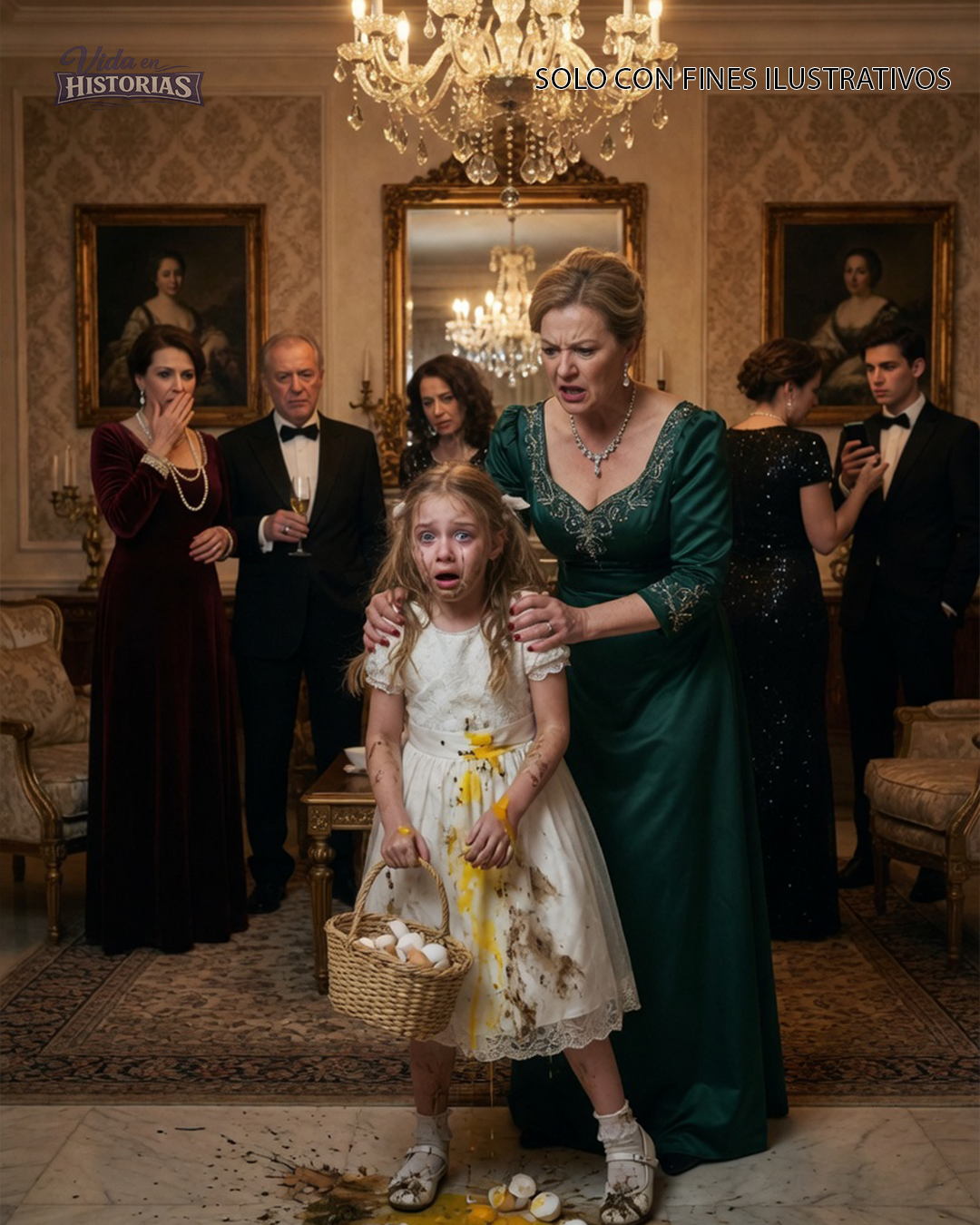
The front door had just opened.
I was still on the marble floor.
Egg yolk was sliding past my muddy boot, and my basket had rolled all the way under the piano.
My stepmom turned around with that fake society smile on her face.
It vanished the second she saw my father standing there.
I was eight years old, small for my age, with dirt on my knees and straw on my sweater.
She was polished, expensive, and always smelled like perfume and power.
And there I was in the middle of her perfect living room, exactly the kind of child she thought made her look cheap.
“Victor,” she said too quickly, pressing a hand to her chest. “Thank God you’re home. Your daughter ran in here like a wild animal and—”
“No,” my father said.
Just one word.
Cold.
Sharp.
The whole room went silent.
He looked at the broken eggs.
Then at my scraped elbow.
Then at the red marks on my arm where she had grabbed me.
Then he looked at me.
“Daisy,” he said, softer now. “Did she push you?”
I nodded.
I didn’t cry.
That part seemed to bother her more than tears would have.
My stepmom laughed nervously and looked around at the guests like she could still control the story.
“Victor, please. She is being dramatic. I was trying to protect the house. Look at those boots. Look at this floor. We have people here.”
People.
That was always her favorite word when she wanted to sound important.
Important people.
The kind she thought could make her untouchable.
But she forgot something my grandfather had taught me on the farm:
The people who brag the loudest about status are usually the ones most afraid of losing it.
My father walked farther into the room.
No one spoke.
One of the women near the staircase slowly lowered her glass.
A man by the fireplace stepped back like he didn’t want to be standing too close to the blast zone.
“Tell me,” my father said, “why my daughter was on the floor.”
“She embarrassed me,” my stepmom snapped before she could stop herself.
The second the words came out, she knew she had made a mistake.
My father’s expression changed.
Not louder.
Worse.
Calmer.
“She embarrassed you?” he repeated.
“She came in here covered in mud,” my stepmom said, trying to recover. “In front of guests. In front of investors. I have worked too hard to build a certain image, Victor. If I’m going to be your wife, I will not have this household looking like a farm.”
My father stared at her for a long moment.
Then he said, “That farm paid for this house.”
A few people inhaled at once.
She blinked.
She actually looked confused.
That was when I understood something even at eight years old:
She had wanted our wealth.
But she had never bothered to learn where it came from.
My grandfather had started with forty acres, two hands, and a rusted tractor.
My father turned it into one of the largest private agricultural operations in the county.
Cattle.
Organic produce.
Land leases.
Equine breeding.
The stables she showed off to guests like decoration?
They were part of a working business.
The eggs on the floor?
From hens my grandfather still insisted we raise properly because, in his words, “Money should never make us useless.”
My muddy boots weren’t a shameful thing.
They were proof that I belonged to the family she was trying to wear like jewelry.
My stepmom straightened her shoulders.
She still thought charm could save her.
“Victor,” she said, softer now, “you know how much pressure I’ve been under. I’m trying to help you move into a more refined circle. I only reacted because she challenged me in front of everyone.”
“I heard what she said,” came another voice.
Everybody turned.
It was Mrs. Lambert from down the street.
She was one of those women who missed nothing.
She lifted her phone slightly.
“And I recorded most of it.”
The room shifted.
You could feel it.
My stepmom’s confidence cracked right down the middle.
“Delete that,” she said at once.
Mrs. Lambert gave her a look that could freeze fire.
“No.”
My father held out his hand.
Mrs. Lambert walked over and gave him the phone.
He watched the video right there in front of everyone.
He watched her sneer at me.
He watched her point at my boots.
He watched her grab my arm.
He watched her shove me.
He watched the eggs explode across the marble while half the room stood there pretending not to see.
When the video ended, he handed the phone back.
Then he turned to the guests.
“I apologize,” he said. “Not for my daughter. For allowing someone into this house who thinks dignity can be measured by shoes.”
Nobody defended her.
Not one person.
That was the first real crack in her fantasy.
The second came two minutes later.
My father asked our house manager to bring the folder from his study.
A thick cream-colored folder.
I had seen it before.
It held documents.
Adult papers.
The kind that made people sit down very quickly.
My stepmom’s voice sharpened. “What is this supposed to be?”
My father opened the folder on the console table beneath the big mirror in the foyer so everyone could see.
“Since you care so much about appearances,” he said, “let’s discuss facts.”
He pulled out page after page.
House deed.
Trust documents.
Prenuptial agreement.
Property schedule.
Business ownership chart.
I didn’t understand every word back then, but I remember the look on her face.
Because for the first time, she wasn’t acting rich.
She was scared.
She had been telling people this house would soon be hers.
That the marriage would make her a partner in everything.
That she was “rebranding” the family.
But she had made one fatal mistake.
She never read what she signed.
My father looked directly at her.
“You own nothing here.”
The room went still again.
“This home,” he continued, “is held in a family trust. The agricultural businesses are in a protected structure. The land will pass to my daughter. You were never added to title, never added to the company, and under the prenup, any abuse toward my child triggers immediate removal from residence and revokes every negotiated settlement clause.”
Her face lost all color.
“What?” she whispered.
My father slid the signed page forward.
Her signature was at the bottom.
Clear as daylight.
“You insisted your attorney was too busy,” he said. “So mine explained it twice. There is even a video acknowledgment.”
She shook her head like the paper might change if she stared at it hard enough.
“No. No, that’s not—”
“It is,” said another voice from the doorway.
Our attorney had arrived.
My father must have called him from the car the moment he saw the security alert.
That was the part nobody but Dad knew until later.
Because yes, there was a security alert.
The living room camera had flagged sudden aggressive motion.
The house system sent a clip to my father’s phone while he was on his way back from the airport.
That was why he walked in already furious.
Not suspicious.
Not confused.
Furious.
My stepmom looked like she might faint.
“You had cameras on me?”
My father answered without blinking.
“I had cameras protecting my daughter.”
That line traveled through the room like a live wire.
I still remember it.
Because in that moment, every person there had to choose what kind of adult they were.
The ones who cared only about status looked away.
The decent ones looked ashamed they hadn’t stepped in sooner.
My stepmom tried one last move.
Tears.
A shaky voice.
“I was trying to teach her how to behave,” she said. “She’s spoiled. She disrespects me. She tracks dirt everywhere. She acts like this place is a barn.”
I stood up then.
My knees were shaking, but I stood.
And I said the thing she hated most.
“It is a farm house,” I said. “You just put expensive curtains in it.”
A few people made sounds they tried very hard to hide.
My father almost smiled.
Almost.
My stepmom pointed at me. “See? See how she talks to me?”
But now she sounded desperate, not superior.
Now everyone could hear the truth under her voice.
She wasn’t offended by my boots.
She was offended by what they represented.
Work.
Roots.
Family before status.
Everything she had tried to erase.
My father turned to the house manager.
“Call security,” he said. “Mrs. Harlow is no longer welcome in this home.”
That was when she truly unraveled.
She shouted.
She begged.
She threatened lawsuits.
She claimed she had sacrificed everything.
She said people would talk.
My father nodded once.
“Yes,” he said. “They will.”
And they did.
By morning, the story had spread through every social circle she had worked so hard to climb.
Not because my father gossiped.
Because rich people forgive many things.
Cruelty to a child in public is not one of them.
The charity board she had been trying to join quietly withdrew her invitation.
The boutique brand that wanted her for a “family values” campaign stopped returning calls.
The country club wives she had chased for months suddenly had other lunch plans.
She wasn’t ruined by revenge.
She was ruined by evidence.
By her own behavior.
By a room full of witnesses.
By the one thing entitled people never think will matter:
the truth.
That night, after she was escorted out, the house felt strange.
Too quiet.
Too big.
I sat on the back steps in clean socks while my father knelt in front of me with a first-aid kit.
He cleaned my elbow gently.
“I’m sorry,” he said.
Those were hard words for a grown man.
“I should have seen her more clearly.”
I looked at him and asked, “Are my boots bad?”
His whole face changed.
He actually looked hurt.
“No,” he said. “Those boots are honest.”
Then my grandfather came in from the stables, still wearing his old work jacket, and said, “Any person ashamed of mud has never planted anything worth growing.”
That made my father laugh for the first time all night.
And me too.
The next weekend, my father did something nobody expected.
He hosted another gathering.
Same house.
Same living room.
But this time the doors to the back grounds were open.
Fresh flowers from the fields were on every table.
The menu featured produce from our farm.
The stable team was invited.
The kitchen staff sat with the guests instead of serving from a distance.
And right by the front entry, on a polished wooden mat, my father placed a small brass sign:
MUDDY BOOTS WELCOME. DISRESPECT IS NOT.
People took pictures of that sign all night.
Some laughed.
Some cried.
A few told stories about the people in their own families who had been mocked for working with their hands.
And something in the house changed after that.
It stopped feeling like a showroom.
It felt like ours again.
As for me, I still worked the farm.
Still collected eggs.
Still wore muddy boots.
Only now, when I walked through that living room, nobody looked at me like I didn’t belong.
Because they knew exactly who I was.
Not some embarrassing little girl.
Not a stain on someone’s social dream.
I was the daughter of the man who built the house.
The granddaughter of the man who built the land beneath it.
And one day, if I earned it, I’d help build what came next.
So here’s the part I want you to share, because too many people still need to hear it:
A child doing honest work is never the embarrassment.
The adult humiliating that child is.
If you believe my father was right to throw her out that same night, share this story.
If you believe family dignity matters more than fake status, stand on that side loudly.
