Physical Address
304 North Cardinal St.
Dorchester Center, MA 02124
Physical Address
304 North Cardinal St.
Dorchester Center, MA 02124

PART 1
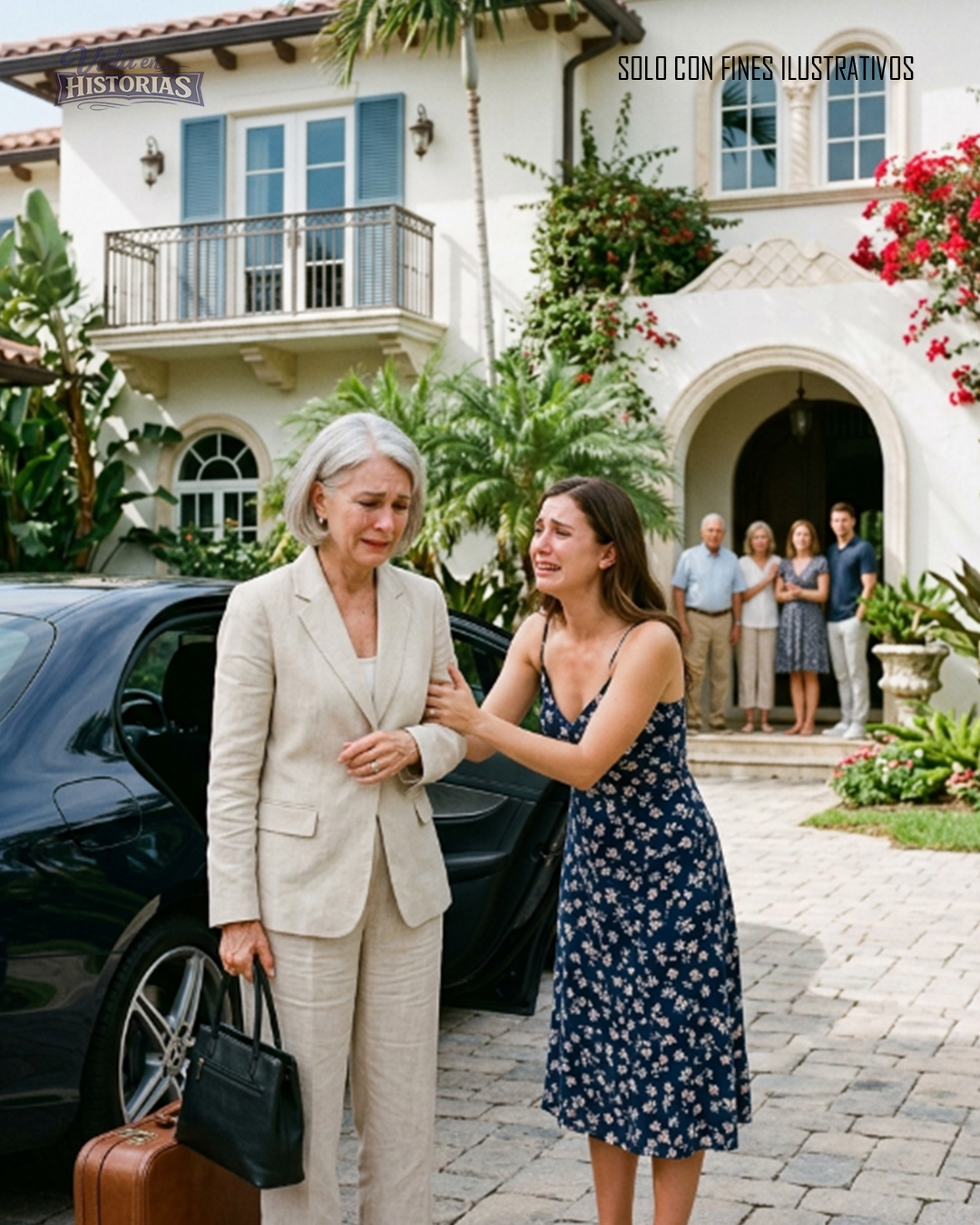
Doña Carmen got into the car convinced that her own adopted daughter was taking her to abandon her in a nursing home. She said nothing when Mariana placed the small blue suitcase in the trunk. Nor did she ask why her daughter avoided looking her in the eye, why she had spent the last few weeks talking on the phone in whispers, or why, the night before, she had heard the word “nursing home” cut through the kitchen door like a knife. Doña Carmen was 72 years old and knew all too well the sound of a disguised goodbye.
The apartment where she lived in Mexico City was no longer kind to her body. Saltpeter seeped up the walls, the elevator broke down every week, and the old pipes creaked as if the building itself were breathing sickly air. Even so, it was the place where she kept her photographs, her recipes, her altar, and the memory of her late husband, Arturo.
Mariana drove in complete silence. Doña Carmen watched her daughter’s hands gripping the steering wheel and remembered the skinny five-year-old girl who had arrived at Arturo’s wake, completely bewildered. Mariana was from her first marriage. After her husband’s death, relatives suggested giving her to a distant aunt.
“You have no obligation to raise another woman’s daughter,” a sister-in-law had told her.
Carmen replied,
“A daughter doesn’t belong to another woman when she calls you ‘Mom’ crying in the dark.”
And she stayed. She stayed when money was tight, when she had to pawn her gold, when she sewed dresses until dawn, when her family said she was foolish for wasting her life on a child who wasn’t her own flesh and blood. Now, 37 years later, Doña Carmen feared discovering that blood was thicker than love.
The week before, he’d overheard Mariana arguing with her husband, Fernando.
“Your mother can’t stay in that apartment,” he’d said, furious. “This is ruining our lives. You’ve already sold too many things; we’ll soon be in debt because of a stubborn old woman.”
That very morning, Fernando appeared and said, in a low, cruel voice,
“I hope she understands that no one can carry a dead weight forever.”
Now, in the car, they were driving along the highway toward Tepoztlán.
“Mariana,” said Doña Carmen, “where are you taking me?”
“You just have to trust me.
‘You.’ Not ‘Mom.’”
When the car stopped, she felt her stomach sink. In front of them was a beautiful two-story white house with large windows and a garden overflowing with bougainvillea. It didn’t look like a nursing home. Mariana got out and took out her suitcase.
“Are you going to let me?” the old woman asked.
Mariana froze. Behind her, the front door opened, and Doña Carmen heard Fernando’s voice.
“Has he arrived yet? You have to be quick before he gets suspicious.”
Doña Carmen froze. Mariana held out her hand.
“Come with me.”
She looked at the wooden sign covered with a cloth at the entrance. For the first time in 37 years, she felt the absolute terror of having loved someone far more than she had been loved. It’s unbelievable what’s about to happen…
PART 2
Doña Carmen crossed the threshold of that house with trembling legs, her heart pounding in her throat. She was prepared to hear an embellished lie, a pretty explanation to justify an unforgivable cruelty. Fear paralyzed her, but as she took her first step into the living room, the scent that greeted her completely disarmed her. It didn’t smell of hospital disinfectant, nor of the cold corridors of a government institution. The air was filled with the unmistakable aroma of freshly brewed coffee, cinnamon, baked cornbread, and cool wood.
The main room was bathed in the golden light of the afternoon streaming through enormous windows. Looking up, Doña Carmen felt the air leave her lungs. Hanging on the immaculate walls were the paintings she knew by heart: the landscape of Popocatépetl and Iztaccíhuatl that had always hung in Arturo’s living room, the old black-and-white photograph of their wedding framed in silver, and the portrait of Mariana at age seven, with her crooked braids and elementary school uniform. Doña Carmen placed a trembling hand on her chest. There, by the window, was her old wooden rocking chair, which she swore had been lost in a past move, covered with the crocheted blanket she herself had hand-knitted two decades earlier. Her old storage cabinet, made of Talavera tiles from Puebla, now completely restored, gleamed in one corner. On a small coffee table rested her oil-stained recipe notebooks, her crystal rosary, and the music box that Arturo gave her and that she played every Christmas.
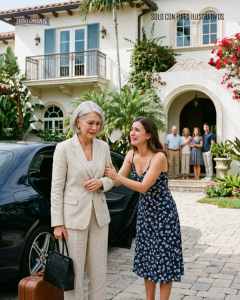
“What is all this?” she asked, her voice choked with tears, completely disoriented.
Mariana closed the heavy oak door behind them, dropped the small blue suitcase on the floor, and took her mother’s wrinkled hands.
“This is your house, Mom. We’re finally home.”
Doña Carmen shook her head, confused and almost annoyed by the intensity of the emotion that overwhelmed her. The pain of the last few days was still too fresh.
“Don’t play with me, girl. I’m old now, my body is heavy, but I haven’t gone stupid. I heard what they were saying. I heard your husband.”
Mariana burst into tears, a deep, cathartic cry. Her voice trembling, she confessed the whole truth. She explained that she had secretly sold her luxurious apartment in Polanco. She had emptied her savings of many years, taken out two bank loans, used the investment fund that Arturo had left in her name when she turned 30, and spent the last eight months remodeling this property in Tepoztlán. She couldn’t bear the thought of Doña Carmen still having to climb broken stairs, sleeping in the city’s sickening humidity, living in fear of slipping in a tiny bathroom, or depending on the neighbors’ charity when she couldn’t visit her.
The supposed distance, the whispered phone calls, the secrecy of the last five weeks weren’t coldness or abandonment: they were meetings with the architects, exhausting paperwork at the bank, arguments with the notaries, construction workers who never showed up, delays in painting and electrical work, and an overwhelming anxiety that was consuming her from the inside. Mariana wanted everything to be perfect.
Doña Carmen listened to every word like someone receiving news too overwhelming to contain. Her spirits returned to her body, but the thorn of pain remained. She remembered the humiliation of that very morning and took a step back.
“And your husband?” she asked firmly, raising her chin with the unwavering dignity of Mexican mothers. “He said I was a burden. He said I was going to ruin you all.”
Mariana’s face hardened. Suddenly, the door to the spacious kitchen opened slowly, and Fernando appeared. He no longer walked with the arrogance and disdain of the past few days; his shoulders were slumped, and his eyes were fixed on the floor.
“I said unforgivable things, Doña Carmen,” Fernando murmured, his voice raspy with shame. “Mariana demanded I come today. She told me that if I didn’t beg her forgiveness on my knees in front of you and everyone, our marriage would end today.”
Doña Carmen glared at him, wounded but unyielding. Fernando confessed, almost in tears, that he had fought out of fear of the debts. He admitted his brutal selfishness and the irrational shame he felt seeing his wife willing to sacrifice her comfort, her luxuries, and her inheritance to put her mother first. He said that when he arrived home that morning and saw that it wasn’t an excessive whim, but a monumental act of justice and love, he understood the misery of his own soul.
But Doña Carmen wasn’t a woman who would be swayed by empty words.
“You called me dead weight,” she retorted, her voice as firm as steel. “‘Dead weight’ is a word that cuts to your bone when you’re an old woman living alone. Money comes and goes, young man, but wounds inflicted with words take a lifetime to heal.”
Mariana hugged her mother by the shoulders.
“He almost ruined my surprise with his selfishness, Mom. And he knows it will cost him his life to regain my respect. But I won’t let his stupidity ruin this day. This day is yours.”
Mariana took Doña Carmen by the hand and led her back to the main entrance. They approached the wooden sign the old woman had seen upon arriving. Mariana pulled back the cloth covering it, revealing the hand-carved wood. It read, in large, beautiful letters: “Casa Carmen.”
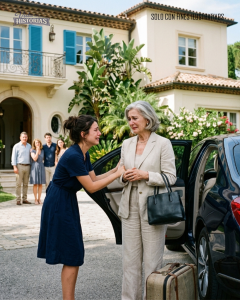
Before the old woman could even process it, the back garden gate swung wide open, and a chorus of voices erupted in the yard. Everyone was there. Her lifelong neighbors, the ladies from the parish, Mariana’s old elementary school teacher, the caretaker from her old building in the capital. And, to her utter astonishment, Arturo’s relatives were there. Among them, pale and with eyes swollen from crying, was Leticia, the same sister-in-law who 37 years earlier had contemptuously told her that Mariana was “someone else’s daughter.”
Everyone was gathered around a long table decorated with papel picado, laden with Oaxacan tamales, casseroles of mole, rice, café de olla, and sweet bread. In the center of the table lay a kraft paper envelope. The garden’s bustle died away completely when Mariana took the envelope in her hands. Even Fernando, leaning against the kitchen doorway, seemed to shrink smaller than his own shadow. Doña Carmen stood in the middle of the freshly cut grass, staring at the sign with her name on it, as if she were still waiting to wake from an impossible dream. Mariana pulled several pages from the envelope, took a deep breath to hold back her tears, and began to read aloud to everyone present.
—Mom… For many years I believed I was the one who needed you most. I was a five-year-old girl, terrified, who had just lost her father. I felt lost, with a deep fear that they would pack me up and send me away like a forgotten suitcase that no one would claim. But today I understand something bigger. Today I understand that you lost everything that day too. You lost the love of your life, you were left alone, penniless, and yet… you chose me.
Mariana’s voice broke. Several of the women in the garden were already wiping away tears with handkerchiefs. Leticia, Arturo’s sister-in-law, lowered her head, red with shame and regret. Mariana took a breath and continued.
“When the family told you I wasn’t your responsibility, you picked me up and held me close. When they yelled in your face that I wasn’t your blood, you sat down to embroider my name on my school uniform and told me that love is the only thing that takes root. When our electricity was cut off because we didn’t have any money, you went hungry so I could go to school with a full stomach. When I had an identity crisis in high school and was ashamed of being adopted, you sat beside me on that old iron bed and taught me the greatest lesson of my life: that love chosen willingly is worth exactly the same as love born of biology.”
Doña Carmen covered her mouth with both hands. She wasn’t crying in a restrained or elegant way; she was crying with a broken soul, letting out deep sobs, like someone who has carried a sack of fears and sacrifices on their back for too long and is finally letting it fall.
Mariana looked up from the papers, searching her mother’s eyes.
“I know perfectly well that these last five weeks you thought I’d grown tired of you. I saw it in your eyes this morning. And that’s what broke my heart the most. I wanted to give you the perfect surprise, but I was a fool to forget that silence, for people who have already lost so much in life, always smells of abandonment. I beg you to forgive me, Mom.”
The elderly woman tried to speak, but her voice caught in her throat. It was then that Mariana, addressing all the guests, revealed the magnitude of the project. This property was not just a pretty house. The entire first floor had been meticulously designed to meet Doña Carmen’s needs. The master bedroom had no steps, the bathroom had grab bars and a non-slip floor, the kitchen was adapted to her height, and the enormous backyard had special raised beds so she could plant her epazote, cilantro, and mint without having to bend down. The back room had been transformed into a sewing and reading room, bathed in morning sunlight. And on the second floor, there was a huge bedroom and two additional rooms so Mariana and any other family member could stay overnight as long as they wished. This house was not a luxurious storage facility for an elderly woman; it was the family’s new center of gravity, a meeting place, a sacred home, a rebirth.
Fernando took a few slow steps toward the center of the garden, approaching his mother-in-law.
“Doña Carmen… I was a coward and a wretch. I let the fear of financial ruin blind me, and I completely forgot that my own wife almost lost the woman who saved her life today. I’m not asking you to forget my insults. That would be presumptuous of me. I’m only imploring you to give me the opportunity to show you that you will never, ever again hear disrespect in this house.”
Doña Carmen stared at him for what seemed like an eternity, making the silence in the garden almost unbearable.
“An apology doesn’t erase words, young man,” the old woman declared. “But our actions from this day forward can prevent that weed from growing in our family. I’ll take you at your word.”
Fernando nodded, visibly relieved but deeply ashamed. Then Leticia, the same sister-in-law who had tried to get rid of Mariana, broke through the barrier and approached, weeping uncontrollably. She took Carmen’s hands and begged her forgiveness. She admitted that she had been a bitter and unfair woman, that she had dismissed Carmen’s love as “madness” simply because she herself would never have had the courage or the heart to make such a colossal sacrifice. Doña Carmen didn’t embrace her immediately. Her face reflected the weight of years of rejection.
“Some wounds age with you, Leticia,” she said calmly but distantly. “But today is not a day to settle old scores. Today is a day to celebrate those who chose to stay.”
After that moment of tension and redemption, Mariana approached her mother and handed her a heavy bronze key adorned with a thick blue ribbon.
“If you accept it, Mom, this house is legally yours. The deed is in your name. I’m not giving it to you out of pity. I’m not giving it to you to pay off a debt, because what you gave me is priceless in this world. I’m giving it to you because, just as you chose me 37 years ago when you didn’t have to, today I want to choose you too.”
Doña Carmen gripped the key with both hands, which wouldn’t stop trembling. She looked around. She looked at the tear-streaked faces of her friends, at the jacaranda trees, at the immaculate facade, at the sign that screamed “Casa Carmen,” and finally, she fixed her gaze on Mariana.
“I really thought you were going to throw me into a nursing home…” she whispered, bursting into tears again.
Mariana let out a heart-wrenching sob and hugged her tightly.
“I almost died of grief when I heard you ask that at the entrance, Mom. How could you even think for a second that I would be capable of abandoning the woman who taught me the true meaning of staying?”
Doña Carmen raised a hand and stroked her daughter’s rain-soaked face.
“Because we old folks live in terror of becoming a burden, my child. And fear, when you let it grow in the dark, goes about inventing gigantic monsters.”
The two women melted into an endless embrace in the middle of that blooming garden, crying loudly, as if the 37 years of sacrifices, deprivations, prejudices and unconditional love had finally found their reward in a single and powerful word: permanence.
Hours later, as the sun began to set behind the hills of Tepoztlán, painting the sky in shades of orange and purple, the party had winded down. Everyone was eating mole and animatedly debating whether the coffee was too sweet. Doña Carmen, exhausted but radiant, sat in her old rocking chair by the living room window. Mariana, with a clay cup in her hands, knelt beside her, resting her arms on her mother’s legs, just as she had done when she was a five-year-old seeking refuge.
“Did you like your house, Mom?” she whispered.
The old woman smiled, her eyes still shining with tears of joy, and stroked her daughter’s hair.
“I loved the house, my love. But do you know what I loved most? I loved realizing that I still have a valuable place in this world.”
Mariana rested her cheek on her mother’s lap and closed her eyes. Outside, the sunset illuminated the garden without a trace of sadness, without the slightest hint of farewell. Doña Carmen continued running her wrinkled fingers through her daughter’s hair, understanding in the peace of that moment that motherhood isn’t something that resides in blood, nor is it a job that ends when children grow up and leave. Some mothers give their surname, a safe roof over their heads, an education, a hot meal, comfort in the early hours, and the courage to face life. And sometimes, miraculously, many years later, a daughter returns to repay all that immense sacrifice in the form of a bronze key, a garden full of bougainvillea, and a beautiful sign on the door proclaiming to the whole world that that woman was never a burden. She was the strongest root of all.
