Physical Address
304 North Cardinal St.
Dorchester Center, MA 02124
Physical Address
304 North Cardinal St.
Dorchester Center, MA 02124

“We sold your car. Family comes first. Be grateful we let you live here.”
That was the text my father sent me at 1:17 p.m. while I was sitting in the break room at St. Agnes Medical Center with half a vending machine turkey sandwich in my hand and fourteen minutes left before my next patient needed wound care.
For a few seconds, I honestly thought I had read it wrong.
The break room was too bright, too ordinary, too cruelly alive around me. A microwave hummed against the far wall. Someone had left coffee burning in the pot, filling the room with a bitter smell that clung to the back of my throat. Two nurses from pediatrics were laughing at something on one of their phones, and the vending machine blinked its little red numbers like nothing in the world had cracked open.
My car.
My silver 2016 Honda Civic.
The car I had bought myself after two years of twelve hour shifts, night classes, bargain groceries, skipped birthdays, and every private little sacrifice nobody in my family ever noticed unless they could turn it into something I owed them.
I read the message again.
Then again.
My thumb hovered over the screen, but before I could type anything, another text appeared.
“Oh, and your brother’s starting college. You’ll cover his first semester. $5,800. Due this week.”
That was the moment my family stopped feeling difficult and started feeling dangerous.
I remember putting the sandwich down carefully, as if any sudden movement might make the room explode. My pulse had gone strange and heavy, beating in my neck instead of my chest. Across the table, my coworker Mia looked up from her salad and narrowed her eyes.
“Harper?” she asked. “You okay?”
I wanted to say yes. I had been trained to say yes. In the Reynolds house, feelings were things you swallowed before they inconvenienced someone else.
But my mouth opened, and nothing came out.
My name is Harper Reynolds. I was twenty four years old, a registered nurse, and until that lunch break, I still believed my parents were unfair because they loved badly. I still believed there was a line they would not cross. I still believed that if I worked hard enough, stayed quiet enough, gave enough, and made myself useful enough, one day they would look at me and see a daughter instead of a resource.
I was wrong.
With shaking fingers, I typed two words.
Not happening.
The reply came almost immediately.
“Then pack your crap. You’re dead to me.”
Dead to me.
Not because I had stolen from them. Not because I had lied. Not because I had hurt my brother or abandoned my mother or disgraced the family name my father polished in public like silver.
Because I said no.
I stood so quickly my chair scraped the linoleum and everyone looked at me. Mia followed me into the hallway without asking. She was older than me by ten years, with kind eyes and the kind of steadiness that made frightened patients trust her before she even touched them.
“What happened?” she asked.
“They sold my car,” I whispered.
Her face changed.
“The Civic?”
I nodded.
“But it was in your name.”
“That’s what I thought.”
I walked into the staff bathroom, locked the door, and called my father. My fingers were damp against the phone. In the mirror, my face looked pale and unfamiliar, like someone had erased me from behind the skin.
Dad answered on the second ring.
“Do not start,” he said.
No hello. No hesitation. Just that voice, low and certain, the voice that had controlled the weather in our house for as long as I could remember.
“Tell me you didn’t sell my car.”
“We did what had to be done.”
“It wasn’t yours.”
“You live under my roof.”
“That doesn’t make my property yours.”
He sighed, as if I were a child asking why the sky was blue.
“Harper, your brother has an opportunity. Family makes sacrifices.”
“I made sacrifices for that car.”
“You’re being selfish.”
The word landed with old precision. Selfish. It was the button they had pressed since childhood whenever I wanted anything that belonged only to me.
I gripped the sink. “Did you forge my signature?”
For the first time, he went quiet.
Not angry. Not offended. Quiet.
The silence answered before he did.
My skin turned cold from my scalp to my wrists.
Then my mother came on the line, soft as poisoned honey.
“Honey, don’t make this ugly. We raised you better than this.”
Behind her, I heard Noah’s voice, lazy and annoyed.
“Tell her I need the money by Friday.”
He did not sound guilty. He sounded inconvenienced.
They had sold my car, and they still wanted $5,800 more.
“I’m not paying Noah’s tuition,” I said, and my own voice surprised me because it did not shake.
Dad came back on the phone.
“You come home tonight with that attitude, and you’d better bring boxes.”
So I did.
But before that, I finished my shift.
I do not know why that detail matters so much in my memory, but it does. Maybe because part of me needed proof that I could still function after my own family had reached into my life and ripped out the one thing I had built with my own hands. I changed dressings. I checked medication charts. I comforted an elderly man whose daughter was late to pick him up. I smiled until my cheeks hurt. I washed my hands until they smelled like sanitizer and grief.
At 7:42 p.m., Mia found me by the employee lockers.
“I’m driving you,” she said.
“I can take a rideshare.”
“No, Harper. I’m driving you.”
The ride home was quiet except for rain tapping against the windshield. Columbus looked smeared and lonely through the glass, all brake lights and wet pavement, the city reflecting itself in broken red lines. I kept my duffel bag on my lap even though it was empty. I had brought it to work for gym clothes that morning. By night, it looked like a prophecy.
When we pulled onto my street, I saw my parents’ house glowing warm and yellow from the windows. For twenty four years, that light had meant home. That night it looked staged, like a set built to convince strangers that nothing terrible happened inside.
Mia parked at the curb.
“Do you want me to come in?”
I shook my head. “No. But don’t leave yet.”
“I won’t.”
I walked up the porch steps. Every board creaked in the same familiar places. My key still worked, which felt almost insulting.
Inside, the house smelled of dish soap, pizza, and my mother’s lavender candle. Dad sat at the kitchen table with his laptop open, wearing his bank manager shirt with the sleeves rolled up. Mom stood at the sink washing a plate that had already been clean for years in her hands. Noah was at the counter, eating pizza from the box. My seventeen year old sister, Chloe, sat at the table with a textbook open, her pencil still, her eyes lowered.
No one looked ashamed.
Dad glanced up.
“You calm now?”
I closed the door behind me.
“You sold my car. You forged my signature. I want the money back.”
Noah laughed under his breath.
“Good luck. It’s already paid toward school.”
I looked at him, waiting for something human to appear on his face. Embarrassment. Regret. Fear. Anything.
There was nothing.
My father leaned back in his chair. “You’re making this dramatic.”
“You committed fraud.”
Mom turned sharply from the sink. “Harper Elise Reynolds, do not use words like that about your father.”
“What word would you prefer?”
Her lips trembled, but not from guilt. From irritation that I was refusing to play my part.
Dad closed the laptop.
“You have always had a problem with gratitude,” he said.
There it was, the sermon.
He had given versions of it my whole life. When I was twelve and wanted new running shoes because mine had holes in the toes. When I was sixteen and asked if I could keep my birthday money instead of putting it toward Noah’s summer camp. When I was nineteen and got accepted into a nursing program two hours away, and he told me girls who loved their families did not run off chasing independence.
Growing up in the Reynolds house meant learning one rule before anything else. Dad’s mood was the ceiling, the walls, the oxygen. If he was calm, the house breathed. If he was angry, everyone moved carefully, like we were carrying bowls full of boiling water.
Outside our home, Richard Reynolds was a respectable man. At First County Bank, he wore polished shoes and shook hands too firmly. At church, he carried donation boxes and told other fathers that a man’s family was his legacy.
Inside our home, he was judge, jury, and punishment.
My mother, Marlene, rarely raised her voice. She did not need to. She could turn guilt into a leash with one sentence.
“After everything we’ve sacrificed for you.”
My brother Noah grew up under different weather. He wanted a gaming computer, and somehow money appeared. He failed two college classes, and Mom said he was overwhelmed. He wrecked the Ford Focus they bought him, and Dad called it an honest mistake.
When I needed textbook money, Dad told me adults solved their own problems.
So I became one.
The Civic had been my proof.
I bought it on a freezing February Saturday from a used dealership on Morse Road. I still remembered the salesman handing me the keys, still remembered sitting alone behind the wheel after signing the papers, my name printed cleanly on the title. My name only. The car smelled faintly of old air freshener and plastic warmed by sun. It was not fancy, but when I drove it off the lot, I cried so hard I had to pull over.
It was the first thing in my life nobody had given me, which meant nobody could take it away.
Or so I thought.
Dad pointed toward the stairs.
“Pack your crap.”
Mom made a wounded little sound. “Richard.”
But she did not stop him.
He looked me straight in the eye.
“You walk out that door, you’re dead to me.”
The old Harper would have begged.
She would have cried. She would have explained herself until her throat hurt. She would have apologized for being stolen from.
But something inside me had gone still.
I nodded once.
“Okay.”
That one word changed the room.
Dad blinked. Mom’s hand froze on the dish towel. Noah stopped chewing. Chloe looked up so fast her pencil rolled off the table.
I went upstairs.
My room was exactly as I had left it that morning, narrow and neat, the bed made, my scrubs from yesterday folded on the chair, a framed photo of me and Chloe at her middle school graduation sitting on the dresser. I packed like someone leaving a burning building. Two duffel bags. Clothes. Nursing license. Passport. Birth certificate. Social Security card. Grandmother’s necklace. The envelope of emergency cash taped behind the bottom drawer.
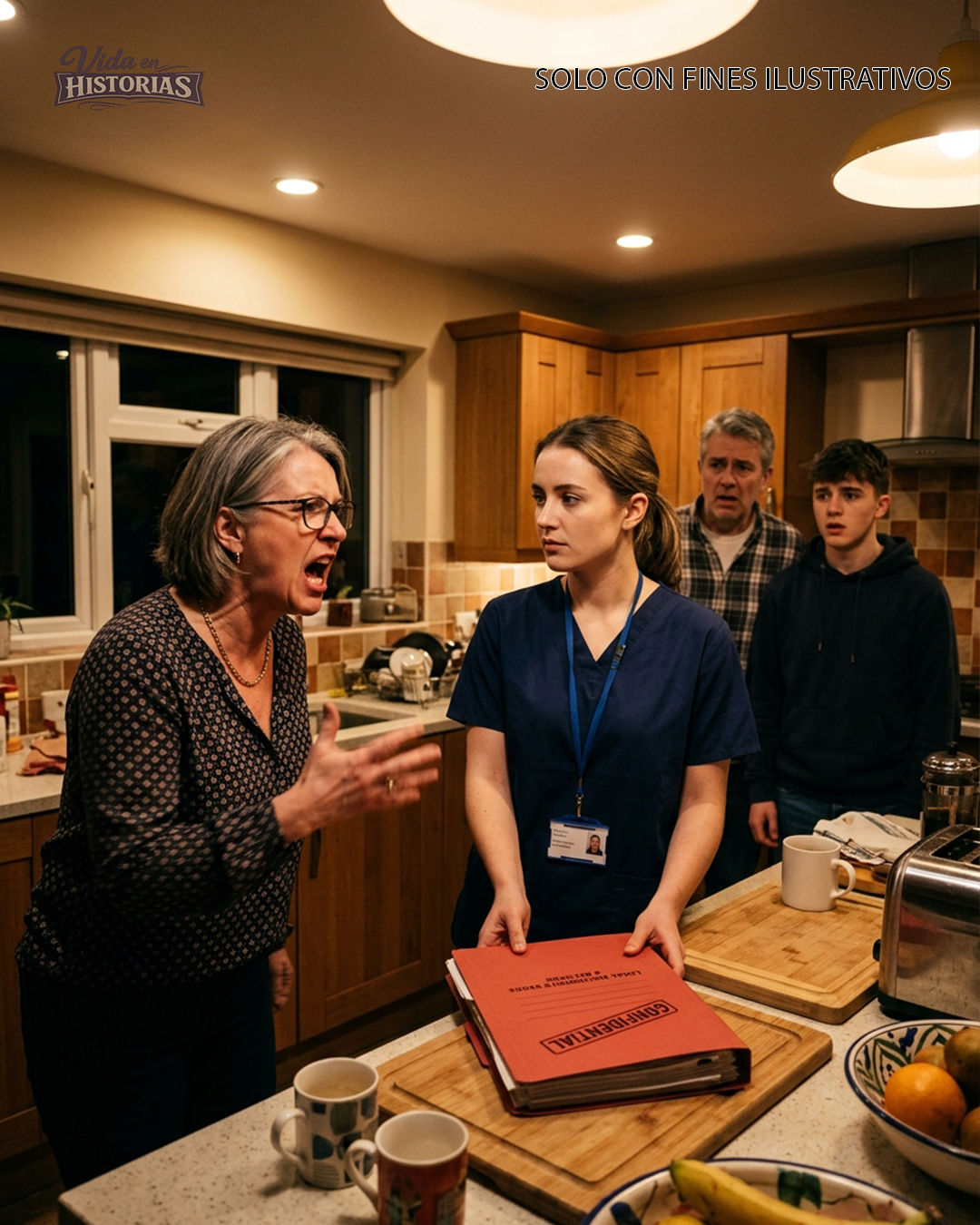
Then I pulled out the red folder from beneath my mattress.
It was thick now.
Six months of screenshots. Bank transfers. Text messages. Notes written after arguments while details were still fresh. Copies of my car title, registration, insurance records, payment receipts, and the dealership paperwork. A scanned copy of my signature beside the signature on the sale document I had found in my father’s email after guessing the password he used for everything.
I had not built that folder because I was brave.
I built it because a quiet part of me had known.
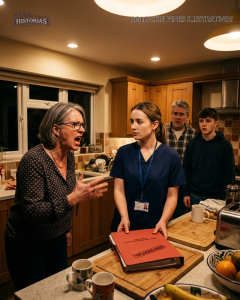
When I came downstairs, Mom stared at the red folder like it was a weapon.
Dad frowned.
“What is that?”
I placed it on the kitchen counter.
“The truth.”
He laughed once, but the sound was thin.
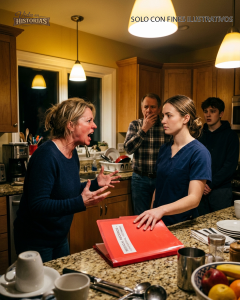
“Don’t be ridiculous.”
I looked at Chloe. Her face had gone white. For a second, I wanted to run to her, hold her, tell her I was sorry for leaving her in that house. But her eyes flicked to the folder, then to me, and something passed between us.
Not fear.
Recognition.
I picked up my bags.
Noah rolled his eyes. “You’ll be back.”
I looked at him one last time.
“No, I won’t.”
Then I walked out into the rain.
Mia was still at the curb, engine running, headlights cutting through the dark. When she saw my face, she got out and took one of my bags without a word.
I did not cry until we reached the end of the street.
I slept on Mia’s couch that night under a quilt her grandmother had made. Her apartment smelled like cinnamon tea and laundry detergent. Around 3:00 a.m., I woke from a dream that I had left something important behind. My chest tightened with panic, and then I remembered.
The folder.
I had left it on purpose.
Not for Dad.
For Chloe.
What I did not know then was that Chloe would not be the first person to open it.
The next morning, at 8:06 a.m., my aunt Linda called me.
I nearly ignored it. Aunt Linda was my mother’s older sister, sharp mouthed, churchgoing, and usually careful not to interfere. But something made me answer.
She was crying.
“Harper,” she said, breathless. “What did he do?”
I sat up on Mia’s couch. Sunlight was cutting across the floor. My whole body went cold.
“What happened?”
“Your mother called me screaming that you abandoned the family and stole documents. I came over because she said you were out of control. Harper, honey, I found the folder.”
For a moment, I could only hear her breathing.
Then, in the background, I heard my uncle Ray yelling.
“You forged her name, Richard? Are you out of your damn mind?”
A door slammed.
My aunt lowered her voice. “There are bank statements in here. Transfers from your account to theirs. Thousands of dollars. Notes about your paycheck. Screenshots of messages. Harper, did they really make you pay their mortgage last winter?”
I closed my eyes.
“Not all of it.”
“That is not an answer.”
I heard my mother sobbing somewhere in the background, not the soft practiced kind she used on me, but a panicked, ugly sound.
Then my father’s voice cut through, furious.
“Give me that folder.”
Aunt Linda snapped back, “Touch me and I’ll call the police myself.”
By 9:00 a.m., the house that had swallowed my silence for twenty four years was choking on the truth.
My phone started vibrating nonstop.
Mom.
Dad.
Noah.
Unknown number.
Dad again.
I let them ring.
Then Chloe texted me.
“I’m sorry. I should have told you.”
My heart lurched.
Told me what?
Three dots appeared. Disappeared. Appeared again.
“I have videos.”
I stared at the words.
“What videos?”
Her reply came one piece at a time, like she was shaking too hard to type.
“Dad signing your name.”
“Mom telling him where your documents were.”
“Noah laughing about how you’d pay anyway.”
“I recorded it because I was scared they’d do it to me next.”
I pressed the phone to my chest and bent over until my forehead touched my knees.
For years, I had thought Chloe was untouched because she was quiet. I had mistaken her silence for safety. But she had been watching. Learning. Preparing.
Just like me.
At 10:30 a.m., a police officer called. Aunt Linda had made the report after all. By noon, I was sitting in a small interview room at the station, my hands wrapped around a paper cup of water, explaining how my car had been sold without my consent.
The officer, a woman with gray in her braid and tired eyes, listened without interrupting. When I showed her the paperwork, her expression tightened.
“That signature isn’t yours?”
“No.”
“And you did not authorize the sale?”
“No.”
“And these messages from your father came after the vehicle was sold?”
“Yes.”
She looked at the folder, then back at me.
“Ms. Reynolds, this is serious.”
I almost laughed. Serious. Such a small word for the feeling of realizing your father had turned your life into an account he could withdraw from.
The next days moved strangely, fast and slow at once.
The dealership was contacted. The buyer was located. The notary who had approved the sale suddenly remembered that my father had come in alone, claiming I was working and had already signed. First County Bank placed my father on administrative leave when the investigation touched forged documents and suspicious internal access.
That part made the local whispers bloom.
Richard Reynolds, respected bank manager, accused of fraud.
Marlene Reynolds, beloved church volunteer, knew.
Noah Reynolds, poor college boy, had used the money.
For the first time in my life, people were not asking what I had done to upset my family.
They were asking what my family had done to me.
Dad’s apology came five days after I left.
Not in person. Not with remorse.
A text.
“You’ve made your point. Call me.”
I did not.
Mom’s message came an hour later.
“Your father may lose his job. I hope you understand what you’re doing to this family.”
I typed back one sentence.
“You did this to the family.”
Then I blocked her.
The Civic was returned three weeks later, after legal pressure, dealership panic, and my aunt’s relentless phone calls. When I saw it parked outside Mia’s apartment, I stood on the sidewalk and touched the hood like it was a living thing that had found its way home.
There was a small scratch near the driver’s side handle that had not been there before.
I cried over that scratch harder than I cried over my father calling me dead.
Maybe because the scratch was honest. It said something had happened. It did not pretend otherwise.
Chloe moved out two months later.
Aunt Linda took her in after Chloe showed the videos to the school counselor, who helped her document everything. My parents called it betrayal. I called it rescue.
Noah did not start college that semester.
The tuition payment was frozen while the investigation continued, and without my money to soften every consequence, his great future suddenly required forms, jobs, and effort. He sent me one message from a new number.
“You ruined everything.”
I looked at it for a long time before replying.
“No. I stopped paying for it.”
Then I blocked him too.
For a while, I thought that was the ending.
I thought the twist was simple: the quiet daughter had kept records, the golden son had been exposed, the father had finally met a door he could not shout open.
But the real twist came in an envelope.
It arrived six months after I left, on a rainy Thursday almost exactly like the day everything began. I was living in a small studio by then, paying too much rent for too little space, but every inch of it was mine. My mugs did not disappear. My paycheck landed in my account and stayed there. The silence did not wait for someone’s anger.
The envelope had no return address.
Inside was a letter from my grandmother.
Not my mother’s mother, whose necklace I had taken with me, but my father’s mother, Evelyn Reynolds, who had died when I was fifteen.
The handwriting was familiar from birthday cards I had kept in a shoebox.
My hands shook as I unfolded it.
My dearest Harper,
If you are reading this, then Richard has done exactly what I feared he would do.
I sat down on the floor.
The letter blurred, then sharpened.
Your grandfather left money for each of the grandchildren. Not much by wealthy standards, but enough to help with school, a car, a first apartment, a beginning. I placed yours in an account with Richard as custodian because I was ill, and because, despite everything, I wanted to believe my son would protect his daughter better than he protected his pride.
My breath stopped.
He was instructed to tell you when you turned eighteen.
Eighteen.
I read the line again.
He was instructed to tell you when you turned eighteen.
There was more. Copies of legal documents. Account numbers. A statement from seven years earlier showing a balance of $42,000.
And at the bottom, one final paragraph.
If he tells you that you owe him, remember this: love does not keep ledgers against children. If he makes you feel small, remember you were the first person in that house who ever made me believe gentleness could survive our name.
The money had existed all along.
Every textbook I had struggled to buy. Every night shift I had worked until my feet throbbed. Every time my father told me adults solved their own problems while he drained the account my grandmother had left for me.
Not only had he stolen my car.
He had stolen my beginning.
For one wild, impossible second, I laughed. Not because it was funny, but because pain sometimes reaches a place so deep it becomes sound before it becomes tears.
Aunt Linda had found the letter while cleaning out old boxes from my parents’ attic after Chloe moved. My grandmother had given a copy to her too, years ago, with instructions to interfere if Richard ever became his worst self. Aunt Linda had been grieving her own husband’s illness back then, and the letter had vanished into storage until the red folder made her look.
The investigation widened.
My father did lose his job. There were charges. There were lawyers. There were relatives who said I had gone too far, and other relatives who quietly confessed that Richard had always scared them. My mother stood beside him in public until the account records proved she had known about the money too. Then she claimed she had been manipulated.
I did not argue.
Some people use helplessness the way others use knives.
The recovered money did not fix everything. Money cannot give back the years you spent believing exhaustion was your natural state. It cannot return childhood, or innocence, or the version of yourself who might have grown up loved without invoices attached.
But it bought me a real bed. It helped Chloe start therapy. It paid for a lawyer who spoke to my parents so I never had to. It let me reduce my overtime and remember that my body was not a machine built to survive other people’s greed.
One year after the day Dad sent that text, I drove the Civic to a lake outside the city with Chloe beside me and Mia following in her own car with a picnic basket. The morning was bright, washed clean by rain. Chloe wore sunglasses too big for her face and kept changing the music every thirty seconds.
At a red light, she looked at me.
“Do you miss them?”
I watched the light sway above the intersection.
“I miss who I needed them to be.”
She nodded, and that was enough.
We spent the afternoon by the water. Mia complained about ants. Chloe laughed for real, head thrown back, mouth open, sunlight caught in her hair. I sat on an old blanket and felt the breeze move across my arms, and for once, peace did not feel like waiting for disaster. It felt like room.
Near sunset, my phone buzzed.
Unknown number.
I almost ignored it, but something made me look.
A message appeared.
“Harper. It’s Dad. I’m sick. I don’t want things to end like this.”
My chest tightened, not with love exactly, and not with hatred either. With the old reflex. The old pull. The child in me still knew the path to his approval, even after everything.
Chloe saw my face.
“What is it?”
I handed her the phone.
She read the message and went still.
For a moment, I thought she might tell me to answer. Instead, she took my hand.
“You don’t have to go back into the burning house just because the person who lit it is cold.”
The sun dropped lower, turning the lake silver.
I deleted the message.
Then I blocked the number.
That was the last thing my father ever took from me: the belief that his need was my responsibility.
Months later, the court ordered restitution. The legal language was dry and bloodless, full of amounts, dates, signatures, and judgments. It did not mention the nights I cried quietly so Chloe would not hear. It did not mention my grandmother’s letter pressed under my pillow like a prayer. It did not mention the little silver car that had carried me away from the only home I knew and toward the first life that belonged to me.
But I kept a copy anyway.
Not in the red folder.
That folder was full now, sealed in a storage box with the past.
I bought a new one.
Blue.
Inside it, I placed my apartment lease, Chloe’s college acceptance letter, Mia’s birthday card, my grandmother’s letter, and a photograph of the Civic parked beside the lake at sunset.
Proof, not of what they did to me.
Proof that I survived it.
And sometimes, when I leave work after a long shift and walk across the hospital parking lot under the soft orange glow of the lamps, I still pause before unlocking my car. I run my fingers over the tiny scratch by the handle. I breathe in the night air. I listen to the distant traffic, the squeak of my shoes, the steady sound of my own life continuing.
Then I get behind the wheel, turn the key, and drive home to a place where no one calls theft love.
