Physical Address
304 North Cardinal St.
Dorchester Center, MA 02124
Physical Address
304 North Cardinal St.
Dorchester Center, MA 02124


When Roman DeLuca stepped through the iron gates of his Lake Forest mansion, it was 2:17 a.m., and Chicago seemed to hold its breath behind him. Dried blood trickled beneath a gold cufflink, his knuckles were swollen, and a shadow hung over his eyes, making even his most loyal men lower their gaze.
For six hours, he had stood in a South Side warehouse, reminding three ambitious men that a city doesn’t change its king just because the wolves are hungry. Now, all he wanted was silence. The one thing Roman DeLuca respected, more than money and more than fear, was the silence of his home: polished marble, dark wood, imported lamps, and servants who knew when to vanish before he even had to ask. But that night, just as he laid his coat on a chair, thinking nothing could touch him within his own walls, he heard a baby cry.
It was a weak, broken cry, almost lifeless, as if asking not for help but for permission to continue existing. Roman stood motionless beneath the crystal chandelier in the hall, and in that instant he understood that something had broken within his perfect kingdom; before dawn, that small voice was going to force him to fight a battle he had never imagined.
Miles, his trusted guard, reached for his weapon.
-Boss?
Roman raised his hand without looking at him. The entire lobby froze.
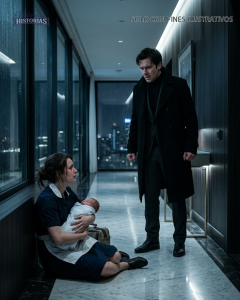
The crying returned, quieter this time, from somewhere beneath the floor, as if emanating from the mansion’s cold depths. Roman knew the traps all too well. In his world, compassion could be a noose around the neck. A woman weeping in a dark street. A wounded man begging for water. A lost child standing outside a door. He had seen enemies turn mercy into bait.
But that was inside his house.
Within its walls.
“Close the outside doors,” he ordered. “Quietly.”
Miles hesitated.
—It could be a trap.
Roman barely turned his head. He didn’t need to raise his voice.
-Noiseless.
The man obeyed.
Roman walked toward the service corridor. He passed through the kitchen, where the black granite gleamed like frozen water and copper pots hung in perfect alignment. No one was there. No one was breathing. Behind a wooden door, he found the old staircase leading to the lower level, an area built decades ago for laundry, storage, and for those people wealthy families preferred not to see.
The air changed as he went downstairs. Upstairs it smelled of leather, firewood, and expensive perfume. Downstairs it smelled of dampness, dust, cheap detergent, and old stone. The crying became clearer. Roman walked past shelves of sheets, boxes of broken Christmas decorations, cans of paint, and forgotten tools until he reached a door warped by time.
The baby was behind.
Roman took the doorknob and opened it.
The cold hit like a slap in the face.
In a corner, on the bare concrete, a woman dressed in a gray maid’s uniform sat up abruptly. Her hair was plastered to her face, her lips were chapped, and an old coat was wrapped around something small against her chest. When she saw Roman, terror clouded her eyes.
“Mr. DeLuca…” she whispered.
Roman vaguely recognized her. One of the cleaning staff on the second shift. Young. Quiet. She cleaned the west library twice a week and left before he went in. He’d never heard her voice before.
—Please —she said, pressing the baby against her body—. Please don’t hurt him.
Roman didn’t answer. He looked at the child.
Her cheeks were flushed with a dangerous fever. Sweat plastered her fine hair to her forehead. Each breath came with effort, as if the air were a door too heavy for her chest. She wasn’t crying anymore; she was moaning. And the sound, so small, stirred something ancient and buried inside Roman.
“What’s your name?” he asked.
The woman blinked, as if she had been expecting a gunshot, not a question.
—Nora Bennett.
—And him?
—Eli.
Roman took a step closer. She backed away against the wall.
—How long have you had a fever?
—Since yesterday afternoon.
—Did you call a doctor?
Shame crossed her face before she could hide it.
-No.
-Because?
Nora lowered her eyes to the baby.
—Because I couldn’t afford one. And because… if I left before the end of my shift, Mrs. Hargrove said she’d fire me.
Mrs. Hargrove. The head housekeeper. A rigid woman with a statue-like face and a voice like a knife, who had managed the mansion’s staff for fifteen years. Roman almost never spoke to her. He’d never had to. In his house, every problem seemed to vanish before it even reached his eyes.
That night she understood why.
“Why are you sleeping down here?” he asked.
Nora swallowed.
—They took me out of the staff room.
Roman remained silent.
-Who?
She didn’t answer. Her fingers trembled on the child’s back.
“Nora,” he said, more quietly. “Who took you out?”
“Mrs. Hargrove said no children were allowed on the property. I had nowhere else to go. Eli’s father left before he was born. My mother died last winter. I figured if we spent just one night here… if he got better… I could keep working and no one would know.”
Roman looked at the concrete, the thin blanket, the sweat-soaked coat, the baby’s purple lips. A sick child had spent the night on the cold floor of his mansion while upstairs there were empty rooms, lit fireplaces, and linen sheets that no one used.
His jaw hardened.
—Give it to me.
Nora squeezed the child desperately.
-No.
Roman stopped. That refusal didn’t anger him. It surprised him.
Armed men had pleaded before him. Debtors had wept. Enemies had sworn allegiance with blood on their lips. But that woman, pale, exhausted, almost without strength, told him no because everything she had in the world fit in her arms.
“I’m not going to hurt him,” Roman said.
—You are Roman DeLuca.
He held her gaze.
—Tonight I am the man who will get your son out of this cold.
Nora looked at him as if she didn’t know where in that sentence to hide her fear. Then Eli coughed. A dry, deep cough that doubled his small body over. Nora broke down. Roman saw the resolve shatter in her eyes before her hands gave way.
He took the child with a gentleness that no one in the mansion would have thought possible. Eli was burning up. Roman felt the heat of the fever pierce his shirt, and for a moment he remembered another small body, another fever, another winter. His younger sister, Lucia, dying in a squalid room while their mother pounded on doors, pleading for help. No one answered. Roman was twelve years old when he learned that the world was unmoved by weak children. That night he vowed to become so powerful that no one would ever shut a door on him again.
But along the way it had become a closed door for others.
—Miles—he called.
The guard immediately appeared in the hallway, gun in hand. Upon seeing the baby, he lowered his weapon.
—Get Dr. Vale. Now. Have him come to the house. And get a car ready in case we have to take him to the hospital.
—Yes, boss.
—And wake Hargrove up.
Nora stood up unsteadily.
—Please, I don’t want to cause any problems.
Roman looked at her, and his voice came out colder than the basement.
—You didn’t cause this.
Fifteen minutes later, the mansion’s main hall looked like a different place. The fireplace was blazing. Nora sat on a huge sofa with a blanket draped over her shoulders, watching her son as if she feared someone might snatch him away. Roman paced back and forth with Eli in his arms, not caring that the baby was staining his shirt with sweat. Every labored breath the child made grated to his soul.
Mrs. Hargrove entered, her dressing gown neatly buttoned and her hair pulled back. When she saw Nora, her mouth tightened.
—Mr. DeLuca, I assure you that I did not know that she had hidden the child inside the house.
Roman didn’t turn around.
—But you did know that I had a child.
—That was none of your business.
He turned around slowly.
—Everything that happens under my roof is my business.
Hargrove lifted his chin.
—With all due respect, sir, the staff understands the rules. If we allow exceptions, the house becomes a refuge.
Nora clutched the blanket between her fingers. Roman saw in her face the fear of someone who has been humiliated so many times that she already expects the blow before it comes.
“A shelter?” he repeated. “Does that seem like a threat to you?”
—It seems like a mess to me.
Roman took a step towards her.
—A sick baby on a concrete floor isn’t a mess. It’s shameful. And it’s shameful for me, because it happened in my house.
For the first time, Mrs. Hargrove lost color.
—I was just trying to protect discipline.
—No. You protected your cruelty under the guise of discipline.
The doorbell rang, breaking the silence. Dr. Vale arrived with a briefcase and disheveled hair. He was one of the few men in Chicago who could enter Roman DeLuca’s house in the early morning without asking questions. He examined Eli on a long table covered with a clean blanket. He took his temperature, listened to his lungs, and examined his throat.
Nora wasn’t breathing.
Neither did Roman.
“He has a severe infection,” the doctor finally said. “His fever is high, and he’s dehydrated. We need to stabilize him. If it doesn’t come down soon, we’ll take him to the hospital. But we arrived in time.”
Nora covered her mouth with both hands and wept silently. It wasn’t complete relief. It was the kind of crying that comes from people who have been holding the world by their fingertips and finally feel someone else touching the edge.
Roman looked at the doctor.
—Whatever you need.
—Medications, fluids, heat, all-night surveillance.
—He’ll have everything.
Hargrove tried to back away towards the door.
“You’re staying,” Roman said without looking at her.
The woman stopped.
During the next few hours, the entire mansion’s pulse shifted. The armed men who had violently stormed into restaurants and warehouses now walked silently carrying cups of tea, bottles of water, blankets, and thermometers. Miles, who could break a man’s wrist in three seconds, stood by the fireplace, looking at the baby with awkward concern.
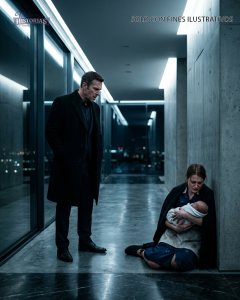
Nora never left Eli’s side. Roman stayed nearby, arms crossed, watching the doctor give her instructions. When Eli cried, Nora sang him a little song, almost embarrassed, and the boy calmed down at his mother’s voice.
Roman looked toward the window. Outside, the night was still dark. But inside, another kind of battle had begun. Not against armed enemies. Not for territory or power. It was against the version of himself that had allowed his house to be a palace above and a tomb below.
At four thirty, Miles approached and spoke to her in a low voice.
—We reviewed the security camera footage. Hargrove had Nora’s key taken away three nights ago. He also ordered part of her salary to be deducted for “unauthorized lodging.” There are messages.
Roman closed his eyes for a moment.
—Who else knew?
—Two supervisors.
—Bring their names.
Hargrove heard that and his composure broke.
—Mr. DeLuca, please. I have served this house for fifteen years.
Roman looked at her with a terrible calm.
—And in fifteen years you didn’t learn that a house is not measured by the shine of the marble, but by what it allows in the dark.
—That woman lied. She brought a child here without authorization.
Nora raised her head, wounded but resolute.
—I didn’t lie to steal. I lied so my son wouldn’t have to sleep on the street.
Roman saw the difference. One sentence defended a rule. The other defended a life.
“Hargrove,” he said, “you’re fired. No recommendation. No additional compensation. And if I find out you touched a penny of Nora’s salary, you won’t need another job: you’ll need a lawyer.”
The woman opened her mouth, but nothing came out. Miles escorted her out.
The silence that followed was not the same as before. It was no longer the silence of a house under siege. It was the silence of a place that had just awakened.
Shortly before dawn, Eli’s fever began to break. The doctor smiled slightly, as if he didn’t want to tempt fate.
“He’s going to be fine,” he said. “He needs rest, monitoring, and antibiotics, but he’s going to be fine.”
Nora bowed her head over her son’s body and finally wept with all her heart. Roman didn’t know what to do with that sound. It was too human for a house he had built to keep all human things from reaching him.
She approached the sofa and placed a cup of water next to it.
“There’s a room ready in the east wing,” he said. “It’s heated. Eli will sleep there.”
Nora looked at him, confused.
—Sir, I can’t pay…
—I’m not charging you for it.
—I cannot accept charity.
Roman sat down opposite her. He looked tired for the first time in many years.
—It’s not charity. It’s a debt.
—I didn’t lend him anything.
—Not you. Life.
Nora didn’t understand. He looked at Eli, who was sleeping with her mouth slightly open, breathing easier.
“When I was a child, my sister died because no one opened a door. I spent the rest of my life making sure every door opened for me. But last night I found your son behind a door I didn’t even know was locked.”
Nora lowered her gaze.
—You couldn’t have known everything.
—No. But I could worry about finding out.
The gray light of dawn began to filter through the windows. Chicago was waking up across the lake, indifferent to the small revolution that had taken place inside that mansion. For the newspapers, Roman DeLuca would remain a feared name. For his enemies, he would remain a dangerous man. For his associates, a shadowy king.
But for Nora, at that moment, he was a man sitting in front of an exhausted mother, with a wrinkled shirt, marked hands, and eyes full of a sadness he did not know how to confess.
“What will happen to me?” she asked.
Roman stood up.
“Tomorrow you’ll sign a new contract. Full salary, health insurance, real days off, and a decent room while you decide what you want to do. If you want to leave, you’ll leave with enough money to get started. If you want to stay, no one will ever touch you or your child again.”
Nora looked at him as if that possibility was harder to believe than any threat.
—Why would I do that?
Roman walked to the window. The sun barely touched the black trees of the property.
—Because last night a baby cried in my house, and for the first time in a long time I didn’t hear fear. I heard opportunity.
-About what?
He took a while to reply.
—If he weren’t just the man everyone fears.
Nora hugged Eli more gently. The boy opened his eyes for a second, dark, tired, alive. Roman held that tiny gaze and felt something inside him, something rusty and forgotten, loosen.
