Physical Address
304 North Cardinal St.
Dorchester Center, MA 02124
Physical Address
304 North Cardinal St.
Dorchester Center, MA 02124

PART 1
“If you come back without money, your place is already sold.”
That was the last thing my mother yelled at me on the phone before I got on the night bus at the Central del Norte, with a shopping bag tied with rope and my heart in pieces.
My name is Lupita, I was twenty-one years old and I worked in a clothing factory in Mexico City. It was December, three days before Christmas, and I was returning to my village in the Mixteca region of Puebla after a whole year of sewing until my fingers went numb. I had two changes of clothes, some cheap blankets for my siblings, and, hidden in the waistband of my skirt, fifteen thousand pesos that I had saved up peso by peso.
The truck was packed. It smelled of sweat, cold tamales, gasoline, and desperation. There were children asleep on sacks, women with turkeys tied up, and drunk men snoring with their mouths open. I ended up sitting almost in the back, next to the bathroom, where the smell was so strong it burned my eyes.
In the middle of the night, at a police station near San Martín Texmelucan, two judicial police officers got in. Between them was a man in handcuffs, his ankles bound by a short chain. He looked to be in his mid-thirties. His white shirt was torn, his face swollen from blows, and his lips split. Someone murmured that he was a murderer.
The police officers sat him down in the aisle, across from me, and secured one of his hands to the seat’s support bar. No one wanted to look him in the eye. Not me either. I clutched my purse and prayed he wouldn’t turn around.
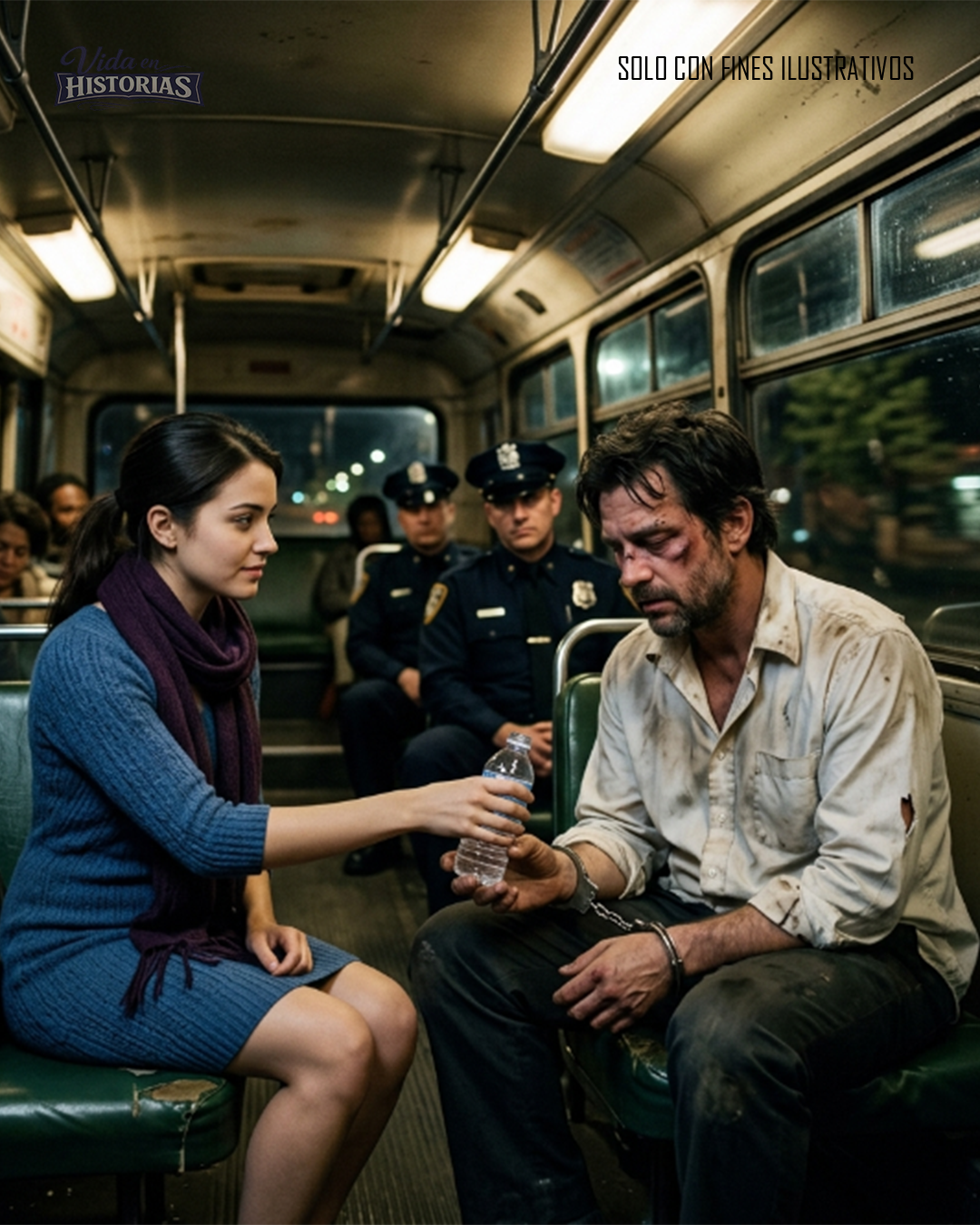
Hours passed. The truck wound its way through the cold, winding road. The police officers fell asleep. Then I heard ragged breathing, like that of a wounded animal. I looked up and saw the man staring at my water bottle. His lips were dry, blood caked in the cracks.
I knew I shouldn’t go near it. But I also knew what it was like to be so thirsty my throat felt like it was closing up. I remembered Maribel, a coworker from the factory who fainted from heatstroke and never woke up again.
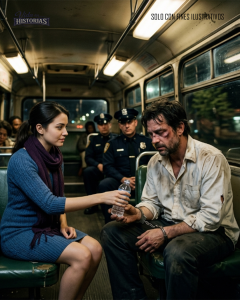
Trembling, I took out my shawl and arranged it to block the police officers’ view. I approached the man and placed the mouth of the bottle to his lips. He drank slowly, with barely contained desperation, without making a sound. When he finished, he looked at me with eyes that no longer seemed those of a murderer.
—Thank you —she whispered.
I returned to my place with my soul pounding in my chest.
At dawn, when the bus arrived at the Puebla terminal, the police stopped it. There was pushing, shouting, and people trying to get off at the same time. Suddenly, the handcuffed man lunged at my bag and kicked it furiously. My blankets, my clothes, and my belongings were scattered all over the aisle.
“Get out of the way, you annoying old woman!” she yelled at me, as if I had done something to her.
My face burned with shame. People murmured. The police subdued him and dragged him off the road, beating him. I gathered my things, tears streaming down my face, not understanding why he had humiliated me after I had helped him.
Before disappearing among the police officers, he turned around only once. His gaze held no hatred. It held pleading.
She couldn’t believe what was about to happen…
PART 2
I arrived in my village with a torn purse and an even more broken heart. My house was the same as always: adobe walls, a tin roof, wood smoke, and chickens scratching in the yard. But this time there was no hug.
My mother snatched the bag from me as soon as I crossed the threshold.
“Did you bring this? Rags? Trash?” he spat.
My father, sitting on a bench, didn’t look up. He only said:
—We’ve already arranged your future.
I felt the blood drain to my feet.
My mother explained to me, as if she were talking about selling a pig, that Don Eusebio, the village butcher, a widower, a drunk, and notorious for beating women, had given money “in advance.” According to them, I was supposed to marry him after Christmas so that my older brother could open a shop.
—You’ve already worked a lot outside the home—my mother said. Now it’s your turn to serve the family.
That night I locked myself in the room where I slept as a child. I cried until I had no tears left. I thought about taking out my fifteen thousand pesos and running away back to the capital, but when I checked the torn bag, I found something that wasn’t mine.
It was a small, hard plastic roll, hidden inside an old blouse. I carefully opened it. Inside was a piece of brown paper stained with dried blood. The writing was crooked, scribbled in desperation.
“My name is Ramón Salgado. If this note reaches the girl who gave me water, I beg you by the Virgin Mary not to throw it away. I killed a man and I will pay for it, but I am not a thief. The factory engineer kept the Christmas bonus of thirty workers. My wife Teresa needs urgent surgery. My daughter Alma has no one to take care of her. I buried the recovered money behind the abandoned chapel of Saint Jude, next to the old textile factory in Atlixco, under the large root of the pepper tree. Take some for your help, but give most of it to Teresa. If you don’t, my soul will have no rest.”
I was frozen.
The blow to my bag wasn’t out of anger. It was a message. He chose me because I gave him water when everyone else looked at him like he was trash.
Outside, my mother was talking to my father about the wedding, as if my life no longer belonged to me. At that moment, I understood that if I stayed, I would die a little inside. Before dawn, I took my money, put the note away, and left without saying goodbye.
I traveled to Atlixco in an old truck, with an empty stomach and sweaty hands. I found the factory at nightfall: high walls, broken windows, a heavy silence. The abandoned chapel was behind it, overgrown with grass. And next to it, the pepper tree.
I dug with my fingernails and a stone. The earth was hard. I cut my fingers, cried with fear, but I kept going. Until I touched a bag wrapped in black plastic.
Inside there were bundles of banknotes.
I couldn’t breathe.
The next morning I looked for Teresa in a tenement near the factory. A neighbor pointed me to a dark room at the back. There I found a pale woman, consumed by fever, now a five-year-old girl trying to heat stale tortillas on a cold griddle.
“Are you Teresa?” I asked.
The woman looked at me with fear.
I put most of the money on the bed.
—Ramón asked me to give it to him.
Teresa opened her eyes as if she had seen a ghost. She hugged the banknotes and then burst into tears.
“He didn’t kill out of greed,” she said between sobs. “That man didn’t just steal his Christmas bonus… that wretch also…”
At that moment someone knocked loudly on the door.
And just before Teresa finished the sentence, I knew that the truth had not yet come out in full.
PART 3
The girl hid behind the bed. Teresa clutched the money to her chest, trembling. I thought they were police officers, or worse, men from the factory looking for what Ramón had hidden.
But it was a neighbor with a bowl of watery broth.
“Sorry, I thought I was still alone,” she said, looking at the money in amazement.
Teresa asked me to close the door. When the neighbor left, she told me everything.
The engineer hadn’t just stolen the Christmas bonus. He’d also fired several workers who tried to complain. Ramón went to beg him for the money because Teresa needed surgery. The man mocked him, had his guards beat him, and days later, went to Teresa’s room to threaten her, demanding that her husband stop insisting. He pushed her. She fell, bled, and nearly died.
Ramón lost his temper. He went looking for him. They argued. There was a struggle. Ramón took a knife from the same office and killed him. Afterward, he recovered the money the engineer had saved, not to get rich, but to save his wife and daughter.
“My Ramón made a mistake,” Teresa cried, “but he wasn’t a bad person. He was just desperate.”
I didn’t know what to say. I just helped her up. That same day I took her to the hospital, paid the initial expenses, and left the baby with a trusted neighbor. Then I took the share Ramón had said was for me and left.
I did not return to my village.
I returned to Mexico City and, with that money, rented a corner in a clothing market in La Lagunilla. I bought a used sewing machine and started making blouses, skirts, and school uniforms. I slept under the stall, ate very little, and worked until my fingers were raw.
Every time I wanted to give up, I remembered Ramón drinking water as if that sip were his last chance to remain human. I remembered Teresa crying on the bed. I remembered Alma, the skinny little girl who looked at me as if I had brought a miracle.
Years passed. My stall grew. Then I had two. Later, a workshop. By the late nineties, I was selling clothes to several states. People started calling me Doña Guadalupe. I, who one day arrived with a torn bag, ended up providing work for dozens of women who, like me, had fled homes where they wanted to sell them, silence them, or break them.
My family showed up when they found out I was doing well. My mother arrived with my father and Don Eusebio, still claiming that I “belonged to her” because she had paid for me.
I received them at the entrance of the workshop.
“No woman is bought or sold here,” I told them.
My father wanted to talk about blood. My mother wanted to talk about obedience. Don Eusebio wanted to shout. I called security and placed in their hands an envelope with the exact amount of money they had once received.
“This pays their debt,” I said. “But what they did to me can never be repaid. Don’t come back.”
I didn’t cry when they left. I was no longer the girl who hung her head in shame.
For years I sent Teresa money anonymously. I also paid for children’s education in that neighborhood without revealing my name. I never had the courage to return. I was afraid of finding out that the surgery hadn’t worked or that Alma was left alone.
But life always finds a way to close its circles.
In 2008, terrible rains flooded entire communities in Veracruz. I organized trucks with food supplies, blankets, and medicine. I went personally, because someone who has been cold can’t just watch others suffer from the cold.
In a makeshift shelter, after three days without sleep, I collapsed from exhaustion. When I woke up, I was on a stretcher. A young doctor was holding a cup of hot water for me.
“Take it slowly, Doña Guadalupe,” she told me. “She’s very weak.”
When I touched the mug, I saw, next to my things, an old green aluminum canteen. It had a dent in the base. Exactly like the one I had that night in the truck.
The doctor noticed my gaze.
“It belonged to my father,” she said with a sad smile. “My mother said that one day, before he died, he received water from a stranger. Thanks to that woman, he was able to leave her a message. Thanks to that message, my mother lived and I studied medicine.”
I felt like the world stopped.
“What’s your name?” I asked, even though I already knew the answer.
—Alma Salgado.
I couldn’t hold back my tears. She was scared, but I took her hands.
“Your father didn’t die forgotten,” I told him. “And your mother wasn’t saved by me. She was saved by his love.”
Alma hugged me, not understanding everything, but feeling everything. Later I learned that Teresa had lived many years after the operation, long enough to raise her daughter and tell her that the smallest act of kindness can change an entire destiny.
That night, amidst the mud and rain, I understood that life doesn’t return what you give in the same way, nor in the same place. Sometimes you give half a bottle of water to a man in chains, and twenty years later, his daughter restores your faith when you’re most weary.
That’s why I never underestimate a small act of compassion. Because no one knows when a trembling hand, an open door, or a drink of water might save not just one life, but many generations.
