Physical Address
304 North Cardinal St.
Dorchester Center, MA 02124
Physical Address
304 North Cardinal St.
Dorchester Center, MA 02124

My name is Rafael Medina Vargas, I am fifty-two years old, and for twenty-three years I believed that my marriage to Verónica Salcedo Rivas was one of those solid structures that neither time nor storms could bring down. We lived in a comfortable house in the Del Valle neighborhood of Mexico City. I worked as an industrial engineer for an infrastructure company, with long hours, constant trips to Querétaro, Puebla, and Monterrey, and exhaustion ingrained in my bones like a second skin.
Verónica stopped working five years after we got married. She said she preferred to take care of the house, manage our finances, and be with me for important events. We never had children. At first, that hurt, then it became a silence we learned not to break. I compensated for her absence by working more, buying more, paying for trips, dinners, clothes, insurance, renovations. I thought that maintaining a quiet life was a way of loving her.
My father, Don Salvador Medina Torres, was seventy-six years old and lived alone in a modest apartment in the Santa María la Ribera neighborhood. My mother had died eight years earlier from a sudden heart attack, and since then, Dad had clung to his independence with a dignity that broke my heart. Every Sunday we ate together. He would make coffee, buy sweet bread, and we would talk about simple things: the weather, the América soccer team, the neighbors, memories of my childhood.
Everything changed one morning in March, when the hospital’s oncologist called me.
—Mr. Medina, I need you to come. It’s about your father.
When I arrived, I found Dad sitting on the stretcher, with his hands clasped and a serenity that frightened me more than any crying.
The diagnosis was brutal: advanced pancreatic cancer. The doctor spoke of palliative treatments, of pain, of months, maybe weeks. I could barely breathe. Dad, on the other hand, put a hand on my shoulder.
—Relax, son. Nobody stays forever.
Two days later I decided to take him home. We had a large, bright guest room overlooking a small interior garden. It seemed absurd to leave him alone or put him in a clinic when he could still sit with me watching old movies and telling stories.
When I told Veronica during dinner, her reaction left me speechless. The fork just hung suspended in her hand.
—Is your dad going to live here?
—Yes. It needs constant care.
—Rafa, have you thought about a specialized place? There are some very good residences. Medical staff, nurses, all that.
—He’s my father, Veronica. Not an old piece of furniture that no longer fits in the house.
She pressed her lips together.
—I was only thinking about what was best for everyone.
At that moment I wanted to believe him.
Dad moved in on a rainy Friday. He brought two suitcases, a photo of my mother, a toolbox, and an old gold alarm clock that he said brought him luck. We set up his bed by the window. I gave him a comfortable chair, a small table for his medicine, and a warm-light lamp.
The first few months were painful, but also beautiful. I would leave work early to have dinner with him. We would watch Pedro Infante movies, listen to boleros, and sometimes talk about Mom until we were silent. Dad was getting thinner every week, but his mind remained sharp. He observed everything. He observed too much.
Veronica began to change. At first, there were small comments.
—The house smells like medicine.
—We can no longer invite anyone.
—This is ruining our lives.
Then came the money.
The appointments, nurses, medications, and treatments began to devour my savings. One night, while I was reviewing bills in the dining room, Veronica stood in front of me with her arms crossed.
—Rafael, this can’t go on like this.
-I know.
“We’re spending a fortune. Perhaps it would be more humane to let him go peacefully in a hospice.”
I looked up, incredulous.
—Are you telling me to abandon my dying father to save money?
—Don’t put it like that. I’m just saying we should also think about our future.
That night I slept on the sofa.
I never imagined that, while I held my father’s hand in his early mornings of pain, she was counting the days until he died.
In October, Dad’s condition worsened. He lost so much weight he looked like he was made of paper. His skin turned yellowish, his voice almost a whisper. My sister Mariana, who lived in Guadalajara, took the first flight when the doctor said it was just a matter of hours.
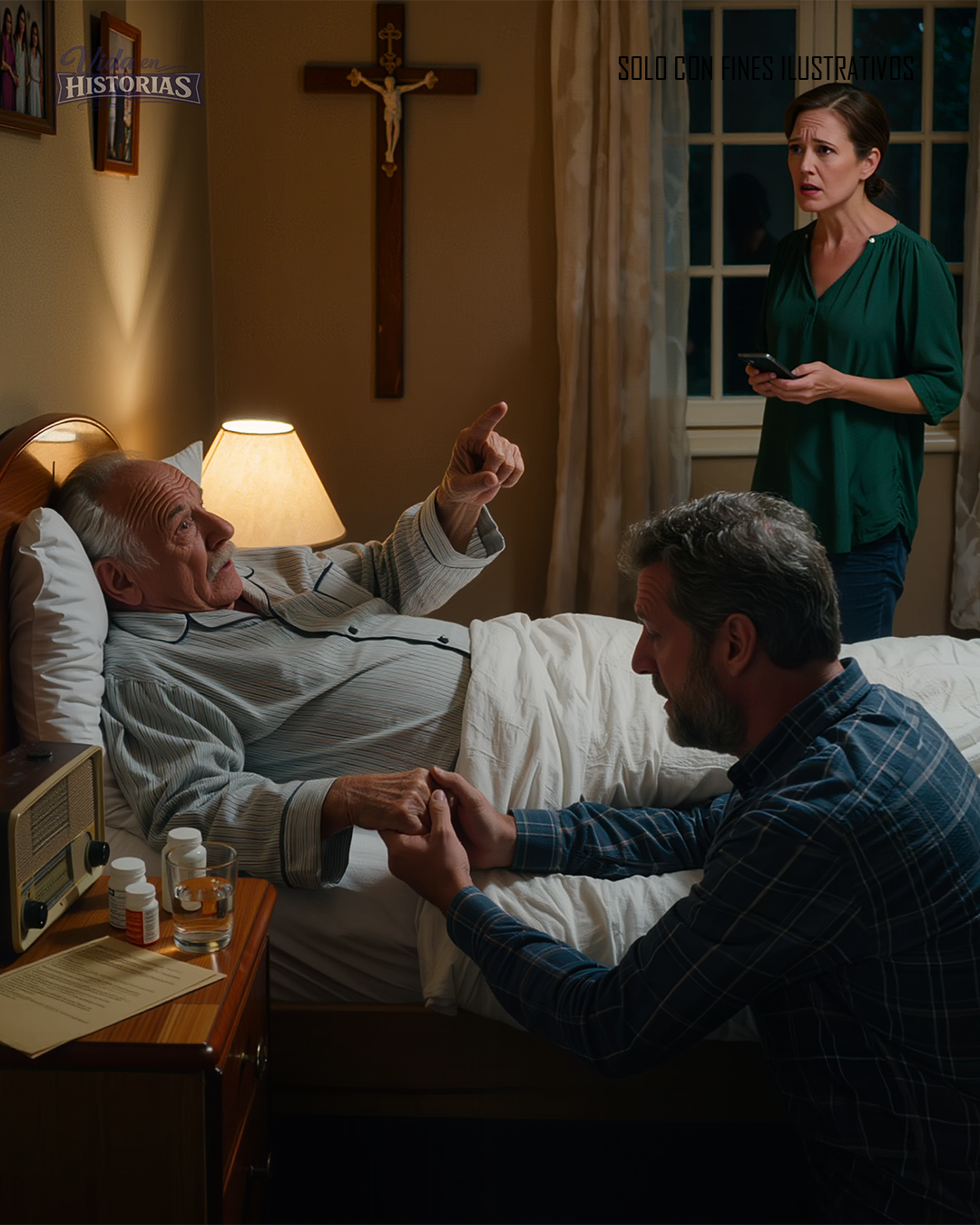
In the early hours of October 14th, Dad’s breathing began to shorten. Mariana was crying silently on the other side of the bed. I was holding his right hand. Verónica was near the window, holding her cell phone, pale, distant, as if she were waiting for an awkward meeting to end.
At three thirty, after hours of unconsciousness, Dad opened his eyes.
“Son,” he whispered.
I approached.
—Here I am, Dad.
His hand squeezed mine with unexpected force. Then he slowly turned his head toward Veronica. She straightened up abruptly. Her cell phone almost fell.
—Verónica—my father said in a hoarse but clear voice—. You’re finally going to get what you wanted.
The silence fell like a stone.
Mariana stopped crying. I looked at my wife, confused.
“Don Salvador is delirious,” she murmured.
Dad barely smiled. It wasn’t a sweet smile. It was the smile of a man who knew something the rest of us didn’t.
—But you don’t know what awaits you.
I felt a chill.
—Dad, what are you saying?
He made a weak gesture towards the drawer of the small table.
—On white paper. Read it when you’re alone. Just you.
-I don’t understand.
—Promise me, Rafael.
-I promise you.
He looked at Mariana.
—Take care of your brother. He’s going to need it.
Then he turned his eyes towards me.
—It wasn’t your fault for trusting.
At 3:47 in the morning, Don Salvador breathed his last.
The funeral was two days later. More people came than I expected: neighbors, former coworkers, domino friends, distant cousins, people I didn’t even know my father had helped. Veronica was there, dressed in black, greeting everyone politely, but several times I saw her hiding behind a column, checking her phone.
That night, when she got home, she left a note in the kitchen: “I took a pill. I need to sleep. Don’t wake me up.”
I went into Dad’s room. It still smelled of lotion, medicine, and goodbye. I sat in his chair, facing the window. The white envelope was in the drawer.
I opened it with trembling hands.
Inside was a letter written in his irregular handwriting and a black USB drive.
“My son,” he began, “if you read this, I am no longer with you. Forgive me for leaving you with this pain, but I needed to protect you. Veronica has been betraying you for years. Not only with another man. Also with your money.”
I felt the air disappear.
The letter said that Dad had overheard Veronica talking on the phone when she thought he was asleep from the morphine. He heard her say, “When the old man dies, Rafael will be so broken I can make him sign the rest of the paperwork. Then I’ll file for divorce, and Bruno and I will go to Puerto Vallarta.”
Bruno.
I didn’t know any Bruno.
I kept reading. Dad had hidden a recorder inside his old alarm clock. For weeks he recorded conversations. Veronica was talking to that man, making fun of me, planning to move money, to sell a beach apartment in Acapulco that I had bought with my savings and that, for some supposed tax strategy, I had put in her name.
“Listen to your memory when you have the strength,” Dad wrote. “Don’t act in anger. Act with intelligence. The fault lies not with the one who trusts, but with the one who betrays that trust.”
I connected the USB to my computer.
The first recording destroyed me.
“Bruno, my love, it won’t be long now,” Veronica’s voice said, sweet, flirtatious, unrecognizable. “The old man won’t last past this month. Rafael is so naive he’ll sign whatever I ask. In February we’ll be free.”
I ran to the bathroom and vomited.
I don’t know how long I spent in that apartment, crying like a child, pounding the tiles with my fists. Twenty-three years. Twenty-three years devoted to a lie.
For three nights I listened to all the audio recordings. Each file was a stab in the back. Verónica called me “the supplier,” “the boring one,” “the office idiot.” She mocked my anniversaries, my tiredness, the way I cried watching movies. With Bruno, she talked about transfers, secret accounts, jewelry, trips. The worst came in a recording from September: Bruno asked her if he couldn’t increase my father’s morphine dose to “speed up the inevitable.” She replied that she had considered it, but it was too risky.
They didn’t do it out of fear. Not out of humanity.
That truth turned me into a different man.
On the fourth day I called Roberto Márquez, an old lawyer friend.
“I need help,” I told him. “And I need absolute discretion.”
Roberto put me in touch with Félix Ramos, a former judicial agent and now a private investigator. We met at a coffee shop in the Roma neighborhood. I gave him the USB drive, bank statements, names, and schedules.
“Don’t confront her,” Felix told me. “If she suspects anything, she’ll destroy evidence. For three weeks, you’ll be the same husband you’ve always been.”
That’s how my silent hell began.
Every morning I kissed Veronica’s cheek before leaving. Every night I had dinner with her while pretending not to know her messages were going to Bruno. She would ask me if I was eating, if I was sleeping, if I missed Dad a lot. Her fake tenderness made my stomach churn.
I lost eight kilos in a month. I slept three hours a night. In the mirror I saw an aged man, but I also saw something new: determination.
Félix found everything. Bruno Salcedo Lira owned a textile company in Polanco, was divorced, in debt, and charming. He’d been with Verónica for three years. There were photos, messages, hotel reservations, and bank transfers. Verónica had withdrawn more than 700,000 pesos from our accounts in small amounts. The Acapulco apartment already had a private sales contract for February.
When Felix handed me the folder, I felt like I was being torn apart again.
“Mr. Medina,” he said, “you have enough to destroy his plan. But do it with a cool head.”
Roberto prepared the divorce petition, the steps to freeze the sale of the apartment, and the fraud claim. We also froze joint accounts and protected my savings. All legal. All documented.
The day of the confrontation arrived on a Friday at four in the afternoon.
Veronica was in the living room watching a series when the doorbell rang. I opened the door. A court officer entered with a large envelope.
—Mrs. Veronica Salcedo Rivas, you are hereby notified of the divorce lawsuit filed by Mr. Rafael Medina Vargas.
She stood up, white as a sheet.
—What is this, Rafael?
I didn’t answer. I laid out the photographs, the bank statements, the transcripts, and a copy of the Acapulco contract.
Veronica first denied it. Then she screamed. Then she cried. She tried to blame me for working too much, for neglecting her, for not making her happy.
“I was alone,” she sobbed.
I looked at her with a calmness that surprised me.
—You weren’t alone. You were ambitious.
When she saw the message about my father’s morphine, she stopped talking. Her legs gave way and she fell back down.
“I’ve lost everything,” she whispered.
“No,” I replied. “You threw it all away. There’s a difference.”
Before leaving the dining room, I stopped and said the words that my father had planted in my heart:
—Dad was right. You finally got what you wanted, Veronica. But you didn’t know what was coming.
The process lasted months. Bruno disappeared as soon as he realized there wouldn’t be any easy money. Later we learned that he had also deceived Verónica. He had debts, lawsuits, and another woman in Querétaro. He abandoned her without even facing her.
The judge annulled the sale of the Acapulco apartment. Verónica had to return part of the embezzled money and lost any chance of keeping the assets she had tried to hide. It wasn’t a joyous victory. It was justice. And sometimes justice doesn’t feel like a celebration, but like the silence after a storm.
Mariana came from Guadalajara and stayed with me for several weeks. At first, I couldn’t go into Dad’s room without breaking down. She would keep me company, open the windows, change the sheets, and make coffee in a clay pot, just like he used to.
One Sunday, he found the old golden alarm clock in a box.
“This watch saved your life,” he said.
I took it in my hands.
—No. Dad saved my life.
With the money I recovered, I bought the shop where my father had worked as an electrician when he was young. It was abandoned, with a rusty curtain and stained walls. We renovated it and opened a small community workshop called Don Salvador. There, we teach basic trades to underprivileged youth: electricity, welding, and appliance repair.
On opening day, I hung a photo of Dad in the entrance. In the picture, he was young, his hands were greasy, and he had a shy smile.
Mariana hugged me.
—I would be proud of you.
I looked at the photo with tears in my eyes.
—I am proud to have been his son.
A year passed. The house stopped feeling like a mausoleum. Sundays once again smelled of coffee. My nephews ran around the yard. In the workshop, the boys laughed, learned, and sometimes called me “teacher,” although I told them that the real teacher was the man in the photo.
I don’t know if I’ll ever get married again. I’m still learning to trust. But I no longer wake up angry. I no longer walk around like a defeated man. My father left me with a wound, yes, but he also left me a way out.
Veronica wanted to keep my money. Bruno wanted to keep my future. But Don Salvador, from his deathbed, gave me back something that no one could take from me: the truth.
And now, every time I close the workshop at night and hear the old alarm clock ticking the hours from a shelf, I feel that Dad is still with me, telling me like he did when I was a child:
—Come on, Rafa. Life isn’t over yet.
And for the first time in a long time, I believe him.
