Physical Address
304 North Cardinal St.
Dorchester Center, MA 02124
Physical Address
304 North Cardinal St.
Dorchester Center, MA 02124

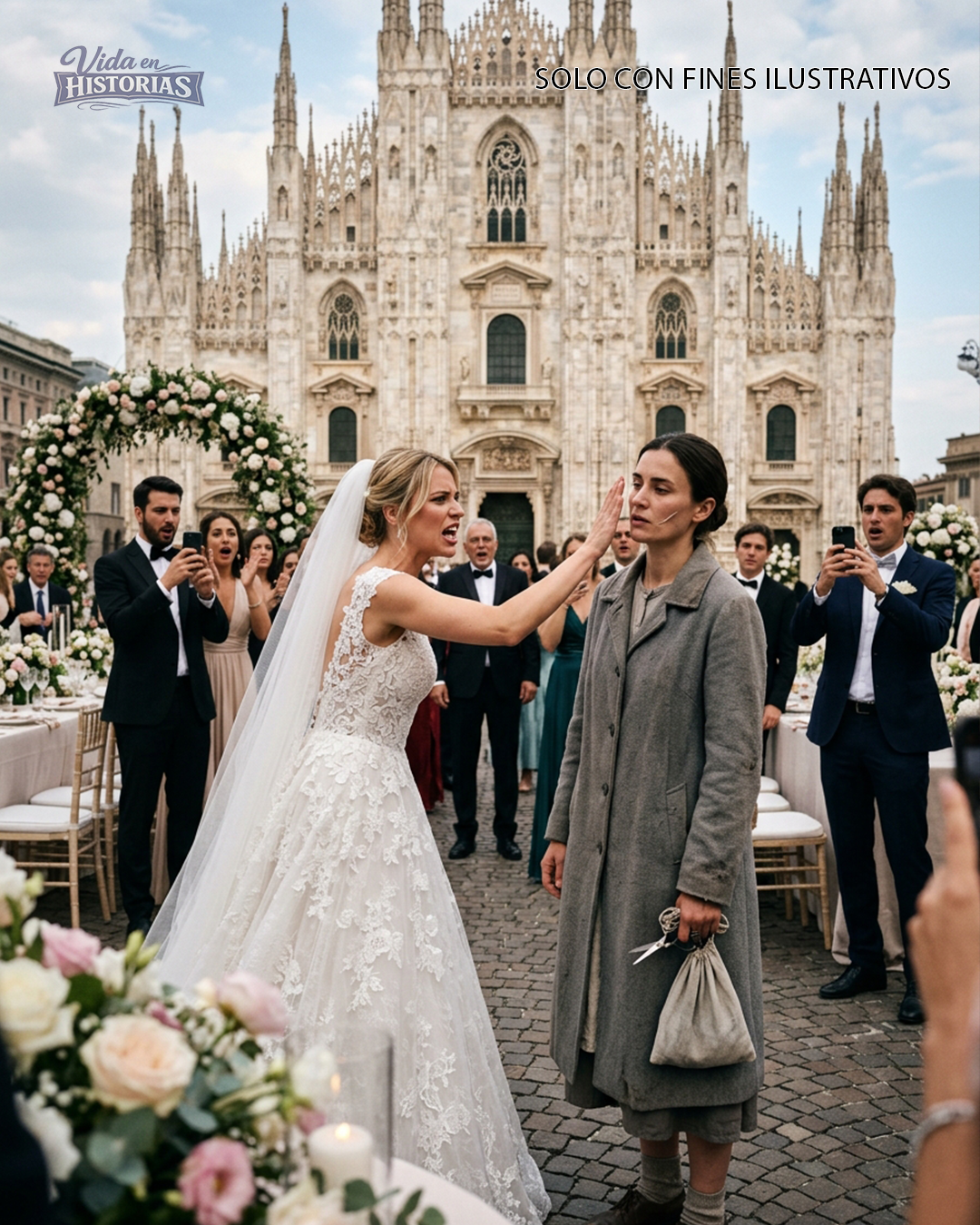
The scissors made one quiet click.
That tiny sound cut through the whole courtyard louder than the slap had.
The bride’s smile disappeared first.
Then her father’s face went pale.
And for the first time that morning, nobody was laughing at the “nanny.”
My name is Elena Voss.
But that morning, they only knew me as “the help.”
Not the designer.
Not the founder.
Not the woman whose private atelier had spent eleven months creating the wedding gown hanging behind the bride like a museum piece.
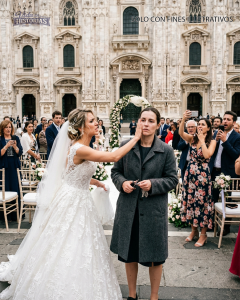
To them, I was just the tired middle-aged woman in old gray clothes carrying fabric bags through a luxury wedding beside Milan Cathedral.
And to the bride, that made me useful.
Until it made me embarrassing.
Her name was Madison Vale.
Twenty-four years old.
A self-proclaimed luxury lifestyle influencer.
The kind of woman who said “my brand” every three minutes and treated waiters like furniture.
She had rented half the courtyard near the cathedral for her wedding.
White roses.
Gold chairs.
Champagne towers.
A violin quartet.
A drone camera.
A social media team.
And, of course, my gown.
She had been bragging about it all morning.
“There is only one in the entire world,” she told her bridesmaids, turning slowly while three phones recorded her. “This dress was made for royalty-level women.”
I was standing five feet away when she said it.
Holding the garment bag.
Quiet.
Invisible.
That was fine with me.
I had learned a long time ago that truly wealthy rooms are not loud.
Insecure rooms are.
Madison’s stylist, Clara, knew exactly who I was.
She had signed the delivery documents herself.
She kept glancing at me nervously, as if she wanted to warn Madison to stop talking.
But Madison was drunk on attention.
She pointed at me with one manicured finger.
“Why is she still here?”
Clara swallowed.
“She’s with the atelier.”
Madison laughed.
“That? She looks like she folds napkins in a basement.”
A few bridesmaids giggled.
One of the groomsmen lifted his phone higher.
I said nothing.
Madison stepped closer.
Her perfume hit before her words did.
“Do you understand what kind of wedding this is?” she asked me.
“Yes.”
“Then why are you dressed like that?”
I looked down at my gray jacket, black trousers, flat shoes.
They were plain, yes.
They were also the clothes I wore when I handled fragile silk, beadwork, and antique lace.
I said, “I came to ensure the gown arrived safely.”
Madison tilted her head.
“Oh, how noble.”
Then she turned to the camera and smiled.
“Look, everyone. Even the nanny thinks she’s part of the fashion moment.”
The comments were probably exploding online.
The guests laughed because they thought they were supposed to.
That is how public cruelty works.
One person starts it.
Weak people join in.
Then everyone pretends it was harmless.
I reached for the garment bag to finish my work.
Madison slapped my hand away.
“Don’t touch my dress again.”
Clara whispered, “Madison, please—”
Madison snapped, “Don’t correct me in front of my guests.”
Then she grabbed the collar of my jacket.
Before I could step back, she yanked.
The seam ripped open with a loud, ugly sound.
Gasps.
Phones.
A bridesmaid covered her mouth and laughed anyway.
Madison held the torn flap between two fingers like it was trash.
“There,” she said. “Now it matches her job.”
My face burned.
Not from shame.
From memory.
Because I had once been that poor.
I had once been the woman nobody looked at twice.
I had once sewn hems for women who threw dresses on the floor and called me “girl” even after my hair turned gray.
But I had not built Voss Maison to become cruel back.
I built it so no one could own my hands again.
Then Madison slapped me.
Hard.
Across the face.
The courtyard went silent for half a second.
Then someone whispered, “Oh my God.”
Madison’s mouth curved into a satisfied smile.
She lifted a black-and-white maid costume from a chair and shoved it against my chest.
“Put this on,” she said. “Or get out of my wedding photos.”
Her mother, seated under a white umbrella, waved one lazy hand.
“Honestly, just change. Don’t make the bride upset.”
That was the moment I stopped seeing a spoiled girl.
I saw a business risk.
Because Madison was not wearing a purchased gown.
She was wearing a loaned couture piece under a strict private-use contract.
A gown valued at nearly $740,000.
A gown protected by a morality clause, handling clause, image clause, and ownership clause.
A gown she had never owned.
And now she had assaulted the founder’s representative.
Me.
I did not announce it.
I did not threaten her.
I quietly picked up my torn jacket seam and placed it in my bag.
Then I checked the small lapel camera I had clipped beneath my scarf.
Still recording.
Clara saw me do it.
Her eyes widened.
I gave her the smallest shake of my head.
Not yet.
Madison turned back toward the mirror.
“Now,” she said, “somebody fix the train. I’m about to go live.”
That was when I took out the scissors.
Not kitchen scissors.
Not craft scissors.
My own silver tailor scissors.
The same pair I had used the first year I opened my studio.
The groom’s father stood up.
He was a red-faced hotel investor named Richard Hale.
He had spent the morning telling everyone he had “secured the most exclusive dress in Europe.”
When he saw the scissors, panic flashed across his face.
“Wait,” he said. “What are you doing?”
Madison spun around.
“Put those down. Are you insane?”
I walked past her.
Straight to the gown.
The entire courtyard froze.
Every phone followed me.
Even the violinists stopped playing.
I touched the outer layer of the skirt.
Italian silk.
Hand-beaded.
Hundreds of hours of work.
A beautiful thing.
Wasted on a woman who thought beauty gave her permission to be ugly.
Madison lunged toward me.
Clara stepped in front of her.
“Don’t,” Clara whispered.
Madison screamed, “Move!”
I looked at Madison and said, calmly, “You told everyone this was your dress.”
“It is my dress!”
“No,” I said. “It is my work.”
Then I cut.
One clean line through the removable ceremonial overskirt.
Madison shrieked like I had cut her skin.
Guests jumped from their seats.
Her livestream caught everything.
The scissors moved again.
A strip of silk fell to the marble floor.
The dress beneath remained intact, but the dramatic outer shell — the part she had planned for her viral entrance — was gone.
Destroyed.
Legally.
Precisely.
Madison grabbed her chest.
“You ruined my wedding!”
I turned toward the guests.
“No. I protected my property.”
Richard Hale stormed forward.
“Do you have any idea who paid for this?”
I reached into my bag and handed Clara a leather folder.
She opened it with shaking hands.
Inside were the contract, the loan agreement, the morality clause, the image-use restrictions, the insurance rider, and my identification.
Clara read the first page out loud because her voice was trembling too much to lie.
“Voss Maison retains full ownership of the commissioned couture garment until final transfer approval…”
Madison’s mother stood up.
“What does that mean?”
I said, “It means she never owned it.”
Madison shook her head.
“No. My father paid.”
“You paid a reservation fee,” I said. “Not ownership transfer. The remaining balance was due after final conduct approval and private inspection.”
Richard’s face changed.
He knew.
That was the part nobody expected.
He knew the transfer had not cleared.
He had told Madison it had because he wanted her influencer wedding to look richer than it was.
Madison turned slowly toward him.
“Dad?”
Richard’s mouth opened.
Nothing came out.
I continued.
“Your contract also prohibits public abuse of staff, brand defamation, unauthorized livestream monetization, and use of the gown in degrading or violent content.”
Madison pointed at me.
“She attacked my dress!”
Clara lifted the tablet.
“No,” she said softly. “You attacked her first.”
Then she played the video.
Not the livestream.
Not a guest clip.
The full lapel-camera recording.
Madison mocking me.
Ripping my jacket.
Slapping me.
Ordering me into a maid costume.
Every word.
Every laugh.
Every entitled little smile.
The courtyard changed.
It was almost physical.
People who had laughed lowered their phones.
People who had filmed suddenly looked ashamed.
One older woman whispered, “That poor lady.”
Madison heard it.
That destroyed her more than the scissors did.
Because women like Madison can survive being hated.
They cannot survive being pitied.
Then my attorney arrived.
He had been sitting in a car two streets away because I already suspected trouble.
Not because I expected violence.
Because three days earlier, Madison’s assistant had emailed our atelier asking if Madison could “stage a funny scene with a poor-looking helper” for content.
We refused.
She did it anyway.
My attorney served the emergency brand withdrawal notice in front of everyone.
The gown was removed from Madison’s body in the private bridal room by two female staff members and Clara.
She was not left exposed for spectacle.
She was given a robe.
That mattered to me.
I wanted justice.
Not cruelty.
But the public part?
That was already done.
Because her own livestream had shown the world exactly who she was.
Within one hour, the wedding hashtag collapsed.
Sponsors deleted her.
The luxury makeup brand pulled its collaboration.
The bridal magazine canceled the feature.
The cathedral venue banned her family from future events.
And Voss Maison filed claims for breach of contract, brand damage, garment alteration, unauthorized monetized use, and assault documentation.
Madison’s father tried to settle quietly.
My attorney refused the first offer.
Then the second.
Then the third.
Not because I needed the money.
Because quiet settlements are how rich cruelty survives.
The final agreement required public acknowledgment, full compensation for damages, and removal of every monetized wedding post using our gown.
Madison’s account was suspended after mass reports and sponsor complaints.
Her “luxury bridal era” ended in less than a day.
The wedding did happen.
But not the way she planned.
She walked down the aisle in an emergency sample dress from a local shop.
Plain.
Wrinkled at the hem.
No viral train.
No exclusive couture.
No royal fantasy.
Just a woman standing in front of 300 people who had watched her true face leak through the makeup.
The groom looked like he wanted the floor to swallow him.
Three months later, Clara opened her own styling agency.
I funded her first studio rack.
She had tried to stop Madison when everyone else stayed quiet.
That deserved to be remembered.
As for Madison?
The last time someone sent me a photo of her, she was modeling budget wedding dresses for a small online shop.
Standing under fluorescent lights.
Pinning polyester at the waist.
Smiling like she had learned nothing.
Maybe she hadn’t.
But I had.
I learned that silence is not weakness.
Sometimes silence is documentation.
Sometimes calm is a contract waiting to be opened.
Sometimes the woman carrying the dress is the only reason the dress exists.
I still keep the torn gray jacket in my private studio.
Not because it hurts.
Because it reminds my younger designers of one rule:
Never let anyone confuse kindness with permission.
And never, ever judge the person holding the scissors.
Share this if you believe dignity matters more than status — and choose a side: was Elena wrong to cut her own gown, or did Madison earn the most public lesson of her life?
