Physical Address
304 North Cardinal St.
Dorchester Center, MA 02124
Physical Address
304 North Cardinal St.
Dorchester Center, MA 02124

PART 1
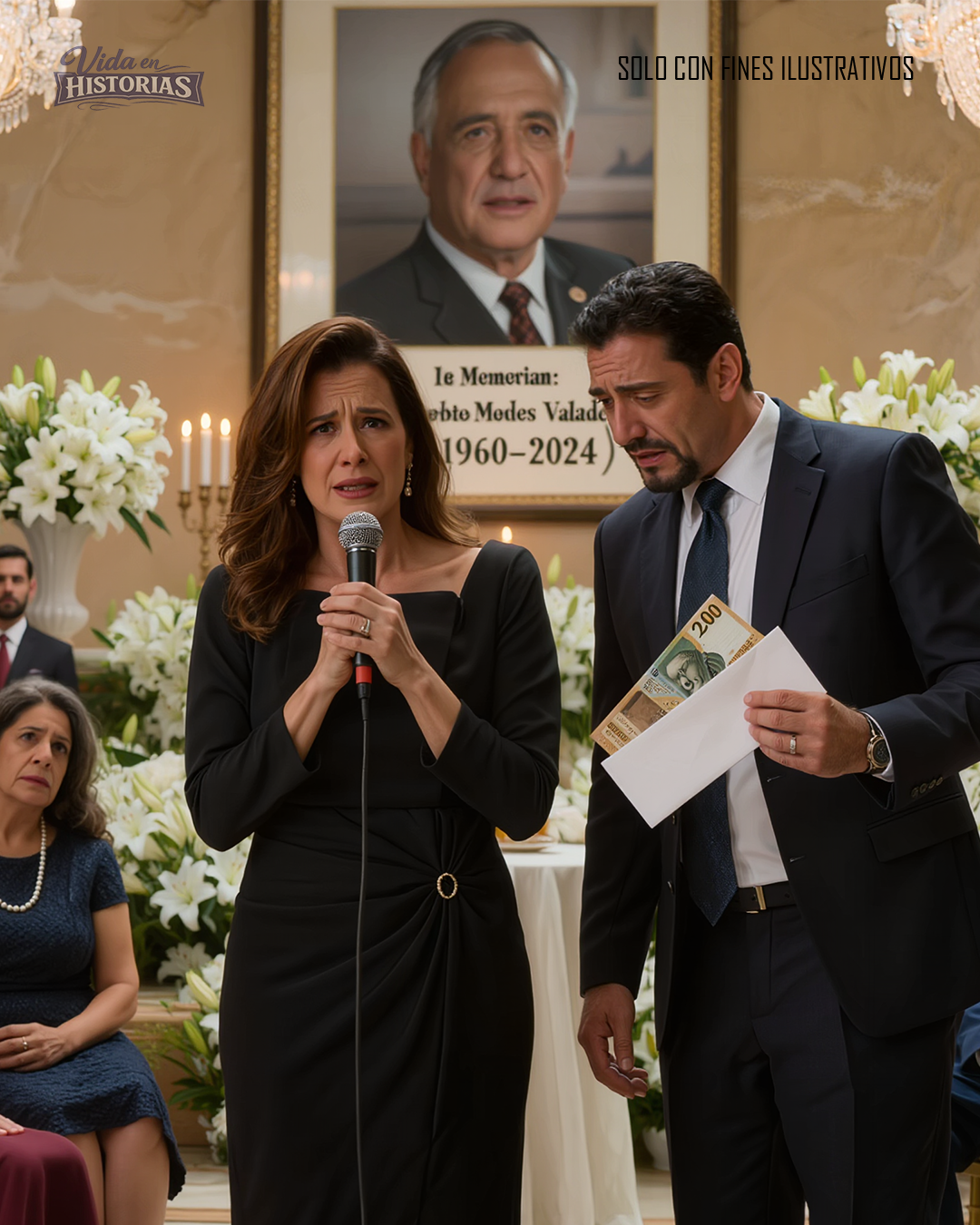
As soon as Rodrigo’s burial was over, Camila’s family didn’t ask her if she could breathe, if she had eaten, or if she needed someone to take her home.
The first thing she received was an audio message from her mother.
—Honey, remember that Rodrigo was supposed to help with your sister’s classroom. Don’t tell us you can’t do it right now.
Camila was standing outside the Mezquitán cemetery in Guadalajara, her shoes covered in mud and her black dress clinging to her body from the rain.
Her husband’s coffin had just been lowered into the ground.
And his family wasn’t there.
Nor Doña Teresa, her mother.
Not even Don Ramiro, his father.
Nor her younger sister, Brenda.
Nobody.
They had all promised to accompany her. They all knew that Rodrigo had died of a heart attack at 38, suddenly, without saying goodbye, without a last word.
But while Camila was burying the only man who had ever treated her with tenderness, they were at Brenda’s birthday party.
A room with mariachi music, golden lights, a dessert table, and a giant sign that read: “Brenda, 30 and fabulous.”
Camila found out because a cousin uploaded stories to Facebook.
There was his mother dancing with a drink in her hand.
Her dad applauding next to the cake.
Brenda in a red dress, smiling as if there was no other pain in the world that day.
In one photo, Doña Teresa wrote:
“With family who are always there.”
Camila read that sentence 3 times.
The family that is always there.
She felt something break inside her, but she didn’t cry anymore. She froze, as if her heart understood before her head.
He got into Rodrigo’s car, that old Tsuru he cared for as if it were new. The driver’s seat still smelled of his cheap supermarket cologne.
Then the cell phone rang.
It was his mother.
Camila answered, still with a foolish hope, thinking that perhaps he was going to ask for forgiveness.
-Mother…
—Finally, Camila. Listen, we’re in a big mess. The guy from the classroom is getting aggressive, and Brenda’s crying. Rodrigo said he was going to come up with 25,000 pesos. I need you to transfer them to me right now.
Camila squeezed the cell phone so hard that her fingers hurt.
—Mom, I just buried my husband.
On the other side there was an awkward silence, but not one of guilt.
—Yes, honey, I’m so sorry, really. But we can’t let people down. Your sister invited half of Zapopan. Rodrigo was very punctual, you know he never left debts.
Camila looked through the fogged-up windshield.
In the distance, a cemetery worker was collecting the last wet flowers.
—Didn’t you come because you were at the party?
—Oh, don’t start. Brenda only turns 30 once. Besides, you already went to the funeral. That’s what being her wife was for.
That phrase landed like a slap in the face.
Camila hung up without answering.
He blocked his mom. Then Brenda. Then his dad.
For several minutes he did not move.
He only heard the rain hitting the roof of the car, while a bitter thought grew in his chest.
Her family had not forgotten her.
He had abandoned her on purpose.
And I still didn’t know that Rodrigo, before dying, had left something prepared… something that was going to turn the family’s most elegant tribute into the most brutal humiliation of their lives.
PART 2
The following days, Camila lived as if she were walking inside a heavy dream.
The house was too quiet.
Rodrigo’s mug was still by the sink. His boots were in the entryway. His rake was in the bathroom. On the couch was the gray blanket they used to watch movies and eat tortas ahogadas with on Sundays.
Everything seemed to be expecting it.
But Rodrigo wasn’t coming back.
Camila started organizing papers because she didn’t know what else to do about the pain. She opened drawers, old boxes, bank folders.
On the desk he found a yellow envelope with his name written in his hand.
“For Camila, in case I’m ever gone.”
The lyrics were by Rodrigo.
He sat down before opening it, because his legs wouldn’t respond.
Inside there was a letter and a life insurance policy.
Camila knew Rodrigo paid for insurance, but she never imagined the amount. It wasn’t a fortune, but it was enough to pay off the house, cover debts, and start a new life without having to ask anyone for a penny.
In the letter, Rodrigo asked her not to let anyone make her feel less than.
“Cam, you always carry guilt that isn’t yours. If I’m ever gone, use this to live in peace. Not to solve the problems of someone who only comes to you when they need something.”
Camila dropped the paper and covered her mouth.
She cried like she had never cried before, not even in the cemetery.
Because Rodrigo, even in death, continued to protect her.
His peace was short-lived.
Since Camila had blocked her mom, Brenda started writing to her from other people’s accounts.
“You’re such a drama queen.”
“My birthday wasn’t to blame for Rodrigo’s death.”
“He promised to help us. Don’t play the victim.”
Then came the message that changed his perspective:
“If Rodrigo were alive, he would be ashamed to see you so miserable.”
Camila read that line sitting in the kitchen.
She looked at the photo of Rodrigo stuck on the refrigerator, where he appeared with a huge smile carrying a bag of sweet bread.
And for the first time since the funeral, she didn’t just feel sadness.
He felt anger.
Not an outrageous rage.
A quiet, cold rage, the kind that doesn’t scream because a decision has already been made.
Brenda wanted an audience.
Doña Teresa wanted to be seen as a self-sacrificing mother.
His dad pretended not to see anything.
So Camila decided to give them exactly that: an audience.
He organized a tribute for Rodrigo.
Not in a small church, but in a beautiful hall in Tlaquepaque, with white flowers, candles, photographs, soft music, and food for everyone.
He invited Rodrigo’s co-workers, neighbors, friends, close relatives, and even those uncles who only showed up at weddings and funerals.
He also sent invitations to his mother, his father, and Brenda.
The card read:
“Celebrating the life of Rodrigo Salazar. A good man deserves to be remembered with the truth.”
Doña Teresa called from an unknown number.
Camila answered.
“My dear, we received the invitation,” her mother said sweetly, as if nothing had happened. “It’s wonderful that you’re finally doing something worthwhile for Rodrigo. Of course we’re going. Family must be united.”
Camila closed her eyes.
—Yes, Mom. Go. It’s important that you’re there.
—And then we’ll talk about what’s left to do, right?
The pending matter.
Camila almost laughed, but she bit her tongue.
—Sure. We’ll talk there.
On the day of the tribute, the hall was more crowded than expected.
There was a huge screen with photos of Rodrigo: on Sayulita beach, at a barbecue, fixing a leak at a neighbor’s house without charging him, hugging Camila at an inn.
People smiled through their tears.
Everyone said the same thing: Rodrigo was a good man. Noble. Hardworking. One of those who didn’t make a fuss, but were always there.
Then Camila’s family came in.
Brenda arrived in a royal blue dress, sparkly heels, and party makeup, as if she were going to a wedding.
Doña Teresa entered greeting everyone, hugging tightly, putting on the face of a devastated mother.
“Oh, my dear son-in-law,” she said aloud. “How much pain he left us with.”
Camila watched her from afar.
He felt no hatred.
She felt embarrassed for him.
Don Ramiro followed behind, serious, with his head down. He didn’t hug Camila. He only touched her shoulder and murmured:
—Don’t cause any trouble today, daughter.
She understood that he knew.
He knew everything.
And yet she had chosen to remain silent.
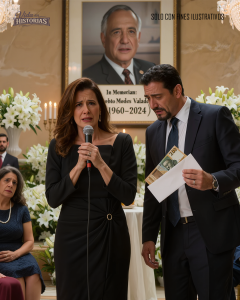
When Rodrigo’s video ended, Camila went up onto the small stage. She took the microphone. Her hands were trembling, but her voice wasn’t.
—Thank you for being here to honor Rodrigo. He was a man who helped many without boasting about it. That’s why today I want to do something that I’m sure would have made him proud.
Among the audience was Leo, a 21-year-old cousin, the son of a sick aunt. He worked as a delivery driver in the mornings and studied nursing at night, but was about to drop out because he owed tuition.
Camila called him to the front.
—Leo, please come here.
The boy stood up nervously. People began to murmur.
Camila took out a white envelope.
—Rodrigo always said you had a huge heart. This is to pay for your studies and so you can finish your degree. Don’t see it as charity. See it as a way for Rodrigo to continue doing good.
Leo opened the envelope and was speechless.
Then she started to cry.
—Cousin… that’s a lot.
“That’s only fair,” Camila replied.
The room applauded. A woman crossed herself. One of Rodrigo’s classmates wiped his eyes.
Doña Teresa did not applaud.
Neither did Brenda.
Both of them stared at the envelope as if something had been stolen from them.
Then Camila returned to the microphone.
—Perhaps some are wondering why I chose that amount.
The room listened attentively.
Doña Teresa stiffened.
—I chose 25,000 pesos because that was exactly what my mother asked me for on the phone minutes after I buried my husband.
Nobody spoke.
Not even the waiters moved.
Camila took a deep breath.
—As I was leaving the cemetery alone, with dirt still on my shoes, my mother called me to demand the money that, according to her, Rodrigo had promised for Brenda’s birthday party. The same party my family decided to attend instead of accompanying me to say goodbye to my husband.
A loud murmur rippled through the room.
Brenda stood up abruptly.
—That’s not true! You’re just bitter because nobody listened to you!
Camila did not raise her voice.
—I have the audio recordings.
Brenda’s face changed.
Doña Teresa opened her mouth, but said nothing.
Camila took her cell phone and signaled to the sound technician.
Doña Teresa’s voice could be heard over the speakers in the hall:
“Brenda only turns 30 once. Besides, you already went to the funeral. That’s what being her wife was for.”
Some people muttered a quiet “no way.”
Others looked at Doña Teresa as if they didn’t recognize her.
Then Brenda’s audio played:
“If Rodrigo were alive, he would be ashamed to see you so miserable.”
Leo clutched the envelope to his chest.
An aunt started crying with anger.
Don Ramiro covered his face with one hand.
Brenda shouted:
—Turn that off, you crazy woman!
But it was too late.
The mask had broken in front of everyone.
Camila looked at her mother.
—I didn’t deny them money out of selfishness. I denied it because for the first time I understood that you never saw me as a daughter, but as a petty cash fund.
Doña Teresa tried to approach.
—Camila, honey, it wasn’t that big of a deal. We all make mistakes. Family forgives.
—No, Mom. The family accompanies. The family doesn’t charge while a daughter buries her husband.
Brenda grabbed her purse and stormed out. Doña Teresa followed her, crying more from shame than remorse.
Don Ramiro stayed for a few seconds.
He seemed to want to say something, but he couldn’t.
He left too.
The living room door closed behind them.
And for the first time since Rodrigo’s death, Camila felt air in her lungs.
After the tribute, many people approached her to hug her. Some apologized for not having known. Others admitted that for years they had seen their family burden her with responsibilities that weren’t hers to bear.
Leo, still crying, promised her that he would finish the race.
“I’m going to do it for Rodrigo too,” he told her.
Camila smiled with a broken heart, but a clean one.
Weeks later, it came to light that Brenda had gone into debt because of her party. She had taken out loans hoping Rodrigo would pay her back. She had to sell her new truck and delete all the birthday photos because people wouldn’t stop commenting on them.
Doña Teresa tried to call many times.
Camila never answered.
Not out of pride.
For peace.
Months later, she sold the house. She kept Rodrigo’s most important things: his watch, his letters, a shirt that still held a little of his scent, and the photo where they were both laughing in front of the sea.
With part of the insurance money, he bought a ticket to Puerto Escondido, the trip Rodrigo always promised to take “when he could.”
Before boarding the plane, Camila looked at the sky and understood something that hurt, but also healed.
Sometimes the people who demand the most forgiveness are the ones who know the least about love.
And sometimes justice doesn’t come with shouting or revenge.
Sometimes it happens when a woman stops asking for permission to save herself… and finally chooses herself.
