Physical Address
304 North Cardinal St.
Dorchester Center, MA 02124
Physical Address
304 North Cardinal St.
Dorchester Center, MA 02124

PART 1
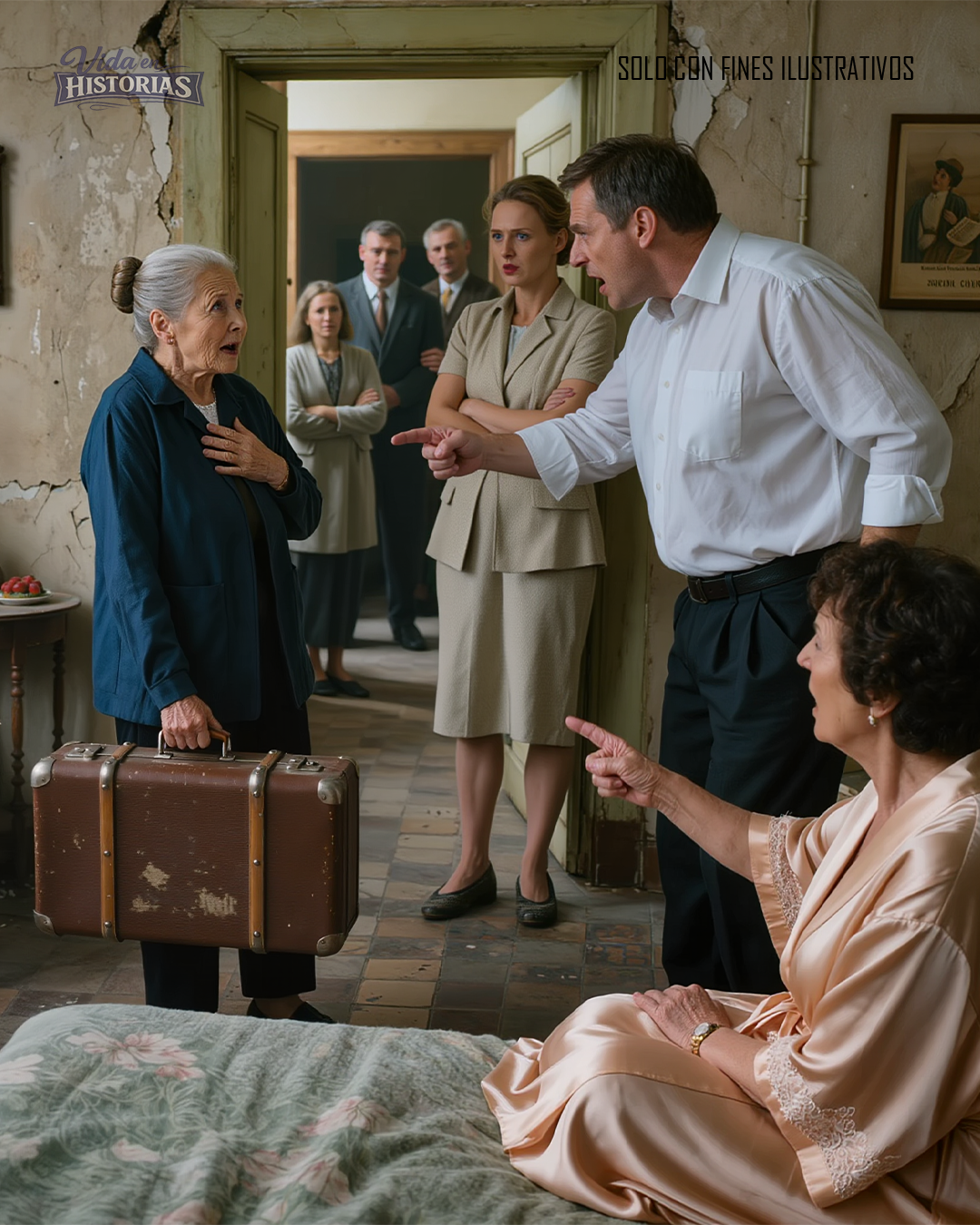
“Get out, Mom! Valeria doesn’t want to see you here.”
My son Diego’s voice cut through the mariachi music like a knife. There were two hundred people in the courtyard of our hacienda in Valle de Guadalupe, wine glasses in hand, elegantly dressed, their laughter frozen. And my only son was yelling at me as if I were an intruder.
My name is María Elena Torres, I am 61 years old, and for 35 years I was a history teacher at a high school in Ensenada. My husband, Julián, died nine years ago from a sudden stroke. Since then, Diego has been all I have left.
I had just returned from a week in Guadalajara, where I had gone to take care of my sick sister. I entered my house tired, still carrying my suitcase, and went up to my bedroom. The same one where Julián and I had slept for thirty years.
But it was no longer my bedroom.
On my vanity were Graciela’s very expensive creams, Valeria’s mother’s. Her sandals were next to my bed. Her designer bag hung on my chair. Even my silk robe, the one Julián gave me for our anniversary, was lying on the sofa.
“Diego,” I said, unable to breathe. “What’s going on? This is my room.”
He appeared behind me with his face red with anger.
—Mom, don’t start. Doña Graciela is going through something very difficult. She needs peace and quiet.
—And that’s why they put her in my bed?
“Don’t be selfish,” she snapped at me. “Valeria is devastated seeing her mother suffer, and you’re only thinking about yourself.”
I felt the floor open up. I had inherited that house from my father. Julián and I built every wall with sacrifice. Diego had grown up there. My granddaughter Sofía had been born there.
—This is my house—I said.
“It’s our house too!” he shouted, and several guests turned around. “We live here, we pay for the electricity, the gas, the internet. We have rights too.”
Valeria appeared at the end of the hall carrying a sleeping Sofia. She didn’t say anything. She just looked at me with fake pity, as if to say, “Don’t make a big deal out of it.”
I wanted to remind Diego who sold her jewelry to pay for his college education. Who stayed up all night when he had pneumonia. Who held him when we buried his father.
But I didn’t say anything.
I grabbed my suitcase. I went downstairs slowly. Each step was a memory. Diego as a child running barefoot. Julián laughing. Sofía taking her first steps.
I left through the front door without looking back.
I walked to the town square and sat down in front of the church, trembling. I took out my cell phone and called Arturo Benítez, the family’s lawyer for decades.
—Maria Elena, is everything alright?
“I need you to prepare an urgent notice,” I said with a calmness that frightened me. “I have tenants on my property who must vacate within 24 hours.”
There was silence.
—Are we talking about Diego?
I looked out at the street, my heart in pieces.
-Yeah.
—Are you sure?
I remembered her words: “Go away, Mom.”
—Completely safe.
What Diego didn’t know was that my silence wasn’t weakness. It was the calm before the earthquake.
And I couldn’t believe what was about to happen…
PART 2
That night I slept in a downtown inn that smelled of cheap lavender and loneliness. As soon as I closed the door, I sat on the bed and cried like I hadn’t cried since Julián died.
I wasn’t crying because of the bedroom. I was crying because my son had erased me.
There was a time when Diego and I were inseparable. When he was a child, he would run to hug me every afternoon, shouting, “My mom’s home!” Julián said I was my shadow. And it was true. After his father died, Diego, barely 17 years old, hugged me at the funeral and said, “You’re not alone, Mom. I’m here.”
That promise sustained me for years.
When he married Valeria, I was happy. She was beautiful, well-mannered, one of those women who know how to smile even when they’re calculating. At first, she treated me well. When Sofia was born, I felt like life was giving me something back.
They lived in a small apartment in Tijuana and complained about the rent.
—Come with me— I suggested. The estate is huge. Sofia will have a garden and you’ll be able to save money.
Diego cried with gratitude.
The first year was lovely. Breakfasts together, Sunday barbecues, Sofia running through the bougainvillea. Then Graciela arrived.
First she came for a weekend because her husband had left her. Then for a week. Then for a month. With each passing day, I took up less and less space in my own home. Valeria decided the menu. Graciela criticized my furniture. Diego stopped asking me how I was.
At eight in the morning, Licenciado Benítez and I arrived at the hacienda. Diego opened the door in sweatpants, disheveled and furious.
—What is this, Mom?
The lawyer handed him the envelope.
—Eviction notice. You have 24 hours to vacate the property.
Valeria turned pale.
—You can’t do this to us. We have a daughter.
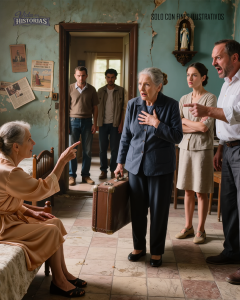
“You should have thought about that before giving my room to your mother,” I replied.
Then Graciela came downstairs wearing my silk robe.
—What scandal is this?
I looked her up and down.
—The scandal ends tomorrow at eight o’clock, when you leave my house.
Diego read the papers with trembling hands.
—I can’t believe it. I’m your son.
—And I am your mother. But yesterday you treated me worse than a stranger.
Valeria started to cry. So did Sofia. For a second I felt like I was going to give up. But I remembered my bed being invaded, my son yelling at me in front of everyone, and I didn’t give in.
That afternoon at the inn, the phone didn’t stop ringing. Neighbors, former students, friends from the parish. Everyone had heard. They all told me the same thing: “María Elena, you are not alone.”
Diego called at three o’clock.
—Mom, please. This has gotten out of control. Graciela has heart problems. Valeria is desperate.
—And my heart, Diego? Doesn’t that count?
Silence.
—I love you.
—It wasn’t noticeable yesterday.
I hung up crying.
The next morning, thirty minutes before the deadline, there was a knock on my bedroom door. It was Monica, my neighbor, with a folder in her hand.
—Mrs. María Elena, forgive me, but you have to see this. My daughter has Valeria added on Facebook.
The first page was a post from Valeria: “Tired of my husband still clinging to his mother’s skirts. It’s time he understood who his real family is.”
The second one was a private message.
Valeria: “My mom had a brilliant idea. If she moves into Maria Elena’s room, the old woman will feel uncomfortable and leave.”
Friend: “What if he doesn’t leave?”
Valeria: “Diego is going to choose. And I know he’s going to choose me.”
I felt nauseous.
Monica showed me another message, sent four days before my return.
Valeria to Graciela: “Go into her room with everything. When she gets back she’ll make a scene. Diego already thinks she’s controlling. All that’s left is to push her.”
I looked at the clock. Twenty minutes to go.
I called the lawyer.
—Arturo, I need you to come right now. And bring copies.
At 7:55 we were in front of the hacienda. Diego was loading suitcases into the car. Valeria was smiling as if she had won.
“He arrived just in time to see us leave,” he said.
“Before you leave,” I replied, “Diego has to read something.”
Valeria stopped smiling.
And when my son opened the folder, his whole world began to crumble…
PART 3
Diego read the first page without understanding. Then the second. Then the third. His face changed from anger to confusion, and from confusion to a horror I will never forget.
“Valeria,” he whispered. “Tell me this is false.”
She pressed Sofia against her chest.
—You’re exaggerating. I was just venting.
“Are you venting?” Diego shouted, his voice cracking. “You planned to bring your mom into my mother’s room to make her look crazy!”
Graciela got out of the car, furious.
—Don’t talk to my daughter like that.
“You also participated,” said attorney Benítez. “This can be legally used as evidence of manipulation, breach of trust, and a possible attempt at misappropriation.”
Valeria lost her mask.
“I only wanted what was rightfully ours!” she shrieked. “This house was going to be Diego’s someday. Why wait until she died?”
The silence was brutal.
I felt like someone was taking the air out of me.
Diego dropped the folder. The pages flew across the grass like wounded birds.
“Is that what you think of my mother?” he asked, trembling. “That she’s a burden until she dies?”
Valeria tried to touch his arm.
—Love, I did it for us.
—Don’t call me love.
Then Diego turned toward me. I no longer saw the man who had thrown me out. I saw the boy running to hug me at the door.
“Mom…” she broke down. “Forgive me. For God’s sake, forgive me. I didn’t see what you were doing. I let you fill my head with lies. I failed you.”
He took two steps and fell to his knees in front of me.
I could have rejected him. I could have told him it was too late. But I’m a mother. And a mother can be broken and still open her arms.
I hugged him.
“It hurt, Diego,” I told him. “It hurt more than you can imagine.”
—I know. I know, Mom. Forgive me.
Valeria started screaming that everyone was attacking her. Graciela grabbed her arm.
-Let’s go.
“No,” Diego said, getting up. “You all leave. Sofia stays with me until we speak to a judge.”
Valeria turned white.
—You can’t take my daughter away from me.
—I’m not taking her away from you. I’m protecting her from your lies.
That day Valeria and Graciela left the ranch. Diego left too, because he understood he couldn’t just apologize and act like nothing had happened. He rented a small apartment in Ensenada. He started therapy. He called me every night.
At first our conversations were awkward.
—Did you eat, Mom?
—Yes, son. And you?
-Also.
Sometimes we just cried in silence.
Three weeks later, she arrived at my door at midnight. Valeria had left with Graciela and threatened not to let him see Sofía. The lawyer acted quickly. With the messages, witnesses, and recordings of her threats, Diego obtained primary custody months later.
It wasn’t a pretty victory. True family victories never are. There were lawyers, hearings, tears, shame. Diego had to face the man he had become and accept that loving someone doesn’t mean you stop thinking.
Six months later, one Sunday afternoon, I was pruning rose bushes in the garden. Four-year-old Sofia was playing in the soil, looking for butterflies. Diego was repairing a loose board on the porch.
“Grandma, look!” cried Sofia. “A yellow butterfly!”
Diego sat down next to me, his hands covered in dust.
—Dad always said that a house is not worth its walls, but the people who learn to take care of it.
I smiled.
—Your father was wise.
—And I forgot it—he said. —I traded you for a lie.
I took her hand.
—No. You got lost. But you came back.
Her eyes filled with tears.
—I will never stop asking for your forgiveness.
“Then don’t talk about it so much,” I replied. “Prove it.”
We watched Sofia run among the flowers. The house was quieter than before, but it no longer felt empty. It felt clean. Like after a storm.
That day I understood something many mothers take far too long to learn: loving a child doesn’t mean allowing them to destroy us. A family isn’t defended by enduring humiliation, but by setting boundaries before the harm becomes ingrained.
I got my house back. Diego regained his conscience. And Sofia, perhaps, will grow up knowing that true love doesn’t require a woman to erase herself so that others feel comfortable.
