Physical Address
304 North Cardinal St.
Dorchester Center, MA 02124
Physical Address
304 North Cardinal St.
Dorchester Center, MA 02124

CHAPTER 1: The Dirt
The afternoon sun beat down on the concrete courtyard of Oak Creek High like it had something personal against the place. It was just past three on a Thursday in late May, the kind of day when the final bell still echoed and kids spilled out in waves of backpacks and shouts. Parents idled in their SUVs along the curb, windows cracked, air-conditioning humming. A few teachers lingered near the flagpole, chatting about summer plans. Everything looked normal—until it wasn’t.
Martha Jenkins had been pushing her wide gray mop bucket across the courtyard for twenty minutes, the wheels squeaking the same rhythm they had for the last eleven years. Seventy-two years old, five-foot-two in her orthopedic shoes, she wore the standard navy-blue custodian uniform that hung loose on her thin frame. Her left knee had given out on her three years back after slipping on a wet cafeteria floor nobody had warned her about. The school had paid for the surgery, sure, but the cane was hers to keep. A plain aluminum one with a black rubber grip, scuffed from a thousand hallways and stairwells. She leaned on it now, the way a sailor leans on a rail in rough water.
The silver Lexus parked square in the fire lane didn’t belong there. It never did on Thursdays. Vice Principal Alan Vance liked to pull in close to the main doors so he could watch the kids leave without walking twenty extra feet. Martha had reminded him about the fire lane twice this month already. Today made three.
She stopped the mop bucket ten feet from the Lexus, wiped sweat from her forehead with the back of her wrist, and called out, polite as always.
“Mr. Vance? Sir? Could you move your car, please? Fire lane’s blocked again.”
Vance stood by the driver’s door in his pressed khakis and blue polo, keys dangling from one hand, phone in the other. He didn’t even look up at first. He was forty-one, broad-shouldered from weekend golf, with a full head of sandy hair he gelled every morning like he was still running for class president. A dozen students milled nearby, waiting for rides. Two mothers stood ten feet away with their phones out, scrolling. A cluster of sophomores laughed over something on a screen.
Vance finally glanced over, eyes narrowing like she’d interrupted something important.
“Martha. It’s three-oh-five. I’m leaving in two minutes. Relax.”
She shifted her weight, the cane creaking under her palm. “It’s the rule, sir. Fire marshal was here last week. They wrote us up again.”
He gave a short laugh, the kind that wasn’t really a laugh. “You gonna call the fire marshal on me, Martha? Over two minutes?”
A few kids turned their heads. One boy in a letterman jacket smirked.
Martha kept her voice steady. Eleven years of cleaning up after teenagers had taught her that raising it never helped. “Just asking nice, Mr. Vance. Like always.”
He sighed loud enough for the parents to hear, shoved his phone in his pocket, and stepped around the car. For a second Martha thought he was going to get in and move it. Instead he walked straight up to her, stopping close enough that she smelled his cologne—something sharp and expensive.
“You know what your problem is?” he said, voice low but carrying. “You think because you’ve been here forever you can boss people around. This is my school. Not yours. You mop floors. That’s it.”
Martha’s fingers tightened on the cane. Heat crawled up her neck, but she didn’t step back. “I’m just trying to do my job, sir.”
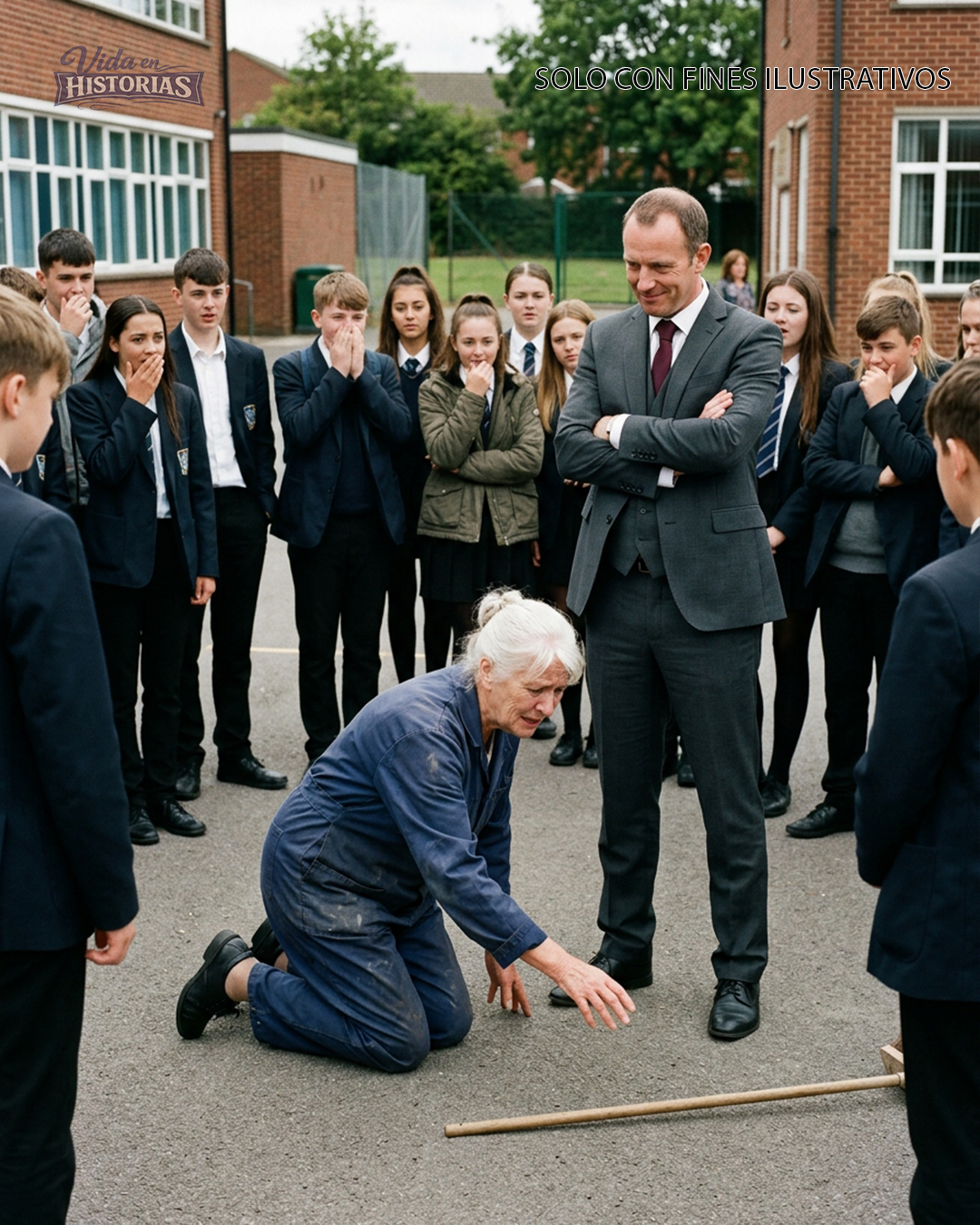
“Your job,” Vance said, and before she could answer he swung his foot in a quick, deliberate arc. The toe of his loafer connected with the rubber tip of her cane. It flew six feet across the concrete, clattering to a stop near a metal drain grate. The sound was small but sharp, like a bone snapping.
Martha’s balance vanished. Her bad knee buckled. She dropped hard, palms smacking the hot pavement, the mop bucket tipping beside her and sending gray water spreading in a slow, dirty fan. Pain shot up her leg like fire. Her uniform skirt rode up an inch; she yanked it down with shaking hands. The courtyard went quiet except for one girl’s gasp.
Students froze. Phones started rising—slow at first, then faster. A mother in a green sundress took two steps forward, then stopped, eyes darting between Martha and Vance like she was weighing her own kid’s future.
Vance didn’t move to help. He stood over her, arms crossed, mouth curled in disgust.
“Pick it up,” he said.
Martha stared at the cane lying in the puddle of mop water. Her wrists burned from the fall. She could feel eyes on her—forty, maybe fifty now. A boy whispered, “Holy shit.” Another parent filmed openly, phone held high, but she didn’t call out. Nobody did.
Vance raised his voice so the whole courtyard could hear. “Go on, Martha. Clean up your own stick. That’s what you do here, right? Clean up messes.”
Her breath came short. Eleven years. She had wiped vomit from the boys’ bathroom on prom night, stayed late every winter to salt the sidewalks so nobody slipped, remembered every teacher’s coffee order on early mornings. She had raised Jax in the little house two blocks from the railroad tracks after his real mother overdosed when he was nine. Jax, who used to sit on the counter while she cooked and call her “Ma” even though the adoption papers had taken four years and every dime she had. And now this man—this boy in khakis—was making her crawl in front of children.
She pushed herself up to her knees. The concrete scraped her stockings. One knee of her uniform was dark with mop water. She crawled the six feet, slow, the way her mother used to make her crawl to the altar when she was small and stubborn. Her hand closed around the wet cane. She pulled it back, used it to lever herself upright. The pain in her knee flared white-hot, but she locked it down. She had practice.
Vance watched the whole thing, smirking. “There you go. See? Not so hard.”
A couple of boys laughed—nervous, unsure laughs. The mother with the phone kept filming, lips pressed tight, but she didn’t speak. Nobody wanted to be the one who got on Vance’s bad side. Not with college recommendations and detention slips and the power he held over every kid in this building.
Martha wiped her hands on her uniform. She reached into the pocket of her smock, slow and deliberate, and pulled out the old flip phone she still carried because it was simple and the battery lasted a week. Her fingers, swollen at the knuckles from years of wringing mops, moved across the buttons. She typed three words. Sent them. The little whoosh sound was swallowed by the courtyard noise.
She slipped the phone back into her pocket before anyone noticed.
Vance was already turning away, done with her. “Next time just do your job and stay out of my way,” he called over his shoulder. Then he spotted a sophomore boy cutting across the grass with his earbuds in. “Hey! You! Get off the grass! What did I tell you about shortcuts?”
The boy jerked like he’d been shocked and veered back onto the sidewalk.
Martha stood there, cane planted, water soaking one shoe. The courtyard started moving again—awkwardly, like a movie that had glitched and now rewound. Kids hurried past her a little wider than usual. One girl offered a hesitant “You okay, Ms. Martha?” but didn’t wait for an answer. The parent with the phone lowered it finally, cheeks red, and hustled her daughter toward their minivan.
Martha’s knee throbbed in time with her heartbeat. She could already feel the bruise forming on her palms. But the text was sent. Three words. That was all it ever took.
From the edge of town, far beyond the football field and the strip mall and the railroad crossing, came a low sound. Not loud yet. Just a vibration under the soles of her shoes, like distant thunder on a clear day. A hum. Steady. Growing.
Vance didn’t hear it. He was too busy yelling at the sophomore, jabbing a finger toward the parking lot, enjoying the way the boy’s shoulders hunched. He laughed again, that same short bark, and glanced back toward his Lexus like the whole ugly moment had already been erased from his memory.
Martha stood perfectly still, one hand on her cane, the other pressed against the pocket where her phone rested warm. She looked at Vance’s back—broad, confident, untouchable—and for the first time in eleven years she didn’t feel small.
The hum from the edge of town rolled closer, engines turning over in perfect unison, still miles away but coming fast.
Vance turned to yell at another student, completely unaware that the distant hum echoing from the edge of town was about to become a roar.
CHAPTER 2: The Swarm
Vance slammed the door to his office harder than he meant to, the sound cracking through the quiet administrative wing like a starter pistol. The clock on the wall read 3:47. He dropped into the cracked leather chair behind his desk, loosened his tie, and let out a long breath that turned into a chuckle. The chuckle grew until he was laughing outright, the kind of laugh that shook his shoulders and made the framed certificate from the state principals’ association rattle against the wall.
“Unbelievable,” he said to the empty room. “Did you see that old bat actually crawl?”
The door was half-open to the main office, and Karen from attendance poked her head in, eyebrows raised. She was forty-five, divorced, and had worked under three vice principals before Vance. She still brought him coffee every morning even though he never said thank you.
“Alan, what happened out there?” she asked, voice low like they were sharing a secret. “I heard the kids talking in the hall. Something about Martha and her cane?”
Vance waved a hand, still grinning. “She parked her mop bucket right in front of my car like she owned the fire lane. I moved it for her. Politely. Woman’s seventy-whatever and acts like the place shuts down without her. Fell on her ass trying to make a point. Classic.”
Karen hesitated in the doorway, fingers tapping the frame. “A parent was filming. I saw the phone go up. You think that’s gonna—”
“Relax,” Vance cut in, spinning in his chair to face the window that overlooked the courtyard. The mop water had already dried to a faint gray smear on the concrete. A couple of late buses were pulling out, kids pressed against the glass. “Nobody’s gonna care about some custodian who can’t stay on her feet. She’s been here forever. People expect her to be slow. Besides, who’s gonna listen to a janitor over me?”
He reached for the small bottle of hand sanitizer on his desk, squirted some into his palm, and rubbed it in like he was washing away the whole afternoon. The scent of artificial lemon filled the room. Karen didn’t laugh with him. She just nodded once, tight, and slipped back to her desk.
Vance leaned back, feet up on the open drawer, and pulled out his phone. He scrolled through the school’s group chat for staff—mostly complaints about the copier jamming again—and typed a quick message to the assistant superintendent: Kids today have no respect for authority. Had to correct a safety issue in the courtyard. All good. He hit send, then opened his personal Instagram. Scrolled past pictures of his wife at yoga and his daughter’s soccer trophy. Posted a quick story: a shot of the empty courtyard with the caption Another day keeping Oak Creek safe. He smiled at his own cleverness.
Outside, the late-May air was still warm, the kind that promised summer break in two weeks. The football field beyond the parking lot shimmered under the sun, goalposts standing like silent guards. A few teachers’ cars dotted the staff lot. Everything was exactly as it should be.
Until the hum started.
At first Vance thought it was the air-conditioning unit kicking on in the ceiling. A low vibration under the floor tiles. Then it deepened, turning into something mechanical. Steady. Growing. He glanced at the window again, frowning. The sound wasn’t coming from inside the building. It rolled in from the west, past the railroad tracks and the old feed store on the edge of town, like a summer storm that had decided to arrive early.
Karen’s voice drifted in from the outer office. “Alan? You hear that?”
“Yeah,” he called back, not bothering to get up. “Probably the marching band practicing late or something. Kids these days can’t read a schedule.”
But the band room was on the opposite side of campus, and the marching band had packed up for the year two days ago. The hum grew into a rumble. Then a roar. Forty distinct engines, perfectly synchronized, the kind of sound that made the glass in the window panes tremble. Vance’s feet came off the drawer. He stood, walked to the window, and pressed his forehead against the cool glass.
The parking lot was filling with black Harley-Davidson motorcycles. They poured in from the main entrance in two perfect lines, chrome glinting under the late sun, exhaust pipes popping like gunshots. Not speeding. Not swerving. Just rolling in with military precision, forty of them, leather-clad riders sitting tall in the saddles. No patches screaming gang names, no colors flying. Just black vests, black jeans, black boots, and faces hidden behind sunglasses and beards. They didn’t circle or rev engines for show. They simply stopped, killing the motors in one coordinated wave, and dismounted. In seconds they had formed a living wall across every exit—side doors, main gate, even the narrow service road that led behind the gym. Arms crossed. Boots planted. Silent.
The school’s PA system crackled to life in the hallway outside Vance’s office. “Lockdown. This is not a drill. All students and staff to nearest secure area. Lockdown. This is not a drill.”
Vance’s stomach dropped. He watched as the front office secretary, Ms. Delgado, fumbled with the blinds, trying to close them. Karen stood frozen at her desk, phone in hand, mouth open. The superintendent’s black SUV had just pulled into the staff lot for the emergency board meeting—right on time, as always—followed by three other cars carrying the school board president and two members. They were trapped now, engines idling, doors locked, staring at the wall of bikers thirty feet away.
Vance’s phone buzzed. A text from the front office: Police en route. Stay inside. He ignored it. His eyes were locked on the biggest man in the group, a giant who had to be six-foot-six, shoulders like bridge beams, a thick salt-and-pepper beard braided at the chin. The man dismounted a matte-black Harley that looked custom-built for his size. He reached into a saddlebag and pulled out a tablet, the screen glowing bright even in daylight.
The giant—Jax, though Vance didn’t know the name yet—didn’t shout. He didn’t gesture wildly. He simply walked forward, boots crunching on the gravel strip between the lot and the courtyard, until he stood ten feet from the superintendent’s SUV. The other bikers stayed put, a silent perimeter. No one moved. No one spoke. The only sound was the distant wail of approaching sirens.
Inside the office, panic started to leak out like steam from a kettle. A sophomore who had been sent to the principal’s office for skipping class peeked around the corner, eyes wide. “Mr. Vance? There’s like… an army outside.”
“Get back to the classroom,” Vance snapped, but his voice cracked. He yanked open his desk drawer, rifled through papers like he was looking for something official, anything that said Vice Principal and carried weight. His hands shook. The certificate on the wall suddenly looked cheap.
The school board president, a balding man named Richard Harlan in a gray suit two sizes too tight, finally climbed out of his car. His tie flapped in the breeze. He held both hands up like he was approaching a wild animal, legs trembling so hard Vance could see it from the second-floor window. Harlan took three steps toward Jax, stopped, and cleared his throat.
“Gentlemen,” Harlan started, voice thin and reedy, “I don’t know what this is about, but this is school property. We have children inside. If you have a grievance, we can discuss it like civilized—”
Jax didn’t interrupt with words. He simply lifted the tablet. The screen faced Harlan directly. On it, the video played—clear as day, shot from the mother’s phone in the courtyard earlier that afternoon. Vance kicking the cane. Martha dropping to her knees. The water spreading. Vance’s voice, tinny through the tablet speaker: Pick it up… Clean up your own stick.
Harlan’s face went the color of old milk. He watched the entire thirty-second clip without blinking. When it ended, Jax tapped the screen once and the video looped, playing again on full volume so the whole parking lot could hear.
Harlan took a stumbling step backward. “That… that can’t be real. Alan would never—”
Jax finally spoke. His voice was low, gravelly, the kind that came from years of road dust and hard living. “It’s real. And your vice principal is still inside that building hiding like a rat.”
The sirens grew louder. Two sheriff’s cruisers pulled up to the edge of the biker line but stopped short. The deputies climbed out, hands on holsters, but they didn’t advance. One of them recognized the formation—forty men, no weapons visible, no threats made—and knew better than to turn this into something ugly on school grounds. They stood back, waiting.
Inside the office, Vance’s phone wouldn’t stop buzzing. Texts from Karen: Board president is talking to them. Texts from the superintendent: Alan get down here NOW. He ignored them all. His forehead was slick with sweat. The air-conditioning felt like it had stopped working. He could see his own reflection in the window—pale, eyes darting, the confident man from twenty minutes ago nowhere in sight.
Down in the courtyard, Jax turned the tablet toward the main office window. The video kept playing on loop, the sound carrying across the empty space. Students pressed their faces against classroom windows on the first floor, whispers spreading like wildfire through group chats. Teachers stood in doorways, unsure whether to keep the kids calm or watch the show unfolding outside.
Harlan wiped his forehead with a handkerchief. “Look, whatever this is, we can fix it. The board will investigate. Alan’s been with us eleven years. There must be context—”
Jax cut him off with a single raised hand. No violence. Just the gesture. Then he pointed—slow, deliberate—with one massive, scarred finger straight at the second-floor window where Vance stood frozen behind the glass.
The finger didn’t waver. It pinned Vance in place like a butterfly on a board.
Vance felt the eyes of every biker, every deputy, every trapped board member, every kid with a phone, all turn toward him at once. The roar of the engines had died, but the silence that replaced it was worse. It pressed in from all sides, heavy and final, the kind of quiet that came right before everything changed.
Jax stared up at the window, expression unreadable behind his sunglasses, and kept that scarred finger pointed exactly where Vance was hiding. The tablet in his other hand still played the video on loop, Martha on her knees, the cane spinning across concrete, Vance’s mocking laugh echoing off the brick walls of Oak Creek High.
And for the first time in his entire career, Alan Vance understood what it felt like to be the one on the ground, looking up.
CHAPTER 3: The Apology
The silence in the courtyard stretched so tight it felt like the whole school might snap in half. Jax kept his scarred finger pointed at the second-floor window, unmoving, the tablet still looping the video in his other hand. The low afternoon sun caught the chrome on forty Harley handlebars, throwing hard glints across the pavement. Deputies stood twenty yards back by their cruisers, radios crackling softly, but nobody moved to break the line. The bikers hadn’t said another word since Jax spoke to Harlan. They didn’t need to. Their presence alone had turned the parking lot into a courtroom with no gavel.
Inside the main office, Alan Vance’s world had shrunk to the size of that single pointing finger. His shirt clung to his back. Sweat ran into his eyes. Karen stood in the doorway, face pale, clutching a stack of attendance sheets like they could protect her. Ms. Delgado had already locked the outer doors and was whispering into the phone with the district office. The sophomore who’d been sent to detention earlier had long since bolted back to his classroom.
Harlan’s voice drifted up from the lot, thin and desperate. “Alan. Alan, you need to come down here. Now.”
Vance didn’t answer. His legs felt bolted to the floor. Through the glass he could see the superintendent, Dr. Evelyn Torres, climbing out of her SUV beside Harlan. She was a small woman, fifty-eight, with steel-gray hair cut sharp and a reputation for handling crises without raising her voice. Today her mouth was a flat line. The other two board members hovered behind her, suits rumpled, eyes darting between the bikers and the building.
“Alan,” Harlan called again, louder, “if you don’t walk out here, they’re not leaving. None of us are. The kids are watching from every window. Think about that.”
Vance’s phone vibrated in his pocket for the twentieth time. He didn’t check it. He knew what it would say. Get down here. Fix this. What the hell did you do?
He swallowed hard, tasted metal, and finally moved. His loafers squeaked on the linoleum as he left the office, walked past Karen without looking at her, and took the stairs down two at a time. Each step echoed. The front doors opened with a hydraulic hiss that sounded too loud. Bright sunlight hit him square in the face. He blinked, raised one hand like a shield, and stepped into the courtyard.
The heat hadn’t broken. The concrete still held the day’s warmth, radiating up through his soles. Every eye in the building seemed trained on him now—kids pressed to glass, teachers standing in doorways, parents who had refused to leave when the lockdown started. Phones were up again, recording openly this time. No one hid behind fake scrolling.
Harlan met him halfway, handkerchief mopping his forehead even though the temperature hadn’t changed. “Alan, for God’s sake. Tell them it was an accident. Tell them you’re sorry. Just end this.”
Vance straightened his polo, tried to square his shoulders the way he did when he addressed the student body at pep rallies. “Richard, this is ridiculous. Some janitor trips over her own feet and suddenly we’ve got Hell’s Angels at the front gate? I’ll handle it.”
He walked past Harlan toward Jax, stopping five feet short. The giant biker hadn’t lowered his arm. The tablet screen still glowed between them, the video playing on mute now but the images unmistakable: Martha on her knees, water spreading, Vance’s mouth moving in that mocking shape.
Vance forced a chuckle, the same short bark he’d used in his office. “Look, I don’t know who you people are or what you think happened, but Martha Jenkins has balance issues. Bad knee. She’s been here forever; everybody knows it. She dropped her cane, I offered to help, she got embarrassed and fell. That’s it. End of story. You can all go home now.”
Jax didn’t blink. He simply turned the tablet outward, toward the gathered crowd—Harlan, Dr. Torres, the board members, the deputies, the kids at the windows—and tapped the volume up until the speaker crackled. The audio exploded across the courtyard.
Pick it up.
Martha’s quiet voice answering, steady despite everything.
Clean up your own stick. That’s what you do here, right? Clean up messes.
The sound of her palms hitting concrete. The wet slap of the mop water. A girl’s gasp off-camera. Vance’s laugh again, sharp and ugly.
The courtyard went dead quiet except for the video. No one coughed. No one shifted. Dr. Torres’s face hardened like concrete setting. One of the board members—a woman in her sixties who’d taught English for thirty years before joining the board—pressed a hand to her mouth.
Vance tried again, voice rising. “It’s edited. You can’t even see the whole thing. She was blocking the fire lane. I was trying to—”
Jax tapped the tablet once more. The video restarted from the beginning, louder. This time the mother who had filmed it stepped forward from the edge of the lot. She was maybe thirty-five, wearing a green sundress, and her voice carried clear.
“That’s exactly what happened,” she said. “I was right there. He kicked her cane. On purpose. My daughter saw it too.”
A ripple moved through the windows. Phones caught every second.
Dr. Torres stepped between Vance and Jax, her heels clicking on the pavement. She looked at Vance like he was something stuck to the bottom of her shoe. “Alan, enough. The district has a zero-tolerance policy on staff misconduct, especially involving vulnerable employees. This video is clear. You’re done.”
Vance’s mouth opened, closed. “Evelyn, you can’t just—”
“I can and I am.” She turned to Harlan. “Richard, as superintendent I am exercising my authority. Effective immediately, Alan Vance is terminated. Security will escort him off campus once this… situation is resolved. His contract is severed. HR will handle the paperwork by close of business tomorrow.”
Harlan nodded so fast his jowls shook. “Yes. Yes, of course. Alan, your things will be boxed and sent to you. Don’t make this worse.”
Vance’s face went blotchy red. The confident man who had ruled these halls for eleven years was shrinking right there on the concrete. He took one step backward, then another, trying to head toward the staff parking lot where his Lexus still sat, keys in his pocket. “This is insane. I have tenure. I have—”
He didn’t finish. Forty bikers moved as one. Not rushing, not shouting. Just a single coordinated step forward, boots scraping in perfect unison. The wall of leather closed the gap between Vance and his car like a gate slamming shut. Arms stayed crossed. Sunglasses reflected the sky. No threats. No fists. Just the simple, terrifying fact that he wasn’t leaving until they said so.
Vance stopped cold. His loafers scraped. A bead of sweat rolled down his temple and dripped onto his collar. He looked left, right, saw nothing but black vests and bearded faces. The deputies watched but made no move to intervene. This wasn’t a riot. It was a reckoning, and the law knew the difference.
Jax finally lowered his arm. He slipped the tablet into a saddlebag, then stepped aside—slow, deliberate—revealing a small figure who had walked out of the side entrance while everyone’s eyes were on Vance. Martha Jenkins. She leaned on her cane, the same scuffed aluminum one, now dry. Her uniform skirt still carried the faint gray stain from the mop water. She moved slowly, knee obviously hurting, but her back was straight. She stopped ten feet from Vance, eyes steady on his face.
The courtyard held its breath.
Jax’s gravel voice cut through the silence. “You made my mother get on her knees in front of the whole school. In front of kids. In front of parents. Now you’re gonna do the same. Right here. Right now. Exactly like she had to.”
Vance’s eyes darted to Martha, then to Jax, then to the superintendent. “You can’t force me to—”
“I’m not forcing anything,” Jax said. “But those forty men behind you? They’re not moving until you do. And neither is she.” He nodded toward Martha. “She’s waited eleven years to watch you learn what respect looks like from the ground up. Your choice. But you’re not walking out of here until it happens.”
Dr. Torres didn’t stop it. Harlan didn’t stop it. The board members stood frozen, faces pale with the realization that the video was already everywhere—group chats, parent networks, probably local news by now. One of the deputies actually took a small step back, arms loose at his sides, as if to say this was no longer police business.
Vance’s breathing came fast and shallow. His hands clenched and unclenched at his sides. The man who had kicked a seventy-two-year-old woman’s cane for sport now looked smaller than the sophomore he’d yelled at earlier. His gaze swept the windows again—hundreds of students watching, some recording, some whispering, but all of them seeing. Really seeing.
He tried one last time, voice cracking. “Martha… I… it was a bad day. I didn’t mean—”
Martha didn’t speak. She simply stood there, cane planted, waiting. The same way she had waited eleven years while he parked in fire lanes and mocked her limp and treated her like the dirt she mopped every night.
Jax crossed his massive arms. The bikers took another half-step forward, boots scraping in unison. The sound was soft but final.
Vance’s shoulders sagged. His knees bent. Slowly—agonizingly—he lowered himself. First one knee, then the other. The concrete bit through his khakis. His palms pressed flat against the same pavement where Martha’s had smacked down earlier. The courtyard stayed silent except for the faint click of a dozen phone cameras.
He looked up at Martha from the ground, face flushed, eyes wet. His voice came out a whisper that somehow carried in the dead air. “I’m… sorry.”
Martha studied him for a long moment. No triumph in her expression. Just the quiet weight of eleven years of quiet endurance. She gave a single nod, the smallest movement, then turned her head toward Jax.
Jax didn’t smile. He simply stepped back, giving her space, the wall of bikers parting just enough to create a clear path toward the staff lot. The deputies finally moved, one of them radioing something low and calm.
Vance stayed on his knees, trembling, as the reality sank in. His career—gone. His reputation—already circling the drain on every parent’s phone. The power he had wielded like a crown—stripped away by a video, a cane, and forty silent men who had come for one reason only.
He looked around at the wall of leather, realized he had no escape, and slowly sank his knees into the dirt.
CHAPTER 4: The Respect
The concrete of the Oak Creek High courtyard felt harder than it had any right to under Alan Vance’s knees. The afternoon sun had dipped lower, stretching long shadows from the flagpole across the pavement, but the heat still clung to the ground like a grudge. Vance stayed exactly where he had sunk down—palms flat, khakis dark at the knees from the faint residue of earlier mop water, head bowed so low his gelled hair fell forward in a sweaty clump. Forty pairs of black boots formed a half-circle behind him, silent and unmoving. The bikers hadn’t cheered, hadn’t jeered. They simply stood, arms crossed, letting the weight of what they had done settle over the entire school like dust after a storm.
Students pressed their faces to every first-floor window. Teachers stood in open doorways, some with hands over their mouths, others with arms folded tight across their chests. Phones were still up, but the recordings had slowed. This part felt too raw to share in real time. Parents who had stayed through the lockdown lingered at the edge of the lot, engines off now, windows down. Even the deputies had backed their cruisers farther away, one of them leaning against a hood and shaking his head slowly, as if he’d seen plenty of arrests but never anything quite like this.
Martha Jenkins stood ten feet in front of Vance, her aluminum cane planted firm between her orthopedic shoes. The gray stain on her uniform skirt had dried stiff. Her bad knee throbbed in steady pulses, the same rhythm it had kept for three years, but she didn’t shift her weight. She looked down at the man who had ruled these halls for eleven years—the man who had once written her up for taking an extra five minutes on her lunch break, who had mocked her limp in the staff lounge loud enough for the cafeteria ladies to hear, who had parked in the fire lane every single Thursday like the rules were suggestions meant for everyone but him.
Vance’s shoulders shook once. He lifted his head just enough to meet her eyes. His face was blotchy, eyes red-rimmed, the confident smirk long gone. His voice came out cracked and small, the kind of whisper usually reserved for hospital rooms or funeral parlors.
“Martha… I’m sorry.” He swallowed, throat working. “I had no right. I treated you like… like you were nothing. You’ve worked here longer than I’ve been alive, and I kicked your cane. I made you get on your knees in front of everybody. I’m so damn sorry.”
The words hung there. No excuses this time. No talk about balance issues or fire lanes. Just the naked truth, stripped bare in front of two hundred witnesses and a whole school’s worth of cell phones.
Martha didn’t speak right away. She studied him the way she studied a spill on the cafeteria floor—something messy that needed cleaning but wasn’t worth getting worked up over anymore. There was no triumph in her face, no gloating smile. Just a deep, tired pity that made her eyes soften at the corners. Eleven years of biting her tongue, of nodding yes sir, of staying late to scrub the same lockers he had walked past without a second glance. She had raised Jax in a two-bedroom rental with a leaky roof, worked double shifts at the school and then at the nursing home on weekends, all so her boy could have a chance. And this man had treated her like the dirt she mopped every night.
She let the silence stretch another beat. Then she reached down with her free hand, not to help him up, but to adjust her grip on the cane. The rubber tip scraped softly against the pavement.
“Get up, Mr. Vance,” she said quietly. Her voice carried clear across the courtyard, steady and plain, the same tone she used when she reminded kids to pick up their trays. “And leave my school.”
Vance blinked up at her, confusion flickering across his face for a split second. He had expected yelling, maybe tears, some kind of victory dance. Instead she offered him nothing but the door. He pushed himself up on shaky legs, brushing at the dirt on his khakis with hands that wouldn’t stop trembling. The bikers parted just enough to let him through. No one touched him. They didn’t need to. Jax simply nodded once toward the staff parking lot, and Vance started walking—head down, shoulders hunched, loafers scuffing the concrete like a man who had forgotten how to stand tall.
The bikers fell in behind him, a loose escort of leather and boots. Not shoving. Not speaking. Just walking with him until he reached his silver Lexus. Vance fumbled for his keys, dropped them once, picked them up, and climbed in without looking back. The engine started with a weak cough. He backed out slow, tires crunching over the gravel strip, and drove toward the main gate. The bikers watched until the Lexus disappeared around the corner by the football field. Then, one by one, they turned back toward Martha.
A low cheer started among them—deep, rumbling, not loud enough to scare the kids but strong enough to fill the courtyard. It rolled through the forty men like thunder clearing the sky. Jax stepped forward first, his massive frame casting a long shadow over the pavement. He didn’t hug her—knew better than to crowd her bad knee—but he rested one scarred hand gently on her shoulder, the way he used to when he was nine years old and she’d bring him cookies after a bad day at the group home.
“You did good, Ma,” he said, voice low. “Real good.”
Martha patted his hand once, the same gesture she’d used a thousand times when he came home with bruised knuckles or a report card full of Cs. “It wasn’t me, Jax. It was all of you. Coming when I needed you. That’s what mattered.”
The cheer grew a little louder. One biker near the back—a bald man with a gray handlebar mustache—called out, “Respect, Ms. Martha!” Others echoed it. The students at the windows started clapping, hesitant at first, then stronger, until the whole building seemed to vibrate with it. Teachers joined in. Even Dr. Torres, standing beside Harlan with her arms finally uncrossed, clapped once, sharp and official.
Harlan cleared his throat, stepping forward with a folded piece of paper he had pulled from his suit jacket. His face was still pale, but his voice tried for steadiness. “Martha… Ms. Jenkins. The board met in the parking lot while… everything was happening. We’d like to make this official.” He unfolded the paper, reading from the typed lines. “Effective immediately, the Oak Creek School Board extends our deepest gratitude for your eleven years of dedicated service. We are increasing your hourly wage by three dollars, retroactive to last month, and naming the main custodial supply closet after you—the Martha Jenkins Memorial Closet. It’s small, but it’s something. And we’re covering any medical bills related to today’s… incident. Fully.”
Martha listened, nodding once. The raise would help with the mortgage. The name on the closet made her lips twitch in the smallest smile. She had mopped that closet more times than she could count.
Dr. Torres added, “And we’ve already started the search for a new vice principal. Someone who understands that every person in this building matters. You included.”
Before Martha could answer, Jax lifted a hand. The bikers parted again, and two of them wheeled something out from behind the line of Harleys. It was a golf cart—shiny black with chrome trim, the kind used on country clubs but customized for work. A heavy-duty frame, extra-wide seat padded with memory foam and covered in weatherproof vinyl, a cup holder already holding a fresh thermos of coffee, and a small metal rack on the back for her mop bucket. The steering wheel had a thick grip for arthritic hands. Painted in white script along the side: Martha’s Ride – Oak Creek High Custodial. The keys dangled from the ignition, a small silver keychain shaped like a tiny Harley.
“We took up a collection,” Jax said, voice gruff but soft around the edges. “Whole crew pitched in. Some of the guys rode two states over last night to pick it up and get it fitted. No more walking the long hallways on that knee. You drive this now. Park it anywhere you want. Fire lane included.”
The cheer from the bikers swelled again, mixing with the students’ applause. Martha’s eyes stung. She blinked hard, refusing to let tears fall in front of everyone. She stepped toward the cart, ran one hand over the padded seat, felt the solid weight of it. Eleven years of aching feet and swollen ankles. Eleven years of pushing that heavy mop bucket up ramps and down long corridors while kids rushed past her like she was invisible. This little cart wasn’t just transportation. It was proof that someone had seen her.
She climbed in slow, careful of her knee, and settled behind the wheel. The seat hugged her back like it had been waiting for her. Jax showed her the controls—simple forward and reverse, a horn that played a soft two-note beep instead of a blare. She turned the key. The electric motor hummed to life, quiet and smooth.
The students were being called back to class now, the PA system crackling with Dr. Torres’s calm voice: “Lockdown lifted. Return to your final period. Thank you for your patience.” But they didn’t scatter right away. A group of sophomores near the front doors actually waited, smiling shyly as Martha eased the cart forward. One girl— the same one who had gasped when Vance kicked the cane—stepped up and said, “Ms. Martha? I’m sorry I didn’t say anything earlier. You always say hi to me in the hall. I should’ve said hi back.”
Martha smiled at her, the gentle one she saved for the quiet kids who ate lunch alone. “You say it now, honey. That’s what counts.”
The girl nodded, eyes bright. A boy in a letterman jacket gave her a small wave. “Need help with the trash later? I got detention anyway.”
She waved them off kindly. “Go learn something. I’ve got this.”
The cart rolled smooth across the courtyard, tires whispering over the same concrete where she had fallen hours earlier. The bikers mounted up, engines rumbling to life one by one in that same perfect unison. Jax lingered a moment longer, leaning down so only she could hear.
“Call if you need anything. Anything at all. We’re two hours away, but we’ll be here in forty-five if you text.”
“I know, baby,” she said, patting his arm. “Now go on. You’ve got your own life to get back to.”
He straightened, gave her one last nod, and swung onto his Harley. The pack rolled out slow, respectful, leaving the school grounds quieter than they had found it.
Inside the building, the final bell of the day rang. Hallways filled with the usual chatter, but something had shifted. Kids who used to barrel past Martha now slowed down, holding doors, offering to carry her bucket until she waved them off with a smile. Teachers who had barely nodded at her in the lounge now stopped to ask how her knee was. The new respect wasn’t loud or showy. It was small things— a folded note left on her cart that read Thank you for everything in careful middle-school handwriting, a freshman boy who actually picked up a wrapper he dropped instead of kicking it under the bleachers.
The next morning, Martha arrived early as always. The golf cart waited in the staff lot, freshly wiped down by one of the night custodians who had left a sticky note: We got the floors in the gym, Ms. M. Take it easy today. She climbed in, adjusted the seat, and drove it through the side entrance, the electric hum barely noticeable over the early morning quiet.
The hallways smelled like fresh wax and coffee from the teachers’ lounge. Fluorescent lights buzzed overhead. Martha guided the cart past the main office, where a new nameplate already gleamed on the vice principal’s door: Dr. Lena Morales, Vice Principal. Dr. Morales herself stepped out of her office right as Martha approached, a stack of folders in her arms and a warm, professional smile on her face. She was in her early forties, dark hair pulled back neat, wearing sensible flats instead of heels.
She saw the cart coming and immediately stepped to the side, pressing her back against the wall to give the full width of the hallway. No rush, no irritation. Just a polite, deliberate move.
“Good morning, Ms. Jenkins,” Dr. Morales said, voice carrying real warmth. “Cart looks perfect. Let me know if you need any adjustments. And thank you again—for everything you do here.”
Martha slowed the cart to a stop for a moment, meeting the new vice principal’s eyes. “Morning, Dr. Morales. I’ll be fine. You have a good day now.”
She pressed the accelerator gently. The cart rolled forward smooth and steady down the long hallway toward the cafeteria, where the breakfast crew was already setting out trays. Martha’s hands rested light on the wheel. Her knee didn’t ache the way it usually did this early. The stain on her uniform skirt was gone—washed out last night in her kitchen sink with a little extra detergent. She wore a fresh one today, the navy blue crisp and clean.
As she passed the glass trophy case, she caught her reflection: seventy-two years old, gray hair pinned back neat, smile lines etched deep around eyes that had seen plenty of hard days and a few good ones. Behind her, the new vice principal stayed exactly where she had stepped aside, watching with quiet respect until Martha disappeared around the corner by the library.
Martha drove on, the gentle hum of the cart mixing with the distant sound of lockers opening and kids laughing. The school was waking up, same as always. But for the first time in eleven years, Martha Jenkins rolled through it not as the invisible woman with the mop, but as someone who had earned every inch of the respect now following her down the hall. She smiled to herself, small and private, and kept driving toward the next spill that needed cleaning—knowing that this time, the building would wait for her to get there on her own terms.
