Physical Address
304 North Cardinal St.
Dorchester Center, MA 02124
Physical Address
304 North Cardinal St.
Dorchester Center, MA 02124

**PART 1**
“My wife, who is 8 months pregnant, is washing your dishes while you eat pizza and laugh like it’s nothing?”
At 10:45 PM, Diego opened the door of his house in a subdivision in Guadalupe, Nuevo León, with his shirt stuck to his body from sweat and his hands covered in workshop grease.
He had worked 14 hours straight fixing cargo trucks.
He just wanted to get home, hug Lucía, kiss her belly, and ask if their baby had moved a lot that day.
But as soon as he walked in, he felt something break inside him.
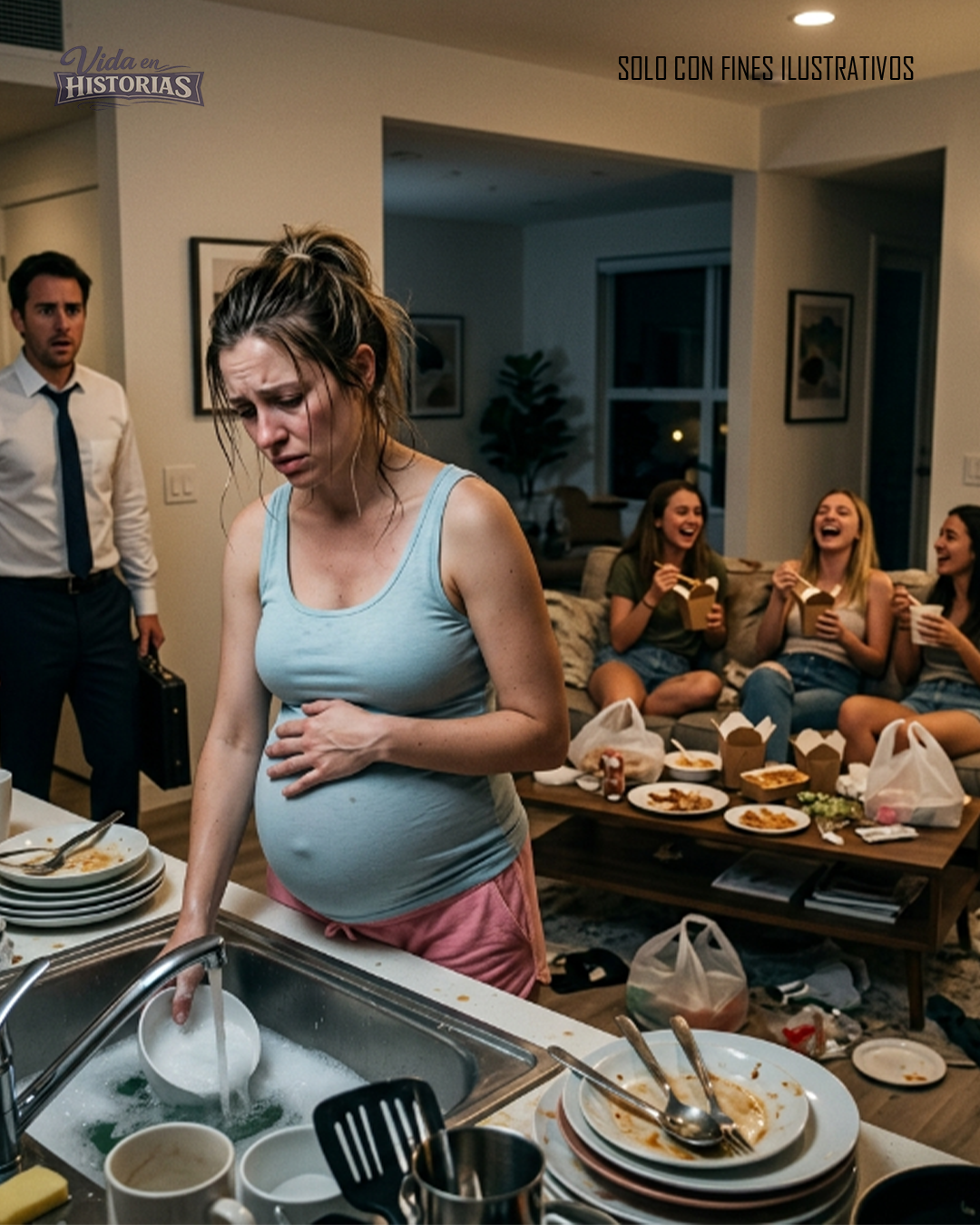
The living room looked like a bar after a game.
There were 3 open pizza boxes on the table, spilled soda cups, greasy napkins on the floor, and a crushed bag of chips next to the couch.
The TV was blasting a gossip show at full volume.
Sitting on the couches were his mother, Doña Carmen, and his 3 sisters: Brenda, 24; Karla, 21; and Sofía, 18.
They were all laughing.
Doña Carmen had her feet up on a cushion, wrapped in a blanket.
Brenda was checking her new phone.
Karla was recording stories for Instagram.
Sofía was complaining because Diego hadn’t sent her money for her nails.
Everything in that house was paid for by Diego.
The mortgage, the food, the electricity, the gas, the internet, the school fees, his mother’s medicine, and even his sisters’ outings.
He thought that was what it meant to be a good son.
He thought supporting everyone was a form of love.
Until that night.
“Where’s Lucía?” he asked, with his jaw clenched.
Brenda didn’t even look up.
“In the kitchen, dude. She said she was tired, but we told her she could at least help with something.”
Karla let out a mocking laugh.
“Oh, Diego, don’t exaggerate. It’s just a few dishes. Besides, being pregnant doesn’t mean she’s useless.”
Doña Carmen sighed as if she were giving a life lesson.
“Son, when I was pregnant with you, I washed clothes, mopped, cooked, and still went to the market carrying bags. Now these girls think that just because they have a belly they’re made of glass.”
Diego didn’t answer.
He walked toward the kitchen.
Each step felt heavier.
When he got there, he froze.
Lucía was barefoot in front of the sink.
Her huge belly bumped against the counter.
She had one hand on her back and with the other she was scrubbing a burnt pot.
Her maternity blouse was wet.
Her eyes were red.
Her face was pale.
Her legs were trembling.
When she saw him, she tried to smile.
“Love… you’re home. Give me 5 minutes and I’ll heat up dinner for you.”
Her voice broke.
Diego turned off the faucet and took the sponge from her hand.
“It’s over, Lucía. You’re not washing another plate.”
She got scared.
“Please, don’t get angry. Your mom is going to get even madder.”
Diego felt rage filling his chest.
“Even madder? Since when have they been treating you like this?”
Lucía looked down.
A tear fell directly onto her belly.
“For the past 3 months. They say I’m a freeloader. That you work yourself to death while I pretend to be sick.”

Diego clenched his fists.
Before he could say anything, Lucía doubled over in pain.
She clutched her belly with both hands and let out a dry moan.
“It hurts… Diego, it hurts so much.”
He immediately picked her up and carried her to the bedroom.
He called the doctor.
The response left him cold.
“At 8 months, that level of effort and stress can cause an emergency. Watch her closely. If there’s bleeding, bring her in immediately.”
Diego went downstairs with his breath caught in his throat.
In the living room, his family was still laughing.
He walked to the TV and yanked the cable out with one pull.
Everything went silent.
“What’s wrong with you?” Sofía shouted. “I was watching my show!”
Diego looked at them one by one.
“Right now you’re going to tell me what you’ve done to my wife.”
And just as Doña Carmen opened her mouth to play the victim, Diego saw something in the kitchen trash can that froze his blood, because it was impossible to believe what was about to happen.
—
**PART 2**
Diego didn’t wait for an answer.
He walked straight to the trash can.
He reached in among greasy napkins, broken boxes, and food scraps.
He pulled out 2 empty medicine boxes.
Then another.
Then a small bottle, still with drops at the bottom.
He read them carefully.
Iron.
Prenatal vitamins.
Blood pressure medication.
Diego’s face changed completely.
It was no longer anger.
It was horror.
“What are these medicines doing in the trash?”
No one spoke.
The turned-off TV left the house too quiet.
Brenda swallowed hard.
Karla stopped recording.
Sofía looked at Doña Carmen.
And Doña Carmen, for the first time that night, had no quick response.
Diego held up the bottle.
“These drops weren’t empty. The doctor prescribed them to Lucía for her blood pressure. Who threw them away?”
“Oh, son, don’t start with the drama,” Doña Carmen said, standing up slowly. “That girl takes too many things. In my time we didn’t need so many pills to give birth.”
Diego felt his vision blur.
“You threw them away?”
Doña Carmen raised her chin.
“I only took away what was making her weak.”
Brenda intervened nervously.
“Mom said it was like a test, Diego. That if Lucía stopped depending on medicine, she would prove she could handle the house and the pregnancy.”
“A test?” Diego almost spat the word. “You gave a test to an 8-months-pregnant woman?”
Karla tried to sound brave, but her voice trembled.
“Well, she always said she felt dizzy, that her head hurt, that she needed to rest. Honestly, it seemed like pure acting.”
Diego slammed the table with his hand.
The glasses jumped.
“She had anemia and high blood pressure! That’s why the doctor prescribed that!”
Sofía started to cry.
“We didn’t think it was that serious…”
“You didn’t think at all,” Diego said. “Because you never think. You only demand.”
Doña Carmen approached him with a hard expression.
“Don’t talk to your mother like that. Everything I did was for your own good. That woman has you manipulated. Ever since she arrived, you’re not the same.”
Diego let out a bitter laugh.
“No, Mom. Ever since Lucía arrived, I started to see who you really are.”
Brenda crossed her arms.
“And now what? Are you going to kick us out over some medicines?”
Diego took out his phone.
He opened the banking app.
The screen lit up his tired face.
“No. I’m going to stop supporting you.”
The four women froze.
“The additional cards are blocked starting now. Uber, nails, clothes, private university, outings, food delivery… it’s all over.”
“No way!” Karla shouted. “I have to pay a fee tomorrow!”
“Get a job.”
“I have a trip to Mazatlán in two weeks!” Brenda whined.
“Cancel it.”
Sofía cried harder.
“And what am I supposed to do without money?”
Diego looked at her without blinking.
“The same thing millions of people in Mexico do: get up early and earn it.”
Doña Carmen put her hand on her chest.
“You’re killing me, Diego. I’m your mother.”
He pointed upstairs.
“My wife is in bed because you humiliated her, exhausted her, and threw away her medicine. Don’t talk to me about death, Mom.”
At that moment, they heard a thud on the second floor.
Then another.
Diego looked up.
Lucía was on the stairs, holding onto the railing.
Her face was white.
Her lips were trembling.
And a trickle of blood was running down her leg.
“Diego…” she whispered.
Then she collapsed.
He ran upstairs.
He caught her before she fell completely.
He carried her as if she were made of glass.
“Open the door!” he shouted.
No one moved.
Doña Carmen was crying.
Brenda kept repeating “this can’t be.”
Karla was paralyzed.
Sofía was praying.
Diego went downstairs with Lucía in his arms, grabbed the keys, and left without looking back.
Doña Carmen tried to stop him.
“Son, please, don’t leave us like this…”
Diego turned around with tears in his eyes.
“When I come back, I don’t want to see any of you in my house. You have 24 hours.”
“We are your family,” his mother sobbed.
Diego held Lucía tightly against his chest.
“My family is bleeding in my arms.”
The drive to the hospital was a nightmare.
Diego drove down nearly empty avenues, honking the horn, praying under his breath.
“Hold on, my love. Hold on for our baby.”
In the emergency room they took her immediately.
The doctors spoke quickly.
Blood pressure at 180.
Severe anemia.
Risk to the mother.
Risk to the baby.
Emergency C-section.
Diego was left alone in the waiting room.
With clothes stained with blood.
With trembling hands.
With guilt eating at his soul.
For years he had believed that being a man meant enduring.
Enduring his mother.
Enduring his sisters.
Enduring complaints.
Enduring blackmail.
But that night he understood something brutal: enduring abuse doesn’t make you noble, it makes you an accomplice.
12 hours passed.
At 2:00 PM the next day, a small but strong cry came from the operating room.
Emiliano had been born.
He weighed 2 kilos.
He was fragile.
He needed care.
But he was alive.
Lucía also survived, although she remained hospitalized for several days.
The doctor was clear with Diego.
“The lack of medication and excessive effort made everything worse. You made it just in time by minutes.”
By minutes.
That phrase stayed stuck in Diego’s mind.
While Lucía recovered, his phone didn’t stop ringing.
Brenda sent crying audios because her card wasn’t working.
Karla said she had no money for transportation.
Sofía asked for money to eat.
Doña Carmen sent long messages accusing him of being a bad son.
Diego only replied once.
“I paid for 1 month in a room near downtown. After that, everyone supports themselves. Don’t ever knock on my door again to demand anything.”
When Lucía returned home from the hospital a week later, the house no longer looked the same.
The living room was clean.
The kitchen was shining.
The sink was empty.
There were no mocking laughs.
There were no piles of dishes.
There were no looks that made her feel less.
Lucía entered slowly, with Emiliano sleeping in her arms.
She cried silently.
Not from sadness.
From relief.
Diego asked for a shift change to be with her during the day.
He learned to make broths, wash baby clothes, clean bottles, and change diapers without making faces.
For the first time, Lucía didn’t have to ask permission to rest.
Meanwhile, reality hit Doña Carmen and her daughters hard.
Brenda ended up working 9 hours a day in a cell phone store.
Karla started working as a waitress in a small eatery where she washed mountains of dishes.
Sofía began selling used clothes at a street market.
Doña Carmen, who had bragged so much about her strength, had to clean other people’s houses to pay for food.
Life taught them harshly what they never wanted to learn with humility.
Six months passed.
One afternoon, someone knocked on the door.
Diego opened it.
It was Doña Carmen.
She came alone.
Without makeup.
In simple clothes.
With her gaze lowered.
“I’m not here for money,” she said with a broken voice. “I’m here to ask for forgiveness.”
Diego didn’t respond.
He looked inside.
Lucía was sitting on the couch, holding Emiliano.
The baby was smiling, unaware of everything.
Doña Carmen took a step, but stopped at the entrance.
“Lucía, I was cruel. I confused being strong with being mean. I taught my daughters that humiliating another woman was normal. I almost lost my grandson because of my arrogance. I don’t deserve anything, but I needed to tell you to your face.”
Lucía looked at her for a long time.
There was no hatred in her eyes.
But there was no naivety either.
“I forgive you, Mrs. Carmen,” she said finally. “Because I don’t want to live carrying poison. But forgiving doesn’t mean opening the door as if nothing happened.”
Doña Carmen started to cry.
Lucía continued.
“If you want to know Emiliano, you’ll have to earn that place with respect. Here, no one rules over my body. No one humiliates me. No one touches my medicine, my food, or my peace again. Blood doesn’t give anyone the right to destroy a family.”
Diego took Lucía’s hand.
Doña Carmen nodded, devastated.
“I understand.”
It was the first time she said it without arguing.
Months later, on a quiet night, Diego went downstairs for water.
He found Lucía in the kitchen, barefoot, illuminated by the light of the refrigerator.
This time she wasn’t washing other people’s dishes.
She was pouring herself a glass of milk while Emiliano slept upstairs.
Diego hugged her from behind.
“I almost lost everything for not setting boundaries in time,” he whispered.
Lucía rested her head on his chest.
“But you did set them.”
He closed his eyes.
In that house, an old chain was finally broken.
The chain of mothers who demand sacrifices in the name of blood.
The chain of women who hurt other women because they were also hurt.
The chain of men who believe that providing money is enough, even if their wife is fading away in front of everyone.
Because a family is not measured by last names.
It is measured by who takes care of you when you are weak.
By who defends you when you have no strength.
And by who understands that true love does not force you to endure humiliations so that others can live comfortably.
