Physical Address
304 North Cardinal St.
Dorchester Center, MA 02124
Physical Address
304 North Cardinal St.
Dorchester Center, MA 02124

**The Day My Son Abandoned Me**
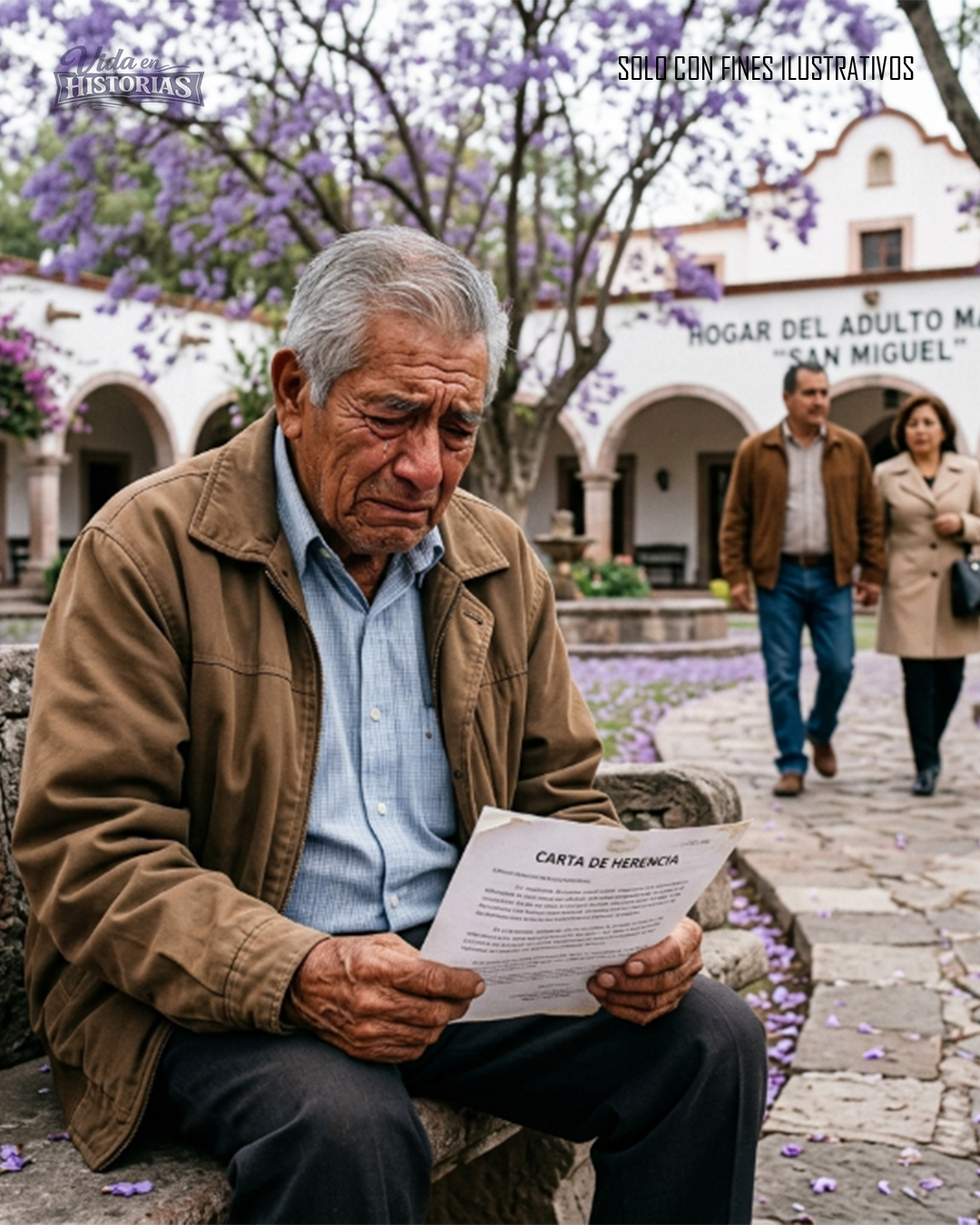
The day I turned seventy, my own son left me in a nursing home in Puebla and said, without looking me in the eyes:
“We can’t take care of you anymore, Dad. You’ll be better off here.”
But when he thought I couldn’t hear him, he added in a low voice, with a coldness that broke my soul:
“We can finally get rid of this old burden.”
My name is Aurelio Hernández Salgado. I was a high school teacher for thirty-eight years. I raised my son Mateo almost single-handedly because my wife, Rosario, died when he was twelve. Since then, my entire life revolved around that boy. I sold my car to pay for his university, worked giving private lessons in the afternoons to buy him his first computer, and when he married Fernanda, I gave them the small house I had inherited from my parents.
That June 4th, I woke up early, as always. I prepared mole poblano, red rice, and hibiscus water because Mateo had promised he would come eat with me for my birthday. I set three plates on the table: one for him, one for Fernanda, and one for my little granddaughter Camila, who was six years old and called me “grandpa of the stories.”
At eleven o’clock, there was a knock at the door. I opened it smiling, but the smile fell from my face when I saw Mateo with a folder under his arm and Fernanda behind him, serious, perfumed, wearing sunglasses even though we were inside the house.
“Dad, we need to talk,” Mateo said.
“Come in, son. The mole is almost ready.”
“We didn’t come to eat.”
I stood still. Fernanda sighed as if I were a nuisance.
Mateo took some papers out of the folder and placed them on the table where I had arranged the party napkins.
“It’s a residence for seniors. It’s called Los Jacarandas. We already paid the first month. You’re moving today.”
I felt the floor sinking beneath my feet.
“Today? But… Mateo, it’s my birthday.”
He clenched his jaw.
“That’s exactly why. You can’t live alone anymore. Last week you left the stove on.”
“I turned it off ten minutes later.”
“You also lost your keys.”
“They were in the pocket of my jacket.”
Fernanda intervened with that sweet voice she used when she wanted to seem like a good person.
“Don Aurelio, don’t see it as a punishment. It’s for your safety. We have many responsibilities.”
I looked at her. There was no concern in her eyes, only urgency.
“This was your idea, wasn’t it?”
Mateo slammed the table.
“Enough, Dad! Always playing the victim. Sign here.”
“And if I don’t sign?”
Fernanda took off her sunglasses. Her smile was small and venomous.
“Then we’ll have to talk to a doctor. There are legal ways to protect someone who is no longer in a condition to make decisions.”
I understood the threat. They wanted to declare me incompetent. They wanted my house, my savings, my pension — everything little I had.
I signed with a trembling hand. Not because I accepted it, but because I was too hurt to fight.
At three in the afternoon, a white van arrived. I packed two changes of clothes, a photo of Rosario, a wooden rosary, and a letter I had found that morning in the mailbox but hadn’t opened yet. It came from a law firm in Monterrey.
When I left, I looked at my kitchen one last time. The mole was still warm on the stove. No one tasted it.
At Los Jacarandas, I was received by Doña Lucía, the director. She was kind, but her kindness hurt me more. She gave me a key, explained the schedule, and took me to a small room with a bed, a nightstand, and a window overlooking the courtyard.
That night I didn’t eat dinner. I sat on the bed, took out the letter, and opened it.
“Dear Mr. Aurelio Hernández Salgado: We regret to inform you of the passing of your uncle, Don Evaristo Salgado Robles. You have been named universal heir to his assets. Please contact us urgently before June 7th.”
My uncle Evaristo. My mother’s brother. He had gone to Monterrey when I was a child. The family said he was a strange, solitary man who owned a small bakery. I never imagined he could leave me anything important.
The next day I called the number on the letter. The lawyer, Licenciada Valeria Cárdenas, asked to see me immediately. I explained where I was. That same afternoon she arrived at Los Jacarandas in a navy blue suit and with a thick folder.
“Don Aurelio,” she said after checking my ID, “your uncle didn’t own a small bakery. He owned a chain of industrial bakeries, two buildings in Monterrey, land in Saltillo, and several investments. The approximate value of the inheritance is forty-two million pesos.”
I didn’t understand the figure. I heard it as if listening to rain from very far away.
“Forty-two… million?”
“Yes, sir. The funds will be available in three days.”
Three days.
Mateo had left me in a nursing home believing I was a poor, useless old man, easy to erase. In three days, everything would change.
I didn’t sleep that night. I thought about Rosario, about how she would have held my hand. I thought about Camila, about her drawings stuck on my refrigerator. I thought about Mateo, about the boy who cried when he had a fever and asked me not to leave his room.
The money didn’t make me happy. It gave me something more dangerous: clarity.
On June 7th, Licenciada Valeria took me to the bank. They confirmed the deposits. I asked to cancel all the additional cards that Mateo and Fernanda had been using for years “for emergencies.” I also changed the passwords on my accounts, withdrew any authorizations, and left notarized instructions: no one would decide for me while I still had my lucidity.
The first call came that same afternoon.
“Dad, what did you do with the cards?” Mateo asked, trying to sound calm.
“I canceled them.”
“Why?”
“Because I’m no longer your responsibility. Remember you left me where, according to you, I would be better off.”
There was silence.
“Dad, don’t exaggerate. Fernanda and I just wanted to take care of you.”
“Take care of me? You abandoned me on my birthday.”
“You were putting your life at risk.”
“No, son. I was putting your plans at risk.”
I hung up.
Two days later, Mateo arrived at Los Jacarandas. He came alone. He wasn’t wearing a tie. His eyes were red and his beard unkempt.
“Dad, I need to talk to you.”
I agreed to see him in the garden, under a jacaranda tree that was shedding purple flowers onto the ground.
“You have thirty minutes,” I told him.
Mateo sat in front of me. For the first time in years, he didn’t look like a confident man, but a lost child.
“Fernanda left with her sister,” he murmured. “She says you ruined our life.”
“I didn’t ruin anything. I just stopped paying for it.”
He lowered his head.
“I was a coward.”
That phrase pierced me more than any insult.
“Yes, Mateo. You were.”
He began to cry.
“I knew you weren’t doing that badly. I knew it. But Fernanda said that if we didn’t act soon, we would lose the opportunity to fix things, to take control, to protect what would one day be mine. And I… I let myself be convinced. I wanted an easy life. I wanted to stop worrying about money. And I ended up using my own father.”
I felt the urge to hug him. I also felt the urge to get up and leave. A father’s love doesn’t disappear, but it also doesn’t erase the damage as if nothing happened.
“And Camila?” I asked.
Mateo covered his face.
“She asks about you every night. We told her you were resting. Yesterday she said to me: ‘Dad, grandparents aren’t stored away like old toys.’”
I broke.
For a few seconds I couldn’t speak. I saw Rosario in my memory, in her yellow dress, telling me that our son would one day have to learn to truly ask for forgiveness.
“Mateo, I can forgive you,” I said at last, “but I’m not going to go back to being the old man everyone uses when it’s convenient. If you want to get your father back, it won’t be because of money. It will be with time, respect, and truth.”
He nodded, crying.
“I’ll do whatever you ask.”
“No. You’ll do what’s right even if I don’t ask you to.”
A week later, Mateo returned with Camila. The little girl ran toward me and threw herself around my neck.
“Grandpa, why did you come to live here?”
I hugged her so tightly I felt my heart return to my chest.
“Because sometimes grown-ups make mistakes, my sky. But they can also learn.”
Camila looked at her dad.
“Did you make a mistake?”
Mateo knelt in front of her.
“Yes, daughter. A big one.”
“Then say sorry to Grandpa.”
Mateo looked at me, and this time there were no excuses in his eyes.
“Forgive me, Dad. Not for the cards. Not for the money. Forgive me for making you feel alone when you never left me alone.”
That day I hugged him. Not like before, not with innocence, but with hope.
With part of the inheritance, I bought a large house in Cholula, with a garden and bougainvillea, where I prepared a room for Camila and one for myself. I also bought Los Jacarandas, not to live there, but to transform it. I changed its name to Casa Rosario, in honor of my wife, and turned it into a center where older adults could receive care, workshops, and companionship without feeling abandoned.
Doña Lucía remained as director. Licenciada Valeria managed the foundation. Mateo, after separating from Fernanda, began coming on Saturdays to give free math classes to the residents who wanted to learn how to use their cell phones or manage their accounts. At first he did it out of guilt. Later, he did it out of love.
Fernanda tried to come back when she found out about the inheritance. She sent me messages, flowers, long apologies. I never responded. I didn’t wish her harm, but I learned that closing a door can also be a form of peace.
A year later, I celebrated my seventy-first birthday in the garden of Casa Rosario. There was mole, red rice, hibiscus water, and a huge cake decorated by Camila. Mateo arrived early, without a folder, without papers, without hurry. He brought in his hands a simple gift: an album with old photos he had rescued from my house.
On the last page there was a photo of him as a child, sleeping on my chest. Below he wrote:
“Thank you for never stopping being my father, even when I forgot to be your son.”
I cried in front of everyone. I wasn’t ashamed.
When I blew out the candles, Camila asked me what wish I had made.
I looked at Mateo. He smiled at me with eyes full of tears.
“I wished for something that has already come true,” I replied. “That this family would learn that love is not inherited, it is cared for.”
And that afternoon, while the jacaranda flowers fell over the courtyard like a purple rain, I understood that my uncle Evaristo had not only left me a fortune. He had left me a second chance.
Not to take revenge.
But to recover my dignity, choose my peace, and discover that even a broken heart can have a home again.
