Physical Address
304 North Cardinal St.
Dorchester Center, MA 02124
Physical Address
304 North Cardinal St.
Dorchester Center, MA 02124

**PART 1**
“Your mom gave you that black eye because someone had to teach you how to obey.”
That’s what Rodrigo said at the altar, with a calm smile, while more than a hundred guests stared at us as if they had misheard.
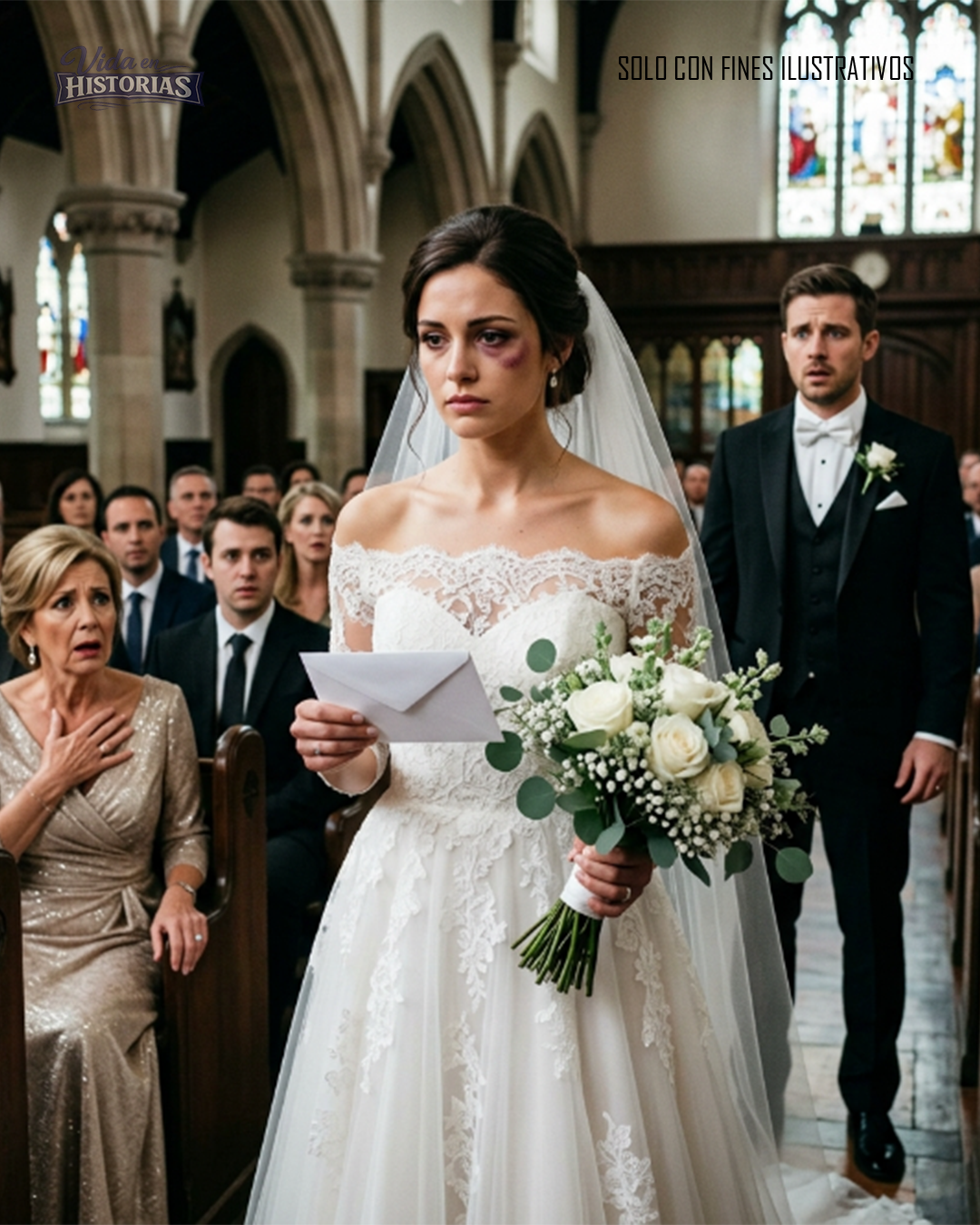
I had arrived at my own wedding with my left eye swollen.
The makeup covered almost everything, but not enough. My best friend, Mariana, spent half an hour in the hotel room trying to hide the bruise with concealer, powder, and a patience that hurt me more than my face. She didn’t cry. She didn’t scold me. She just looked at me in the mirror and said:
“We can still leave, Lucía.”
I clutched the bouquet to my chest.
“Not yet.”
What Mariana didn’t know was that inside that bouquet, among the white roses and baby’s breath, I was carrying a small envelope. And inside that envelope was the reason I hadn’t canceled the wedding the night before.
Photos. Screenshots. A letter.
Evidence.
Rodrigo Salazar had been my boyfriend for almost four years. An engineer, punctual, polite — the kind of man who shakes hands firmly and makes a good impression on aunts from the first coffee. My mom, Teresa Villalobos, adored him.
And that was exactly the problem.
My mom had always been the kind of woman people admire from afar. She organizes charity breakfasts in Guadalajara, knows half the city at the club, wears pearls even to the bank, and has a voice capable of making you feel guilty without raising her tone.
My dad died when I was twelve. Since then, my house stopped being a home and became my mother’s territory. That’s where I learned to apologize before knowing if I had done anything wrong. I learned to read silences, to lower my gaze, to never contradict her in public.
My aunt Carmen, my father’s sister, was the only adult who ever made me feel safe. That’s why, when my mom wanted to put her in the back rows at the wedding to seat her club friends up front, I said no.
It was the first time I told her no without softening it.
“Carmen stays in the third row,” I said.
My mom smiled as if I were a child throwing a tantrum.
“Lucía, don’t start. Important people should be visible in the photos.”
“My aunt is family.”
“She’s your father’s family,” she replied, in that tone that turned my father’s name into something uncomfortable.
That night I went to her house to “talk like adults.” She had set out the good china, expensive wine, and soft music, as if the setting could make what she wanted to impose reasonable.
At 9:20, I got up from the table.
“I’m not arguing anymore.”
She grabbed my arm. I pulled away. Her hand flew out and the diamond ring my dad had given her split the skin near my cheekbone.
We froze.
Then, with a calmness that still turns my stomach, she said:
“Look what you made me do.”
I drove to my apartment with one hand on the wheel and the other on my face. Mariana arrived twenty minutes later. She took photos from several angles. She saved copies. I sent everything to my email and also to my aunt Carmen.
Then I called Rodrigo.
I told him everything with a broken voice. I told him my mom had hit me. That I had photos. That I didn’t know what to do.
He sighed.
“Love, rest. We’ll deal with this after the wedding.”
“After?”
“There are only two days left. Let’s not cause a scandal now. Your mom is difficult, but you get too worked up with her too.”
I felt something break, but I still couldn’t name it.
The next day I printed the photos. I also printed the messages my mom sent me that morning.
“Cover that mark well.”
“I hope you’ve calmed down already.”
“This happens when you don’t listen.”
My therapist, Dr. Elena Márquez, wrote me a short letter on letterhead. It confirmed that I had been talking for years about emotional family abuse and that I had come to the appointment with a visible bruise consistent with what I had described.
I put everything in the envelope.
And I walked toward the altar.
My mom was in the front row, impeccable, in a light blue dress and pearls. She didn’t even blink when she saw me.
Rodrigo was waiting for me, smiling.
When I reached his side, his eyes went straight to my mother. She barely lifted her chin.
Then he said those words.
“Your mom gave you that black eye because someone had to teach you how to obey.”
First there was silence.
Then some awkward laughter.
Then more laughter, because in Mexico many people laugh when they don’t know if they should be outraged.
I looked at Rodrigo.
“What did you say?”
He clenched his jaw.
“Don’t start, Lucía. We’re in the middle of the ceremony.”
“Tell them what you meant.”
Rodrigo leaned toward my ear, but the room had good acoustics.
“Your mom says that’s the only way you understand. And honestly, sometimes you are impossible.”
The air left my body.
My mother lowered her eyes, pretending to be ashamed. But I saw her smile.
That’s when I understood everything.
I couldn’t believe what was about to happen…
—
**PART 2**
I let go of the bouquet with one hand and felt the edge of the envelope hidden among the flowers.
For years I thought fear was a normal part of love. That loving someone meant learning not to bother them too much. That a good daughter should protect her mother’s image. That a good girlfriend should endure certain things so as not to ruin a wedding.
But at that altar, with a hundred people watching, I understood that my entire life had been a table set for others to eat peacefully while I swallowed the truth.
“My mom hit me two nights ago,” I said.
I didn’t shout. I didn’t need to.
The room fell completely silent.
My mom stood up abruptly.
“Lucía, enough.”
“No, Mom. Now you’re going to listen.”
Rodrigo grabbed my arm, not hard, but enough to try to stop me. I looked at his hand and then at his face.
“Let go.”
He obeyed, more out of fear of the guests’ eyes than out of respect.
“You’re making a fool of yourself,” he whispered.
“No. I’m telling what happened.”
I reached into the bouquet and pulled out the envelope. Several people leaned forward. My aunt Carmen, in the third row, stood up slowly.
I walked over to the justice of the peace, Licenciada Beatriz Ríos, a serious woman who had agreed to marry a couple and suddenly found herself facing something very different.
“Here are photographs, messages, and a professional letter,” I said. “I’m giving them to you because I don’t want anyone to say I’m exaggerating again.”
The justice took the envelope with both hands.
My mom instantly changed tactics. Her face transformed. She went from furious to wounded, as if she had been attacked for no reason.
“Daughter, you’re confused. It was an accident. You pulled my hand.”
That phrase gave me an icy clarity.
“You said: ‘Look what you made me do.’”
Someone in the second row breathed sharply.
Rodrigo tried to smile, but no one was playing along anymore.
“Lucía, love, this can be discussed in private.”
“That’s what you wanted. For everything to be in private. As always.”
My mom looked around. I saw her calculating who was watching her, who might believe her, who was still on her side.
“Your father would die of shame,” she said.
That phrase hit me harder than the ring.
My aunt Carmen moved toward the center aisle.
“Don’t bring my brother into this, Teresa.”
The entire room turned toward her.
My mother tensed.
“Carmen, this is not your place.”
“It’s been my place for twenty years,” my aunt replied. “It was my place when you pushed Lucía away from her father’s family. It was my place when you made her feel guilty for mourning him. It was my place every time I saw her apologize for things she hadn’t done.”
I didn’t know that. Not like that. Not in those words.
My mom lifted her chin.
“You always wanted to meddle where you weren’t called.”
“No. I always wanted to protect her. But you were the perfect widow, the respectable lady, the untouchable Teresa Villalobos.”
My aunt’s voice trembled, but it didn’t break.
“And today it ends.”
Rodrigo took a step toward me.
“Lucía, think carefully. If you do this, there’s no going back.”
I looked at him. I saw the man who for years had told me “just apologize,” “it’s not worth fighting,” “your mom is just like that,” “you’re too sensitive.” I saw the man who didn’t defend me because he never wanted to. I saw the man who wasn’t trapped between my mother and me, but comfortably sitting on her side.
I took off the ring.
Rodrigo opened his hand by reflex.
I placed it in his palm.
“I’m not marrying you.”
The murmur was immediate.
My mom let out a dry laugh.
“Don’t be dramatic. You’re destroying your future over a tantrum.”
“No,” I said. “I’m saving it.”
Rodrigo lowered his voice.
“After everything I’ve done for you.”
“What have you done for me?”
He stayed silent.
“Cover for my mom? Laugh at me? Say in front of everyone that I deserved to be hit?”
His face lost color.
“It was a joke.”
“No. It was a confession.”
Licenciada Beatriz opened the envelope. She didn’t do it as a spectacle, but as someone who understands that a document can change a room. She saw the photos. Then the screenshots. Then the letter.
Her expression hardened.
“Miss Lucía,” she said, “this should be turned over to the authorities.”
My mom stepped forward.
“You have no right to review anything.”
“It was given to me voluntarily,” the justice replied. “And what I see here is serious.”
A woman on Rodrigo’s side stood up and almost ran out. Another began to cry. Mariana appeared beside me and took my hand.
Then my mom did the last thing I expected.
She approached Rodrigo and said, loud enough for everyone to hear:
“Do something. That’s why I wanted you in this family.”
The silence that followed was worse than any scream.
Rodrigo looked at her, terrified. Because that phrase didn’t just expose him. It exposed both of them.
I felt the ground open, but this time not to swallow me. To show what had been buried.
My aunt Carmen squeezed my shoulder.
“Lucía, we’re leaving.”
But before I moved, Licenciada Beatriz took out a sheet from the envelope — my therapist’s letter — and looked at my mother.
“Mrs. Teresa, I think everyone here deserves to know why your daughter showed up like this at her wedding.”
My mother opened her mouth.
And just when it seemed she was finally going to be completely exposed, Rodrigo did something no one saw coming…
—
**PART 3**
Rodrigo knelt.
Not like a repentant man. Not like someone who had just understood the harm. He knelt like someone trying to regain control with a bigger scene than the previous one.
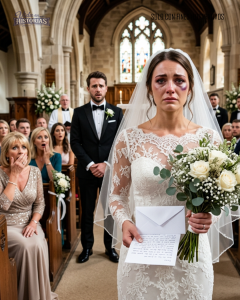
“Lucía, forgive me,” he said, his voice broken for the audience. “I was wrong. I didn’t know you were so affected.”
I felt nauseous.
So affected.
He didn’t say hurt. He didn’t say beaten. He didn’t say betrayed.
He said affected.
My mom, seeing him on the floor, understood the play and began to cry without tears.
“My daughter has always been very sensitive,” she said. “Since she was a child she interprets everything as an attack.”
Licenciada Beatriz looked up.
“Ma’am, there are photographs of a visible injury and messages written by you.”
My mother lost her mask for half a second.
“Because she doesn’t listen to me!”
There it was.
The truth, naked, in a single phrase.
Not because it was an accident. Not because I was wrong. Not because I’m sorry.
Because she doesn’t listen to me.
The entire room heard it.
Rodrigo remained kneeling, but no one was looking at him with tenderness anymore. Several people had their phones in their hands. I don’t know if they were recording, if they wanted to call someone, or if they just needed to hold something so they wouldn’t feel part of it.
Mariana stepped forward.
“I took the photos that night,” she said. “I arrived at her apartment twenty minutes later. Lucía was shaking. She wasn’t making anything up.”
My aunt Carmen added:
“And I received the copies that same night.”
An older man, a friend of my father’s, slowly stood up from one of the center rows.
“Teresa,” he said, “Roberto would never have allowed this.”
My mother turned to him furiously.
“Don’t say my husband’s name.”
“He was my friend,” he replied. “And that girl was his daughter too.”
Something broke in the room.
Not in me.
In the version of my mother that everyone had bought for years.
I took a deep breath. I looked at Rodrigo, still on the floor.
“Get up. I’m not going to give you a forgiveness scene.”
He stood up slowly.
“You’re going to regret this.”
“Maybe,” I said. “But not this.”
I walked toward the microphone that had been set up for the vows. I took it with a hand that no longer trembled.
“Thank you for coming,” I said. “I’m sorry you had to witness this, but I’m not sorry I said it. For years I believed that telling the truth was humiliating my family. Today I understood that the humiliation is not in saying what happened. It’s in having done it.”
My mom covered her face.
“How cruel you are.”
“No, Mom. Cruel was hitting me and asking me to cover it up for the photos.”
Someone started to applaud.
It was a small, solitary clap. Then another. Then more.
It wasn’t celebration. It was support.
My mother looked around, desperate. She no longer had an obedient daughter. She no longer had an allied son-in-law. She no longer had a room willing to pretend.
Licenciada Beatriz approached me.
“Lucía, I can accompany you to file this formally.”
I nodded.
“Yes. Today.”
My mom took a step back.
“You’re going to report your own mother?”
That question would have destroyed me years earlier.
Not that day.
“I’m going to report the person who hit me.”
Mariana hugged me. My aunt Carmen took my bouquet, as if she could finally take from my hands something that weighed too much.
The reception never happened as planned. Some guests left uncomfortably. Others stayed in silence, ate because the food was already served, and approached me to say awkward but sincere things: “I didn’t know,” “how brave,” “sorry for laughing.”
Rodrigo tried to call me thirty times that night. Then he sent an email.
He said he only wanted to help me handle my mom. That he didn’t understand the seriousness. That he got carried away. That he was willing to do couples therapy.
I didn’t respond.
My mother hired a lawyer. She tried to say it was an accident. But there were the photos, the messages, the letter, the witnesses, and her own phrase in front of everyone: “Because she doesn’t listen to me.”
The report didn’t send her to prison. There was a restraining order, a fine, and mandatory intervention sessions. Many people will say it was too little. Maybe it was.
But for me it meant something enormous: for the first time, what I had lived through stopped being “family drama” and became a documented fact with a date, name, and signature.
Three months later I moved near my aunt Carmen. On Sundays we had chilaquiles for breakfast in her kitchen, and she told me stories about my dad that my mom never wanted to tell me. I discovered that he laughed loudly, that he danced badly, that he kept all my Father’s Day cards in a shoebox.
I cried a lot.
Not for Rodrigo.
Not for the wedding.
I cried for the little girl who believed that love meant enduring.
One day Mariana sent me a photo she took before the ceremony. I’m sitting in front of the mirror, dressed as a bride, with the bouquet on my lap. The bruise is barely visible. Almost.
But my eyes are.
They’re not looking at the mirror. They’re looking beyond it.
For years I thought that day I had lost a wedding, a fiancé, and a family.
Now I know that day I recovered something much more important.
My own voice.
