Physical Address
304 North Cardinal St.
Dorchester Center, MA 02124
Physical Address
304 North Cardinal St.
Dorchester Center, MA 02124

Thump. Drag. Thump. Drag.
That was the soundtrack of my junior year.
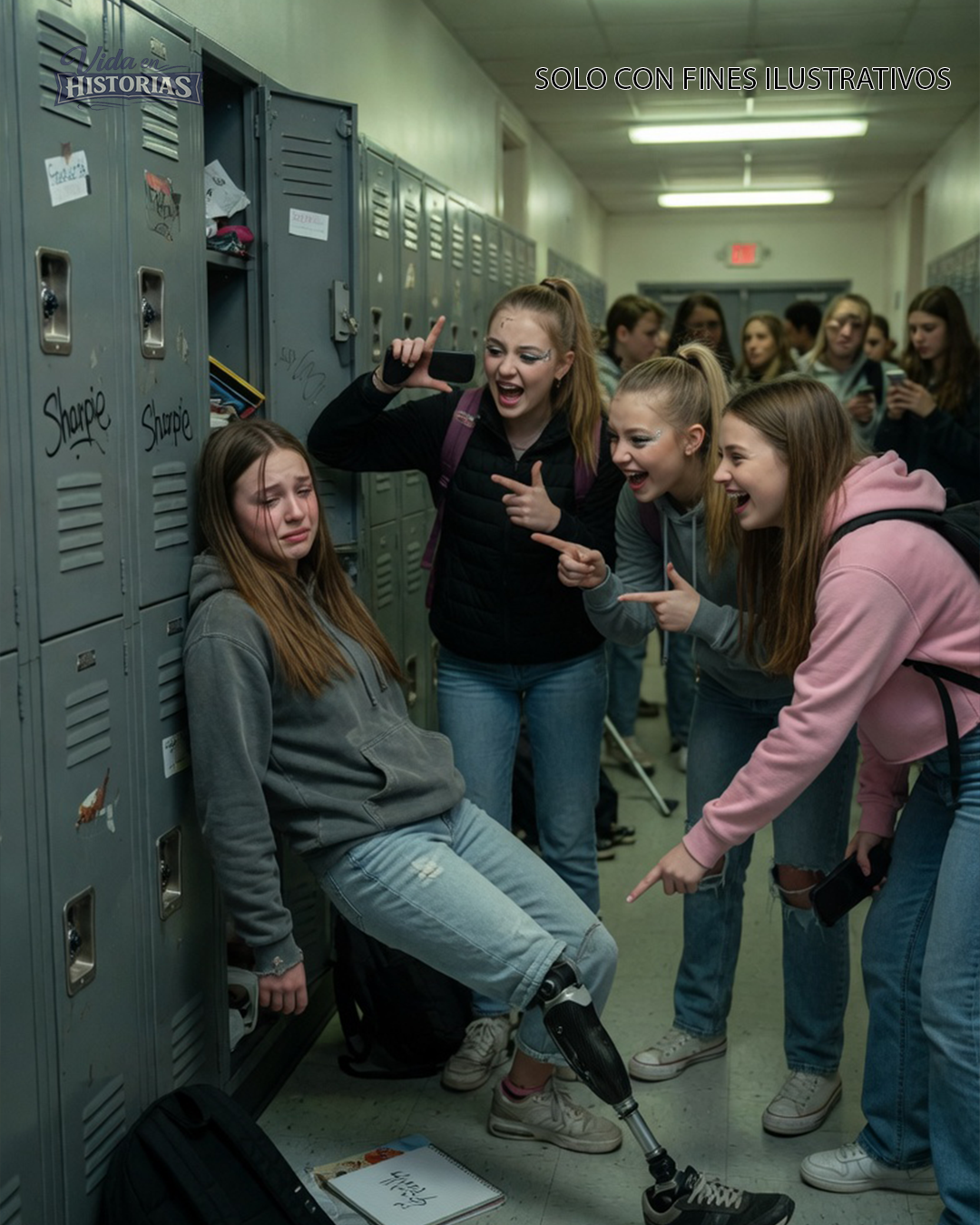
It was the sound of my heavy, articulated metal leg brace dragging across the scuffed linoleum floors of Westbridge High School. Every single step I took was a broadcast to the entire hallway. There was no blending in. There was no sneaking into class late without every head turning to look at the girl who survived the accident but lost her stride.
I hated that sound. But not as much as Chloe, Harper, and Madison seemed to hate it.
It was 12:15 PM. Lunch break. The bell had just screamed through the PA system, and the hallway was an absolute madhouse of slamming locker doors, shouting voices, and the smell of stale cafeteria pizza and cheap body spray.
I was trying to stay near the wall. If I stayed near the wall, I wouldn’t get trampled. My physical therapist said I was making great progress, but “great progress” in a doctor’s office didn’t translate to surviving the stampede of hungry American teenagers.
I was almost to the cafeteria doors. I could see the exit to the main parking lot just beyond it through the glass panes. It was raining outside, a miserable, freezing, grey Tuesday downpour.
“Hey, Robo-bitch.”
The voice cut through the hallway noise like a screeching tire.
I stopped. I didn’t turn around immediately. I just closed my eyes for a second, gripped the fraying straps of my black backpack, and took a deep breath.
Before I could even pivot on my good leg, a hand clamped down on my shoulder.
It wasn’t a gentle tap. It was a hard, aggressive shove.
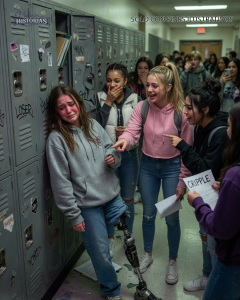
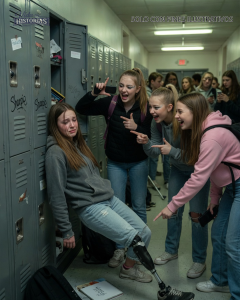
My brace locked up. I lost my balance entirely. My shoulder blades slammed hard against the cold, painted metal of locker 402. The combination lock dug sharply into my spine, stealing the breath right out of my lungs.
My backpack slipped off one shoulder, hitting the floor with a heavy thud.
I opened my eyes to see Chloe standing directly in my personal space. She was flanked by Harper and Madison. They looked like they had just walked out of a mall catalog—pristine hair, perfect makeup, expensive clothes. And they were looking at me like I was a piece of trash that had somehow blown into their immaculate hallway.
“Did you not hear me talking to you?” Chloe sneered, crossing her arms. She looked down at my leg brace, her upper lip curling in absolute disgust. “Or does that metal contraption short-circuit your hearing, too?”
Harper giggled, a high-pitched, grating sound. “Careful, Chloe. You might get rust on your sweater.”
Madison kicked my backpack lightly with her pristine white sneaker. “You’re taking up the whole hallway, freak. Move.”
A small crowd was starting to form. High schoolers love a spectacle. They love a car crash. And right now, I was the car crash. People were slowing down, whispering, pulling out their phones.
My heart was hammering against my ribs like a trapped bird. The metal locker was freezing against my back. My bad leg was throbbing from the sudden impact, a dull, agonizing ache radiating from my knee down to my ankle.
But I didn’t say a word.
I looked at Chloe. I looked straight into her mocking, hateful eyes. And I just stared at her.
“What?” Chloe snapped, stepping closer, her voice rising in pitch. She hated it when people didn’t react. She fed on tears. She fed on apologies. “Are you mute now, too? Speak! Apologize for being in my way!”
She shoved me again. Harder this time. The back of my head tapped against the metal locker.
“Leave her alone,” a weak voice mumbled from the crowd, but nobody stepped forward. Nobody ever did. In Westbridge High, you didn’t cross Chloe’s dad, who owned half the car dealerships in the county, and you definitely didn’t cross Chloe.
“I said, apologize!” Chloe yelled, her face turning a blotchy red. She raised her hand, like she was about to shove me a third time.
I kept my mouth shut. I didn’t cry. I didn’t flinch.
Why was I silent?
Because they thought power was yelling in a hallway. They thought power was picking on a girl who literally couldn’t run away. They thought they were untouchable because they had money, because they were pretty, because the school principal always looked the other way when they bullied the kids they deemed ‘lesser’.
They didn’t know a damn thing about real power.
Real power doesn’t need to scream in a high school hallway. Real power doesn’t need to push disabled girls against lockers.
As Chloe raised her hand, my eyes shifted past her perfectly curled hair. I looked through the heavy glass doors leading out to the front of the school.
The rain was coming down in sheets, blurring the pavement.
Through the grey downpour, blinding LED headlights pierced the gloom.
A massive, sleek, completely black Lincoln Navigator glided smoothly into the fire lane—the spot right in front of the doors where absolutely no one was allowed to park. Not the principal. Not the mayor. No one.
The car was pristine. Intimidating. It sat there idling, a dark beast in the rain, heavy drops beading off its tinted windows.
Chloe, noticing my gaze, stopped her hand in mid-air. She frowned and turned her head to look out the glass doors. Harper and Madison looked, too. The whispers in the hallway died down as the students closest to the doors noticed the vehicle.
“Who the hell is that?” Madison whispered, her bravado suddenly faltering. “You can’t park there.”
I didn’t answer. I just watched.
Through the rain, the heavy rear door of the Lincoln unlatched with a solid clunk that seemed to echo even through the thick glass.
The door swung open.
A polished, black leather heel stepped out onto the wet concrete.
I felt a slow, cold smile creep onto my face.
They thought I was weak. They thought I was alone.
They were about to find out exactly who they had just shoved against a locker.
CHAPTER 2
The first thing that emerged from the cavernous, black interior of the Lincoln Navigator wasn’t a person. It was an umbrella. A massive, heavy-duty, stark black umbrella that snapped open with a sharp, aggressive thwack that seemed to momentarily overpower the sound of the driving rain.
Then came the polished, black leather heel. It struck the wet pavement of the fire lane with absolute authority.
The hallway had gone completely silent. A moment ago, it had been a deafening symphony of slamming metal, overlapping conversations, and the chaotic energy of five hundred teenagers desperate for a forty-five-minute escape from trigonometry and world history. Now, you could hear a pin drop. You could hear the hum of the vending machines down the hall. You could hear the heavy, rhythmic drumming of the rain against the glass doors.
Chloe’s hand was still hovering in the air, a few inches from my shoulder. She hadn’t moved. Harper and Madison were frozen beside her, their previously cruel, smirking faces now slack with confusion. They were like deer caught in the headlights of an oncoming freight train, completely unaware of the sheer tonnage of the disaster hurtling toward them.
From the driver’s side of the Navigator, a man stepped out. He didn’t bother with an umbrella. He was built like a cinderblock wall, wearing a sharply tailored dark suit that struggled to contain the broadness of his shoulders. A small, coiled earpiece wire snaked down the back of his neck, disappearing into his collar. He moved with a terrifying, practiced efficiency, scanning the parking lot, the surrounding cars, and finally, the glass doors of the school. He walked around the front of the SUV, his eyes cold and analytical, and took his place beside the open rear passenger door.
He wasn’t just a driver. He was a US Marshal.
And the woman he was shielding from the rain was my mother.
My mother, Eleanor Vance, stepped fully out of the vehicle.
Even through the rain-streaked glass, her presence was suffocating. She was dressed impeccably, as she always was. A charcoal grey, custom-tailored skirt suit that screamed high-end Manhattan rather than suburban New Jersey. A crisp, white silk blouse buttoned precisely to the collarbone. A subtle string of pearls. A classic beige trench coat draped over her shoulders to ward off the chill. Her dark hair was pulled back into a severe, flawless French twist, not a single strand daring to fall out of place, not even in the storm.
She stood there for a split second, adjusting her leather gloves, her gaze sweeping over the front of Westbridge High School. She looked at the building not like a parent coming for a PTA meeting, but like a general surveying a piece of territory she was about to forcefully annex.
Then, her eyes locked onto the glass doors. She saw the crowd of students. She saw the open space they had formed around locker 402.
And she saw me.
She saw the heavy metal brace strapped to my left leg. She saw my backpack discarded on the dirty floor. She saw the three girls standing aggressively in my personal space, with Chloe’s hand still raised in a threatening posture.
Even from thirty feet away, through a sheet of heavy rain and thick reinforced glass, I saw the exact moment the temperature in her eyes dropped to absolute zero.
My mother was not a woman prone to screaming. She didn’t throw tantrums. She didn’t yell. When my mother was angry, the world didn’t explode; it froze. She was the Honorable Judge Eleanor Vance, sitting on the bench of the United States District Court. She was a woman who routinely handed down federal life sentences to cartel bosses, corrupt politicians, and white-collar sociopaths without so much as a tremor in her voice. She dismantled arrogant, high-priced defense attorneys for sport before her morning coffee.
And right now, she was looking at three high school juniors who thought they ran the world because they had a thousand Instagram followers and daddies with credit cards.
“Is that… is that the Mayor?” I heard a sophomore whisper behind me.
“No, idiot, the Mayor drives a Tahoe,” someone else muttered back. “That’s a federal plate.”
My mother began to walk toward the school. The Marshal walked half a step behind her, holding the large black umbrella perfectly steady over her head. They moved with a synchronized, predatory grace. The rain seemed to actively avoid them.
As she reached the front doors, the Marshal reached out and pulled the heavy glass handle, holding the door open for her.
She stepped over the threshold, bringing the bitter cold and the smell of the storm into the stuffy, pizza-scented hallway. The Marshal stepped in behind her, shaking out the umbrella and letting the door swing shut with a heavy, final click.
The crowd of students instantly parted. It wasn’t a conscious decision; it was a primal instinct. The sheer, unadulterated aura of authority rolling off my mother was palpable. The students fell back, pressing themselves against the lockers on the opposite side of the hall, leaving a wide, clear path directly to me.
The rhythmic clack, clack, clack of my mother’s heels echoed sharply against the linoleum. Every step sounded like a gavel striking a sounding block.
Clack. Order in the court.
Clack. All rise.
Clack. Judgment is here.
Chloe finally dropped her hand. The aggressive, flushed redness in her face was rapidly draining, replaced by a pale, sickly realization that she was entirely out of her depth. Harper took a tiny, involuntary step backward, suddenly finding the floor tiles fascinating. Madison crossed her arms tightly over her chest, as if trying to shrink into herself.
My mother stopped exactly three feet away from Chloe.
She didn’t look at me yet. She kept her eyes entirely on the girl who had just shoved her daughter against a metal locker.
The silence stretched. It was excruciating. Three seconds. Five seconds. Ten seconds. My mother just stood there, her hands clasped elegantly in front of her, her posture rigidly perfect, staring down at Chloe with an expression of clinical, detached fascination. It was the same look a biologist might give a particularly repulsive, slightly venomous insect pinned to a corkboard.
Chloe shifted her weight uncomfortably. She tried to maintain her haughty expression, pulling her shoulders back and lifting her chin, but her eyes were betraying her. They were darting frantically, looking for an exit, looking for backup, looking for anyone to break the suffocating tension.
“Can I… help you?” Chloe finally managed to say. Her voice, usually so loud and commanding, sounded thin and reedy. It cracked slightly on the last word.
My mother didn’t answer immediately. She slowly unbuttoned her trench coat, slipping it off her shoulders. The Marshal was there instantly, taking the coat and folding it neatly over his arm, stepping back into the periphery, a silent, looming threat.
“I highly doubt it,” my mother said. Her voice was terrifyingly calm, perfectly modulated, and carried beautifully through the dead-silent hallway. It was a voice trained to command massive, echoing courtrooms. It was smooth as silk and hard as titanium.
She tilted her head a fraction of an inch, examining Chloe’s face.
“You must be Chloe Sterling,” my mother stated. It wasn’t a question. It was a fact entered into the record.
Chloe blinked, surprised. A tiny flicker of her usual arrogance returned, fueled by the assumption that her family’s local prominence had preceded her. “Yeah. I am. My dad owns Sterling Automotive. Who are you?”
My mother smiled. It was a terrifying expression. It didn’t reach her eyes. It was the smile of a trap snapping shut.
“I am aware of who your father is, Miss Sterling,” my mother replied smoothly. “Richard Sterling. He operates three mid-level car dealerships in this county. He plays golf at the Oak Ridge Country Club on Tuesdays, he recently financed a commercial development project on Route 9, and he currently has a pending zoning variance request sitting on a desk at the county courthouse.”
Chloe’s pale face went entirely chalk white. The flicker of arrogance vanished, extinguished by a sudden, icy wave of dread. She didn’t understand how this impeccably dressed stranger knew her father’s schedule, let alone his business dealings.
“I also know,” my mother continued, her voice dropping an octave, becoming a lethal, quiet purr, “that your father is currently under a preliminary audit by the IRS for creative accounting practices regarding his inventory depreciation. A minor issue, perhaps. But certainly an embarrassing one.”
A collective gasp echoed down the hallway. Teenagers are vicious; they thrive on the destruction of the popular elite. The kids who had been terrified of Chloe two minutes ago were now holding their breath, watching her world get systematically dismantled by a woman who hadn’t even raised her voice.
“How… how do you know that?” Chloe stammered, taking a step back. She bumped into Harper, who violently flinched away, not wanting to be associated with a sinking ship.
My mother ignored the question. She slowly turned her gaze to Madison, then to Harper, dismissing them in less than a second as irrelevant collateral. Finally, she turned to me.
The cold, terrifying mask melted for just a fraction of a second. I saw the mother underneath the judge. I saw the woman who had sat next to my hospital bed for fourteen days straight, sleeping in a plastic chair, holding my hand while I cried through the agony of shattered bones and multiple surgeries.
She looked at the locker behind me. She looked at the scuff mark on the wall where my shoulder had hit. She looked down at my heavy metal brace, and then at my backpack lying on the dirty floor.
When she turned back to Chloe, the mother was gone. The federal judge had returned, and she was preparing to pass sentence.
“My daughter,” my mother said, her voice echoing off the metal lockers, “suffered a traumatic crush injury to her left tibia and fibula thirteen months ago. She spent four weeks in an intensive care unit. She has undergone five reconstructive surgeries. She spends three days a week in agonizing physical therapy just to be able to walk down this hallway without a wheelchair.”
She took a single, slow step toward Chloe. Chloe practically shrank against the lockers.
“She is wearing a titanium brace that is physically bolted to a custom orthopedic boot, which causes her severe, chronic pain every single time it rains,” my mother continued, her eyes locked onto Chloe’s trembling face. “And yet, despite all of that, she still manages to hold a 4.0 GPA, she still manages to show up to this school every day, and she still manages to have more grace and resilience in her shattered left leg than you have in your entire, pathetic, privileged existence.”
Tears welled up in Chloe’s eyes. The invincible bully, the queen of the juniors, was visibly shaking, humiliated in front of half the student body.
“I saw you shove her,” my mother stated, the words dropping like heavy stones. “I watched you physically assault a disabled student. I watched you attempt to intimidate her. I watched you create a hostile environment.”
“It… it was just a joke!” Chloe cried out, her voice cracking, a desperate, pathetic attempt to backpedal. “We were just messing around! Right, guys?” She looked frantically at Harper and Madison.
Harper looked at the ceiling. Madison took two large steps away. There is no loyalty among predators when a bigger predator arrives.
“A joke,” my mother repeated flatly. “I see.”
Suddenly, the heavy wooden doors at the end of the hallway burst open. Principal Davies came sprinting down the corridor, his tie askew, his face flushed red, closely followed by Mr. Harrison, the campus security guard. Davies was a nervous, sweating man who spent his entire career trying to appease the wealthy parents in the district.
“What is going on here?” Principal Davies panted, pushing his way through the crowd of students. “Break it up! Everyone get back to the cafeteria! This is a clear violation of…”
He stopped dead in his tracks. He saw the towering US Marshal. Then, he saw my mother.
Principal Davies looked like he had just swallowed a golf ball. The blood drained from his face so fast I thought he might faint.
“Judge Vance,” Davies choked out, his voice a high-pitched squeak. He immediately began wringing his hands together. “I… I had no idea you were coming to campus today. We would have… prepared. Is there a problem?”
The entire hallway let out a collective, silent ‘Oh my god’.
Judge Vance. The name echoed through the minds of every student present. Even teenagers who didn’t care about politics or law knew that name. Eleanor Vance was a local legend. She was the one who had recently sentenced the corrupt former mayor to federal prison. She was the one the local news anchors spoke about with a mix of reverence and sheer terror.
Chloe looked at the Principal, then at my mother. The realization of exactly who she had just assaulted hit her like a physical blow. Her knees visibly buckled.
“Principal Davies,” my mother said, her tone suddenly shifting from lethal threat to icy, professional courtesy. It was somehow even more terrifying. “Good afternoon. I am here to collect my daughter for a medical appointment.”
“Of course, of course, Your Honor,” Davies stammered, nodding furiously. “Is she alright? We weren’t informed…”
“She was fine until roughly three minutes ago,” my mother interrupted smoothly. “When I witnessed her being physically shoved against this locker by Miss Sterling here, while her two friends provided an audience.”
Davies whipped his head around to stare at Chloe in absolute horror. If there was one thing Principal Davies hated more than bad press, it was bad press involving a federal judge’s disabled daughter.
“Chloe?” Davies gasped. “Is this true?”
Chloe couldn’t speak. She just stood there, tears freely running down her perfectly contoured cheeks, her mouth opening and closing like a suffocating fish.
“I will be taking my daughter now,” my mother said, turning away from the trembling principal. She didn’t raise her voice. She didn’t demand a suspension. She didn’t ask for a meeting. She knew exactly how to wield power: by letting the implication of it hang heavily in the air.
She turned to the Marshal. He immediately stepped forward, stooping down with surprising gentleness for a man of his size, and picked up my discarded backpack.
My mother finally looked at me. The coldness vanished completely. Her eyes were warm, protective, and fiercely loving. She reached out and gently cupped my cheek, her thumb brushing against my skin.
“Are you okay, sweetheart?” she asked softly, loud enough for only me to hear.
I swallowed the lump in my throat and nodded. “I’m okay, Mom.”
“Good.” She smiled, a real, genuine smile. “Let’s get out of here. Your physical therapist had a cancellation, so we’re going to get lunch instead. I know a place that makes those truffle fries you like.”
She wrapped her arm protectively around my shoulders, avoiding the side that had hit the locker.
We turned to leave. The crowd of students remained completely silent, pressed against the walls, watching us walk toward the glass doors.
Before we reached the exit, my mother stopped. She turned her head, looking back over her shoulder at Principal Davies, who was currently glaring at a weeping Chloe Sterling.
“Oh, Principal Davies,” my mother called out, her voice echoing clearly one last time.
“Yes, Judge Vance?” Davies practically tripped over his own feet to respond.
“I expect a full, detailed incident report regarding this physical altercation to be filed by the end of the school day,” my mother said casually, as if asking for a weather update. “I will also be placing a courtesy call to the district superintendent this afternoon to discuss the lack of hallway supervision for disabled students. Furthermore, I suggest Miss Sterling calls her father. He is going to need a very good lawyer by the end of the week, and I would hate for him to be caught off guard.”
She didn’t wait for a response. She turned back around.
The Marshal pushed open the heavy glass doors. The cold wind and rain rushed in, welcoming us.
Thump. Drag. Thump. Drag.
My brace scraped against the floor as I walked out, leaning slightly on my mother. But this time, the sound didn’t make me feel weak. It didn’t make me feel broken.
It sounded like a victory march.
We stepped out into the storm, the black umbrella shielding us from the rain, leaving the ruined, weeping queen of Westbridge High School standing frozen in the hallway, surrounded by the absolute wreckage of her own arrogance.
CHAPTER 3
The heavy door of the Lincoln Navigator pulled shut with a solid, airtight thud, instantly cutting off the howling wind and the chaotic noise of the school.
Inside the SUV, it was another world entirely. It smelled of expensive leather, faint vanilla, and the crisp, ozone-like scent of my mother’s cold rain-dampened trench coat. The ambient temperature was a perfect seventy-two degrees. Soft, classical music was playing at a barely audible volume through the premium sound system.
It was a sanctuary.
I sank back into the plush leather seat, my heavy metal brace awkwardly jutting out, taking up entirely too much legroom. For the first time since Chloe’s hand had slammed into my shoulder, I let out a breath I didn’t realize I’d been holding. My hands were shaking. I hid them beneath my thighs, hoping my mother wouldn’t notice.
She always noticed.
“Marcus,” my mother said quietly, her voice losing that terrifying, metallic edge it had held in the hallway.
The US Marshal up front—Marcus—adjusted the rearview mirror slightly. “Yes, Judge?”
“Take us to The Capital Grille downtown, please. And let dispatch know I’ll be off the grid for the next two hours.”
“Copy that, ma’am,” Marcus said. He put the massive SUV into drive, and we pulled smoothly away from the curb, leaving Westbridge High School shrinking in the rain-streaked rear window.
My mother turned to me. The rigid, perfect posture relaxed just a fraction. She reached out and took my shaking hands from beneath my legs, holding them in her own warm, steady grip.
“You’re shaking, Maya,” she said softly.
“Adrenaline,” I muttered, staring down at my knees. “And… I think my back hit the combination lock on the locker pretty hard.”
Her jaw tightened. The terrifying flash of ‘Judge Vance’ threatened to return, but she forced it down, taking a deep, slow breath. “We can go to the clinic first if you need an X-ray, honey.”
“No,” I said quickly. “No, I’m okay. Really. Just… a bruise. It just surprised me, that’s all.”
She didn’t let go of my hands. “I am so sorry I didn’t get there thirty seconds earlier.”
“Mom, you didn’t have to do that,” I said, finally looking up at her. “I was handling it.”
“Were you?” She tilted her head, her dark eyes studying my face with an intensity that made me want to look away. “Handling it by standing there and taking it? Handling it by letting a spoiled, entitled bully treat you like a doormat because she thinks your silence is submission?”
“What was I supposed to do?” I shot back, a sudden surge of defensive anger bubbling up. “Fight her? With this?” I gestured aggressively down at the titanium struts of my leg brace. “I can’t even walk up a flight of stairs without holding the railing! If I push her back, I fall over. If I yell, I’m just the crazy, angry cripple. You know how this school works.”
My mother squeezed my hands. “Maya, listen to me. Power isn’t always physical. It’s rarely physical, actually. Physical intimidation is the lowest, most pathetic form of power. It’s what stupid people use when they have nothing else.”
She leaned closer, her voice dropping into that quiet, commanding register that commanded absolute attention.
“You survived a multi-ton truck crushing the back of our sedan. You survived weeks in the ICU. You survived learning how to walk again when the doctors said you might lose the leg entirely. You have more strength in your fingernail than that girl has in her entire lineage.”
Tears pricked the corners of my eyes. I hated crying. I hadn’t cried when the bone broke. I hadn’t cried in the hospital. But sitting here in the quiet luxury of the car, safe from the storm, the dam was starting to crack.
“I just wanted to be invisible today,” I whispered, wiping a traitorous tear from my cheek. “I just wanted to get to the cafeteria, eat a stale bagel, and read my book. That’s all I wanted.”
“I know, baby,” she said softly, wrapping an arm around my shoulders and pulling me against her side. “But you are not invisible. You never will be. And when people like Chloe Sterling realize they can’t break you, they will try to humiliate you instead. You cannot let them.”
“You kind of humiliated her, Mom,” I pointed out, a tiny, nervous laugh escaping my lips.
My mother actually smiled at that. A genuine, slightly wicked smile.
“I merely stated facts into the public record,” she said innocently. “If the facts are humiliating, that is her father’s problem, not mine.”
“Wait,” I said, pulling back slightly to look at her. “Was that stuff real? About her dad’s car dealerships? The IRS audit?”
My mother smoothed an invisible wrinkle from her skirt. “Maya, I am a federal judge. I do not make idle threats, and I do not bluff. Richard Sterling has been playing fast and loose with his inventory depreciation for five years. The IRS Criminal Investigation Division flagged his accounts three months ago. He’s been quietly panicking, trying to liquidate assets to cover the impending fines. It was highly confidential information.”
My jaw dropped. “And you just… announced it to the entire junior class?”
“I merely suggested she call her father,” my mother corrected smoothly. “What the junior class infers from that is entirely up to them.”
I stared at her in absolute awe. My mother was a terrifying, brilliant tactician. She hadn’t just embarrassed Chloe; she had fundamentally dismantled her social foundation. In Westbridge, money and status were everything. Chloe’s entire reign of terror was built on the assumption of her family’s wealth and untouchability.
My mother had just casually taken a sledgehammer to that foundation.
“He’s really going to need a good lawyer?” I asked.
“Oh, he’ll need the best he can afford,” my mother replied, looking out the rain-streaked window. “Which, unfortunately for him, will be significantly less than he could afford yesterday.”
The rest of the drive was quiet. For the first time all day, the throbbing pain in my leg felt manageable. The heavy weight of the morning—the anxiety of navigating the crowded halls, the exhaustion of trying to blend in—had evaporated.
We arrived at The Capital Grille. Marcus dropped us at the front door, waiting in the idling SUV while my mother and I went inside. The hostess, recognizing my mother instantly, practically tripped over herself to escort us to a private booth in the back, far away from the noise of the main dining room.
Over a plate of perfectly crisp truffle fries and a medium-rare steak that my mother insisted I eat for “iron replenishment,” we talked. We didn’t talk about Chloe anymore. We talked about my physical therapy. We talked about college applications. We talked about the upcoming weekend.
For an hour, we were just a mother and daughter having lunch.
But as my mother paid the check, slipping her sleek black Amex into the leather folio, my phone buzzed in my pocket.
I pulled it out.
My screen was an absolute waterfall of notifications.
iMessage. Snapchat. Instagram. TikTok. The banners were rolling down so fast I couldn’t even read the previews.
I opened iMessage first. My best friend, Sam, who was home sick with the flu, had texted me sixty-four times.
SAM: MAYA.
SAM: OMFG.
SAM: ANSWER YOUR PHONE.
SAM: ARE YOU ALIVE?
SAM: IS YOUR MOM ACTUALLY A HITMAN?
SAM: LOOK AT TWITTER. LOOK AT THE MAIN SCHOOL STORY.
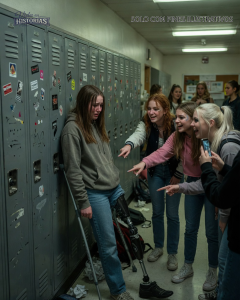
My stomach dropped. I tapped on the school’s unofficial Snapchat story.
The video started playing immediately.
The angle was from down the hall, slightly shaky, clearly filmed from someone holding their phone near their chest to hide it. The audio was surprisingly clear.
It showed me against the lockers. It showed Chloe raising her hand.
And then, it showed the heavy glass doors opening.
Whoever was filming had managed to capture the entire exchange. The audio of my mother’s voice—crisp, authoritative, absolutely lethal—echoed out of my phone’s tiny speakers.
“She spent four weeks in an intensive care unit… She has more grace and resilience in her shattered left leg than you have in your entire, pathetic, privileged existence.”
The video cut off right after Principal Davies came sprinting down the hall, looking like a panicked middle manager about to be fired by the CEO.
I checked the view count. It had been posted thirty minutes ago. It already had four thousand views. There were only fifteen hundred kids in the entire school.
“What is it?” my mother asked, noting my expression.
I slowly turned the phone around to show her the screen. “Someone filmed it. The whole thing.”
My mother looked at the paused video. She didn’t look angry. She didn’t look surprised. She merely raised a single, perfectly sculpted eyebrow.
“Well,” she said softly. “I suppose that saves me the trouble of calling the district superintendent. It appears they will be calling me.”
“Mom, this is going to go viral,” I said, a wave of panic washing over me. “I’m going to be the center of attention. Everyone is going to be staring at me tomorrow.”
She reached across the table and took my phone, locking the screen and setting it face down on the white tablecloth.
“Maya, they were already staring at you,” she said gently, but firmly. “They were staring at you because you wear a brace. They were staring at you because you walk with a limp. You let them look at you with pity, and you let girls like Chloe look at you with disgust.”
She leaned forward. “Tomorrow, when you walk into that school, they are still going to stare at you. But they won’t be looking at you with pity anymore. They will be looking at you with respect. And a healthy amount of fear.”
“Fear?” I swallowed hard. “I don’t want people to be afraid of me.”
“It is not a bad thing for people to understand that you have boundaries, and that crossing those boundaries has severe, catastrophic consequences,” she said, her judge-persona slipping back into place for a brief moment. “You are not a victim, Maya. You are a survivor. And as of today, the entire school knows it.”
She was right.
I knew she was right. But the thought of walking back into those hallways tomorrow morning made my chest tight.
The rest of the evening was a blur. When I got home, I retreated to my room and turned off my phone. I didn’t want to see the comments. I didn’t want to see the memes that were inevitably being created. I just wanted quiet.
I spent an hour stretching my leg, doing the agonizing exercises my physical therapist prescribed to keep the scar tissue from tightening around my knee joint. The dull, persistent ache in my bones reminded me of the locker, of the shove, of the helpless feeling of losing my balance.
I looked at the heavy titanium brace sitting on my floor. It looked like a piece of medieval armor. I used to hate it. I used to look at it and see a cage.
But tonight, as I traced the cold metal with my fingers, I thought about what my mother had said.
More grace and resilience in her shattered left leg than you have in your entire, pathetic, privileged existence.
I strapped the brace back on. It locked into place with a heavy, satisfying click.
I stood up. I walked across my bedroom.
Thump. Drag. Thump. Drag.
I stopped in front of my full-length mirror. I looked at the girl staring back at me. She looked tired. There were dark circles under her eyes. But she didn’t look broken anymore.
The next morning, the sky was a brilliant, clear blue. The storm had passed, leaving the air crisp and cold.
My mother didn’t take me to school in the Lincoln Navigator. She let me drive my modified Honda Civic with the hand-controls, just like I did every other Wednesday. She kissed me on the forehead at the front door, handed me my backpack, and told me to have a good day.
I pulled into the student parking lot at 7:45 AM.
The lot was packed. Students were milling around their cars, drinking iced coffee, blasting music. Standard high school morning chaos.
I found a spot near the back, turned off the engine, and took a deep breath.
Here we go.
I opened the door and stepped out.
The heavy clack of my orthopedic boot hitting the pavement was loud.
Instantly, the conversation in the immediate vicinity stopped.
A group of senior boys leaning against a pickup truck turned to look at me. Two sophomore girls who were gossiping nearby froze.
I grabbed my backpack from the passenger seat, slung it over my right shoulder, and shut the car door.
I didn’t keep my head down. I didn’t hunch my shoulders. I stood up straight, letting the brace support my weight, and I looked directly at the senior boys.
They immediately looked away. One of them actually took a step back, making a wide path for me.
I started walking toward the main entrance.
Thump. Drag. Thump. Drag.
The sound echoed across the asphalt. It was the same sound it had always been. But the reaction was entirely different.
As I walked, the crowds naturally parted. People stopped talking as I passed. They looked at me, yes. But my mother had been right. It wasn’t pity. It was a mixture of absolute awe and sheer terror.
I reached the front doors—the same glass doors my mother had walked through twenty-four hours earlier.
A junior named Tyler, who played defensive tackle for the football team and usually wouldn’t give me the time of day, was standing by the door.
As I approached, he scrambled forward and pulled the heavy glass door open for me.
“Morning, Maya,” he mumbled, looking nervously at my leg brace and then up at my face.
“Morning, Tyler,” I said smoothly, stepping through the doorway. “Thank you.”
I walked into the main hallway.
It was surreal. The moment I entered, the noise level dropped by half. Heads snapped in my direction. Whispers erupted like a wildfire jumping from locker to locker.
“That’s her.”
“Did you see the video?”
“Is Chloe even here today?”
“Her mom is basically a mafia boss.”
I kept walking. I didn’t speed up. I didn’t slow down. I walked with the deliberate, heavy rhythm of my brace, letting the sound announce my presence.
I reached my locker. Number 402.
The dent from where my shoulder had hit was still there.
I spun the combination dial, popped the locker open, and started grabbing my books for first period.
“Maya?”
The voice was tiny. Hesitant.
I turned around.
It was Madison. One of Chloe’s sidekicks.
She was standing about five feet away, clutching her binder to her chest like a shield. She looked terrified. She wasn’t wearing her usual pristine makeup, and her hair was pulled back into a messy bun.
“What do you want, Madison?” I asked, keeping my voice flat and emotionless.
“I… I just wanted to say,” she stammered, looking nervously around to see if anyone was listening. (Everyone was listening.) “I just wanted to say I’m sorry. About yesterday. I shouldn’t have laughed. I shouldn’t have let Chloe do that.”
I looked at her. Really looked at her. I didn’t see a popular girl anymore. I saw a scared teenager who had realized the social hierarchy she worshipped had just collapsed, and she was desperate not to be crushed in the rubble.
“Where is Chloe?” I asked.
Madison swallowed hard. “She’s not here. Her dad kept her home. Apparently, there were… people at their house this morning. Men in suits. And her dad was screaming on the phone.”
I felt a cold wave of satisfaction wash over me. My mother wasn’t joking. The audit was real. The empire was falling.
“Okay,” I said to Madison, turning back to my locker.
“Are we… are we okay?” Madison asked, her voice trembling slightly.
I closed my locker with a loud, sharp metallic bang. Madison flinched violently.
I turned to face her, looking her dead in the eye.
“We are absolutely nothing, Madison,” I said quietly, so only she could hear. “We aren’t friends. We aren’t enemies. You don’t exist to me. And if you or Harper or Chloe ever step into my personal space again, my mother won’t be the one you have to worry about.”
Madison’s eyes widened in sheer terror. She nodded frantically, backed up three steps, and practically ran down the hallway.
The bell rang.
The hallway started to clear out.
I adjusted the straps on my backpack, turned toward my AP History class, and started walking.
Thump. Drag. Thump. Drag.
It was going to be a very good year.
CHAPTER 4
The rumor mill at Westbridge High School didn’t just spin; it caught fire and burned the entire social hierarchy to the ground.
By Friday of that week, the story of my mother’s arrival had mutated into urban legend. Some freshmen swore there were snipers on the school roof. A group of sophomores claimed my mother had personally ordered a SWAT team to raid Chloe Sterling’s locker.
I let them talk. I didn’t confirm anything. I didn’t deny anything. I just went to class, ate my lunch, and did my homework.
But the truth playing out in the real world was actually far more brutal than any high school rumor.
Two weeks after the incident at locker 402, the front page of the Westbridge Chronicle dropped a bomb on the town.
LOCAL AUTO TYCOON RICHARD STERLING INDICTED ON MULTIPLE COUNTS OF FEDERAL TAX FRAUD.
It wasn’t just a routine audit. The IRS Criminal Investigation Division had cracked Sterling Automotive wide open. They found two sets of books, offshore accounts, and a multi-million dollar inventory depreciation scam that had been running for nearly a decade.
The FBI had raided all three of his dealerships simultaneously on a Tuesday morning. The local news stations aired footage of federal agents carrying out dozens of cardboard boxes filled with hard drives and financial records.
Richard Sterling’s assets were completely frozen. The massive, gated mansion on the hill was put up for a short sale. The country club quietly revoked their membership.
The empire didn’t just fall; it evaporated.
Chloe didn’t return to school for a month.
When she finally did, it was mid-November. The weather had turned brutally cold, the kind of biting northeastern chill that seeps into your bones and makes the metal of my leg brace ache with a dull, constant throb.
I was standing by the library return drop before homeroom when she walked through the front doors.
The silence that fell over the hallway was deafening. It was the exact same silence that had greeted my mother, but the energy was entirely different. It wasn’t awe. It was the collective, ruthless judgment of five hundred teenagers watching a former queen return as a peasant.
Chloe was unrecognizable.
The pristine, salon-styled hair was pulled back into a messy, uneven ponytail. She wasn’t wearing her usual uniform of cashmere sweaters and designer jeans. She wore plain black leggings and an oversized, faded grey college hoodie that looked like it belonged to her dad. She had no makeup on. Her skin was pale, drawn tight over her cheekbones, and dark, heavy bags bruised the skin under her eyes.
She looked small. She looked broken.
Harper and Madison, her former shadows, were standing by the water fountain. When they saw Chloe walking down the hall, they didn’t wave. They didn’t run up to her. They turned their backs and hurriedly walked in the opposite direction.
High school is a shark tank. The moment there’s blood in the water, even your own school will turn on you.
Chloe kept her head down. She hugged her plain black backpack tightly to her chest, her eyes fixed entirely on the scuffed linoleum floor. She was doing exactly what I had done for a year. She was trying to be invisible.
She walked past the library. She didn’t see me until she was less than ten feet away.
When she finally looked up, she stopped dead in her tracks.
The few kids lingering in the hall held their breath. Cell phones were discreetly pulled out of pockets. The tension was thick enough to choke on.
I didn’t move. I stood straight, my weight resting evenly on my right leg and the heavy titanium struts of my left brace. I just looked at her.
Chloe swallowed hard. Her hands were visibly shaking. She looked at the heavy brace on my leg, then slowly brought her eyes up to meet mine.
For a long, agonizing moment, neither of us said a word.
Then, Chloe took a small, hesitant step forward.
“Maya,” she whispered. Her voice was cracked, dry, and incredibly small.
“Chloe,” I replied. My voice was steady, perfectly flat.
She opened her mouth, closed it, and took a shuddering breath. “I… I wanted to say…”
She stopped. She looked around the hallway, seeing the eyes of the students burning into her. She saw the phones. She saw the absolute ruin of her reputation.
“I’m sorry,” she finally choked out. A single tear escaped, cutting a track down her pale cheek. “I am so, so sorry. For everything. For the locker. For what I said. For… for how I treated you.”
I studied her face. I looked for the manipulation. I looked for the trap.
There was none. She was entirely defeated. The arrogance had been burned out of her, leaving only the terrifying realization of how quickly the world can turn its back on you.
“Okay,” I said.
She blinked, confused by the lack of venom in my voice. “My dad… he’s facing ten years. We have to move into an apartment across town. I lost my car. My friends won’t even look at me.”
She was looking at me like she wanted absolution. Like she wanted me to tell her it was going to be okay.
“You didn’t lose those things because of me, Chloe,” I said quietly, my voice carrying only far enough for her to hear. “You lost them because they were built on a lie. And your friends abandoned you because you taught them that loyalty is only tied to power.”
She flinched as if I had physically struck her.
“I didn’t ask my mother to destroy your life,” I continued, adjusting the strap of my backpack. “She just held up a mirror to it. The rest was already rotting.”
Chloe wiped the tear from her face with the sleeve of her faded hoodie. She nodded slowly, completely defeated.
“I know,” she whispered. “I know.”
She stepped to the side, giving me a wide berth, and walked toward her homeroom. She didn’t look up again.
I watched her walk away. I didn’t feel a rush of victory. I didn’t feel a surge of vindictive joy. I just felt tired. I realized in that moment that carrying around anger and hatred was just as exhausting as dragging around a fifteen-pound metal leg brace.
I was done carrying both.
The months bled into winter, and then thawed into a bright, sudden spring.
As the snow melted off the Westbridge High parking lot, something else shifted.
The physical therapy sessions that had once left me sobbing in pain on a padded mat started to feel different. The sharp, agonizing stabs in my knee dulled into a manageable ache. The muscles in my left thigh, which had atrophied into nothing, began to slowly, stubbornly rebuild themselves.
I was pushing myself. Not to prove anything to the kids in the hallway, but to prove something to myself.
By early May, the heavy winter coats were gone, replaced by t-shirts and open windows.
It was a Tuesday afternoon. The exact same day of the week the incident had happened all those months ago.
I was sitting on the examination table in Dr. Aris Thorne’s orthopedic clinic. The room smelled of rubbing alcohol and sterile paper.
My mother was sitting in the plastic chair in the corner. She wasn’t wearing her judge’s robes. She was in a soft cream-colored sweater and jeans, her hair pulled into a messy clip. She looked just like a regular mom, nervously watching the doctor.
Dr. Thorne, a tall man with kind eyes and a grey beard, was looking at the latest set of X-rays glowing on the light board mounted to the wall.
“Bone density looks fantastic, Maya,” Dr. Thorne said, tracing the bright white lines of my tibia with his pen. “The micro-fractures have completely calcified. The titanium rod we placed internally is sitting perfectly flush. There’s no inflammation around the joint capsule.”
He turned off the light board and spun around on his little rolling stool to face me.
“So,” he said, clapping his hands together. “Are you tired of lugging that hunk of metal around?”
My heart slammed against my ribs. I looked at my mother. She sat up straight, her hands gripping the edges of her plastic chair.
“Are you serious?” I breathed.
“I’m serious,” Dr. Thorne smiled. He reached into a drawer and pulled out a small electric medical drill. “It’s time. Your own muscles need to take over the load now. If we keep the heavy brace on any longer, you’ll start to rely on it too much.”
I couldn’t speak. I just nodded frantically.
Dr. Thorne knelt down. The drill whirred to life.
Zzzzt. Zzzzt. Zzzzt.
He unscrewed the four heavy locking bolts that secured the titanium struts to the custom orthotic boot. He popped the metal hinges on the sides.
With a gentle pull, he slid the heavy, cage-like structure off my leg.
It hit the linoleum floor with a heavy, dead clunk. The same sound it had made dragging down the school hallway for over a year.
I looked down at my bare leg. It was scarred. It was slightly thinner than my right leg. A long, jagged purple line ran from my knee down to my ankle where the surgeons had opened me up.
But it was mine. And it was free.
“Now,” Dr. Thorne said, standing up and handing me a sleek, black, tightly woven compression sleeve with flexible carbon-fiber ribbing sewn into the sides. “You slide this on. It’ll give your ankle support and keep the knee tracked properly, but it weighs less than a pair of thick socks. You can wear it under jeans. You can wear it with normal sneakers.”
I took the sleeve. My hands were shaking, but this time, it was pure adrenaline and joy.
I pulled it over my foot and up my calf. It fit snugly, perfectly contoured. I slipped my foot into a regular, off-the-shelf running shoe that I had brought in a plastic bag, hoping against hope I’d get to wear it.
“Stand up, Maya,” my mother said softly from the corner, her eyes shining with unshed tears.
I slid off the examination table.
I planted my right foot on the floor. Then, I planted my left foot.
I put my weight on it.
There was a slight twinge, a ghost of the old pain, but the joint held solid. The bone didn’t grind. The muscle engaged.
I let go of the table. I stood entirely under my own power.
“Walk to your mom,” Dr. Thorne instructed gently.
I took a step.
It was awkward at first. My brain was still trying to compensate for fifteen pounds of metal that was no longer there. But I took another step. Then another.
There was no thump.
There was no drag.
There was only the quiet, normal squeak of a rubber sneaker on linoleum.
I reached my mother. She stood up and wrapped her arms tightly around me, burying her face in my shoulder. She was crying. I was crying.
“You did it, baby,” she whispered into my hair. “You did it.”
The next morning was the last day of the school year.
The air was warm, smelling of cut grass and the promise of three months of absolute freedom.
I pulled my Honda Civic into the parking lot. I parked in the same spot near the back.
I turned off the engine. I grabbed my backpack.
I opened the door and stepped out onto the pavement.
I was wearing a pair of light blue denim jeans and white Converse sneakers. The black compression sleeve was completely hidden under the denim.
I closed the car door.
I started walking toward the main entrance.
People were milling around, signing yearbooks, laughing, completely ignoring the warning bell.
I walked right through the middle of the crowd.
Nobody stopped staring. Nobody backed away in terror. Nobody pointed.
Because I didn’t sound like a monster approaching. I sounded like everyone else. I blended into the noise.
I walked through the heavy glass doors and stepped into the main hallway. It was loud. It was chaotic. It was exactly what a high school should be.
I walked past locker 402. The small dent from the combination lock was still there, a permanent little scar on the painted metal. I ran my fingertips over it as I passed, feeling the cool steel under my skin.
A reminder.
I walked out the side doors of the school, heading toward the student pickup lane.
My mother was waiting for me.
She wasn’t in the black Lincoln Navigator today. There was no US Marshal. There was no umbrella.
She was sitting behind the wheel of her personal car, a modest silver sedan, with the windows rolled down and the radio playing softly. She had her sunglasses pushed up on her head, smiling as she watched me approach.
I walked toward the car. My steps were light. They were quick. They were completely silent.
I opened the passenger door and tossed my backpack onto the floorboard.
“Hey, Mom,” I said, sliding into the seat and buckling my belt.
“Hey, sweetheart,” she smiled, putting the car into gear. “How was the last day?”
“Quiet,” I answered truthfully. “Really, really quiet.”
She pulled away from the curb, leaving the school behind us.
I looked out the window at the passing trees, feeling the warm spring air blowing across my face. I looked down at my legs, resting evenly in the footwell.
They thought I was weak because I couldn’t run. They thought I was broken because I made a loud noise when I walked.
They didn’t realize that sometimes, the most dangerous people in the room aren’t the ones screaming for attention. They aren’t the ones shoving people against lockers.
Sometimes, the most powerful people are the ones who learn how to survive the fire, rebuild themselves from the ash, and finally learn how to walk away without making a single sound.
