Physical Address
304 North Cardinal St.
Dorchester Center, MA 02124
Physical Address
304 North Cardinal St.
Dorchester Center, MA 02124

**Part 1**
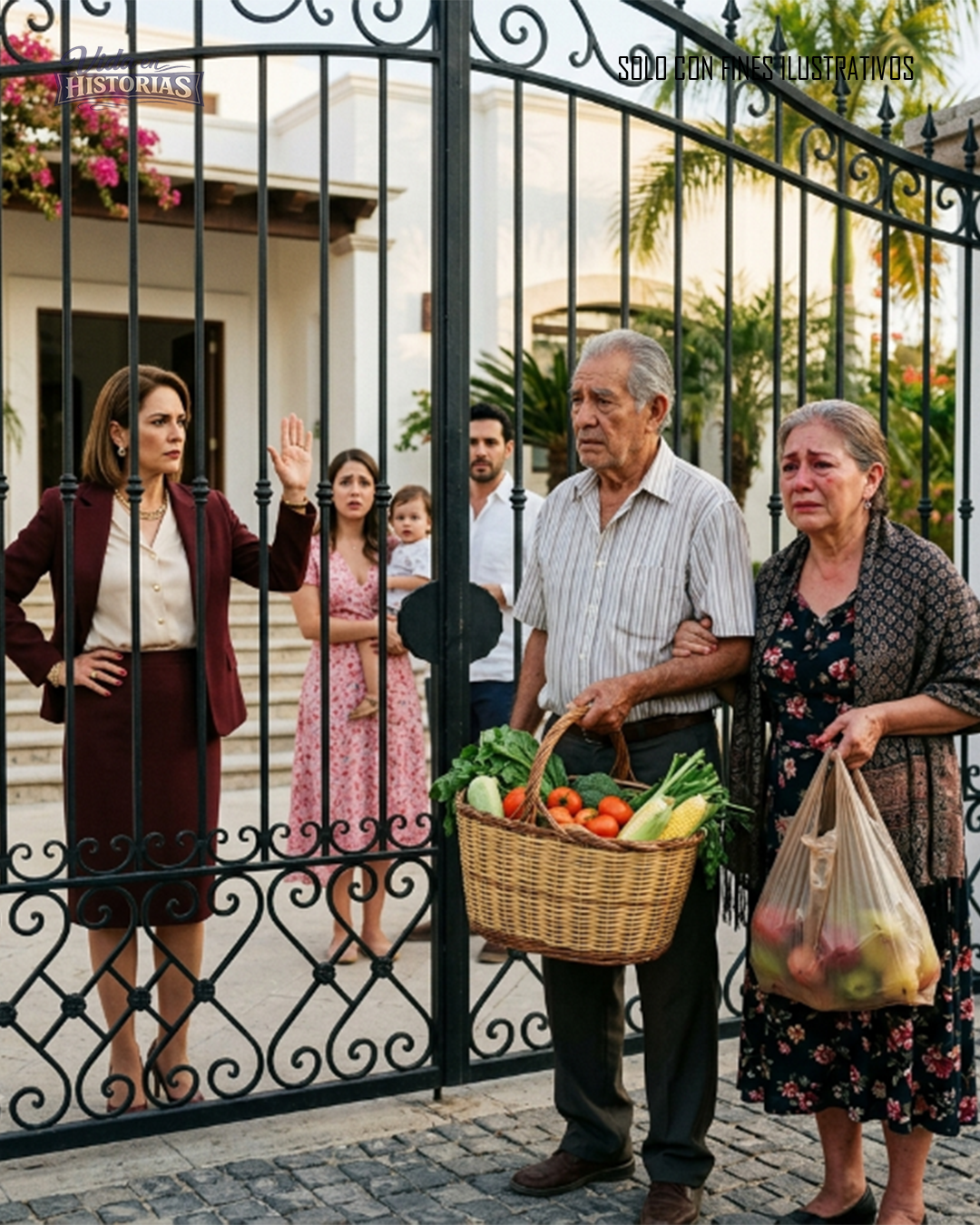
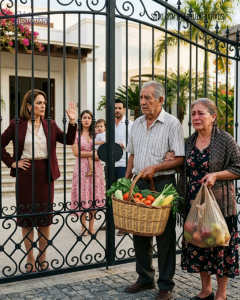
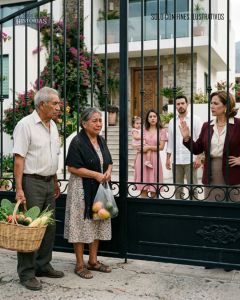
“Your parents are not coming into this house with those village bags,” said my mother-in-law, slamming the gate in their faces.
I was in the kitchen holding my baby when I heard Doña Gloria’s voice cut across the patio like a knife. At first I thought she was arguing with some vendor, but then I recognized my mother’s trembling voice.
“We came to see Elena… we brought food for the baby.”
My blood ran cold.
My parents had left at four in the morning from San Miguel, a small town in Hidalgo where people still wake up to roosters instead of alarms. They took a combi, then a bus, then the Metro, carrying chicken in mole, tender nopales, zucchini, fresh cheese, handmade tortillas, and a bag of guavas that my father had picked from the tree in their yard.
All of that for me.
For my son.
To show me that even though I had moved to a gated community in Tlalpan, I still had a place to return to.
But Doña Gloria looked at them as if they were carrying garbage.
“This isn’t a wholesale market,” she spat. “I’m not going to let you fill my house with dirt and smells. Go back where you came from.”
I ran to the gate, desperate.
“Doña Gloria, open up! They’re my parents!”
She didn’t even turn around.
My husband, Rubén, was standing by the stairs. I looked at him, hoping he would do something, say a single word, remember that those two elderly people had sold half their land to help us when he didn’t even have money for the down payment on the house.
But Rubén lowered his gaze.
He did nothing.
My father stood there for a few seconds, holding the bag with the mole. My mother clutched her shawl to her chest, as if she wanted to hide her heart inside so no one could break it further.
Then they left.
Without shouting.
Without complaining.
With that quiet sadness of humble people who still apologize even when they are being humiliated.
When I finally managed to open the gate, they were already gone.
Only a few muddy footprints remained by the gate and a bag of guavas lying on the ground, as if even the fruit had felt ashamed.
That night I called my mother. She answered, pretending to be strong.
“Don’t worry, daughter. Don’t make a scene. We’re almost home.”
Rubén only said to me:
“You know how my mom is. Just put up with it.”
But something inside me broke.
Because it wasn’t the first time Doña Gloria had treated me like an intruder. She criticized my clothes, my accent, the food I made, even the way I carried my son.
Two days later she said in front of the neighbor:
“Elena should not forget that she lives in a house that isn’t hers.”
I stayed silent.
But this time my silence wasn’t out of fear.
It was a decision.
And I couldn’t believe what was about to happen…
**Part 2**
I didn’t tell anyone what I was planning to do.
Not Rubén.
Not my mother.
Much less Doña Gloria.
For three days I followed my routine as if nothing had happened. I made coffee, washed clothes, cooked, took care of my son, and listened to my mother-in-law giving orders from the living room, sitting in her favorite armchair, convinced that we all revolved around her personality.
But every night, when the house went quiet, I took out a blue folder from the back of the closet.
There were the papers.
The same ones Rubén had asked me to keep “so there wouldn’t be any problems.” The same ones Doña Gloria had never wanted to see because she lived convinced that the house belonged to her family.
On Friday morning, I waited for Rubén to return from dropping off some documents at the office. Doña Gloria was in the kitchen, inspecting the vegetables as if they were jewels.
“These zucchinis look ugly,” she said. “They must be the kind your people buy.”
I took a deep breath.
I picked up my son, sat him in his high chair, and placed the blue folder on the table.
Doña Gloria frowned.
“Now what drama are you bringing?”
“No drama,” I replied. “Just the truth.”
She laughed.
“Oh, Elena, girls like you always think crying wins.”
I opened the folder.
I took out the house deed and placed it in front of her.
“Read the name.”
She didn’t want to touch it at first. Then she snatched it angrily. Her eyes scanned the pages until they stopped on one line. Her face changed.
The owner was me.
Elena Morales Hernández.
Not Rubén.
Not her.
Me.
“This can’t be,” she murmured.
“Yes, it can,” I said. “The down payment came from the land my parents sold. That land you call ‘village dirt.’ Rubén was in debt and couldn’t put anything in his name. That’s why the house is in my name.”
Doña Gloria turned pale.
At that moment Rubén walked in.
He saw the papers, saw his mother, saw me. He knew immediately what was happening.
“Elena…” he said, almost pleading.
“No,” I interrupted. “Today you’re not going to ask me to put up with it.”
Doña Gloria slammed the table.
“Rubén, tell her this house is ours!”
He opened his mouth, but nothing came out.
Again, silence.
Only this time it didn’t hurt the same. This time it gave me clarity.
“I’m leaving with my son,” I said. “Not because you’re kicking me out, but because I don’t want him to learn that love means letting yourself be stepped on.”
I took the bag I had already prepared: clothes, documents, diapers, medicine. Nothing more.
Doña Gloria stood up, trembling with rage.
“You’re not taking my grandson out of this house.”
I looked at her calmly.
“My son is not anyone’s property.”
Rubén took a step toward me.
“We can talk about this.”
“We had years to talk about it,” I replied. “But every time your mother humiliated me, you chose the floor instead of my face.”
That phrase left him frozen.
I was reaching the gate when I heard Doña Gloria’s voice break.
“Wait.”
I thought another insult was coming. Another threat. But when I turned around, I saw her sitting down, with the deed in her hands, as if the paper weighed more than all her arrogance.
“Your parents sold their land for this house?” she asked.
I didn’t answer immediately.
“They sold half of the only thing they had so their daughter wouldn’t have to rent with a newborn.”
Rubén covered his face.
Doña Gloria lowered her eyes.
For the first time, she didn’t look furious.
She looked ashamed.
But the worst was still to come.
Because that afternoon, before I walked out the door, someone rang the doorbell.
And when Rubén opened it, my parents were outside.
They weren’t alone.
They were holding a letter that was going to finish breaking everything…
**Part 3**
My mother entered first, serious, with her shawl neatly arranged. My father came behind her, holding an old brown folder. They didn’t look at Doña Gloria. They didn’t look at Rubén. They looked for me.
“Daughter,” my father said, “forgive us for coming without warning, but we couldn’t stay silent any longer.”
Doña Gloria stood rigid.
My father placed the folder on the table. His hands were rough, full of years of working the fields, machetes, harvests, and sacrifice.
“When we sold the land,” he said, “we didn’t do it so Elena could have a pretty house. We did it so she could have peace.”
He took out receipts, transfers, a copy of the land sale contract, and a handwritten letter from my mother. In that letter, dated the day the deed was signed, my parents explained that the money was for me and my son, not for Rubén’s family, not so anyone could throw it in my face.
Doña Gloria barely read a few lines and began to cry.
But my father didn’t stop.
“You closed the gate on us as if we were dirt. And maybe our clothes had soil on them, ma’am, but that soil paid for the roof you sleep under.”
The silence was brutal.
Rubén sat down, defeated.
“Don Manuel… I…”
My father raised his hand.
“I’m speaking to you too. Because a mother can be harsh, but a cowardly husband does even more damage. Elena didn’t need you to fight with punches. She needed you to defend her with words.”
Rubén cried.
I had never seen him cry like that.
Doña Gloria slowly approached my parents. For a moment I thought she would justify herself, talk about her personality, her difficult life, her fears. But she didn’t.
She knelt.
Right there in the middle of the living room.
“Forgive me,” she said with a broken voice. “There is no excuse. I treated you as if you were worth less, and you are worth more than all of us put together.”
My mother brought a hand to her chest.
“Get up, ma’am.”
“No,” Gloria said. “Let me apologize from the place where I put myself.”
She cried like a child.
She confessed that she had always felt shame about her own origins, that she also came from a poor family, that she had spent her life trying to seem “finer” so no one would despise her. And without realizing it, she ended up despising those who reminded her of where she came from.
My mother listened to her in silence.
Then she approached and touched her shoulder.
“Poverty doesn’t stain,” she said. “What stains is forgetting who gave you a hand when you had nothing.”
Doña Gloria cried even harder.
So did I.
Not because everything was suddenly fixed. There are wounds that don’t close with just an apology. But something changed that afternoon. Something fell into place.
I didn’t leave that day.
I also didn’t pretend nothing had happened.
I set conditions.
My parents could enter my house whenever they wanted. No one would ever humiliate my origins again. Rubén would have to learn to be a husband before being an obedient son. And Doña Gloria, if she wanted to stay, would have to show respect.
For the first time, no one argued.
The months passed.
The house no longer smelled of fear. It smelled of chicken broth, hot tortillas, and coffee. My mother started coming on Sundays. My father taught my son how to plant cilantro in pots. Doña Gloria, awkwardly at first, learned to ask permission and say thank you.
Rubén changed slowly, but he changed. One day, when his mother tried to give too much opinion, he stopped her.
“Mom, this is Elena’s house. And here we respect Elena.”
I didn’t say anything.
I just felt that, finally, I was not alone.
Sometimes justice doesn’t come with shouts or revenge.
Sometimes it comes when the truth is placed on the table and forces everyone to look in the mirror.
Because a family is not measured by last names, or by the gated community, or by clean shoes.
It is measured by the dignity with which it treats those who arrive carrying love in simple bags.
