Physical Address
304 North Cardinal St.
Dorchester Center, MA 02124
Physical Address
304 North Cardinal St.
Dorchester Center, MA 02124


**PART 1**
“If you’re pregnant again, I swear you won’t leave this house as a victim, but as the guilty one.”
That was the last thing Camila heard before feeling her mother-in-law’s hand slap across her face.
The kitchen fell silent. Outside, in a quiet neighborhood in Guadalajara, the gas truck passed by announcing itself with its horn. Inside, the smell of reheated coffee and freshly made tortillas seemed to mock her, as if that house continued to be normal while her life broke into pieces.
Camila was twenty-four years old, with two small children and a marriage that for a long time had felt more like a debt than a family. Julián, her husband, sat in the dining room, looking at his phone, pretending he hadn’t heard anything.
“It wasn’t planned,” Camila said, her voice trembling. “I didn’t expect it either.”
Doña Teresa let out a dry laugh.
“Nothing with you is planned. Not the first pregnancy, not moving in here, not ruining my son’s life.”
Camila looked down. She had learned to stay quiet. In that house, answering back was provoking; crying was manipulating; asking for respect was being ungrateful.
“Mom, enough,” Julián murmured, without standing up.
But it wasn’t defense. It was exhaustion. It was the phrase of someone who didn’t want problems, not someone who loved.
Doña Teresa moved closer. Her floral perfume enveloped her like a threat.
“Three children, Camila. With what face? With what money? Or do you think my son was born to support you for life?”
“I take care of the children, I clean, I cook, I do everything in the house…”
“That doesn’t make you useful. That makes you a freeloader.”
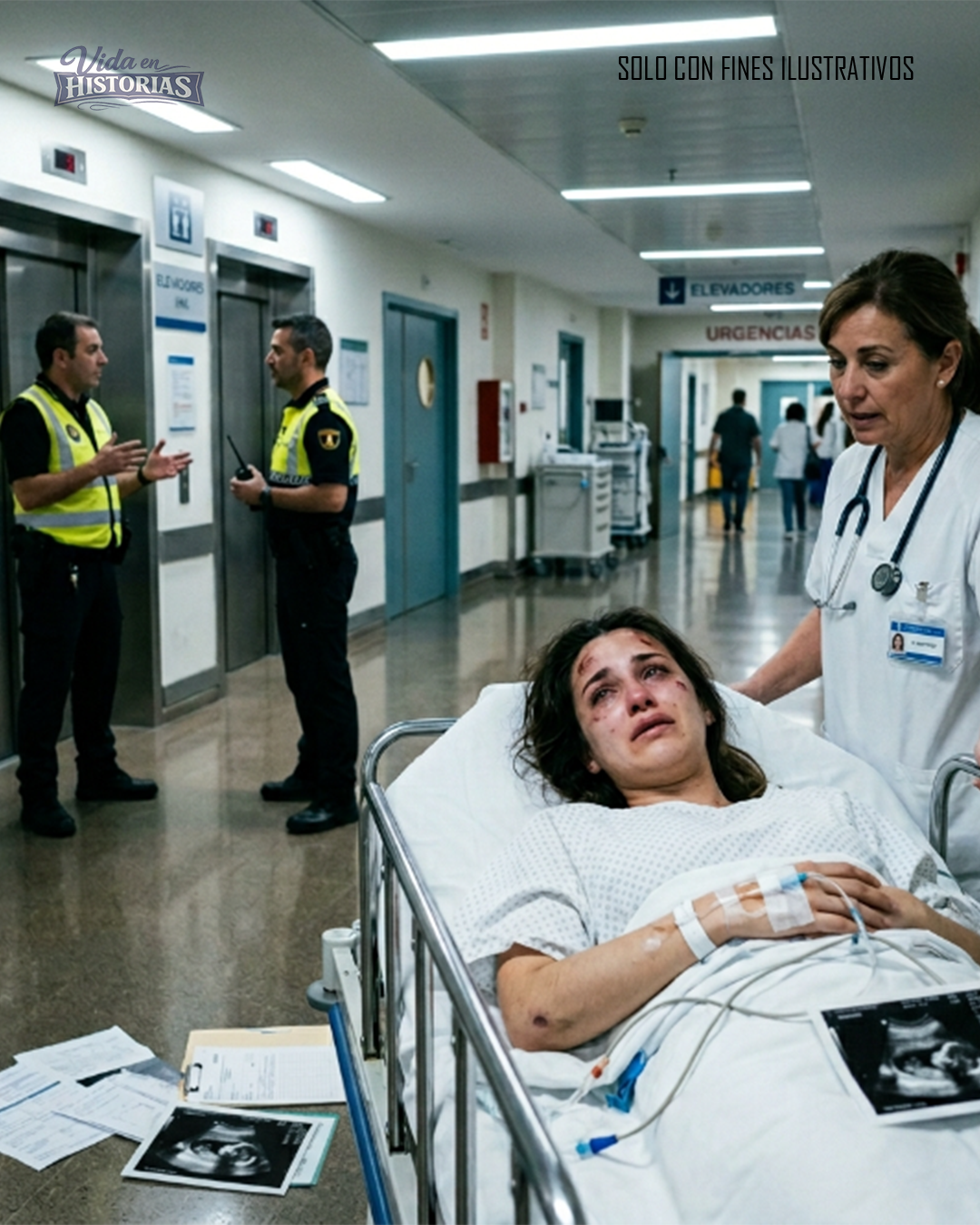
The slap came without warning. Camila felt her cheek burn and took a step back. She tried to hold onto the door frame, but Teresa pushed her hard. Her head hit the corner of the wood. Everything went black.
When Julián reacted, Camila was already on the floor. A line of blood ran down her forehead.
“What did you do, Mom?”
“She fell,” Teresa replied, pale. “She slipped. That’s all.”
Five minutes later, they were taking her to the hospital. Teresa had cleaned the floor, hidden the blood-stained cloth, and ordered the children to stay locked in their room.
In the emergency room, she cried in front of the receptionist like a desperate mother.
“My daughter-in-law fell down the stairs. She’s pregnant. Please, help her.”
But Dr. Ramírez didn’t believe the story. When he examined the bruise on her cheek, the head wound, and the marks under Camila’s nails, his expression changed.
“These injuries don’t look like they came from a fall,” he said calmly. “I’m going to notify social services.”
Teresa pressed her lips together.
“Doctor, you don’t understand. She’s been very unstable lately.”
Hours later, Camila opened her eyes. The first thing she saw was her mother-in-law sitting by the bed, smiling with fake sweetness.
“It’s good you woke up, dear. You fell while cleaning. That’s what happened, right?”
Camila wanted to speak, but fear closed her throat.
“Yes,” she whispered.
From the doorway, Dr. Ramírez watched everything in silence.
And although Camila didn’t know it yet, that lie was about to break in the most unexpected way.
**PART 2**
The next day, the social worker came to the room. Her name was Laura and she had a calm voice, the kind that doesn’t pressure but also doesn’t let itself be fooled.
“Camila, I need to speak with you alone.”
Doña Teresa tried to stay.
“I’m her family. She’s weak.”
“That’s exactly why she needs to answer without company,” Laura said.
When the door closed, Camila felt her heart rise to her throat.
“Did you fall?” Laura asked.
Camila thought about Santiago and Emilia, her children. She thought about not having a job, not having money, about her mother, whom Teresa had forced her to stop calling years earlier. She thought about Julián, always standing on his mother’s side even when he claimed to be neutral.
“Yes,” she answered. “I fell.”
Laura didn’t insist. She just looked at her with a sadness that seemed to say: I know you’re lying, but I’ll wait until you can speak.
That afternoon, Julián arrived with the children. Emilia was sleeping in a stroller; Santiago, seven years old, held his tablet clutched to his chest. Julián stood beside the bed, uncomfortable.
“My mom says it was a fall,” he said. “Is that what happened?”
Camila looked at him with pain.
“Is that what you want me to say?”
Julián didn’t answer.
When he left the room to answer a call, Santiago approached the bed and hugged his mom carefully.
“Mommy,” he whispered, “I have the video.”
Camila blinked, confused.
“What video, sweetheart?”
Santiago turned on the tablet. He had a file recorded by accident. At first it only showed the floor of the upstairs hallway, but the audio was clear. Camila’s voice saying she was pregnant. Teresa’s fury. The slap. The body falling. And then that freezing phrase:
“If you say it was me, you’re leaving this house forever.”
Camila covered her mouth. She didn’t know whether to cry from horror or from relief. Her son, without realizing it, had saved the truth she didn’t dare to speak.
Dr. Ramírez entered at that exact moment. He saw the tablet, heard the recording, and his expression hardened.
“Camila, this changes everything.”
“I’m scared,” she said.
“I know. But you’re not alone anymore.”
That same night, the hospital activated the domestic violence protocol. Laura filed a confidential report and requested protection for Camila and the children. When Teresa found out she was being investigated, she began to move.
First she tried to bribe a nurse with five thousand pesos not to report the bruises. Then she called acquaintances to say that Camila was “mentally unstable” because of the pregnancy. After that she pressured Julián.
“Your wife wants to destroy me,” she told him. “Are you going to let some nobody take your mother away from you?”
Julián arrived at the hospital with red eyes.
“My mom is devastated. She says you’re exaggerating.”
Camila let out a bitter laugh.
“Exaggerating? She hit me while I was pregnant.”
“You said it was a fall.”
“Because I’m afraid of her, Julián. I’ve been afraid of her for years. And you always knew it.”
He looked down.
“She’s my mom.”
“And I’m your wife.”
The silence was crueler than any answer.
But that same night someone else appeared. Doña Neida, an elderly neighbor, arrived with a bag of mandarins and an old key.
“I heard many things from my house,” she confessed. “Shouts, insults, crying. I didn’t say anything and I regret it.”
Camila looked at her surprised.
“Why are you coming now?”
“Because you are not the first.”
Doña Neida told her that years earlier, Mariana, Julián’s first girlfriend, had lived in that house. One day she appeared with a black eye. Weeks later she disappeared. Teresa said she had left of her own will, but Neida remembered seeing her leave crying, without a suitcase.
“That woman doesn’t want daughters-in-law,” she said. “She wants obedient servants.”
She handed her the key.
“I have a small empty house in Tlaquepaque. If you need to leave, use it.”
For the first time, Camila felt there was a door.
But Teresa had no intention of letting her cross it.
On the third day, while Camila was sedated, Teresa entered the hospital wearing a stolen white coat. She disconnected the IV, covered Camila with a sheet, and began pushing the stretcher toward the service elevator.
On the ground floor, two guards stopped her.
“Where are you taking the patient?”
Teresa stammered.
“Urgent medical transfer.”
“And your identification?”
Camila opened her eyes barely. She saw Teresa above her and understood.
“Help…” she murmured.
The guards blocked the exit. Teresa tried to run, but it was too late.
When the police arrived, Camila was trembling, but awake.
And this time she didn’t say she had fallen.
**PART 3**
Doña Teresa’s arrest shook the entire family. She was charged with aggravated domestic violence, attempted unlawful deprivation of liberty, and obstruction of justice. But even in handcuffs, she walked down the hospital hallway with her head held high, as if everyone else was guilty except her.
The story quickly spread on social media. An independent journalist, Lucía Mendoza, approached Camila with respect.
“I don’t want to exploit you,” she said. “But if you decide to speak, many women will recognize themselves in your story.”
Camila hesitated. She didn’t want cameras, she didn’t want pity. She wanted to sleep without fear. But Santiago took her hand.
“Mommy, I want other moms to be safe.”
That phrase sustained her.
The interview was recorded in the hospital room, with low light. Camila spoke about the years of insults, about how Teresa checked her phone, distanced her from her mother, forbade her from working, and repeatedly told her that without that house she was nobody. She spoke about the slap, the lie, and the video her son had accidentally recorded.
In less than a day, the testimony went viral in Mexico. Women from Monterrey, Puebla, Mérida, Ecatepec, and Tijuana commented: “It happened to me too.” “My mother-in-law did the same to me.” “I never dared to speak.”
Public pressure forced the prosecutor’s office to review the case more thoroughly. Julián, cornered by the truth, checked the house security cameras. He found the full recording: Teresa hitting Camila, pushing her, lying afterward. He turned it over to the authorities.
When he came to see her at the hospital, his face was devastated.
“I believed you too late,” he said.
Camila looked at him without hatred, but without tenderness.
“Don’t ask me for forgiveness. Ask your children for it.”
He cried silently. For the first time, not as Teresa’s son, but as a man who understood the damage of his cowardice.
At the hearing, Teresa tried her last move.
“Camila is unstable,” she said before the judge. “She always wanted to separate my son from me. Who even knows if that baby is Julián’s.”
A murmur filled the room. Camila felt the floor disappear beneath her feet. It wasn’t just a lie: it was a way to strip her of her dignity in front of everyone.
The judge ordered tests. The results came two days later: the baby was Julián’s. Additionally, the medical analyses revealed something worse. Camila had been sedated on several occasions with small doses of a controlled medication. Someone had kept her confused, weak, and obedient.
The prosecutor’s office expanded the charges.
The preliminary sentence was clear: pretrial detention for Teresa, investigation for possible substance manipulation, reopening of Mariana’s case, and immediate protection for Camila and her children.
When she heard the ruling, Camila didn’t smile. She simply placed her hands on her belly and breathed. It wasn’t joy. It was relief. It was justice arriving late, but arriving.
A month later her daughter was born. She named her Alma, because that was what she felt she had recovered.
Camila did not go back to Julián. She allowed him to see the children under supervision and asked him for one thing: therapy. He accepted. Not as punishment, but as the first decent decision of his life.
With the help of Doña Neida, Laura, and other women she met at the hospital, Camila restored the small house in Tlaquepaque. She turned it into a small shelter called Voces Vivas. At first it had only two beds, a coffee maker, and a notebook to write down legal appointments. Then donations came, volunteer psychologists, lawyers, mothers with children in their arms, and women who entered trembling, just as she once had.
One morning, while Santiago and Emilia played in the patio and Alma slept by the window, Camila received a letter with no return address. It was from Graciela, a former employee of Teresa’s.
“Thank you for speaking for Mariana, for yourself, and for all of us who stayed silent out of fear.”
Camila cried, but not like before. These were no longer tears of defeat. They were of mourning, of memory, of strength.
She looked at her children under the sun and understood something no sentence could explain: sometimes justice doesn’t erase what was lived, but opens a door so the pain is not inherited.
Because silence can protect the guilty for years.
But when a woman decides to rise, her voice doesn’t just save herself.
It also lights the way for all those who are still looking for the exit.
