Physical Address
304 North Cardinal St.
Dorchester Center, MA 02124
Physical Address
304 North Cardinal St.
Dorchester Center, MA 02124

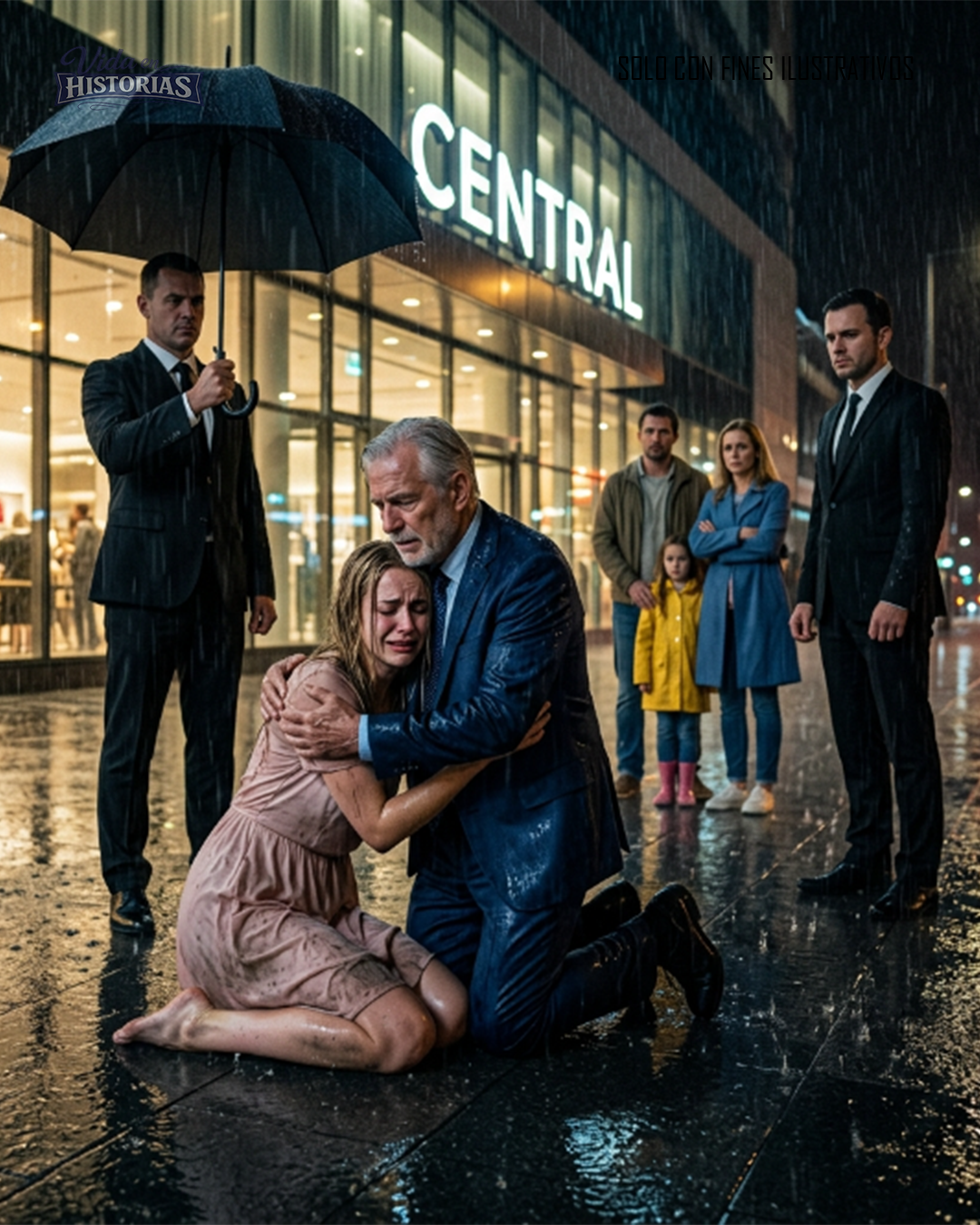

The rain hammered against the hospital entrance as if trying to tear the doors off. It was an October night in Mexico City, one of those nights when the sky turns black early and the wind drags trash, leaves, and bad decisions across the sidewalks. In the middle of that storm, under the white light of the headlights and the flashing red of an ambulance that had just rounded the corner, Julián Barrera pushed his pregnant wife off the sidewalk.
It all happened in seconds.
Zaira fell to her knees first. Then her palms. Then the weight of her body and her eight-month pregnant belly slammed against the wet pavement.
Her mother-in-law, Leonor, smiled with cold satisfaction from the building entrance. Beside her, Fabiola — Julián’s mistress — held her phone up high, recording everything with the vulgar cruelty of people who confuse tragedy with entertainment.
The paramedics ran toward Zaira while the rain soaked her hair and clothes. She didn’t scream. She didn’t cry. She only clutched tightly the golden pendant she wore around her neck: a lion’s head with a small diamond in one eye.
Then the black SUVs arrived.
They braked sharply in front of the hospital. Three men in dark suits got out and walked toward the stretcher with a silent confidence that made even the nurses step aside. The head doctor, a gray-haired man who until that moment had only seemed busy trying to save a life, looked at Julián from a distance and said quietly:
“You shouldn’t have touched her.”
Julián didn’t understand the tone of that sentence. Not yet.
Because there are men who don’t know what they have in their hands until the whole world sees them drop it. And there are women who seem quiet, gentle, invisible… until one day the truth stands beside them, and then no one confuses their silence with weakness again.
Zaira had not always lived like this.
Twelve years earlier, she was not the silent wife of a mediocre man nor the woman humiliated by a venomous mother-in-law. She was Zaira Calderón, the only daughter of Don Emilio Calderón, the richest man in Mexico and one of the most powerful in Latin America. Owner of hospitals, pharmaceutical companies, laboratories, and investment funds, Don Emilio had built an empire so vast that most people knew his companies but not his face.
After his wife’s death in childbirth, his entire life was reduced to one mission: raising his daughter.
He didn’t raise her with empty luxuries, but with presence. He took her to school, had dinner with her, taught her to play chess, to read contracts, and above all, to recognize her own worth without needing anyone else’s applause.
When Zaira turned sixteen, her father took her to the garden of the family hacienda in Valle de Bravo and placed the pendant around her neck.
“This lion,” he told her, “is not just a piece of jewelry, daughter. It is a reminder. The world will try to tell you who you are according to what suits them. But your value does not depend on anyone’s gaze. If you ever feel lost, touch this pendant and remember your name.”
Zaira grew up being kind, not weak. Quiet, not submissive. She studied nursing because she wanted to ease real pain, not manage other people’s fortunes. And it was during a health fair in Iztapalapa that she met Julián.
He was attractive, ambitious, talkative. He came from little, dreamed of rising, of “going far,” of “conquering the world.” Zaira saw in him what she wanted to see: a man hungry for the future. He saw in her a calm, simple, hardworking woman. He never asked much about her family, and she offered no details. She wanted to be loved for being Zaira, not for being a Calderón.
They got married the following year.
Don Emilio did not approve of Julián, but he respected his daughter’s decision. He promised her one thing: he would never stop watching from a distance.
At first, everything seemed normal. A modest apartment. A discreet life. Zaira continued working. She cooked, helped Julián with expenses, encouraged him when his businesses failed, and stood by him when no one else believed in him. If he achieved anything, it was because she had held the ground beneath his feet.
But Leonor, his mother, hated her from the first day.
Not because Zaira was rude or arrogant. Quite the opposite. She hated her because she didn’t react. Because she didn’t compete. Because she didn’t ask for permission. Leonor was one of those women who ruled through drama, blackmail, and noise. She had raised Julián alone and turned that sacrifice into a throne. Everything in her son’s life had to pass through her.
Zaira didn’t fight for that place. She simply existed with a calmness Leonor could not control.
And when a manipulative person cannot dominate you, they begin to poison the person next to you.
First came the comments.
“She doesn’t talk about her family because she’s hiding something.”
“A woman that quiet isn’t normal.”
“What if that child isn’t even yours?”
Then came Fabiola, Julián’s coworker. Flashy, loud, always too close. Leonor welcomed her with open arms. Soon, Fabiola was at family gatherings, dinners, and photos. She mocked Zaira without hiding it. Julián looked the other way.
The betrayal grew like mold behind a wall: in silence, until it was impossible to hide.
Zaira saw the foreign perfumes, the hidden messages, the way Julián turned his phone face down every time she entered the room. She saw it all.
And she stayed silent.
Not out of cowardice. Out of clarity.
Four days before the storm, she made one call. Just one.
“Dad,” she whispered when she heard Don Emilio’s voice on the other end. “It’s time they knew who I am.”
The night of the push was not improvised. Leonor and Fabiola had emptied Zaira’s closet, stuffed her clothes into trash bags, and repeated rehearsed phrases. Julián let them do it. He even participated.
“I want you out before midnight,” he told her without looking at her.
Fabiola laughed.
“The replacement has expired.”
Zaira took her suitcase. She didn’t beg. She didn’t remind him out loud how many times she had paid the rent while Julián was “building his business.” She didn’t mention the nights she came home exhausted from the hospital and still cooked for everyone. She didn’t say a single word.
She just left.
And seconds later, Julián pushed her.
At the hospital, Zaira was moved to a private area before her name was even registered in general admission. They recognized her by the pendant. The lion was not just jewelry: it contained a microchip identification linked to the Calderón family’s security protocol.
That same early morning, Zaira gave birth to a healthy boy.
When she woke up, her father was sitting beside her with the baby in his arms.
He didn’t ask if she wanted to press charges. He didn’t demand explanations. He didn’t reproach her for being wrong about Julián. He simply looked her in the eyes, then at the scrapes on her hands, and said with a terrifying calmness:
“No one will ever touch you again.”
Meanwhile, Julián continued with his life, convinced he had thrown a woman with no resources out onto the street. Fabiola was already parading around the apartment as if she were the new owner. Leonor bought new curtains and served coffee as if celebrating a victory.
They had no idea that disaster was already on its way.
Three weeks later, the Calderón Foundation announced that it would fully finance a new maternity wing in the capital’s most important private hospital. The donation would be presented at the annual charity gala, in front of businessmen, politicians, doctors, and the press.
Julián attended because his company had secured a table. Fabiola went with him, wearing a red dress. Leonor, as always, slipped in thanks to borrowed connections and fake confidence.
The night sparkled with chandeliers, fine glasses, and impeccable suits.

And then, in the middle of the event, the presenter smiled into the microphone.
“With you, the woman who has made this historic donation possible… Licenciada Zaira Calderón, heiress of the Calderón Salud Group.”
The salon doors opened.
Zaira entered wearing an ivory dress, elegant and sober. Her hair was pulled back, her face serene, and the golden pendant shining under the lights. She didn’t walk like a victim. She walked like truth when it finally decides to enter a room.
Julián dropped his glass. The crystal shattered on the floor.
Fabiola froze. Leonor lost the color in her face.
Zaira stepped onto the stage without looking toward their table. She spoke about vulnerable mothers, about women who survive abandonment, about babies who deserve to come into the world surrounded by dignity. She spoke about silent strength, about the importance of shelters, and about the new wing that would bear the name “Hope.”
She never raised her voice once.
But every word fell like a hammer.
When she finished, the entire salon stood up.
Julián tried to move forward.
“Zaira! Wait for me! I didn’t know! Let me explain!”
Two security guards blocked his path. She turned only once. She looked at him. Not with hatred. Not with rage. Worse than that: with the absolute calm of a woman who had already buried inside herself everything she felt for him.
Then she turned around and left the stage.
That same week, Julián lost his job. It turned out that a subsidiary of the group where he worked belonged, indirectly, to a fund controlled by the Calderóns. There was no scandal. Just a restructuring. His position “no longer existed.”
Fabiola left him eleven days later.
“I didn’t come here to struggle with you,” she said before leaving.
Leonor soon received notice of foreclosure on the house she had been showing off for years. Julián had signed as guarantor in better times, and without a job he could no longer sustain anything.
The final blow arrived by courier.
It was the divorce papers. Full custody for Zaira. Zero visitation rights until further court order. And attached, a disc with the full video of the night of the storm: Fabiola’s laughter, Leonor’s smile, and Julián pushing his pregnant wife.
It also included a simple legal note: if he contested custody or tried to approach without permission, the video would be sent to the prosecutor’s office, the media, and business boards.
Julián signed without fighting.
Six months later, at the hacienda in Valle de Bravo, the air smelled of jasmine and moist earth. Little Mateo slept in his mother’s arms while his fingers played with the lion pendant.
Zaira was sitting in the same garden where years earlier her father had reminded her of her worth.
Don Emilio watched her from the corridor with a cup of coffee in his hand. When she looked up, he simply nodded.
No more words were needed.
She had survived. She had come home. And she remained intact inside.
Over time, Zaira decided to open her own foundation for pregnant women who were victims of violence and abandonment. She called it Casa León. There, no woman slept on the street. No woman had to beg for respect. No woman was forced to prove she deserved help.
And one afternoon, while holding Mateo in her arms during the inauguration of the third shelter, a journalist asked her:
“After everything you went through, what would you say today to women who are staying silent, enduring humiliations?”
Zaira caressed the pendant on her chest and replied in a soft voice:
“That silence is not always surrender. Sometimes it is strength gathering. And that one day, when their moment comes, they will rise. Not with screams. Not with revenge. They will rise with truth. And that always weighs more.”
Then she kissed her son’s forehead, looked up at the clear sky, and smiled.
Because those who pushed her into the rain thought they were destroying her.
And in reality, they were only pushing her back to her true place.
