Physical Address
304 North Cardinal St.
Dorchester Center, MA 02124
Physical Address
304 North Cardinal St.
Dorchester Center, MA 02124

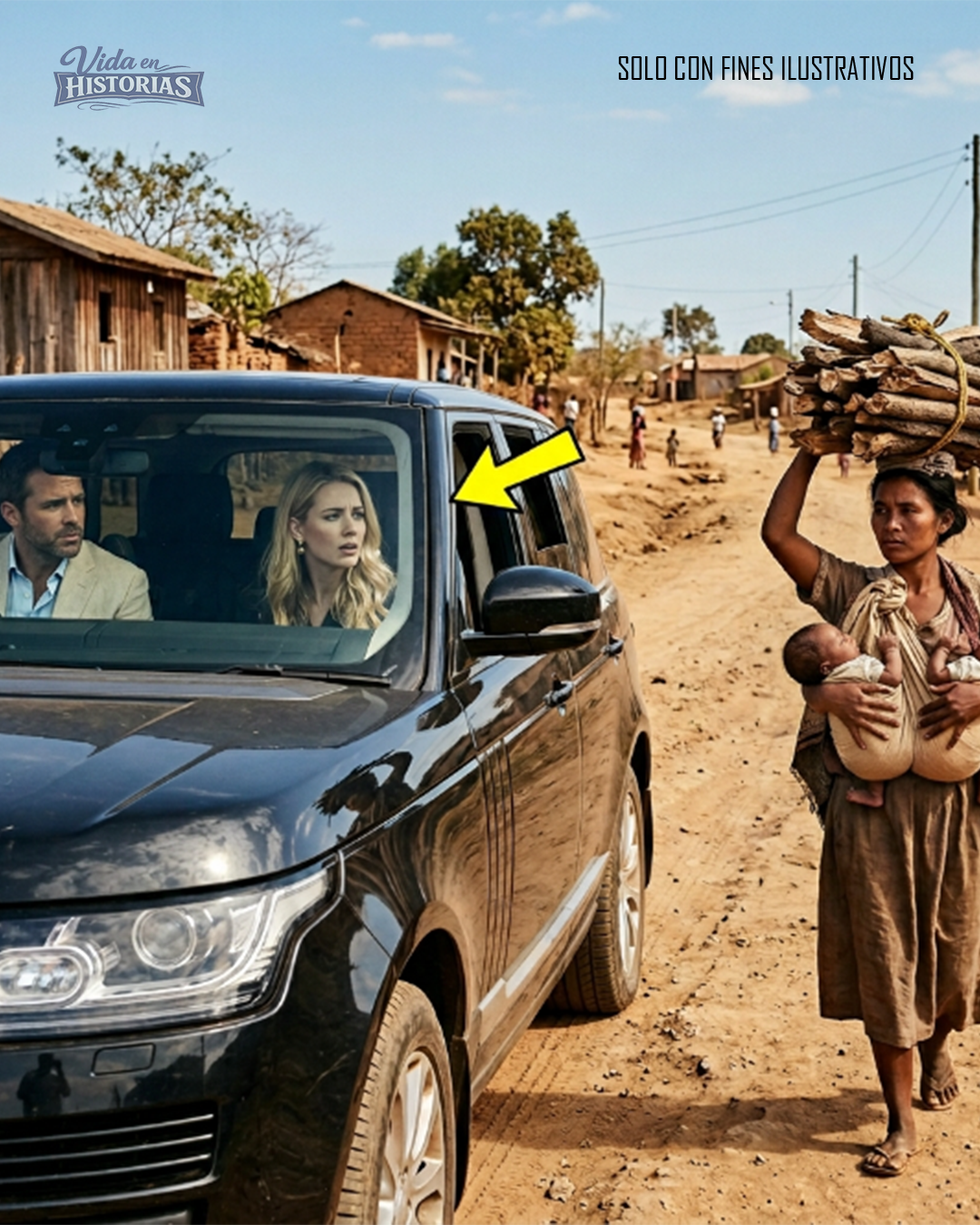
The dust rose on the dirt road as if the town itself wanted to warn Alma Villaseñor that something bad was coming toward her.
It was almost three in the afternoon and the sun over San Jerónimo del Valle beat down with white fury on the dry hills. Alma walked slowly, with a bundle of firewood tied to her back and one hand supporting her enormous eight-month pregnant belly. The other hand held the faded blue shawl covering her head. Every step sent a stab of pain through her waist, but she kept walking. There was no gas at her house, and the child (or children, since the village doctor had suspected there might be two) she carried inside would not wait for her to rest.
Then the truck appeared.
Black, shiny, so polished it seemed not to belong on that dirt road. It braked in front of her, raising a dry cloud that hit her face and got into her mouth. The tinted window rolled down with a soft hum, and Alma felt the blast of cold air coming from inside, smelling of expensive leather, imported perfume, and a life she once believed would also be hers.
Behind the wheel was Mauricio Salgado.
Her ex-husband.
Light suit, outrageously fine watch, dark glasses. Everything about him screamed wealth, but Alma knew too well the rot behind that appearance.
“Get out of the way,” he snapped. “You’re going to cover my truck in dust.”
In the passenger seat, a blonde woman with perfect lips and red nails looked at her with disgust. She wore a cream dress, huge sunglasses, and a diamond bracelet. She was one of those women who didn’t seem to touch the ground when she walked.
“Is she the ex?” she asked in a honeyed voice. “I thought you were exaggerating, Mau. She looks worse.”
Alma didn’t respond. She straightened her back a little, even though the weight of the firewood and the pregnancy burned her spine. Her dark eyes locked onto Mauricio with a calmness that irritated him instantly.
He hated that look.
He remembered it from the last night they spent together, when he announced that “things were going to change” and that he needed her to sign some papers “to speed up a project.” Alma refused. Two weeks later, Mauricio disappeared with the money from the account her father had left and with documents he should never have touched. Since then, everyone in the valley thought he had won: he bought land, closed deals with investors from Monterrey and Guadalajara, promised luxury hotels, golf courses, and “progress.” Meanwhile, Alma survived alone in a small adobe house.
What no one knew was that Don Hilario Villaseñor, her father, had been smarter than all of them.
“Are you going to move or not?” Mauricio shouted, hitting the steering wheel.
Alma took a deep breath.
“The road belongs to everyone.”
The blonde let out a contemptuous giggle.
“Oh, how brave. My love, tell her to step aside. Either you tell her, or I will.”
Mauricio was about to get out when the truck’s Bluetooth rang. An international call appeared on the dashboard screen. He turned pale instantly.
“Answer it,” the woman ordered. “It’s probably about the reservation in the city.”
Mauricio pressed the button with tense fingers. A man’s metallic voice spoke in Spanish with a foreign accent.
“Mr. Salgado, the board has reviewed the deeds. There are inconsistencies. If you do not present today, before midnight, the original waiver of rights signed by the legitimate owner, the trust will be canceled. Furthermore, our lawyers will proceed with charges of document fraud. There will be no further extension.”
The call ended.
A thick silence filled the truck.
The woman slowly turned toward Mauricio.
“What does fraud mean?”
He didn’t answer.
And then his eyes turned to Alma, no longer with contempt, but with something worse: need.
Alma felt the touch of the paper hidden under the lining of her shawl, right at her chest. There, hand-stitched, were the real deeds to the spring, the high lands, and the old mill. Everything Mauricio thought he had stolen from her.
“Get in,” he finally ordered, getting out of the truck. “We’re going to fix this in the square.”
“I’m not going anywhere with you.”
“Yes, you are. Because if you don’t sign, I swear you won’t just lose your house. I’ll also use my influence to take those children from you as soon as they’re born. Do you understand?”
The threat froze her blood.
Not out of fear of him.
But because he had just touched the only point that could break her.
Alma looked at him in silence for a second. Then she continued walking toward the square, without hurry, without bending. Not because she was obeying, but because she had already decided that this day would end everything.
—
The square of San Jerónimo was half empty because of the heat, but it was enough for the black truck to park next to the kiosk for people to peek out from the portals. Don Chuy stopped fixing bicycles. Doña Tomasa came out of the grocery store with her hands full of flour. The boys playing dominoes put away their pieces. In a few minutes, the whole town seemed to be holding its breath.
Mauricio wanted to put on a show.
He needed to.
He wanted to humiliate her before begging.
He opened the passenger door and let his fiancée get out first. The woman — whose name was Rebeca, according to what Alma had heard when Mauricio introduced her in the town days earlier — adjusted her sunglasses, observed the crowd, and smiled as if entering a theater.
“Well, here she is,” Mauricio said, raising his voice. “The owner of misery and drama.”
He took a leather folder from the glove compartment and then a wad of bills.
“Here’s more money than you’ll see in your entire life, Alma. Sign the waiver, take this, and disappear from the valley.”
The bills fell onto the dusty ground in front of her.
No one moved.
Alma looked down at the bills, then at Mauricio, and finally at the town hall, where under the shadow of the arch stood Don Lázaro Méndez, the town notary, with his old briefcase under his arm.
He gave a slight nod.
It was the signal.
Rebeca, impatient, took the iced coffee she had been carrying since the drive and threw it at Alma’s sandals. The sweet, sticky liquid soaked her feet and stained the hem of her dress.
“So you can clean yourself up, at least a little,” she said with a grimace.
An indignant murmur ran through the square.
Mauricio did not stop his fiancée. On the contrary, he seemed to enjoy it.
“Sign already, Alma. Don’t make me waste my time.”
She lifted her face.
“Money doesn’t buy honor, Mauricio. And certainly not the honor you already lost.”
The phrase fell dry and exact.
Mauricio’s smile cracked.
“Honor?” he laughed hysterically. “Look how you live. Look how you walk. You’re alone, pregnant, carrying firewood like a beast. And you talk to me about honor? Sign, or I’ll show the whole town that you’re nothing but a stubborn, starving woman.”
He took a step toward her and, with violence, kicked a branch from the bundle of firewood that had come loose. The wood split in two with a sharp crack.
Then Alma, very slowly, dropped the bundle of firewood to the ground.
The sound echoed across the entire square.
With both hands she undid a seam inside her shawl and pulled out a package wrapped in plastic.
Mauricio’s eyes widened with such evident terror that even Rebeca stepped back.
Alma removed the plastic.
She showed the papers.
Official seals. Original signature. Authentic registration.
“You don’t need just any waiver, Mauricio,” she said with a serenity that destroyed him. “You need my signature because all of this has always been mine.”
Don Lázaro then stepped forward and stood beside Alma.
“I can attest to that,” he announced in a clear voice. “Don Hilario Villaseñor left these deeds exclusively in his daughter’s name. Mr. Mauricio Salgado falsified documents two years ago to sell lands that did not belong to him. Since this morning there is a formal complaint filed with the regional prosecutor’s office.”
The square erupted in murmurs.
Rebeca turned toward Mauricio, pale.
“You lied to me? All of this was stolen?”
“It’s not what it seems,” he stammered.
“You were going to drag me into fraud!”
She pulled away as if touching him would contaminate her.
“Rebeca, wait…”
“Don’t touch me.”
She got back into the truck, this time in the driver’s seat. Mauricio ran after her.
“Don’t be ridiculous! We can still fix this!”
Rebeca looked at him one last time, with glacial contempt.
“The only thing I’m going to fix is getting away from you.”
She started the engine and drove off, leaving him covered in dust in front of the entire town.
Mauricio stood motionless for a few seconds.
He looked older. Smaller.
He looked at Alma, then at Don Lázaro, then at the people who no longer avoided his gaze, but now looked at him for what he really was: a coward.
He wanted to speak, to threaten, to shout.
But nothing came out of his mouth.
—
Months later, when the rains came and the valley turned green again, Alma gave birth to two healthy boys at the small municipal clinic. She named them Julián and Mateo, in memory of her grandfather and the hope she had almost lost. With Don Lázaro’s legal help and the town’s solidarity work, she recovered the springs and stopped the sale of the valley.
Instead of selling the land, she founded a cooperative.
The women who once walked kilometers carrying firewood learned to manage greenhouses, package coffee, and sell preserves. The men who emigrated every season found work in the same town. Doña Tomasa became the head of the community dining hall. Don Chuy drove the delivery trucks. And where Mauricio had promised a hotel for foreigners, Alma built a technical school and a small health center for mothers.
Mauricio did not go to prison, although he came close. His lawyers managed an agreement: total embargo, financial restitution, and years of community service under supervision. The man who once wore luxury watches ended up carrying bags of cement to build the school in the same valley he tried to sell.
The first time Alma saw him again was one midday in July.
He was sitting next to a pile of bricks, exhausted, with his shirt soaked in sweat and his hands raw. He didn’t look up when she passed, as if he was ashamed to exist in front of her.
Alma stopped.
She looked at Don Chuy, who was coordinating the work.
“Give him cold water,” she said.
Don Chuy looked at her surprised.
“To him?”
“To everyone,” she replied. “No one works here without water.”
They brought the glass to Mauricio. He finally looked up.
There was defeat in his eyes, yes, but also something new: understanding.
He didn’t say thank you.
He didn’t dare.
But he took the glass with trembling hands and, when Alma continued on her way, he lowered his head.
Five years later, San Jerónimo del Valle was no longer the same place.
The irrigation canals ran clean. The technical school bore the name of Don Hilario Villaseñor. The children of farmers learned agronomy, administration, and trades without having to go north. At the entrance to the cooperative there was a simple bronze statue: a pregnant woman with a bundle of firewood on her back and her face raised toward the horizon.
Below, a phrase:
“Dignity is worth more than all the gold in the world.”
On the day of the first graduation, Alma arrived dressed in white, with Julián and Mateo running by her sides. The five-year-old boys laughed as they chased each other around the restored kiosk.
The whole town was there.
Doña Tomasa in the front row. Don Chuy with a new hat. Don Lázaro, now very old, sitting under an umbrella, wiping his eyes with a handkerchief.
In the back, far away, almost hidden among the trees, was Mauricio.
Not as the guest of honor.
Not as the protagonist.
Just as another man from the valley, working in silence, living with the exact weight of his actions.
Alma saw him.
He took off his hat in a brief, respectful gesture.
She didn’t smile, but she didn’t look away either.
There was no hatred left.
Only a firm truth: evil had not won, and that was enough.
When it was her turn to speak in front of the young graduates, Alma didn’t read any speech. She looked at the green valley, the school, her children, the gathered town, and said in a clear voice:
“Years ago they tried to make us believe that poverty was shame and that money was power. They were wrong. The true wealth of this land is not in the water, nor in the coffee, nor in the hectares. It is in the people who refuse to sell their dignity, even when life puts the sun on their heads and pain on their backs.”
The applause filled the square.
Julián and Mateo hugged her legs.
And Alma, with bright eyes under the afternoon light, finally understood that she had not only recovered some lands.
She had recovered her name.
Her future.
And the certainty that sometimes justice is late, but when it arrives, it does so with deep roots and clean hands.
