Physical Address
304 North Cardinal St.
Dorchester Center, MA 02124
Physical Address
304 North Cardinal St.
Dorchester Center, MA 02124

—
I made the decision to visit my husband’s mistress in the hospital on a Tuesday afternoon. I didn’t go to scream, or to pull her hair, or to ask her what she had that I didn’t after thirty years of marriage. I went to understand. To look her in the eyes and, perhaps, find in her face the answer that Ricardo had denied me for months.
But when I pushed open the door to that room, everything I thought I knew about my life shattered.
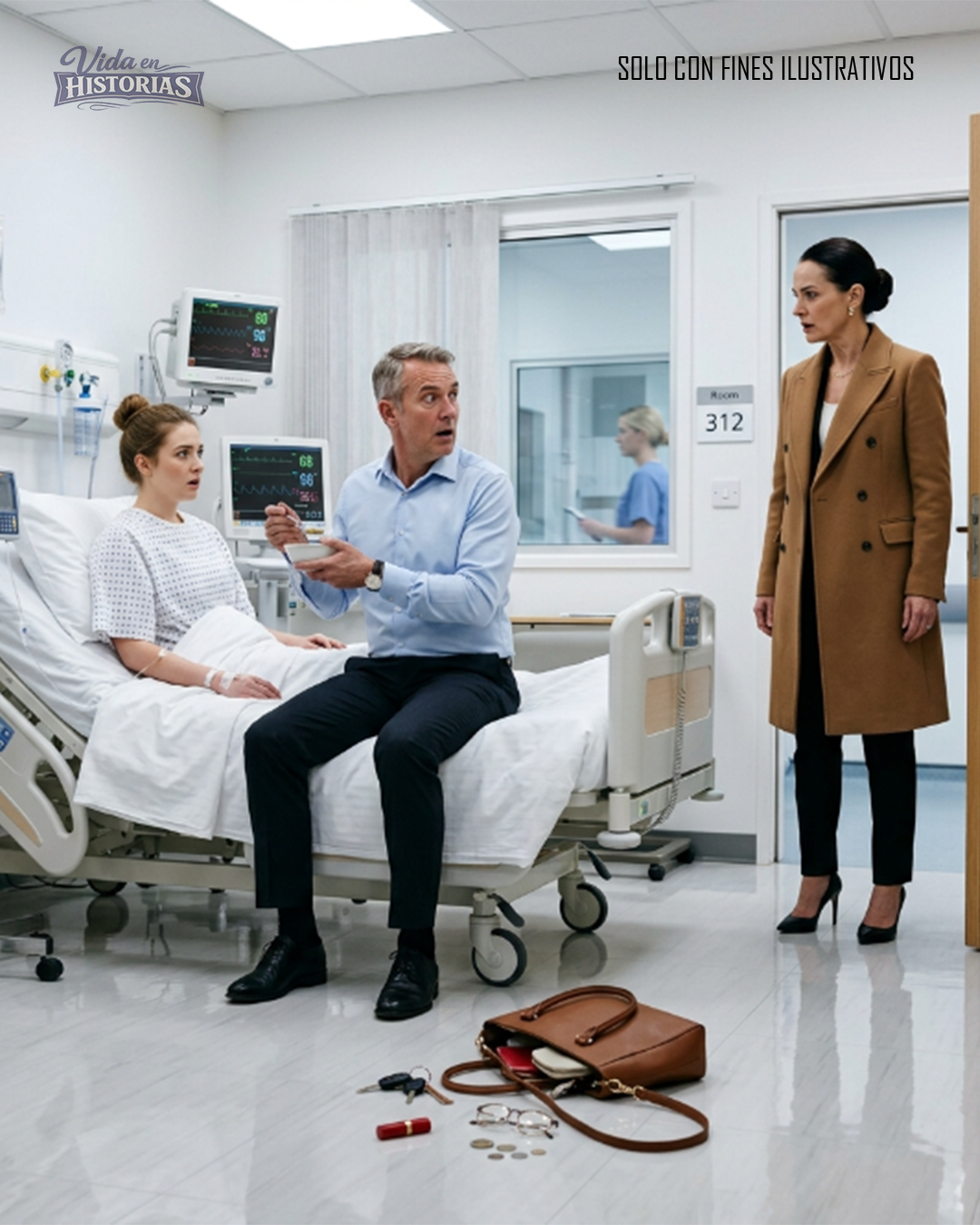
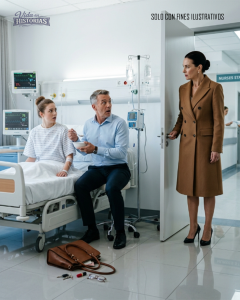
My purse slipped from my hands. The keys, the lipstick, my glasses, and a pack of tissues fell to the floor with a dry crash that echoed down the hallway like a gunshot. They both turned at the same time.
And in that instant, the woman I had been until then ceased to exist.
The hallways of Hospital San Gabriel in Querétaro smelled of chlorine, IV fluid, and defeat. The white ceiling lights made everyone look sick, even the healthy visitors. I knew that world well. I had worked as a nurse almost my entire life. I had assisted in births, said goodbye to the dying, calmed hysterical mothers, and held cold hands at three in the morning.
I thought I had seen every form of pain.
I had not seen this one.
Room 212 was at the end of the internal medicine wing. For three weeks I had repeated that number in my head like a curse. Two hundred twelve. There was the woman named Renata Salas, twenty-nine years old. That was all I knew about her before walking in. Twenty-nine. She hadn’t even been born when I met Ricardo. When I was already ironing his shirts, sewing his frayed cuffs, and working double shifts so he could pay for the courses that helped him build his financial firm.
I took a deep breath before opening the door. I wanted to enter with dignity. I wanted to ask her one thing: Was it worth destroying a family?
But what I saw left me breathless.
The golden afternoon light came through the window. Ricardo, my husband, the man who had kissed me on the cheek that same morning saying he had a meeting with clients, was sitting on the edge of the bed. He held a spoon with applesauce and brought it to the mouth of a pale, thin young woman with her hair tied back and skin almost transparent against the white sheets.
It wasn’t just the act of feeding her that broke me.
It was the tenderness.
The way he wiped the corner of her lips with a napkin.
The way he leaned his head to whisper something in her ear.
The small, trusting smile with which she looked at him.
It was the same look he used to give me when I was sick. The same care. The same devotion. The same love I thought was exclusively mine.
Then I saw it.
On his wrist shone the silver watch I had given him for our thirtieth anniversary. I had worked extra shifts for three months to buy it. On the back I had engraved: “Always yours, Elena.”
My gift.
On my husband’s body.
While he fed another woman.
When our eyes met, the color drained from his face.
“Elena…” he whispered, standing up abruptly. “I… this isn’t…”
I didn’t let him finish.
I took a step back, bumped into the door frame, and fled. I ran down the hallway, past the nurses’ station, the coffee machines, the people with flowers and balloons. I ran all the way to the parking lot. Only when I locked myself in my car could I collapse onto the steering wheel and cry with my whole body.
Thirty years.
Thirty years cooking his favorite dishes. Thirty years supporting his dreams. Thirty years raising our children, Diego and Valeria. Thirty years believing we were partners, and not a marriage where one built while the other learned to lie.
But after a while, the tears stopped.
Not because the pain had gone away.
But because something colder, clearer, began to take its place.
I had gone to the hospital to see the woman who, according to me, had taken my husband from me. And instead, what I saw was the real man I had married.
A man capable of completely replacing me.
A man capable of kissing me in the morning and lying to my face before going to care for his other life.
A man who no longer deserved my tears.
That night, sitting in the kitchen of the house we had bought twenty-five years ago in a quiet gated community, I opened my phone and started looking at old photos. Vacations in Huatulco. Christmas with the little children. Ricardo’s fiftieth birthday. In all the images we were smiling, but looking closely I realized something terrifying: his eyes had been absent for a long time. He smiled with his mouth, not with his soul.
Then I remembered the small things I had preferred not to see.
The new password on his phone.
The late-night meetings.
The new shirts.
The times he turned his phone face down during dinner.
The strange charges on the card.
The “business” trips with no signal.
The time I gently asked if there was someone else and he let out a condescending laugh.
“Please, Elena,” he told me. “We’re not old enough for those silly things. You’re tired. You work too much. You’re imagining things.”
I didn’t know what to call it then.
Now I do: gaslighting.
I didn’t want to be right. I wanted to save my marriage, not prove its ruin. But the day after the hospital I understood that I was no longer facing a suspicion, but a terminal diagnosis.
And as a nurse, when a diagnosis is serious, you don’t faint.
You gather evidence.
The first person I called was Carolina Mejía, my best friend from university. She took the opposite path from mine: while I chose nursing, she entered the judicial police and, years later, opened her own private investigation agency.
She received me in her downtown office with a short hug and a sharp look.
“You found something, didn’t you?”
I showed her bank statements, receipts, screenshots from Ricardo’s phone, and the photo I managed to take of Renata’s file from the hospital hallway. Carolina read everything in silence. Her expression changed halfway through the second document.
“This isn’t just an affair,” she murmured. “This smells like something much worse.”
And she was right.
She traced payments from our joint account to an apartment in Juriquilla. Fifty-four thousand pesos monthly for almost two years. She checked transfers to a private psychiatric clinic called Instituto Santa Isabel. She found emails, legal consultations, and a series of notes that left me frozen.
Ricardo had requested information on the process to declare a spouse mentally incompetent.
“No,” I whispered, not recognizing my own voice. “It can’t be.”
Carolina turned the screen toward me.
“Yes, it can. And apparently that’s what he planned to do with you.”
There were payments classified as “related patient evaluation” and “partial guardianship consultation.” There were emails asking how viable it was to request financial control over an emotionally unstable wife. There was even a reference to “a linked second case,” which Carolina quickly connected to me.
He wasn’t just an unfaithful man.
He was a man preparing my ruin.
Using my money to support his mistress.
Using the clinic to treat her and, at the same time, building the argument that I was losing my mind.
“He wants to erase you,” Carolina said with professional coldness. “Remove you from the house, control your finances, leave you as the hysterical wife who had to be ‘protected.’”
For a moment I felt the floor open beneath my feet. Thirty years of marriage. Two children. A house. A life built on sleepless nights, shifts, and sacrifices. And all of it was being manipulated by a man who had become so calculating that I no longer recognized him.
“What do I do?” I asked.
Carolina didn’t hesitate.
“We give him exactly what he thinks he wants.”
That’s how our plan began.
We installed tiny cameras in the living room, kitchen, hallway, and our bedroom. We hid them in frames, clocks, and an aroma diffuser. Everything connected to a private cloud. Then, when Ricardo came home that night, I sat in front of him with an untouched cup of tea and tired eyes.
I didn’t have to pretend much.
“I think we need space,” I said quietly. “I’m going to stay with my sister for a few days. I need to think.”
I saw the relief in his eyes before he covered it with a carefully rehearsed expression of concern.
“Maybe it’s for the best, Elena,” he replied. “Rest. You’ve been very sensitive lately.”
Very sensitive.
The phrase almost made me laugh.
Three days later, the cameras recorded what we needed.
It was Sunday when Ricardo’s black Mercedes entered the garage. I was in Carolina’s apartment, two streets away, watching the live feed. Renata got out of the passenger seat. She walked slowly, still fragile, leaning on him.
Ricardo opened the door to my house with the key I had given him thirty years ago.
Our home.
My kitchen.
My living room.
My bedroom.
Everything began to fill with his voice and his lies.
He helped her sit on the couch. He brought her a blanket. He showed her the master bedroom as if presenting a new property.
“You’re going to rest here,” he told her. “It’s quiet. You’ll like it.”
She picked up a framed family photo, one of the last where we still pretended to be happy.
“And these things?” she asked.
Ricardo let out a small laugh.
“Just old memories. The woman who lived here never knew how to let go of the past.”
The woman who lived here.
Not my wife.
Not Elena.
Not the woman who built his life.
Just a ghost that was convenient to erase.
Then came the worst.
Renata asked what was going to happen to me. And he replied, with repulsive gentleness:
“She’s not well. The loneliness and stress have affected her a lot. Lately she confuses reality. It’s better if she’s with her family. She needs help.”
I turned off the screen for a second because my hands were shaking too much.
But Carolina stopped me.
“No. Watch until the end. The truth also serves when it hurts.”
On the third day we had enough material to bury him in any trial. But Carolina wanted more: for his reputation to fall, not just his legal strategy.
That’s how the dinner was born.
I called Ricardo and asked him to come on Saturday night. I told him I didn’t want to end everything in silence, that we should talk with our children, with his parents, with our close friends.
“I want to do it with dignity,” I told him.
He swallowed the bait without suspicion.
“That speaks very well of you, Elena,” he replied in the voice of a magnanimous man. “It seems mature.”
Mature.
If I could have, I would have spat the word at him.
Saturday arrived beautiful, warm, almost insulting. I returned to the house early. There was a foreign perfume in the air. My photos were missing. My grandmother’s vase was missing. Renata’s presence was in small details, and that hurt me more than if they had set the living room on fire.
At six the guests began to arrive. His parents. Diego. Valeria. His business partner. Two neighbors. Everyone tense, confused, convinced — by him — that I was going through a nervous breakdown.
Ricardo entered last, impeccable, in a dark suit and serene expression. He approached to kiss my cheek.
“Thank you for doing this,” he told me. “It really means a lot.”
I looked at him and thought: what an educated monster.
The dinner was brief and silent. You could hear the clinking of cutlery and the beating of my heart. When they finished the main course, I placed my napkin beside my plate and stood up.
“Before dessert,” I said, “I want to show you something.”
Ricardo frowned.
“Elena, maybe this isn’t the—”
I pressed play.
The first recording filled the dining room with his voice.
“They’re just old memories. The woman who lived here never knew how to let go of the past.”
No one moved.
The second clip was worse.
“You can tell she’s acting strange lately,” he said. “She’s very sensitive, very unstable. If things get worse, I’m going to have to take care of everything for her own good.”
His mother covered her mouth. Diego stared at the table. Valeria began to cry silently.
Ricardo stood up abruptly.
“What the hell is this? Have you been recording me?”
Carolina then came out of the kitchen with a thick folder and placed it on the table.
“I’m a private investigator,” she announced calmly. “And this is just a part. Bank statements, payments to the clinic, transfers to your mistress’s apartment, consultations about legal guardianship of your wife, and records of misuse of shared funds.”
Ricardo turned pale.
“That’s taken out of context.”
“No,” I replied for the first time since the projection began. “What’s taken out of my life is you.”
Then I played the last recording. The most damning one.
His voice, clear as glass:
“If we can get a doctor to declare her emotionally unstable, I can manage her assets, her care, everything. It will be easier for everyone.”
The silence that followed was absolute.
Not an empty silence.
A silence of collapse.
His partner was the first to speak.
“Ricardo… this is criminal.”
His father slumped into the chair as if something had been ripped from his chest. His mother cried. Diego stood up, his face twisted with disgust.
“I admired you my whole life,” he said. “What a shame.”
Valeria came to me and took my hand.
I didn’t cry.
I had already cried enough.
Carolina slid an envelope in front of Ricardo.
“Divorce lawsuit. Protective measures. And notification to the professional board.”
He looked at me then, really, perhaps for the first time in years. Not with love. Not with arrogance. With fear.
“Elena, we can fix this…”
I shook my head.
“No. What you wanted was to bury me alive. What I’m going to do is outlive you.”
I took my purse. Valeria and Diego walked beside me. Before leaving, I turned one last time.
“You taught me something, Ricardo,” I said calmly. “When someone shows you who they really are, you should believe them. And I finally believed you.”
One year later, I still sometimes wake up expecting to hear Ricardo’s car in the driveway or his coffee cup hitting the counter. Habits take time to die. But the silence no longer weighs on me.
It gives me peace.
The divorce was finalized six months later. He lost the firm, his license, and a good part of what he built… with me. The judge granted me the house, restitution of the diverted money, and a permanent order of asset protection. Renata wrote to me through her therapist. She asked for forgiveness. She confessed that Ricardo had told her he had been divorced for years. That I was a difficult ex-wife. That she never knew the truth.
I believed her.
Not because I was naive.
But because I recognized in her another victim of the same lie.
Today I am the director of patient care at the same hospital where I met Ricardo thirty-one years ago. The irony doesn’t escape me. But it no longer destroys me. I also started therapy, something I used to think was reserved for others. My therapist told me a phrase that changed the way I breathe: you can’t control who betrays you, but you can decide how you rise.
And I rose.
My children come to see me often. Diego says he never fully understood the word dignity until that night. Valeria hugs me tighter than before. In the mornings I drink coffee by the window, with the sun coming in clean over the table, and for the first time in decades I don’t have to pretend I don’t see.
If there’s one thing I want to remain from this story, it’s this: when your heart whispers that something is wrong, listen to it. Don’t justify the absences, the secrets, the lies told with a soft voice. Peace built on denial is not peace.
It is poison.
True love does not erase you. It does not trap you. It does not make you small so that another can live large.
And true healing begins the day you stop waiting for someone to come rescue you… and decide to save yourself.
