Physical Address
304 North Cardinal St.
Dorchester Center, MA 02124
Physical Address
304 North Cardinal St.
Dorchester Center, MA 02124

**PART 1**
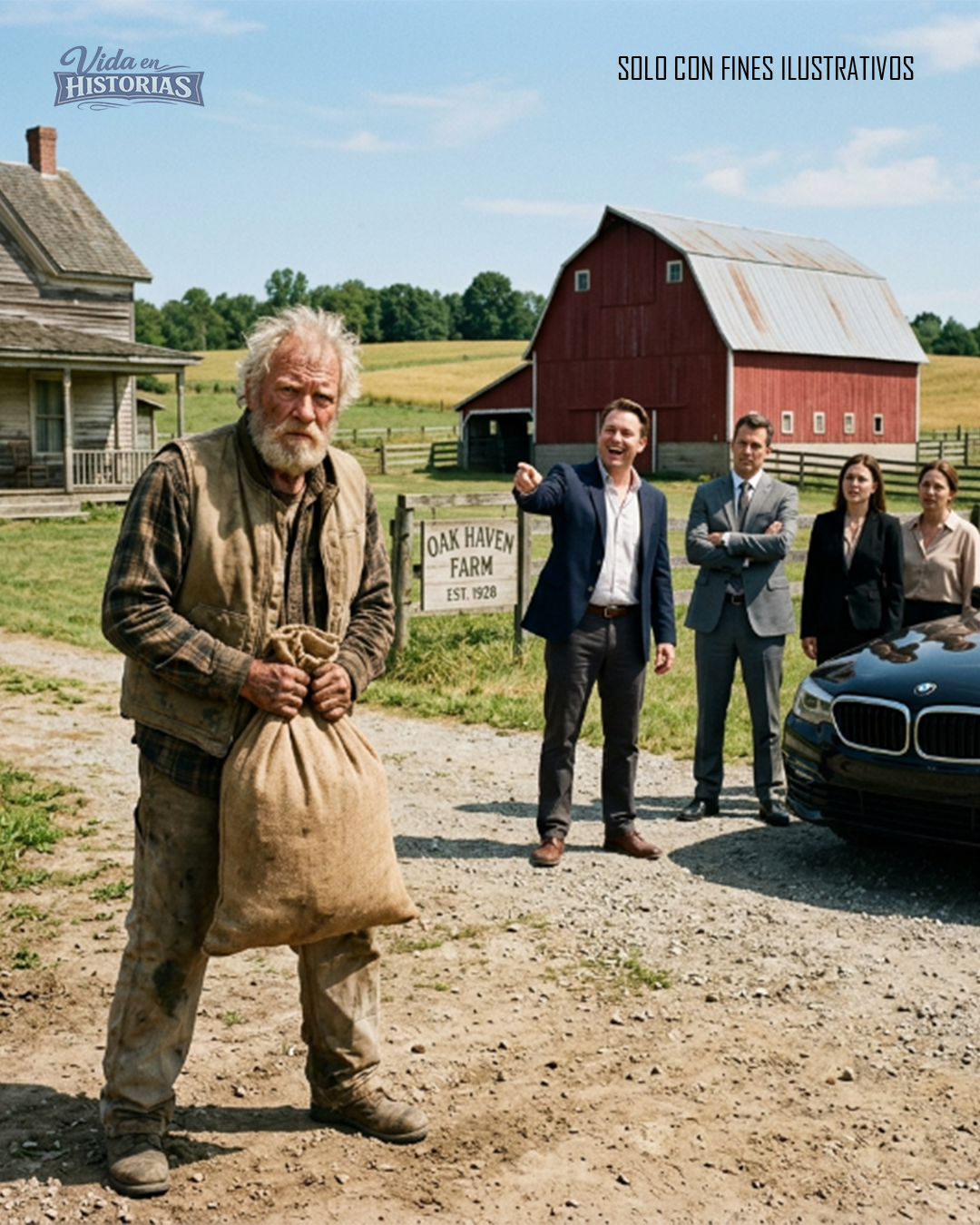
Don Raimundo Saldaña owned two hundred and fifty hectares of corn and sorghum in the Bajío, three silos visible from the highway, and an investment portfolio that silently held more wealth than most people in his town would see in their entire lifetime. But after his wife died, he discovered something that left him more alone than mourning itself: his children only reached out to him when they needed money, a signature, or something that smelled like inheritance.
It hadn’t always been like that. Or at least, it didn’t seem that way while Elena was alive.
They got married in 1979 in a small ceremony where the food was served in his mother’s patio — mole, rice, and sodas in glass bottles. He had inherited forty hectares in debt and an old house that creaked whenever the wind changed. Elena, the daughter of cattle ranchers from another town, arrived with soft hands and a strong character. Together they patched leaks, built fences, expanded the kitchen, and over the years turned that humble beginning into a respected property. He worked the land. She handled the accounts, the dates, the birthdays, the silences, the arguments, and the reconciliations.
They had four children.
Marcos, the eldest, was born with his eyes set beyond the fields. He moved to León, studied business, and built an insurance company. Diana, sharp-minded and sharp-tongued, moved to Monterrey and became a marketing director. Julián stayed closer; he opened a body shop and paint shop in Salamanca, and every year seemed to need new help to keep it afloat. And Nora, the youngest, a late surprise from Elena, became a teacher and married Beto, an honest mechanic who smelled of grease and loyalty. For fifteen years, Nora called every Sunday at six in the evening without missing a single one.
Elena was the thread that held them all together.
When things went wrong for Marcos in 2009, Elena showed up at his house with food and patience. When Diana’s marriage fell apart, Elena slept for two weeks in her apartment. When Julián needed money to save his workshop, it was Elena who convinced Raimundo to help him without humiliating him. Raimundo provided. Elena brought them closer.
And so they lived for forty-seven years, until pancreatic cancer arrived like a death sentence.
She fought for nine months. She became thinner, paler, more fragile, but she never stopped writing things in a brown notebook she kept by her bed. The children came, yes, but not in the same way. Marcos flew in twice and stayed briefly. Diana arrived for Christmas but spent more time on her phone than by the bedside. Julián showed up restless, constantly checking his watch. Nora, on the other hand, drove three hours every weekend with her two children, Lili and Santi, in the back, and read novels to her mother until the pain let her fall asleep.
Elena died on a Thursday in July. Raimundo held her hand long after she stopped breathing.
At the funeral, while the whole town spoke of what a good woman she had been, Raimundo began to see what Elena had once softened. Marcos spoke quietly with a real estate developer in the parking lot. Diana checked messages during coffee. Julián, standing by the coat rack, asked if they had already handled the life insurance. Nora was the only one who went to the kitchen, turned off the faucet that had been left running, and took his hand without saying a word.
The following months confirmed his suspicion. Marcos called to suggest selling the silos. Diana sent a message on the Mexican Thanksgiving that Elena had improvised — the family meal in November — saying she had an unmovable conference. Julián showed up in December to ask for money. Nora continued calling every Sunday. She asked if he had eaten, if he was still going to mass, if he felt too lonely. And when he answered “I’m fine,” she would reply with sad tenderness:
“I don’t believe you, Dad… but I’m here.”
In April, while sorting Elena’s clothes to donate them, Raimundo found the notebook.
He opened it at random and a phrase pierced his chest:
“A man’s children should visit him because they want to see him, not because there’s something to sign. I’ve spent thirty years telling Rai that providing is not the same as loving. But he only taught them the language of transactions, and now they all speak to him in that language.”
Raimundo closed the notebook. He sat for a long time.
The next morning, he went to his lawyer, Don Francisco, and said:
“I want to know which of my children would come to see me if I had nothing.”
He redirected the ranch’s profits to a trust, moved the machinery to his compadre Heriberto’s lot, stored his truck, closed the big house, and moved into the old trailer where the day laborers used to sleep. Then he called his four children and told them the lie: bad investments, hidden debts, drought, the ranch was bankrupt.
The responses came like different knives.
Marcos asked if anything could still be salvaged from the land.
Diana sighed and said, “So what’s the plan, Dad?”
Julián replied, his voice tight: “And what about the money you were supposed to help me with?”
Nora stayed silent for a few seconds and only asked:
“Are you sure? Have you eaten? I’ll come on Saturday. Don’t argue with me.”
That night, Raimundo took out a small notebook and wrote down four names. Next to each one, he noted their first words.
And then he began to wait.
**PART 2**
Nora arrived that Saturday with grocery bags, a pot of broth, her two children, and the serious expression Elena used when something truly worried her.
She opened the trailer’s pantry, saw it was almost empty, and didn’t say “how sad,” or “how did you end up here,” or “I warned you.” She simply started putting away milk, bread, eggs, coffee, beans, canned soup, and some tortillas wrapped in a clean cloth.
“Tell me what happened,” she said, serving him coffee in a chipped cup.
Raimundo repeated the lie: debts, bad decisions, lost harvests.
Nora listened without interrupting. When he finished, she didn’t ask how much he had lost.
She asked:
“What do you need?”
That night he wrote that phrase in the notebook and underlined it twice.
The others also appeared, but each one revealed something about themselves.
Marcos arrived in a clean sedan, wearing a pressed shirt and the eyes of an appraiser. He entered the trailer like someone inspecting a property in foreclosure. He talked about diversification, assets, restructurings, and sales possibilities. He didn’t ask if the heater worked or if he had eaten. He stayed less than two hours.
Diana called from time to time. Her calls were short, as if she were between meetings. She talked about some senior residences in Querétaro, “quite decent,” she said. She promised to come “when the workload eased.” She never did.
Julián showed up one October morning with the face of a man whose last board had broken under his feet. He asked about hidden accounts, insurance, any savings Elena might have kept. When Raimundo told him there was nothing, Julián confessed that the workshop was sinking, that he owed the bank, that Tamara had taken a second job, and that his son needed braces.
“I was counting on…” he stopped, swallowing his shame.
“On the inheritance?” Raimundo asked.
Julián looked down.
It wasn’t malice in him. It was fear.
Raimundo wanted to tell him the truth, open his hand, save him. But he remembered Elena’s notebook and stayed silent. That night he wrote: “He didn’t ask how I am. But he is truly afraid.”
And as autumn turned to winter, Nora kept coming every Saturday.
She brought blue curtains she had sewn in her kitchen to cover the cold glass of the trailer. She fixed a dripping faucet. She tightened a loose hinge. She cooked chicken with rice using one of Elena’s recipes. She stuck drawings from Santi on the refrigerator with cow magnets. Once, while arranging some blankets, she told him:
“My mom always said a house doesn’t become warm because of the stove, but because someone takes care of it.”
And the trailer, as ugly and narrow as it was, stopped feeling abandoned.
In January, pneumonia knocked Raimundo down. He called Nora on the usual Sunday, trying to pretend it was just a cough, but his voice betrayed him.
The next day she was already there.
She took him to the doctor, argued with him in the parking lot until she got him to promise to take the antibiotics, asked for a substitute at school, and stayed four nights sleeping on the couch. Beto came after work with Styrofoam sheets and sealed the cracks where the cold air came in. In the early morning, Nora boiled water so he could breathe steam and took his temperature with the same loving stubbornness Elena used to care for everyone.
One of those nights, when the fever broke, Raimundo opened Elena’s notebook again.
He read an entry written years before her illness:
“Rai loves his children, but he loves them in silence, like the earth loves the rain: from below and without saying a word. The problem is that children need to see it. If I’m ever gone, I fear the family will fall apart because I was the bridge and he never learned to cross it.”
That hurt him more than the pneumonia.
Because it was true.
Marcos talked about money because he had taught him to speak that way. Diana hid in her work because he had always put work first. Julián only came when he was desperate because Raimundo had never offered another way to connect. Nora was different, yes… because Elena had raised her more closely, with more listening, more shared meals, more Sundays.
The test was no longer just for his children.
It was also for him.
In May, sitting on the trailer steps while the sun melted over the fields, Raimundo understood that he had seen enough. He had seen ego, haste, shame, fear… and also true love, tired, constant, without calculation.
Then he asked Nora to gather everyone the following Saturday at the big house.
“It’s time to end this,” he said.
Nora looked at him for a long time, as if she sensed an entire wall was about to fall on the family.
But she nodded.
“They’ll come,” she replied. “Even if I have to drag them.”
**PART 3**
Saturday dawned with a clear sky and a warm wind that smelled of living earth. Heriberto opened the big house early. He swept it, made coffee, and aired out the rooms that had been closed for months. On the dining table lay the account statements, contracts, trust documents, and, next to all that, the small notebook where Raimundo had been noting his children’s behavior.
Nora was the first to arrive, as always.
Then Marcos, impeccable, with a tense frown.
Then Diana, with dark glasses and her phone in her hand.
Finally Julián, thinner than before, with exhaustion clinging to his shoulders.
The four of them stood in the kitchen where Elena had made tortillas, scoldings, and miracles.
Raimundo stood at the head of the table and said without preamble:
“The ranch didn’t go bankrupt.”
The silence was so abrupt it felt like a blow.
“The silos are still working. The land is still producing. The money is still where it was. I lied to all of you.”
Marcos turned red.
“You tested us?”
“Yes.”
Diana pressed her lips together.
“That’s cruel.”
Julián didn’t even get angry right away. He stared at the papers with a mix of relief and humiliation.
Raimundo opened the notebook.
He read to Marcos his visits measured in minutes, his calls about sales and opportunities, his exact interest in every hectare. He read to Diana the cold tally of her short calls and postponed promises. To Julián he read less, because in his name there was less ambition than desperation. And when he finished with them, he closed the notebook and looked at Nora.
“You fill almost all the pages.”
Nora didn’t smile.
“Were you testing me too, Dad?”
Raimundo swallowed.
“No. Well… yes. But not the way you think. I needed to remember what love looks like when it comes without asking for anything.”
Nora’s eyes grew moist, though her voice came out firm.
“I didn’t pass any test. I just came. Because you were alone.”
Then Julián spoke, his voice broken:
“I did fail. But not just out of self-interest. I was ashamed. Every time I came to see you, it was to ask for something. When I thought you had nothing… I didn’t know how to approach you without feeling like a wretch.”
Diana looked down.
“I hid in my work. I always said ‘when I have time.’ And I never did. The truth is I could have come. I just didn’t.”
Marcos was the last to soften.
“You lied to us,” he said, still stiff. “But also…” he paused and took a deep breath. “We never knew how to talk to you unless it was about business. You never taught us anything else.”
The blow hit Raimundo right in the center.
He sat down slowly in Elena’s chair.
“You’re right. Your mother told me a thousand times and I didn’t listen until it was too late. I thought giving you a roof, education, money when needed, was enough. It wasn’t. I failed you in games, in calls, in hugs, in words. I failed you before I lied to you. And for that… I ask your forgiveness.”
No one spoke right away.
Outside, they could hear the laughter of Lili and Santi, and Beto’s voice with Heriberto. Life continued, like the fields after a storm.
Nora was the first to approach. She placed a hand on his arm. Julián sat beside him and covered his face for a moment. Diana dragged a chair and stayed at the table. Marcos took longer, as always, but eventually sat down too.
There was no instant novel-like reconciliation.
There was something better: truth.
That same month, Raimundo changed the will. The land and silos were placed in a family trust for all the grandchildren, with Nora as the main administrator, not because she was the favorite, but because she had shown love and good judgment. The investment portfolio was divided equally among Marcos, Diana, and Julián, with no punishments or conditions. When the lawyer asked if he wanted to add clauses, Raimundo shook his head.
“One test was enough for one family.”
He only added one line written in his own handwriting:
First Sunday of every month, lunch at the big house. Come because you want to. The table has room for everyone.
The first lunch was in July.
Nora cooked using Elena’s recipe book. Beto set up folding tables because they didn’t all fit. Julián arrived early and asked if he could help; he ended up peeling potatoes at the counter. Diana showed up with a bakery pie and a new awkwardness, like someone learning to come back. Marcos arrived last with his wife and children, stood at the door for a few seconds, and then shook his father’s hand with a different kind of strength — less businesslike and more human.
During dinner, Lili spilled the milk. Santi hid a roll under the table. Diana laughed genuinely for the first time in a long time. Marcos talked with Beto about engines even though he knew almost nothing about the subject. Julián, now without his workshop, told Raimundo on the porch that he wanted to gradually return to the farming business, learn about the silos, and start over.
“I don’t know if I deserve another chance,” he murmured.
Raimundo placed a hand on his shoulder.
“This isn’t about deserving. It’s about coming back.”
That night, when the house grew quiet and the smell of coffee, meat, and warm tortillas still lingered, Raimundo stepped out onto the porch. He touched the wedding ring he wore on a chain around his neck and looked at the land stretching under the dark sky.
“You would have been very angry with me, Elena,” he said to the air, with a tired half-smile. “But look… in the end I brought them to the table.”
Behind him, the screen door opened.
“Grandpa, are you coming in or are you going to keep talking to yourself?” asked Lili, disheveled and barefoot.
Raimundo turned toward the light of the house. Inside, he could hear voices, plates, footsteps, Nora’s soft laughter, and Beto’s calm tone. It was no longer the hollow silence of mourning. It was the imperfect noise of a family trying to learn again.
“I’m coming, my queen,” he replied.
And this time, without looking back too long, he went inside.
