Physical Address
304 North Cardinal St.
Dorchester Center, MA 02124
Physical Address
304 North Cardinal St.
Dorchester Center, MA 02124

When the light touched the corner of that canvas, the room stopped breathing.
The socialite’s smile disappeared first.
Then the curator stepped closer.
Then my son squeezed my hand so tightly I felt his little fingers tremble against mine.
Nobody knew what they were looking at yet.
But she did.
Her name was Vanessa Whitmore, and in Chicago society, people treated her like old money even though most of her money came from marrying it.
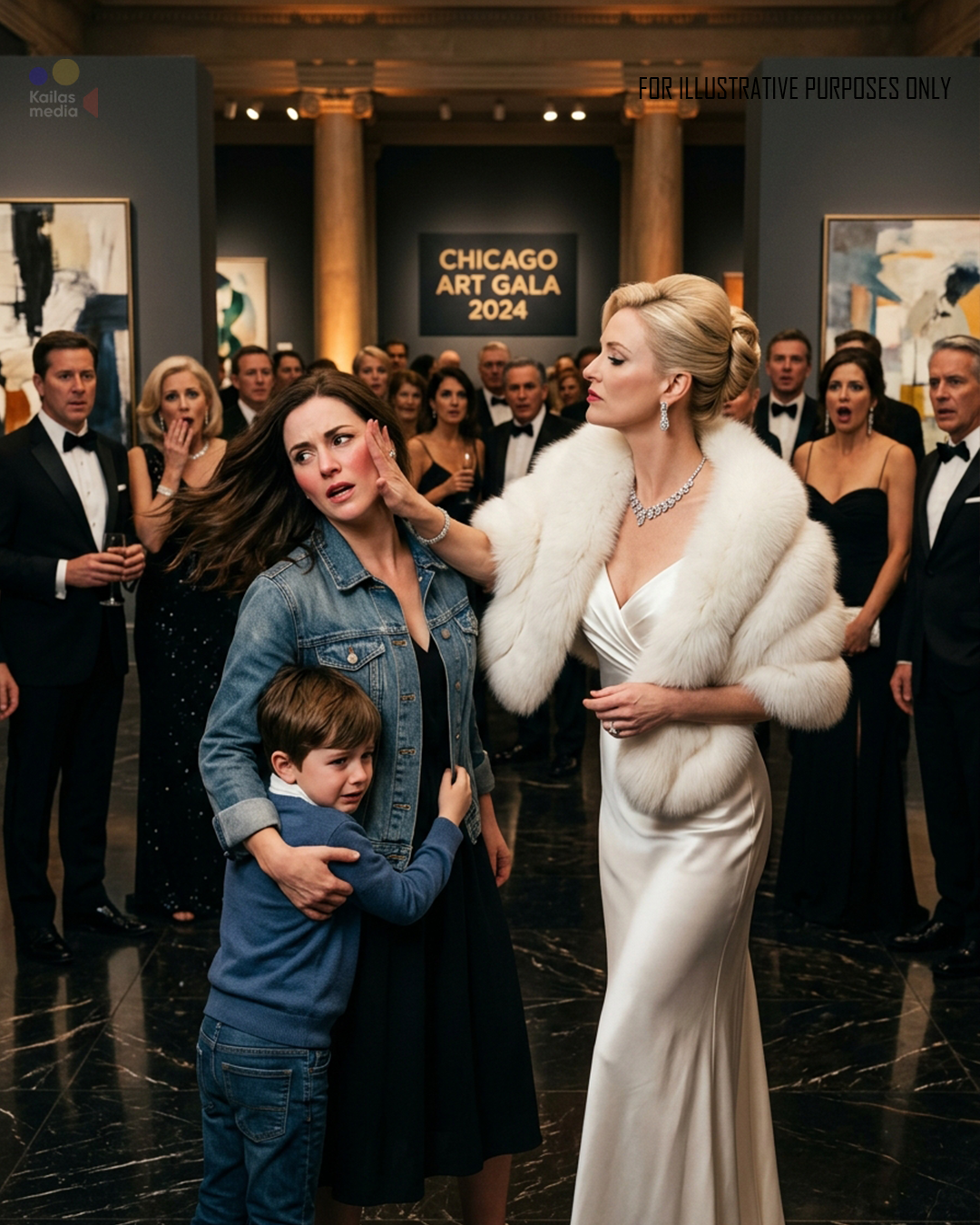
She stood under the gallery lights in a silver silk dress, one hand on her diamond necklace, the other still red from the slap she had left across my cheek.
Behind her were thirty-two paintings.
All under her name.
All priced higher than any home I had ever lived in.
And all of them were mine.
Six months earlier, I had been painting in a freezing basement apartment on the south side with a space heater, three lamps from a thrift store, and my son, Noah, doing homework at the kitchen table.
“Mom,” he would say, kicking his little feet under the chair, “when people see your paintings, are they going to clap?”
I always smiled, even when my fingers were numb.
“Maybe one day.”
“Will they know you made them?”
I looked at the half-finished canvas in front of me.
A woman standing in a field of blue shadows, holding a child’s red mitten.
“They’ll know if they look closely enough.”
That was something my father had taught me.
He had been a sign painter before arthritis took his hands. He never got rich. Never got famous. But he taught me one thing I carried into every canvas.
“Leave a truth where only honest eyes will find it,” he used to say.
So I did.
In every painting, beneath a final glaze of color, I hid a tiny signature: three curved strokes shaped like an unfinished bird.
Not visible under regular light.
Not obvious to buyers.
But under a narrow beam, from the right angle, it appeared like a ghost.
It was my mark.
My proof.
My name was Lena Marrow, though almost nobody in the art world knew it.
Vanessa knew me only as the quiet woman who cleaned her late husband’s private studio office twice a week.
I needed the money. Noah needed dental work. Rent was overdue. So when the Whitmore estate manager offered cash for evening cleaning, I said yes.
The first night I entered that house, I saw framed European sketches, marble floors, and a hallway longer than my apartment building.
Vanessa looked me up and down like I was something delivered by mistake.
“You’ll use the side entrance,” she said.
“Yes, ma’am.”
“And don’t touch anything with your bare hands.”
I nodded.
She smiled without warmth.
“People like you always say they won’t.”
I swallowed the insult because rent was due Friday.
For three weeks, I cleaned that house.
Then one evening, Vanessa walked into the study while I was wiping dust off a table.
She froze when she saw the sketchbook tucked halfway out of my tote bag.
“What is that?”
“My son’s homework folder,” I lied.
She pulled it out before I could stop her.
Inside were studies for my paintings: hands, faces, window light, a child standing beside a museum rope.
Her eyes changed.
Not softened.
Sharpened.
“You did these?”
“Yes.”
“You paint?”
“When I can.”
She flipped through the pages slowly.
Then she laughed.
“A cleaning woman with a secret hobby.”
I reached for the sketchbook.
She held it away.
“These are… interesting.”
“They’re mine.”
“Relax,” she said. “I’m not stealing your little notebook.”
But two days later, the notebook was gone from my bag.
Then my storage unit was broken into.
Only one thing disappeared.
My canvases.
Six years of work.
Every painting I had made while Noah slept, while bills piled up, while I stretched cheap canvas over recycled wood because I could not afford proper frames.
I reported it.
The officer took notes, sighed, and asked if I had receipts proving the materials were mine.
I had some.
Not enough.
Then three months later, I saw my painting on a billboard downtown.
“VANESSA WHITMORE: THE UNNAMED MUSE”
Chicago Contemporary Art Exhibition.
Opening Night.
My knees nearly gave out right there on the sidewalk.
Noah saw it too.
“Mom,” he whispered. “That’s yours.”
I wanted to scream.
Instead, I went home and pulled out every photograph, every dated sketch, every supply receipt, every video Noah had ever taken of me painting in our tiny kitchen.
Then I called an attorney.
Not a fancy one.
A tired woman named Ruth Carver who worked copyright cases out of a small office over a bakery.
She listened to everything.
Then she said, “Do not confront her privately.”
“Why?”
“Because thieves love darkness. Let her lie where everyone can hear her.”
So I waited.
I bought the cheapest secondhand black dress I could find. Noah wore the only button-down shirt he owned. I brushed his hair twice because my hands were shaking too badly the first time.
“Are we going to get your paintings back?” he asked.
“We’re going to tell the truth.”
“But what if they don’t believe us?”
I looked at his sweet, worried face.
“Then we show them where to look.”
The gallery was packed that night.
Critics. Donors. Collectors. Influencers. Men in tailored suits. Women with champagne glasses and diamond bracelets.
And in the center of it all stood Vanessa.
She was glowing.
Not from talent.
From theft.
A reporter asked her, “What inspired this collection?”
Vanessa placed a hand on her heart.
“Motherhood,” she said softly. “Loss. Survival. The invisible labor of women.”
My stomach twisted.
She was describing my life like she had purchased it with the paintings.
Then Noah whispered, “Mom, that one.”
He pointed toward the biggest canvas.
The Blue Room.
My most personal piece.
A mother sitting beside a sleeping child under a cracked window, moonlight spilling across their faces.
I had painted it after a winter night when our heat went out.
Noah had slept in two coats.
I painted while crying quietly so I would not wake him.
Vanessa had priced it at $480,000.
I stepped closer.
Noah followed.
A gallery assistant moved toward us.
“Please don’t cross the rope.”
Noah stopped immediately.
But his sleeve brushed the velvet rope.
That was all it took.
Vanessa turned.
Her eyes landed on me.
Recognition flashed across her face.
Then panic.
Then anger.
“What are you doing here?”
I lifted my chin.
“Looking at the collection.”
A few people turned.
Vanessa walked toward us, smiling for the crowd but speaking through clenched teeth.
“This is a private opening.”
“The invitation page said public after eight.”
Her smile tightened.
“You brought a child?”
Noah moved behind me.
“He loves art.”
Vanessa looked down at his shoes.
Scuffed. Clean, but old.
Then she said the words that made every camera turn.
“Children like him don’t belong in a temple of art.”
The room quieted.
I felt Noah’s hand grab my coat.
I said, “Don’t speak to my son that way.”
She laughed.
“Oh, now the cleaning woman is giving etiquette lessons?”
A murmur moved through the crowd.
Someone whispered, “Cleaning woman?”
Vanessa’s eyes brightened. She liked that.
She liked the audience.
“She used to mop floors in my house,” she announced. “And now she walks in here pretending she understands fine art.”
My face burned.
But I remembered Ruth’s words.
Let her lie where everyone can hear her.
So I stayed quiet.
Vanessa stepped closer.
“You should leave before you embarrass yourself.”
Noah whispered, “Mom…”
Then Vanessa looked at him again.
“And teach your son not to touch things he can’t afford.”
That was when I said, “At least he doesn’t steal them.”
The silence became sharp.
Vanessa’s face hardened.
“What did you say?”
I turned toward the largest painting.
“I said, at least he doesn’t steal them.”
Her hand flew so fast I barely saw it.
The slap cracked across my cheek.
Gasps burst around us.
Noah cried out, “Mom!”
My head turned from the force of it. My cheek stung. My eyes watered.
But I did not move.
Vanessa whispered, “You should have stayed invisible.”
That sentence broke something open inside me.
Not rage.
Clarity.
I took Noah’s hand and walked straight to The Blue Room.
“Ma’am,” the curator said, hurrying over, “please step back.”
I looked at him.
“Do you have a narrow-beam flashlight?”
He blinked.
“What?”
“A narrow-beam flashlight. Conservation staff use them to inspect paint layers.”
Vanessa laughed loudly.
“She’s insane. Get security.”
But the curator hesitated.
Because I had used the correct term.
A gray-haired critic near the front said, “Let her speak.”
Vanessa snapped, “This is my exhibition.”
I looked at the crowd.
“No. It isn’t.”
The room erupted in whispers.
Vanessa turned pale.
I pointed to the lower left corner of The Blue Room.
“There’s a glaze layer under the blue shadow near the window. Under direct light, from a low angle, you’ll see three curved strokes.”
The curator frowned.
“That detail is not visible.”
“I know.”
Vanessa said, “Anyone could invent that.”
I kept my eyes on the painting.
“Then ask her what the strokes mean.”
Every face turned to Vanessa.
She opened her mouth.
Closed it.
Then smiled.
“It’s obviously part of my symbolic language.”
“What does it symbolize?” the critic asked.
Vanessa’s smile twitched.
“Flight. Freedom. Feminine emergence.”
I almost laughed.
“No,” I said. “It’s an unfinished bird.”
The curator looked at me.
“Why unfinished?”
I swallowed.
“Because my father’s hands gave out before he could finish teaching me how to paint one.”
The room went quiet again, but this time it felt different.
Softer.
The curator took a flashlight from a staff member.
Vanessa stepped forward.
“This is ridiculous. I want her removed.”
But two security guards paused near the entrance as an older woman in a navy suit walked in.
Ruth Carver.
My attorney.
Beside her were two men from a copyright litigation firm she had partnered with after reviewing my evidence.
Ruth did not raise her voice.
She simply said, “Nobody is removing Ms. Marrow.”
Vanessa stared at her.
“And you are?”
“The attorney representing the registered copyright holder of these works.”
A low sound moved through the crowd.
Vanessa laughed, but it cracked at the edges.
“Registered? That’s impossible.”
Ruth opened a folder.
“Not impossible. Just inconvenient for you.”
The curator switched on the flashlight.
He crouched.
The beam touched the lower corner of the painting.
For one second, nothing happened.
Then three pale strokes emerged beneath the blue.
Small.
Delicate.
Hidden.
An unfinished bird.
Noah whispered, “There it is.”
Someone gasped.
A collector stepped closer.
Another person lifted a phone.
The curator’s hand shook slightly.
“This mark is beneath the final glaze.”
The critic asked, “Meaning?”
“It was made during the painting process,” the curator said slowly. “Not added afterward.”
Ruth handed him printed photographs.
“Here are dated images of Ms. Marrow painting this exact canvas in her apartment six years ago. You’ll see the same cracked window, the same underdrawing, and the same hidden mark before the final glaze.”
Vanessa’s lips parted.
I turned to her.
“You stole my sketchbook first. Then my storage unit.”
“That is a lie.”
Ruth looked at the crowd.
“We have security footage from the storage facility showing a vehicle registered to Ms. Whitmore’s estate manager entering the property after hours. We also have messages between Ms. Whitmore and a private art handler discussing the removal and reframing of ‘basement canvases.’ Her words, not ours.”
The room exploded.
Vanessa spun toward the gallery director.
“Stop this. Stop them!”
But the director had already backed away from her.
A man near the front said, “I bought one of these tonight.”
Ruth nodded.
“Then you may want to speak with counsel. Every sale made under false authorship may create serious civil exposure.”
Vanessa’s face flushed.
“You people don’t understand. I elevated the work. Without me, nobody would know her name.”
I finally stepped toward her.
“My name was already on them.”
I pointed to the hidden bird.
“You just never thought anyone would look under the paint.”
Noah stood beside me, still scared but no longer hiding.
Vanessa saw him watching and tried one last time.
“You think this makes your mother special?” she snapped at him. “She’s still nobody.”
The old critic turned sharply.
“That child has heard enough.”
Then the curator faced Vanessa.
“Ms. Whitmore, this exhibition is suspended immediately.”
Her mouth opened.
“What?”
“Pending legal review, provenance investigation, and copyright verification.”
Ruth added, “And a federal copyright complaint will be filed first thing tomorrow morning.”
One of the collectors said, “I want my payment frozen.”
Another said, “I want my name removed from any sponsorship materials.”
A woman from a Chicago arts foundation looked at Vanessa with disgust.
“You made us promote stolen work?”
Vanessa backed up as if the room itself had turned against her.
For the first time that night, nobody moved out of her way.
The cameras that had filmed my humiliation now filmed her downfall.
But I did not feel triumph the way I thought I would.
I felt tired.
I felt the weight of every night I had painted after cleaning someone else’s house.
Every bill.
Every insult.
Every moment I had told Noah to be patient because one day things would be different.
Then the curator turned to me.
“Ms. Marrow,” he said softly, “would you be willing to tell the audience about The Blue Room?”
I looked down at Noah.
He nodded.
So I walked to the front of the gallery.
Not Vanessa’s stage.
Mine.
The crowd parted.
My cheek still burned.
My dress still looked cheap under the expensive lights.
My shoes still had glue near the sole.
But behind me were my paintings.
My life.
My proof.
I stood beside The Blue Room and touched the air near the canvas, careful not to touch the paint.
“I made this during the coldest week of January,” I said. “My son was asleep beside me in two coats because our heat had gone out.”
The room was silent.
“I painted the moonlight brighter than it really was because that night, I needed to believe there was still light somewhere.”
Noah’s eyes filled.
I continued.
“The unfinished bird is for my father. He taught me that art doesn’t need permission from rich people to be real.”
A few people wiped their eyes.
The critic who had defended me earlier began clapping.
Then another person joined.
Then another.
Soon the entire gallery was applauding.
Not politely.
Not for society.
For truth.
Noah wrapped his arms around my waist.
“Mom,” he whispered, “they know.”
I held him close.
“Yes,” I whispered back. “They know.”
The lawsuit took months.
Vanessa denied everything at first.
Then the messages came out.
The storage footage.
The art handler invoices.
The altered certificates.
The forged artist statements.
Her reputation collapsed faster than the opening-night champagne tower.
Collectors sued.
Sponsors demanded refunds.
The gallery issued a public apology and cooperated with the investigation.
Vanessa faced a massive copyright judgment, fraud claims, and the kind of public disgrace money could not polish away.
But the best part was not watching her lose.
The best part was what came after.
The Chicago Contemporary Gallery reopened the exhibition three months later under its rightful name:
LENA MARROW: THE UNFINISHED BIRD
This time, my name was printed on the wall.
Not hidden.
Not stolen.
Not whispered.
Noah wore a new little blazer donated by a tailor who had heard the story. Ruth stood in the front row. My father’s old brushes were displayed in a glass case beside the first sketchbook I ever filled.
And when I walked onto the stage, the entire room stood.
I looked at my son.
He was clapping harder than anyone.
After the opening, a woman brought her daughter to me.
“She wants to paint,” the woman said. “But she thinks artists have to come from important families.”
I knelt down to the little girl.
“Important families are nice,” I told her. “But honest hands matter more.”
Noah grinned.
On the way home that night, he leaned against me in the back of the cab.
“Mom?”
“Yes, baby?”
“Are we rich now?”
I laughed for the first time in what felt like years.
“Not yet.”
He thought about that.
“But people know your name.”
I looked out the window at the lights of Chicago sliding across the glass.
“Yes,” I said. “They do.”
He smiled and closed his eyes.
The next morning, I hung one small canvas above our kitchen table.
Not the most expensive one.
Not the famous one.
Just a painting of an unfinished bird rising over a city skyline.
Under it, I wrote my name in black ink.
Lena Marrow.
Visible.
For everyone.
