Physical Address
304 North Cardinal St.
Dorchester Center, MA 02124
Physical Address
304 North Cardinal St.
Dorchester Center, MA 02124

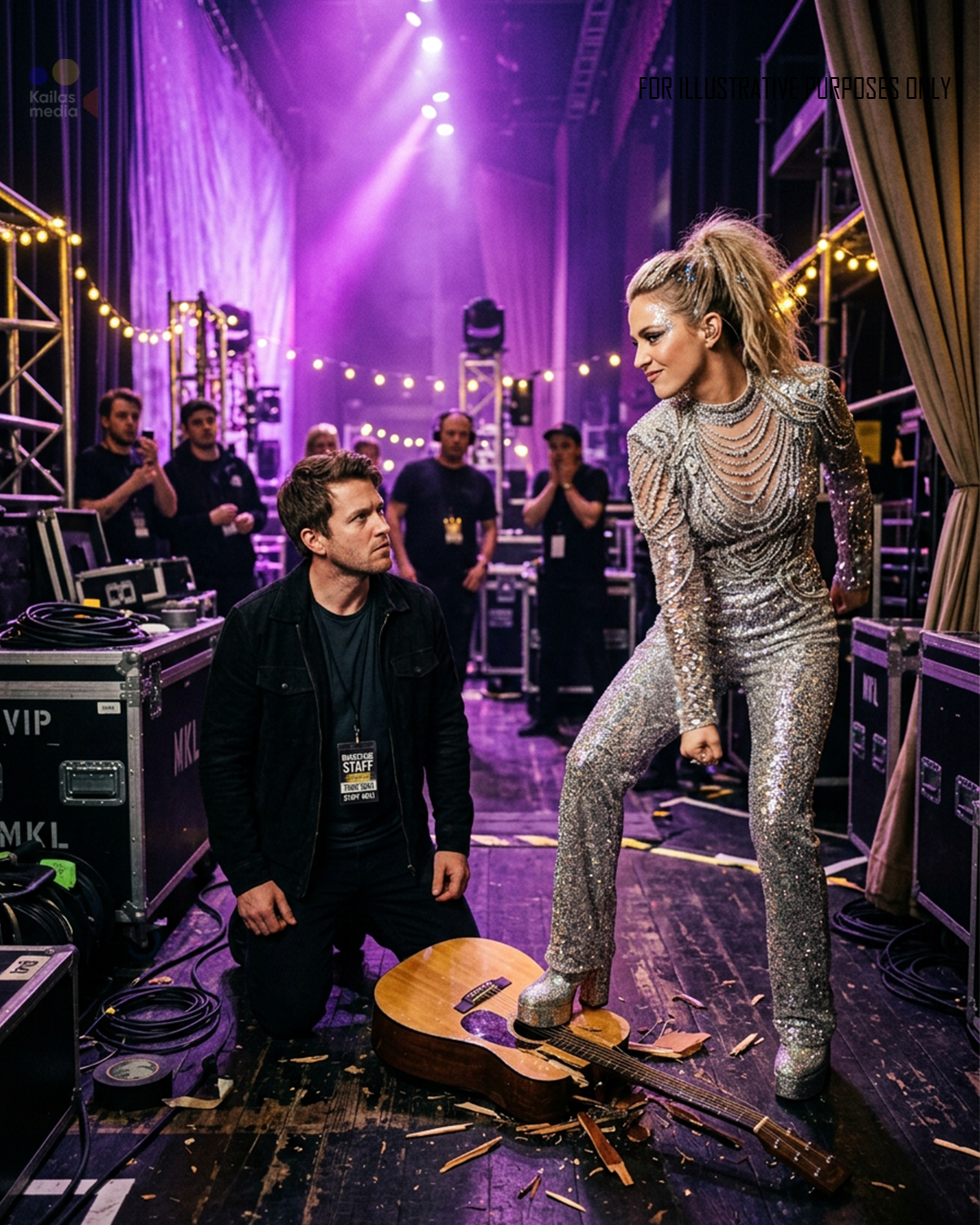
She crushed my guitar like it was a paper cup.
Not in private.
Not by accident.
Right there in the Coachella VIP backstage corridor, with security guards, stylists, dancers, managers, and half a dozen influencers watching like it was part of the show.
I was there because nobody noticed boys like me.
That was useful.
A plain black T-shirt. Worn boots. A faded guitar bag over my shoulder. To people like Sienna Vale—the biggest pop princess on the festival bill—I looked like another backstage helper sent to carry cables and stay silent.
She was already in a bad mood when she came storming down the corridor.
“Why is he standing here?” she snapped, pointing at me like I was a stain on the floor.
One of her assistants said, “He’s probably crew.”
Probably.
That word followed me my whole life.
Probably staff.
Probably broke.
Probably nobody.
I shifted to let them pass. That should have been enough. It wasn’t.
Sienna stopped in front of me, looked me up and down, and laughed.
“No VIP wristband. No pass worth showing. And that bag?” She smirked. “What is that, thrift-store cosplay?”
A few people laughed.
Not because it was funny.
Because she was famous.
Then she flicked the front of my guitar bag with one manicured nail and said, loud enough for everyone to hear, “The help is getting very creative this year.”
My ears burned.
I could feel the cameras turning.
I could hear the low murmur people use when they smell humiliation coming.
I should tell you something.
The guitar in that bag was not flashy. It wasn’t polished. It didn’t sparkle under lights. Most people would have seen old wood, worn edges, and years of use.
But if you knew guitars, really knew them, you would have noticed the grain.
The bridge.
The hand-carved repair near the lower bout.
And the signature hidden inside the body.
A signature from Lennon Hart.
My father.
The man people still called the last true ghost of rock and roll.
He had died when I was fourteen.
The world knew his voice.
Very few people knew he had a son.
Fewer knew I could play.
My father had protected my privacy while he was alive. After he died, I kept it that way. No interviews. No labels. No reality-show grief tour. Just lessons, silence, and a promise I made to him over his hospital bed:
Don’t sell the music to people who don’t respect it.
Sienna didn’t know any of that.
She just knew I looked small enough to insult.
“Answer me,” she said. “Who let you in here?”
Before I could speak, one of her dancers snickered, “Maybe he wants an autograph.”
That got a bigger laugh.
Sienna leaned closer. I could smell expensive perfume and ego.
“Here’s some advice,” she said. “If you want to survive around real artists, learn to stay out of the frame.”
Then she shoved my shoulder.
Not hard.
Just enough to make the bag slide off.
The guitar hit the concrete.
The sound that came out of it didn’t sound like wood.
It sounded like history breaking.
I dropped to my knees.
The neck had split near the headstock. One tuning key had snapped clean off. The lacquer was cracked across the body.
The whole hallway went quiet.
Even the people filming stopped whispering.
Sienna rolled her eyes.
“Oh my God,” she said. “It’s just a guitar.”
Then she did the thing nobody could excuse.
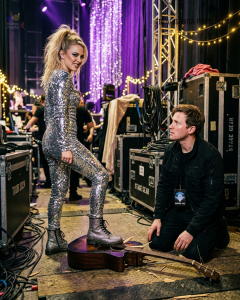
She stepped on it.
One glitter boot.
A sharp crunch.
And a smile.
“You can cry later,” she said. “Move.”
For one second, I couldn’t breathe.
Not because of the money.
The guitar was insured, yes. My father’s estate had lawyers, archivists, contracts, appraisers—the whole machine. But none of that mattered in that second.
My dad had written his last unfinished riff on that guitar.
I still had the voice memo.
I still had the coffee stain near the tuning pegs from the night he forgot it on the piano.
It was the last thing of his that still felt alive in my hands.
And she stomped on it because she thought I was beneath her.
I wanted to scream.
Instead, I looked up and said, very quietly, “You probably should’ve asked whose guitar that was.”
She laughed again.
“Oh, perfect. He thinks he’s mysterious.”
But people around us had started leaning in.
One older stage technician crouched beside the guitar and his face changed instantly. He didn’t touch it. He just stared.
“No way,” he whispered.
A producer from side stage came closer. He saw the inner label through the split and went pale.
Then the stage manager, Ross Kellan, pushed through the circle.
Ross had toured with my father in the late nineties. He hadn’t seen me in years.
He looked at me.
Looked at the guitar.
Then looked at Sienna like she had just set fire to a church.
“What did you do?” he asked.
Sienna straightened. “This child was blocking the corridor.”
Ross ignored her and knelt down beside me.
“Eli?” he said softly.
Just hearing my name from someone who knew my father nearly broke me.
I nodded.
That was when the whispering really started.
“Eli?”
“Wait—Hart?”
“No, that can’t be—”
“It is.”
Phones came up everywhere.
Sienna’s publicist rushed forward, suddenly smiling in that fake emergency way people do when their career is trying to sprint away from them.
“Let’s all calm down,” she said.
Ross stood up.
“No,” he said. “Let’s not.”
He turned to security.
“Lock this hallway down. Nobody leaves. Collect every angle from the security cams now.”
Sienna blinked. “Excuse me?”
Ross didn’t even look at her.
Then he said the sentence that changed the air:
“That guitar is registered under the Hart estate archive. It was on temporary documented transfer for tonight’s tribute slot.”
Sienna’s face emptied.
Because now this wasn’t a little backstage tantrum.
Now this was property destruction.
Now this was recorded.
Now this involved an insured cultural artifact, a signed performance agreement, and a festival schedule she didn’t control.
See, what Sienna didn’t know was that Coachella had planned a surprise legacy segment that night. Very private. Very protected. Only a handful of people knew. A tribute to Lennon Hart, ending with an unannounced live performance by me.
Not a speech.
Not a photo montage.
A real performance.
Ross had begged me for months to do it. I finally said yes because my father’s fans deserved one honest night.
Sienna had just destroyed the centerpiece.
In front of witnesses.
On camera.
While standing under a contract clause that required all headliners to respect archived instruments, guest performers, and production property in restricted areas.
There it was.
The legal hammer. 🤯
Her assistant started whispering frantically in her ear.
“You need to apologize,” the publicist hissed.
Sienna tossed her hair back. “He dropped it. Everyone saw him drop it.”
I stood up slowly.
“Yes,” I said. “After you shoved me.”
The older stage technician raised his hand. “I saw the push.”
A makeup artist said, “I did too.”
Then one of Sienna’s own backup dancers, maybe because she was tired of being around that kind of cruelty, said, “And she stepped on it after.”
That changed everything.
The publicist closed her eyes.
Sienna snapped, “You’re all being dramatic over a prop.”
Ross’s voice went flat. “It was never a prop.”
He turned to me.
“Can you still play?”
I looked down at the broken guitar.
My chest hurt.
Then I heard my father in my head the way I always did when life got ugly:
Play anyway.
The neck was damaged, but not impossible. The strings could still hold for one song if the tuning stayed stable. Ross had another guitar ready for the tribute, but suddenly I didn’t want the clean backup.
I wanted the wounded one.
The real one.
The one she tried to bury.
“I can play,” I said.
Ross nodded once. “Then we go live.”
Sienna finally understood something bigger was happening.
“Go live?” she said. “What are you talking about?”
Ross turned, looked straight at her, and said, “Your set is being adjusted.”
She stared. “I’m the headliner.”
“Tonight,” he said, “you’re the cautionary tale.”
Twenty minutes later, I stood in the dark wing of the stage while eighty thousand people roared for what they thought was Sienna’s special guest moment.
Backstage, the gossip had already spread like fire through dry grass. By the time I stepped toward the mic, the internet was boiling. Clips of the corridor. Freeze frames of her boot on the guitar. People zooming in on the Hart archive mark.
But the crowd didn’t know the whole truth yet.
That was still seconds away.
The lights dropped.
A single spotlight hit the broken guitar in my hands.
The screen behind me lit up with one black-and-white image of my father, head down, fingers on strings.
The audience gasped.
Then I played.
The first note was raw.
The second was cleaner.
By the fourth bar, the crowd had gone so silent it felt holy.
I played the unfinished riff my father left behind.
Then I finished it.
Not like him.
Like me.
That was the point.
By the time I reached the chorus, people were crying. Grown men. Tough security guards. Women in rhinestone jackets with both hands over their mouths. Phone lights spread through the crowd like stars.
When I finished, there was half a second of total stillness.
Then the place exploded.
Not polite applause.
Not celebrity applause.
Real applause.
The kind people save for truth.
Ross stepped onstage with me and took the mic.
“I think everyone deserves to know,” he said, “that the guitar used in this performance was damaged backstage tonight by someone who thought music was less important than status.”
The crowd started booing before he finished.
And then the side screens showed the hallway footage.
No editing.
No drama music.
Just facts.
Sienna sneering.
Sienna shoving.
Sienna stomping.
Sienna laughing.
The boos got louder.
But that wasn’t even the end of her fall.
Because once the crowd turned, the industry did too.
A live sound engineer posted a clip from her previous show that same night.
Then another.
Then another.
Raw board feeds.
No lead vocal on the tracks where her mouth was supposedly singing.
Only backing stems and preloaded guide takes.
People had suspected lip-syncing for months.
Now everyone was watching with fresh eyes.
By midnight, the story had become bigger than the guitar.
It was about fraud.
Arrogance.
Disrespect.
Everything people were already tired of.
Her team released an apology at 1:12 a.m.
It blamed stress.
Then “miscommunication.”
Then “an unfortunate backstage misunderstanding.”
That lasted eleven minutes.
Because a festival employee leaked the property incident report.
Then the estate attorney released a formal statement confirming the instrument’s provenance, the recorded witness accounts, and intent to pursue damages.
Then Ross publicly announced that Sienna had been removed from the festival’s closing collaboration and placed under review for breach of contract.
Sponsors followed.
One beauty brand paused its campaign.
A streaming platform quietly removed her from a featured playlist.
An awards show producer announced she would no longer open their summer broadcast.
By Monday morning, “Sienna Vale lip-sync” was trending above her own name.
And me?
I went home with a splintered guitar and a phone I could barely look at because it wouldn’t stop vibrating.
I didn’t feel triumphant at first.
I felt tired.
Grief does that.
People think revenge feels warm. Sometimes it feels like standing in a kitchen at 2 a.m. holding something broken and wishing the person you really miss had been there to see it.
The next morning, I took the guitar to Mara Levin, the only restoration specialist my father ever trusted.
She examined the damage for a long time.
“Can it be saved?” I asked.
She smiled a little.
“Oh, sweetheart,” she said. “It’s wood. Wood remembers how to heal.”
That nearly undid me.
The lawsuit didn’t take long.
Not because money fixed anything, but because facts were facts. There was video. There were witness statements. There was the contract clause. There was the insurance valuation. There was the documented transfer order. There was the public damage to estate property and professional interference with a scheduled performance.
Sienna settled.
Quietly, but not quietly enough.
The settlement covered restoration, damages, and a donation—required, not voluntary—to a foundation for young musicians who couldn’t afford instruments.
The festival added a new backstage protection rule for artist-owned and archived gear.
Ross asked if they could name the annual tribute slot after my father.
I said yes on one condition.
“Make it for new artists too,” I told him. “Not just legends. Give unknown kids a chance to walk onstage before the world tells them who they are.”
He shook my hand.
Done.
Three months later, the guitar came back to me.
Restored, but not erased.
You could still find the hairline scar near the lower body if the light hit just right.
I loved that.
Perfect would have felt dishonest.
At the next festival, they introduced me not as Lennon Hart’s son, but as Eli Hart.
That mattered more than I can explain.
I played the restored guitar under a plain white light.
No fire cannons.
No dancers.
No giant ego.
Just music.
After the set, a teenage boy with a cheap gig bag waited by the stage fence. He looked nervous, like he expected someone to tell him he didn’t belong there.
I walked over.
He swallowed hard and said, “People keep telling me I look like crew.”
I smiled.
“Good,” I said. “That means they’ll never see you coming.”
He laughed so hard he almost cried.
And for the first time since my father died, I felt something unclench in me.
Not revenge.
Release.
Sienna still has fans. People like shiny things. That never changes.
But every time someone tries to act like dignity belongs only to the rich, the famous, or the loud, this story comes back.
Because the truth is simple.
Talent does not need permission.
Legacy does not wear a VIP badge.
And the people who treat others like dirt in public should never act shocked when the whole world watches them fall.
So pick a side and mean it:
Respect the quiet ones… or keep defending the people who confuse fame with worth.
And if you believe dignity matters more than status, share this story with someone who still needs that reminder.
