Physical Address
304 North Cardinal St.
Dorchester Center, MA 02124
Physical Address
304 North Cardinal St.
Dorchester Center, MA 02124

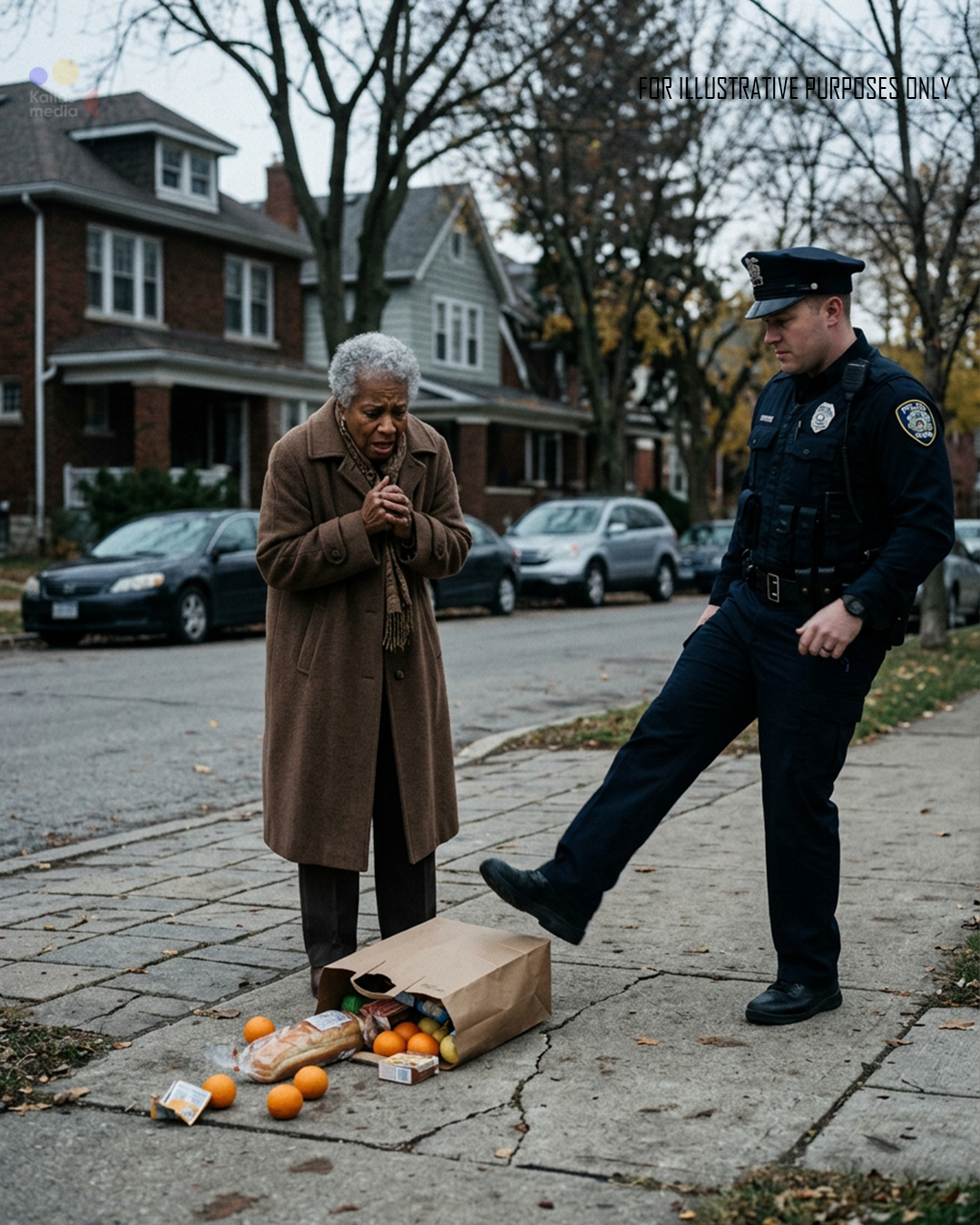
The mid-afternoon sun beat down heavily on the cracked sidewalks of the South Side. The heat radiated off the concrete, making the air shimmer above the street.
Dorothy Washington shifted the brown paper bag in her arms.
It wasn’t too heavy today. Just a loaf of sliced bread, a carton of milk, some fresh greens, and a heavy glass jar of strawberry preserves.
She liked the walk. It kept her moving. It kept her connected to the world.
She was sixty-eight years old. Her knees sometimes argued with the concrete, and her back held a dull ache on rainy days, but she refused to give up her routine.
She liked the familiar, comforting scent of the corner bodega. She liked waving at the old men playing checkers outside the barbershop. She liked the sound of the neighborhood kids playing jump rope on the corner.
This was her home. It had been her home for forty years.
She had raised her son on these streets. She had buried her husband in the cemetery just over the hill.
But lately, things were changing. Fast, and not for the better.
The old brick buildings with their fading murals were being bought up by faceless development groups. Bright, expensive coffee shops with twenty-dollar lattes were replacing family-owned hardware stores.
And with the new money came a new kind of tension. A heavy, suffocating atmosphere.
The police presence had tripled in the last six months. The city called it a “neighborhood revitalization effort.”
The longtime residents just called it an occupation.
Cruisers rolled slowly down the narrow streets like sharks looking for a meal. The officers didn’t walk the beat. They didn’t know anyone’s name. They just watched from behind heavily tinted windows.
They stopped young men for walking too slow. They stopped old men for talking too loud. They made sure everyone knew who really owned the streets now.
Dorothy kept her head down. She didn’t want any trouble. She just wanted peace.
She was a fiercely proud woman. She had a secret that she kept carefully guarded from the aggressive new patrols.
She had raised a son who now sat in the highest office in the state.
Governor Marcus Washington.
Marcus was her pride and joy. A good man. A powerful man.
He constantly begged her to let his state security detail drive her to the store. He begged her to move to a gated community in the affluent suburbs, far away from the sirens and the changing neighborhood.
Dorothy always refused.
She didn’t want a massive black SUV and armed men in suits trailing her to the grocery store. She didn’t want to hide behind tall iron gates like a prisoner of her son’s success.
She just wanted to live her quiet, normal, grounded life.
But as she reached the intersection of 4th and Elm, just two short blocks from her front porch, that quiet life shattered.
The screech of tires cut through the heavy, humid air like a knife.
Dorothy flinched, her shoulders jumping toward her ears.
A black-and-white patrol cruiser whipped around the corner. It didn’t slow down for the stop sign.
It swerved sharply, the front right tire slamming against the curb directly in front of her. The bumper stopped inches from her kneecap.
Dorothy stopped cold.
Her heart gave a hard, painful thump against her ribs. The sudden spike of adrenaline made her fingers tingle.
The cruiser blocked her path entirely, resting illegally in the crosswalk. The engine idled with a low, menacing rumble.
The driver’s side door kicked open violently, hitting the limit of its hinges.
Officer Ryan Miller stepped out into the heat.
He was young, maybe thirty-two, with a tight, military-style haircut and shoulders that looked permanently, aggressively tense.
He didn’t wear his uniform like a public servant. He wore it like armor. The dark blue fabric was tight across his chest, and his heavy black utility belt was loaded with weapons.
He slammed the car door shut. The sound echoed off the brick buildings.
Dorothy tightened her grip on the bottom of her grocery bag. Her knuckles turned a faint white.
She took a half-step backward, giving him space on the sidewalk. She assumed he was responding to a frantic 911 call. She assumed he was about to run past her toward an emergency.
She was wrong.
Miller didn’t run past her. He stopped directly in front of her.
He rested his right hand heavily on his duty belt, right next to the black handle of his radio.
He looked her up and down. His eyes were cold, flat, and full of naked, unchecked contempt.
“ID,” Miller snapped.
No greeting. No explanation. No human decency. Just a barked, aggressive command.
Dorothy blinked. The midday sun was blinding behind his head, making him look like a dark, towering silhouette. She forced herself to look him in the eye.
“Excuse me?” she asked softly, her voice carrying the natural rasp of a woman her age.
“Are you deaf?” Miller took a slow, deliberate step forward. His heavy boots scraped against the concrete. “I said I need to see your ID. Right now.”
The street suddenly felt completely, terrifyingly empty.
The old men at the barbershop were a block away, out of sight. The new coffee shop across the street was closed for afternoon renovations.
It was just her and a man with a badge and a gun.
“Officer,” Dorothy kept her voice perfectly level, falling back on decades of survival instincts. “I am just walking home from the market. I live two blocks away.”
“I didn’t ask for your life story.”
Miller’s jaw tightened. A muscle twitched near his temple. He didn’t like being spoken to calmly. He wanted fear. He wanted submission. He thrived on the panic of the people he stopped.
“You match the description of a suspect in the area,” Miller lied effortlessly. The words rolled off his tongue like a script he had practiced a thousand times in the mirror.
“A suspect?” Dorothy frowned, genuine confusion leaking into her steady voice. “I’m a sixty-eight-year-old woman carrying groceries. I don’t understand.”
“Show me your ID, or I’m taking you in for obstruction.”
The threat hit her like a physical blow to the stomach.
Obstruction.
A manufactured charge. A magic, devastating word that let them do whatever they wanted. It was the catch-all excuse to ruin a day, drain a bank account, or break a body.
Dorothy felt a cold sweat break out on the back of her neck. The heat of the day suddenly felt suffocating.
“My identification is in my purse,” she said slowly, deliberately trying to telegraph her movements so she couldn’t be accused of reaching for anything hidden. “My purse is at the bottom of this grocery bag.”
She shifted the heavy paper bag slightly in her arms. She prepared to bend her stiff knees and set the bag down on the hot sidewalk so she could safely reach inside.
Miller didn’t let her.
Without warning, his arm shot out.
His thick, heavy fingers clamped down on the twisted brown paper at the top of the bag.
Dorothy gasped.
He yanked it violently.
The sheer force of the pull twisted Dorothy’s right shoulder. She stumbled forward, the rough concrete scraping the rubber bottom of her sandals.
She immediately let go of the bag to keep from falling face-first onto the pavement.
Miller stood there, holding the bag dangling in his fist.
He looked at her. He looked at the grocery bag.
He didn’t open it. He didn’t search it for a weapon. He didn’t ask her to pull the purse out.
Then, with a casual, cruel flick of his wrist, he dropped it.
The paper bag hit the concrete with a dull thud.
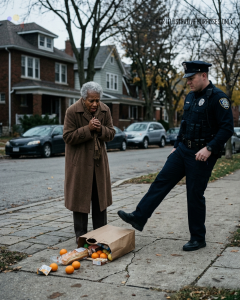
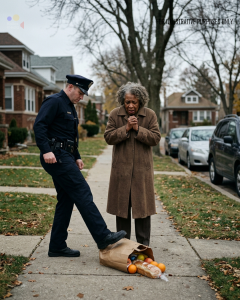
Before Dorothy could even process what was happening, Miller drew his heavy black tactical boot back.
He kicked the bag. Hard.
He put his entire weight behind it, treating the groceries like a soccer ball.
The heavy glass jar of strawberry preserves took the brutal brunt of the impact.
A loud, sickening shatter echoed down the quiet street, sounding horribly like a breaking bone.
The thick paper bag tore wide open, skidding halfway into the busy street.
Glass fragments exploded across the asphalt, glittering dangerously in the harsh afternoon sun.
Thick, dark red jelly splattered violently against the concrete curb, looking terrifyingly like fresh blood.
The loaf of sliced bread tumbled out of the ruined paper, rolling through the dirty, oil-slicked gutter water.
The carton of milk split straight down the middle, a white puddle rapidly expanding and hissing against the hot black pavement.
Dorothy stood completely frozen.
Her hands were empty. Her arms felt strangely light.
She stared at the ruined food.
The bread she was going to toast for dinner tonight. The milk for her quiet morning tea. The preserves she had treated herself to because they were on sale.
Destroyed. In an instant. For absolutely no reason.
A deep, burning humiliation flared hot in her chest. It was quickly, violently followed by a sharp, suffocating spike of pure terror.
She slowly looked up at Officer Miller.
He was smiling.
It wasn’t a friendly smile. It wasn’t even a professional smirk. It was a vicious, predatory grin.
He had intentionally provoked her. He had destroyed her property just to watch it break.
Now, he was waiting for her reaction.
He wanted her to yell. He wanted her to curse at him. He desperately wanted her to reach down for her ruined things, to lower her head so he could establish total dominance.
If she did any of those things, he would hurt her.
Dorothy knew the unspoken rules of the street. She had lived them her whole life. She knew exactly how easily an angry, unchecked cop could turn a shattered jar of jam into a brutal hospital visit.
She clamped her mouth tightly shut. She locked her trembling knees.
She stood perfectly, rigidly still.
The silence stretched out, thick, heavy, and extremely dangerous.
Miller’s smirk slowly faltered. The corners of his mouth turned down.
He didn’t like her silence. He didn’t like her quiet dignity.
To a bully in a uniform, silence felt like defiance. Standing tall felt like a threat.
The air between them crackled with ugly, violent energy. The heat seemed to press in on them from all sides.
“What’s your problem?” Miller suddenly barked, his voice twice as loud, carrying a fake, aggressive edge.
Dorothy didn’t answer. She couldn’t. Her throat was tight with fear. She just looked at him, her dark eyes wide and terrified, but completely steady.
Miller closed the distance between them in one massive, aggressive stride.
He was suddenly entirely inside her personal space.
He towered over her, his broad, vest-covered chest aggressively angled toward her face.
Dorothy could smell the stale, sour coffee on his breath. She could see the faint bead of sweat rolling down his thick red neck. She could feel the heat radiating off his dark uniform.
He reached down and deliberately unclipped the leather retention strap securing his service weapon.
The metal snap sounded like a gunshot in the quiet afternoon air.
Dorothy’s breath caught in her throat.
“I told you to calm down!” Miller screamed at the top of his lungs, his face contorting into a mask of fake, exaggerated panic.
He was acting.
He was performing for an invisible audience. For anyone who might be watching from the brick apartment windows above. For the microphone on his body camera.
“Stop acting aggressive!” he yelled, waving his left hand defensively in the air while his right hand hovered dangerously over the exposed handle of his gun.
Dorothy’s blood ran completely cold. The world tilted sideways.
Aggressive.
She hadn’t moved a single muscle. She hadn’t spoken a single word since he destroyed her food. She was barely even breathing.
But he was building the narrative. Right here on the hot sidewalk.
He was laying the groundwork for a violent takedown. He was planting the seeds for his incident report.
Suspect became verbally aggressive. Suspect lunged. Suspect refused to comply with lawful orders.
Dorothy felt a massive wave of absolute, crushing helplessness crash over her.
She was a sixty-eight-year-old widow. She was standing in a puddle of spilled milk and shattered glass.
And this man was preparing to ruin her life, or end it entirely, simply because he was bored and she was there.
“I’m not doing anything,” Dorothy whispered, her voice finally cracking, trembling with a fear she couldn’t hide anymore.
“Stop resisting!” Miller roared back, stepping even closer.
He aggressively shoved his thick forearm toward her collarbone, forcing her to stumble back another step.
Her back hit the cold metal side of the police cruiser.
There was nowhere left to back up.
She was trapped against the heavy car, staring into the dead eyes of a man who held all the power in the world, and fully intended to use every drop of it to break her.
The metal of the patrol car was burning hot against Dorothy’s back.
It baked through the thin fabric of her floral blouse.
She didn’t dare move away from it.
Officer Ryan Miller was standing inches from her face.
His chest heaved. He was breathing hard, manufacturing an adrenaline rush for a threat that didn’t exist.
His right hand was wrapped tightly around the grip of his gun. Not drawing it. Just holding it.
Waiting for a reason.
“I said, keep your hands where I can see them!” Miller screamed.
His voice echoed sharply off the brick facades of the apartment buildings.
Dorothy’s hands were empty. They were resting flat against her sides.
“My hands are visible, Officer,” she said. Her voice was barely a whisper, but it was steady.
“Don’t you talk back to me! Get your ID! Now!”
A direct, contradictory order.
Keep your hands where I can see them.
Reach for your ID.
It was the oldest trap in the book.
If she moved her hands up, he would say she was refusing to identify herself.
If she reached down toward the spilled groceries where her purse lay in the puddle of milk, he would say she was making a sudden movement. He would say he feared for his life.
Dorothy was sixty-eight years old. She knew exactly how this worked.
She had watched boys on this very street bleed out on the asphalt because they panicked. Because they tried to follow contradictory orders and made the wrong guess.
She wasn’t going to guess.
“Officer,” Dorothy said, keeping her dark eyes locked on his. “If I reach for my purse, I have to move my hands.”
“Stop being difficult!” Miller barked, his face turning a dark, ugly shade of red. “You are failing to comply!”
He was losing the narrative. He could feel it.
He needed her to cry. He needed her to yell. He needed her to swing her arms in frustration so he could justify a physical takedown.
Her absolute stillness was ruining his script.
Up above, a shadow moved.
Dorothy caught it out of the corner of her eye.
Second floor. The faded green curtains of the Higgins apartment.
Old Mr. Higgins was standing at the window. He was watching.
Across the street, the door to the hardware store cracked open.
The owner, a man named Elias who had known Dorothy for twenty years, stepped out onto the curb.
He took one look at the police cruiser. He saw Miller’s hand resting on his gun.
Elias froze.
Nobody crossed the street. Nobody yelled for the officer to stop.
Dorothy didn’t blame them.
Interfering with a patrol officer in this neighborhood was a death sentence. Or at least a guaranteed trip to county jail on a fabricated obstruction charge.
They were trapped in the same system she was. They were hostages in their own homes.
Miller noticed her eyes darting away.
“Keep your eyes on me!” he yelled, stepping sideways to block her line of sight.
He kicked at the pile of ruined groceries again.
His heavy boot caught the shattered remains of the strawberry preserves jar. A jagged piece of glass skittered across the concrete and hit Dorothy’s sandal.
“You’re making a huge mistake, lady,” Miller hissed. His voice dropped the theatrical volume. This was just for her.
“I asked for your ID. You’re giving me attitude. You think you’re special?”
“I think I’m walking home,” Dorothy said.
Miller’s jaw flexed. He hated her.
He hated that she wasn’t shrinking. He hated the quiet dignity in her posture.
He was used to the new residents of the neighborhood. The affluent ones who either deferred to his badge out of shared class solidarity, or the young locals who ran because they knew they couldn’t win.
Dorothy was doing neither.
She was just enduring him.
“Alright,” Miller said, nodding slowly. “You want to do this the hard way.”
He pulled his hand off his gun and reached for the radio on his shoulder.
“Dispatch, I’ve got a non-compliant suspect at 4th and Elm. Refusing to ID. Acting erratic.”
Acting erratic.
The words hung in the hot air.
It was a lie so blatant, so completely detached from reality, that it took Dorothy’s breath away.
“I am not erratic,” Dorothy said.
“Step away from the vehicle!” Miller suddenly shouted, shoving his hand forward.
He didn’t wait for her to move.
He closed the two inches between them and intentionally drove his broad shoulder into hers.
It was a hard, aggressive bump.
The impact knocked Dorothy off balance.
Her shoulder slammed against the side mirror of the cruiser. Pain flared hot down her arm.
She let out a sharp gasp and instinctively raised her right hand to catch herself against the car door.
That was all he needed.
Movement.
“Don’t you touch me!” Miller roared.
He grabbed her right wrist.
His grip was brutal. Thick fingers digging viciously into her thin, aging skin.
He twisted her arm down and wrenched it hard behind her back.
A sharp, terrifying pop echoed in Dorothy’s shoulder joint.
Tears instantly pricked the corners of her eyes. The pain was blinding.
“Officer, please! You’re hurting me!”
“Stop resisting!” he screamed, yanking her arm up higher.
He shoved her forward. Her chest hit the hot trunk of the cruiser.
The metal burned right through her shirt.
Her cheek was pressed flat against the paint.
She could smell the harsh exhaust. She could see her own ruined groceries scattered on the street just a few feet away.
With his free hand, Miller reached to the back of his duty belt.
The harsh, metallic rattle of steel handcuffs broke the silence of the neighborhood.
It was happening.
He was actually doing it.
He was arresting a sixty-eight-year-old widow for dropping a bag of groceries.
“You are under arrest,” Miller sneered, his breath hot and sour against her ear.
He snapped the first cold steel cuff roughly around her right wrist. He clamped it down tight. Too tight. It instantly bit into her bone.
“For what?” Dorothy choked out, her voice finally breaking under the sheer physical pain.
Miller smiled. He had won. He had finally broken her calm.
He grabbed her left arm and wrenched it violently behind her back to meet the right.
The second cuff snapped shut.
“For assaulting a police officer,” Miller said.
The trap had closed.
Dorothy’s cheek burned against the hot metal of the trunk.
Her wrists throbbed. The steel cuffs were unyielding. Every time she took a breath, the metal dug deeper into her skin.
Assaulting an officer.
The words looped in her mind like a broken record.
It was a felony.
It was a charge that carried years in prison. It was a charge that ruined lives, bankrupted families, and destroyed reputations.
And he had built it out of thin air in less than three minutes.
Miller leaned his heavy weight against her back. He was deliberately making it hard for her to breathe.
He was enjoying this.
He patted her down roughly. His hands slapped against her pockets, checking for weapons he knew didn’t exist.
“Where’s your ID now, huh?” he mocked.
He didn’t let her answer. He kicked her ankles apart, forcing her to spread her legs uncomfortably wide on the concrete.
“I said, where is it?”
“In… in my purse,” Dorothy gasped. The pressure on her lungs was suffocating. “On the ground.”
Miller stepped back, leaving her pressed awkwardly against the car.
He walked over to the spilled groceries.
He didn’t bend down.
He used the toe of his boot to kick through the shattered glass, the squished bread, the puddle of milk.
He found the strap of her small, worn leather purse.
He hooked it with his foot and flipped it up, catching it in one hand.
He unzipped it roughly.
He dumped the entire contents directly onto the hood of his patrol car.
Lipstick. Packets of tissues. A worn leather wallet. Keys. Peppermints.
The small, quiet details of a grandmother’s life scattered like trash across the police cruiser.
Miller grabbed the wallet. He flipped it open and pulled out her driver’s license.
He looked at the name.
Dorothy Washington.
It didn’t register.
To him, it was just another name. Just another face to process through the system.
He didn’t recognize her address. He didn’t care.
He tossed the wallet carelessly back onto the hood.
“Alright, Dorothy,” he said, using her first name with deliberate, insulting familiarity. “You’re going to take a ride.”
Dorothy closed her eyes.
A single tear slipped down her cheek, leaving a wet trail against the hot metal of the car.
She wasn’t crying because of the pain in her shoulder, though it was excruciating.
She wasn’t crying because of the tight handcuffs.
She was crying from the absolute, crushing weight of the humiliation.
She had lived a good life.
She had paid her taxes. She had gone to church. She had baked pies for the neighborhood block parties.
She had raised a son who commanded the state police.
And none of it mattered.
Right here, right now, on the pavement of her own neighborhood, she was nothing.
She was just a body to be manhandled. A quota to be filled. A power trip to be satisfied.
The uniform stripped her of her humanity.
Miller didn’t see a mother. He didn’t see an elder.
He saw a target that couldn’t fight back.
Dorothy turned her head slightly, peeling her cheek off the trunk.
She looked at the street.
The neighborhood was still watching.
More curtains were pulled back now.
A young woman on the third floor was holding up her phone, recording through the glass.
Two teenage boys had stopped their bicycles at the end of the block. They were watching in stunned silence.
They were all witnessing her degradation.
They were learning the lesson Miller wanted to teach.
Look what I can do to the sweet old lady who lives down the street. Imagine what I can do to you.
“Move,” Miller barked.
He grabbed her heavily by the bicep.
He pulled her away from the trunk.
Dorothy stumbled. Her knees were shaking. The sudden movement sent a fresh wave of agony through her twisted shoulder.
Miller didn’t catch her. He just dragged her upright.
He marched her toward the rear passenger door of the cruiser.
“Watch your head,” he said mechanically, opening the door.
He pushed her down. He forced her into the cramped, hot, plastic-lined back seat of the patrol car.
The smell of stale sweat and cheap disinfectant hit her instantly.
It was the smell of a cage.
Miller slammed the heavy door shut.
The lock engaged with a loud, electronic clunk.
Dorothy was trapped inside.
There were no door handles on the inside. The windows were heavily tinted and covered with a thick steel mesh.
The heat inside the car was already stifling.
She sat awkwardly sideways. Her hands were cuffed so tightly behind her back that she couldn’t lean against the seat.
Her shoulder throbbed with a dull, sickening rhythm.
Outside, Miller was taking his time.
He casually swept her dumped purse contents back into the bag.
He threw the purse into the front seat.
He left the ruined groceries, the broken glass, and the spilled milk right there on the sidewalk.
A permanent stain on the concrete. A warning to anyone who walked past.
Dorothy looked out through the steel mesh.
The world outside felt a million miles away.
She felt a cold, hard knot of fear settle deep in her stomach.
She was in the system now.
Once the doors of a police cruiser lock, reality bends.
Miller’s word would become the official truth. His lies would become legal facts.
She would be booked, fingerprinted, and thrown in a holding cell.
She thought about Marcus.
Her son. The Governor.
She had specifically told him not to send his security detail today.
She had told him she would be fine.
I’m just going to the corner, Marcus. Stop worrying.
She closed her eyes and let her head rest against the hard plastic divider.
She prayed he wouldn’t find out like this.
She prayed she wouldn’t have to call him from a dirty jail phone, begging him to bail her out.
Miller finally got into the driver’s seat.
The suspension of the heavy car dipped under his weight.
He looked at her through the rearview mirror.
He was still grinning.
He reached for the gear shift.
He was ready to pull away. He was ready to take her down to the precinct and file his fabricated assault charge.
He had won.
The neighborhood was his. The streets belonged to him.
But as Miller’s hand gripped the shifter, a sound cut through the low rumble of the cruiser’s engine.
It wasn’t a siren.
It wasn’t a shout.
It was the heavy, aggressive roar of a massive V8 engine, winding up tight and fast.
Miller frowned.
He looked up into his side mirror.
Dorothy turned her head, straining against her painful shoulder to look out the back window.
A vehicle had just turned the corner.
It wasn’t slowing down for the stop sign. It wasn’t yielding to the narrow street.
It was tearing down the asphalt, headed straight for them.
It was a massive, heavily armored, black SUV.
The windows were tinted pitch black.
Hidden strobe lights embedded in the grill were flashing a violent, rapid sequence of red and blue.
The SUV wasn’t just driving down the street.
It was hunting.
And it was aiming directly at the rear bumper of Officer Miller’s patrol car.
The heat inside the back of the cruiser was a living, suffocating thing.
The thick plexiglass divider trapped the hot air, turning the tiny space into an oven. There was no airflow. There were no door handles.
Dorothy sat awkwardly on the hard plastic bench. She had to sit sideways. The steel handcuffs were cutting off the circulation to her hands.
Her right shoulder throbbed with a deep, sickening ache.
Every time she inhaled, her ribs shifted, sending a fresh spike of pain through her twisted joints. She closed her eyes and focused on the floorboard. It was sticky. Covered in dirt and God knows what else.
In the front seat, Officer Ryan Miller was perfectly comfortable.
The air conditioning blasted from the dashboard vents, rustling the collar of his uniform shirt.
He was humming.
It was a low, casual, off-key hum. The sound of a man who had just finished a day’s work and was thinking about what to grab for dinner.
He reached over and tapped the screen of his mounted laptop. He was starting his report.
Suspect became verbally hostile. Suspect exhibited erratic behavior. Suspect resisted lawful detention.
He was typing away her freedom. He was writing a fiction that the system would treat as gospel.
“Alright, Dorothy,” Miller said over his shoulder, not looking back. His voice was muffled by the thick plastic divider. “Let’s go get you processed.”
He reached for the gear shift.
He didn’t make it out of park.
A deep, heavy vibration rattled the windows of the cruiser.
It wasn’t the sound of another police car. It wasn’t the rattle of a passing delivery truck. It was the low, aggressive growl of a massive V8 engine, running hot and fast.
The sound bounced off the brick apartment buildings, drowning out the ambient noise of the city block.
Miller frowned. He paused, his hand still resting on the shifter.
He checked his side mirror.
A vehicle was tearing down the narrow street. It wasn’t slowing down for the intersection. It wasn’t yielding.
Dorothy turned her head, wincing as her shoulder ground against the plastic seat back. She strained to look out the rear window through the heavy steel mesh.
A massive, blacked-out Chevrolet Suburban was bearing down on them.
It looked like a tank rolling down a civilian street. The paint was spotless, gleaming like dark glass under the afternoon sun. The windows were tinted so deeply they looked like solid obsidian.
It wasn’t a civilian vehicle.
Hidden behind the dark front grille, a rapid, blinding sequence of red and blue strobe lights flashed violently.
No sirens. Just the blinding lights and the roar of the engine.
Miller’s eyes widened in the rearview mirror.
“What the hell?” he muttered.
The Suburban didn’t just pull up behind him. It swerved sharply, crossing the double yellow line.
The heavy armored bumper stopped less than six inches from the back of the patrol car.
It completely blocked the cruiser in. There was nowhere for Miller to back up. There was no way to pull out into traffic.
The SUV had pinned him against the curb.
Miller’s face instantly flushed dark red.
His territory was being challenged. Someone was driving aggressively on his streets. Someone was blocking his exit.
He didn’t care about the flashing strobes in the grille. Local unmarked cars didn’t pull moves like this.
He threw the cruiser into park.
He killed his own engine, unbuckled his seatbelt, and violently kicked his door open.
“Hey!” Miller yelled, stepping out into the brutal heat.
He rested his right hand heavily on his duty belt, right next to his gun. It was his default stance. Intimidation first. Questions later.
“Hey! Back that vehicle up right now! You’re blocking a police cruiser!”
The black SUV idled. The engine purred with terrifying, mechanical precision.
Nobody answered him.
The heavy tint of the windshield made it impossible to see the driver.
Miller took two aggressive steps toward the hood of the Suburban. He puffed out his chest, making himself as wide as possible.
“I said move the damn vehicle! Are you deaf? Back it up!”
The street, which had been buzzing with nervous whispers from watching neighbors, suddenly went dead silent.
Old Mr. Higgins, watching from his second-floor window, pressed his hands flat against the glass.
The teenage boys on bicycles at the end of the block stopped completely.
Even the wind seemed to die down.
Then, the doors of the Suburban opened.
They opened in absolute, terrifying unison. The driver’s side and the front passenger side popped open at the exact same second.
Two men stepped out onto the hot asphalt.
They were not local cops. They were not neighborhood watch.
They were large men wearing perfectly tailored, dark charcoal suits. Their ties were straight. Their shoes shone. Small, coiled clear tubes disappeared behind their ears.
They didn’t carry themselves like men who needed to yell to get respect. They carried themselves like men who ended lives for a living.
State Police. Executive Protection Unit.
Miller stopped in his tracks.
His aggressive stride faltered. The manufactured anger on his face slipped, replaced by a flicker of genuine confusion.
He looked at the two men.
They didn’t look back at him. They didn’t even acknowledge his existence.
They simply stepped out, scanned the rooftops, scanned the street, and took up flanking positions by the rear doors of the SUV.
Miller swallowed hard. His hand slipped away from his duty belt.
He suddenly felt very stupid standing there yelling in his sweaty, tight uniform.
“Look,” Miller tried again, his voice dropping an octave, losing its bark. “I have a suspect in custody. You need to clear the right of way.”
The detail agents remained completely silent.
Inside the sweltering back seat of the cruiser, Dorothy’s breath caught in her throat.
She knew those suits.
She knew that vehicle.
She closed her eyes. Her chest heaved against the tight handcuffs. No, she thought. Not here. Not like this.
The heavy rear door of the Suburban clicked open.
A third man stepped out into the harsh afternoon sun.
He didn’t wear a uniform. He wore a sharp navy blue suit, the jacket unbuttoned, revealing a crisp white shirt.
He was forty-five years old. Tall. Broad-shouldered.
He possessed a face that was printed on thousands of campaign posters across the state. A face that commanded press conferences and signed legislation into law.
Governor Marcus Washington.
He stepped onto the cracked concrete of the South Side.
He didn’t look at the broken glass on the sidewalk. He didn’t look at the puddle of spilled milk baking in the sun. He didn’t look at the old men watching from the barbershop.
His eyes locked instantly onto the black-and-white patrol car.
More specifically, he looked at the steel mesh of the rear window.
Miller stared at the man.
The officer’s brain short-circuited. He recognized the face. Everyone in the state recognized the face.
But it didn’t make sense. The Governor didn’t come to the South Side on a Tuesday afternoon. The Governor didn’t roll up on random traffic stops.
“Governor?” Miller said. The word sounded weak. Stupid. It hung in the air like a bad joke.
Marcus didn’t look at him.
He walked forward. His stride was long, heavy, and purposeful.
The two detail agents moved with him, a flawless, silent shadow.
Miller suddenly realized the Governor was walking directly toward him. The officer’s panic spiked. He tried to straighten his posture. He tried to look official.
“Governor Washington, sir,” Miller stammered, stepping into Marcus’s path. “Officer Miller, local precinct. We have a situation under control here. Just a non-compliant—”
Marcus didn’t slow down.
He didn’t even blink.
He simply walked straight through Miller’s personal space. The lead detail agent seamlessly stepped up, placing a heavy, immovable hand squarely against Miller’s chest, shoving the officer aside like a piece of useless furniture.
Miller stumbled back, his boots scraping against the concrete.
Marcus walked right past him.
He stopped at the rear door of the patrol cruiser.
He leaned down. He placed both of his hands flat against the tinted glass. He cupped his face to block out the glare of the sun.
He looked inside.
He saw the sweltering heat. He saw the cramped, dirty plastic bench.
He saw the floral blouse.
He saw the steel handcuffs cutting deep into thin, aging wrists.
He saw the dark red bruise already blooming across the frail skin.
He saw his mother.
Dorothy looked back at him through the steel mesh. Her eyes were wide, filled with a mixture of profound relief and crushing, agonizing shame.
She looked away. She couldn’t bear to look her son in the eye while locked in a cage like an animal.
Marcus stood up.
The air around him seemed to drop ten degrees.
The politician vanished. The polished, diplomatic smile that won elections was entirely gone.
What was left was a son who had just found his mother locked in a police car, battered and bleeding on her own street.
He turned around.
He looked at Miller.
It wasn’t a look of anger. It was a look of absolute, terrifying destruction.
Miller felt the blood drain completely out of his face. His mouth went completely dry. He looked from the Governor, to the back of the cruiser, and back to the Governor.
The gears in his head finally clicked.
The name on the ID. Washington.
The destroyed groceries. The brutal takedown. The handcuffs.
Miller’s stomach dropped out from under him. A cold, paralyzing terror seized his spine.
He opened his mouth to speak. To explain. To lie.
Marcus stepped forward. He closed the distance, standing inches from the officer’s face.
He didn’t yell. He didn’t raise his voice.
He spoke with a low, deadly quiet that carried over the entire street.
“Take your hands off my mother.”
The words hung in the dead, sweltering air.
Take your hands off my mother.
Miller’s brain simply refused to process the information. It was like trying to swallow a stone. He stared at the Governor, his mouth slightly open, a bead of sweat tracing a slow, cold path down his spine.
He looked at the woman locked in the back of his cruiser.
Then he looked back at the man standing in front of him.
The facial structure. The eyes. The quiet, dignified posture.
It was true.
The absolute worst-case scenario wasn’t just happening. It was standing directly in front of him, staring a hole through his chest.
Marcus didn’t wait for the officer to find his voice.
He stepped around Miller. He reached for the handle of the rear passenger door. He pulled it.
The handle clicked uselessly. The door was locked from the front console.
Marcus let go of the handle. He turned around slowly.
He didn’t yell. He didn’t curse. He simply extended his right hand, palm up.
“Keys.”
The single word cracked like a whip across the quiet street.
Miller flinched. His right hand instinctively twitched toward his duty belt, a muscle-memory reaction to being commanded.
The lead detail agent instantly shifted his weight. His jacket parted slightly, revealing the dark, matte-black grip of his shoulder-holstered weapon. His eyes locked onto Miller’s right hand.
It wasn’t a threat. It was a promise.
If Miller touched his belt, he wouldn’t live to unclip his holster.
Miller froze. He raised both hands to chest height, palms out, his chest heaving with shallow, panicked breaths.
“Sir, I—” Miller stammered, his voice cracking horribly. “The door is electronic. I have to unlock it from the front seat.”
Marcus didn’t move his hand. He just stared.
“Do it,” Marcus said quietly.
Miller stumbled over his own heavy boots. He moved toward the open driver’s side door. His hands were shaking so badly he slapped the doorframe twice before he could find the internal lock switch.
Clack.
The heavy electronic deadbolts disengaged.
Marcus immediately opened the rear door.
A wave of suffocating, stale heat rolled out of the tiny plastic cage. It smelled of cheap disinfectant, old sweat, and burning rubber.
Dorothy was pressed against the far side of the plastic bench. Her knees were drawn together. Her head was bowed.
“Mama,” Marcus said.
His voice broke. The Governor vanished entirely. He was just a boy from the South Side who had failed to protect his mother.
He reached into the sweltering heat. He gently gripped her left shoulder.
Dorothy winced. A sharp hiss of pain escaped her lips.
Marcus pulled his hand back as if he had touched a hot stove. He looked at her shoulder. The floral fabric was stretched tight over an unnatural angle.
He leaned deeper into the car. He saw her arms forced violently behind her back.
He saw the thick steel of the heavy-duty police handcuffs biting deeply into her frail wrists. The metal was locked down to the last possible notch. The skin around the steel was already turning a dark, mottled purple.
Blood circulation was entirely cut off. Her hands were swelling.
A cold, terrifying rage settled over Marcus’s face. It was the kind of anger that didn’t scream. It was the kind that destroyed careers, dismantled lives, and burned things to the ground.
He backed out of the car. He turned to Miller.
“Take them off,” Marcus said.
Miller swallowed hard. His throat clicked audibly.
“Governor, please listen,” Miller pleaded, his voice rising in pitch, desperate to build a bridge of authority between them. “I was responding to a situation. She was entirely non-compliant. I had to secure the scene.”
Marcus took one slow step forward.
“Take. The cuffs. Off.”
Miller scrambled to the back of his duty belt. He fumbled with his small leather key pouch. His thick fingers were useless. He dropped the small silver key on the hot pavement.
He cursed under his breath, knelt down, and snatched it up.
He moved to the open door. He reached inside.
“Don’t touch her roughly,” Marcus warned, his voice a low, gravelly hum.
Miller nodded frantically. He leaned in, his hands shaking violently as he inserted the tiny key into the first steel cuff.
Click.
The heavy metal jaw swung open.
Dorothy let out a ragged breath. Her right arm fell forward, dead and heavy. She couldn’t lift it.
Miller unlocked the second cuff.
Marcus immediately stepped in, physically boxing Miller out of the way. He knelt beside the open door and gently took his mother’s swollen hands in his own.
He rubbed her wrists, trying to work the blood back into her purple fingers.
“I’m okay, Marcus,” Dorothy whispered. Her voice was raspy. She refused to cry in front of the officer, but a single tear had already tracked through the dust on her cheek.
“I know, Mama. I know you are,” Marcus said softly.
He helped her slowly shift her weight. He guided her out of the suffocating heat of the patrol car.
When her sandals touched the pavement, she stumbled slightly. The adrenaline crash was making her dizzy. Marcus caught her under the arm, supporting her full weight.
He led her two steps away from the cruiser, resting her gently against the cool, dark metal of his armored Suburban.
The lead detail agent immediately stepped between Dorothy and the rest of the street, shielding her from view.
Marcus turned back to face the patrol car.
Miller was standing by the open door. He was holding the empty steel handcuffs in his hands. He looked like a man who had just woken up on the edge of a cliff.
The panic was fully setting in. The arrogant smirk was entirely gone.
He needed to fix this. He needed the Governor to understand the reality of police work. He needed to spin the narrative before the silence became permanent.
“Sir, you have to understand,” Miller started, raising his voice so his body camera would catch the audio clearly. He was playing for the official record now. “I did not know who she was. She refused to identify herself.”
Marcus crossed his arms. He didn’t interrupt.
Miller took the silence as an invitation to keep digging.
“I gave her a lawful order to provide ID. She became verbally hostile. She started waving her hands. She was acting erratic.” Miller pointed to the brown paper bag lying in the street. “She threw her groceries at me, sir. She was creating a public disturbance.”
It was a practiced lie.
It was the same lie he had used a dozen times before. The same lie that had put young men in jail and old men in the hospital.
It was a lie that relied entirely on the fact that a badge always beat a civilian in a courtroom.
Marcus looked down at the street.
He looked at the puddle of milk baking into the black asphalt.
He looked at the squished loaf of white bread.
He looked at the shattered glass jar, the dark red strawberry preserves splattered across the concrete curb like a violent crime scene.
“She threw her groceries at you,” Marcus repeated flatly.
“Yes, sir,” Miller nodded quickly, gaining a fraction of confidence. “She lunged. I had to use minimal force to subdue her for my own safety. It’s standard protocol.”
Marcus didn’t argue. He didn’t call the officer a liar.
He slowly uncrossed his arms. He looked past Miller. He looked at the neighborhood.
The street was lined with people now.
They weren’t hiding behind curtains anymore. They were standing on their front porches. They were standing on the sidewalks.
Old Mr. Higgins had come down his front stairs.
Elias, the hardware store owner, was standing right on the edge of the curb.
They had all heard Miller’s lie. They all knew exactly what really happened. But they were silent. They were waiting to see if the system was going to protect its own, just like it always did.
Marcus looked back at the intersection.
He looked at the old brick bodega on the corner.
He noted the faded green awning. He noted the cigarette advertisements in the window.
And he noted the small, black dome camera mounted securely to the brick wall, pointed directly down the length of the sidewalk. Pointed directly at them.
Marcus didn’t say a word. He just pointed at the camera.
The second detail agent, a tall man named Harris, followed the Governor’s finger. He nodded once.
Harris turned and walked quickly down the sidewalk toward the bodega.
Miller followed the agent’s path. He looked at the camera.
The remaining color drained completely from his face. He looked like a corpse.
“Governor,” Miller stepped forward, his voice suddenly desperate, dropping the official tone. “Governor, listen to me. This neighborhood is dangerous. We have a job to do out here. You know how these people get.”
Marcus turned his head slowly. The look in his eyes was so profoundly cold it made Miller stop dead in his tracks.
“These people?” Marcus asked softly.
Miller realized his mistake too late.
“I mean, the element,” Miller scrambled. “The crime rate. We’re just trying to keep the streets clean.”
“You kicked a sixty-eight-year-old woman’s groceries into the street,” Marcus said, his voice carrying clearly to the watching neighbors. “And then you locked her in a cage.”
“She was resisting!” Miller insisted, his voice cracking. He was clinging to the script. It was his only lifeboat.
“We’ll see,” Marcus said.
They stood there in silence.
The heat baked the street. The red and blue strobe lights from the Suburban flashed rhythmically against the brick walls, painting Miller’s pale face in alternating bursts of harsh light.
Two full minutes passed. It felt like two hours.
The bodega door chimed open.
Agent Harris walked out. He wasn’t holding a gun. He was holding a sleek, silver tablet.
He walked back down the sidewalk. The crowd parted for him silently.
Harris approached the Governor. He tapped the screen twice.
“Bodega owner was very cooperative, sir,” Harris said smoothly. “High-definition feed. The angle is perfect.”
Marcus nodded.
“Put it on the hood,” Marcus instructed.
Harris walked over to Miller’s patrol cruiser. He brushed aside Dorothy’s spilled wallet and tissues. He set the tablet directly in the center of the hot metal hood, propping it up against the windshield wiper.
“Officer Miller,” Marcus said. “Step over here.”
Miller didn’t want to move. His boots felt like they were made of lead.
But the lead detail agent stepped up behind him, offering a silent, physical incentive.
Miller shuffled to the front of his own car. He stood next to the Governor.
Marcus reached out and tapped the play button.
The video filled the screen. Crisp, clear, undeniable reality.
There was no audio, but none was needed. The violence spoke entirely for itself.
They watched Dorothy walking slowly down the sidewalk, minding her own business.
They watched the cruiser whip around the corner, running the stop sign, nearly hitting her knees.
They watched Miller jump out, aggressive from the very first second.
Miller stared at the screen. He watched himself.
He watched his digital self snatch the brown paper bag violently from the old woman’s arms.
He watched the bag drop.
And then, in high-definition, he watched himself draw his leg back and brutally kick the groceries into the street.
The jar of preserves shattered silently on the screen.
They watched the manufactured trap. The sudden closing of distance. The heavy forearm shove against a frail woman’s collarbone. The brutal twisting of her arm.
There was no erratic behavior. There were no thrown groceries. There was no lunging.
There was only a bully terrorizing a grandmother for sport.
The video ended. The screen went black.
The silence on the street was absolute.
Miller stared at the black reflection of the tablet. He could see his own face in the glass. He looked weak. He looked pathetic.
His entire career, his entire defense, his entire twisted worldview, had just evaporated in forty-five seconds of silent footage.
“She was hostile,” Marcus said quietly, repeating Miller’s official report.
Miller didn’t answer. He couldn’t. His throat was closed tight.
“She was erratic,” Marcus continued, his voice perfectly even, twisting the knife.
Miller looked down at his boots.
“You had to secure the scene,” Marcus said.
Marcus picked up the tablet. He handed it back to Agent Harris.
He turned to face the officer.
Miller tried to look up, but the sheer weight of the Governor’s stare forced his eyes back down to the pavement. He was stripped bare. He had no shield, no union rep, no fabricated police report to hide behind.
He was just a violent man who had finally picked the wrong victim.
“Your shift is over, Officer Miller,” Marcus said.
The silence on the sidewalk was thick, heavy, and absolute.
Officer Ryan Miller looked down at the hot hood of his patrol car. He didn’t look at the Governor. He couldn’t. His chest was heaving under his tight ballistic vest, his breath coming in short, ragged gasps.
The power had completely drained out of him. The uniform that had felt like impenetrable armor five minutes ago now felt like a target painted on his back.
“Governor,” Miller whispered. His voice was cracked, stripped of all its previous authority. “Sir, please. I have a family. I’ve been on the force for eight years. I’ve never had a disciplinary infraction.”
Marcus Washington didn’t look at him. He stood with his hands slid deep into his suit pockets, his face a cold, unreadable mask.
“Eight years,” Marcus repeated flatly. “And how many times did the camera miss it?”
Miller didn’t answer. He couldn’t.
Before he could try to spin another excuse, a sharp, wailing siren cut through the humid afternoon air.
Two blocks away, a second local police cruiser rounded the corner. It was responding to Miller’s earlier frantic radio call about a “non-compliant suspect.” The tires shrieked against the asphalt as it sped down Elm Street, its red and blue lights flashing against the brick apartment buildings.
The local cruiser pulled up sharply on the opposite side of the street.
The doors flew open, and a heavy-set sergeant with graying hair and a thick mustache stepped out. His name tag read Sgt. Kowalski. He had his hand on his holster, his eyes scanning the scene aggressively as he walked toward the parked cars.
“Miller!” Kowalski yelled, his voice booming across the asphalt. “What do we got? Who’s the—”
Kowalski stopped dead in his tracks.
He looked at the massive black SUV blocking Miller’s car. He looked at the two large men in tailored gray suits standing in flanking positions, their hands resting near their chests.
Then he looked at the man standing next to Miller.
Kowalski’s hand slowly dropped away from his holster. His aggressive posture melted instantly. He was an old-timer; he knew the faces of power in this city better than anyone.
“Governor Washington?” Kowalski stammered, stepping into the street. He quickly adjusted his uniform hat, his face turning a pale, nervous shade of white. “Sir. I didn’t realize… what’s going on here?”
Marcus turned his head slowly to face the local sergeant.
“Sergeant,” Marcus said, his voice carrying a dangerous, quiet weight. “Your officer here just arrested a citizen on a completely fabricated charge. He assaulted her, destroyed her property, and locked her in the back of a sweltering cruiser.”
Kowalski blinked. He looked at Miller, whose head was bowed so low his chin was nearly touching his chest. Then he looked over at the black SUV, where Dorothy was resting against the side panel, her arm hanging limply, her wrists bruised and swollen.
“Sir, there must be a misunderstanding,” Kowalski said, trying to find a professional footing. “Officer Miller is a good cop. If a suspect was resisting—”
“There is no misunderstanding,” Marcus cut him off. The words were quiet, but they slammed into the conversation like a brick wall. “We have the entire encounter on high-definition video from the bodega on the corner. Your officer lied on the radio. He lied to my face. And he used his badge to terrorize an innocent elderly woman.”
Kowalski swallowed hard. He looked at the silver tablet still resting on the hood of the cruiser. He didn’t need to see the video. He could see the absolute ruin written across Miller’s face.
“Who… who is the citizen, sir?” Kowalski asked, his voice dropping to a cautious whisper.
Marcus didn’t blink. “She is my mother.”
The words hit the local sergeant like a physical blow. Kowalski actually took a step back, his eyes widening as he looked over at Dorothy.
“Oh,” Kowalski whispered.
The entire street seemed to hold its breath.
The crowd of neighbors on the sidewalks had grown larger now. Word had spread fast through the apartment blocks. People were coming out of their front doors, standing on the stoops, watching the unfolding drama. They saw the local sergeant arrive, and they saw him immediately shrink in front of the Governor.
Marcus turned away from Kowalski and looked at the lead detail agent, Harris.
“Call the State Police Superintendent,” Marcus instructed. “Tell him I want a containment unit here immediately. Tell him to send the regional captain.”
“Already on it, sir,” Harris replied, tapping his earpiece. “They’re four minutes out.”
Miller looked up, his eyes wide with pure panic. “Governor, please. Don’t do this. Let the local precinct handle it. We can do an internal review. We can resolve this administratively.”
An internal review.
Everyone on the street knew what that meant. It meant a stack of paperwork that sat on a desk for six months. It meant a paid administrative leave while the union lawyers found a loophole. It meant the story fading away until the public forgot, allowing the bully to put his uniform back on and return to the same streets.
“No,” Marcus said. “The local precinct isn’t touching this.”
Four minutes later, the high-pitched, piercing shrieks of state trooper sirens echoed from the main avenue.
Three white-and-gold State Highway Patrol cruisers ripped around the corner in tight formation. They didn’t park across the street; they pulled directly onto the sidewalk and the curb, completely surrounding Miller’s local patrol car and Kowalski’s vehicle.
The doors opened, and four state troopers in wide-brimmed campaign hats and immaculate grey uniforms stepped out. They were led by a tall, stern-looking captain with silver bars on his collar.
The captain walked straight to Marcus, completely ignoring the local officers. He offered a sharp, crisp salute.
“Governor Washington,” the captain said. “Captain Vance, State Police. We received the call. What are your orders, sir?”
Marcus pointed a single, steady finger at Officer Ryan Miller.
“This officer has committed aggravated assault, official misconduct, and filing a false police report,” Marcus said. His voice was cold, clinical, and completely devoid of mercy. “He is a danger to this community. I want him disarmed, relieved of duty, and taken into custody immediately.”
Captain Vance didn’t hesitate for a single second. He didn’t ask to see the video. He didn’t check with the local precinct. He turned to his troopers.
“Disarm him,” Vance ordered.
Two large state troopers stepped forward. They closed the distance to Miller, their movements synchronized and robotic.
“Officer Miller,” the first trooper said, his voice flat. “Stand up straight. Put your hands on your head.”
Miller didn’t move fast enough. His arms felt heavy, his mind completely numb with the realization that his life was unraveling in front of the entire neighborhood.
The trooper didn’t wait. He grabbed Miller’s right arm—the same way Miller had grabbed Dorothy’s—and pulled it up behind his back.
A collective murmur ran through the crowd of watching neighbors.
“Look at that,” someone whispered from a front porch. “Look how he likes it.”
The second trooper reached down and unclipped the heavy leather retention strap on Miller’s holster. He carefully pulled the black Glock service weapon from the sleeve. He cleared the chamber, a brass 9mm round popping out and hitting the hood of the cruiser with a sharp clink, before sliding the weapon into a secure evidence bag.
Then came the handcuffs.
The trooper unclipped Miller’s own heavy steel cuffs from his belt. He pulled the officer’s hands behind his back and snapped the metal joints shut.
Click. Clack.
The sound was identical to the one that had broken Dorothy’s spirit just ten minutes prior. But this time, the metal was locking around the wrists of the man who wore the badge.
The trooper tightened them. Not maliciously, but firmly. Miller winced, his shoulders twisting uncomfortably.
Next, the captain stepped up. He reached out and gripped the heavy silver badge pinned to Miller’s chest. He gave it a sharp, downward tug. The fabric of the tight uniform shirt tore slightly as the heavy metal pin was ripped free.
The captain set the badge flat on the hood of the car, right next to the silver tablet.
Then he reached over and unclipped the radio from Miller’s shoulder, turning the dial to the off position, cutting the officer off from the network entirely.
In less than two minutes, Miller had been stripped bare. He was no longer a representative of the law. He was no longer a protected authority figure who could dictate life and death on a street corner.
He was just a man in a torn shirt, cuffed behind his back, standing powerless on the concrete.
“Get him out of here,” Captain Vance ordered.
The two troopers gripped Miller by the biceps. They didn’t drag him, but they marched him purposefully toward the back seat of the leading state cruiser.
As they walked him past the crowd, the silence finally broke.
“Bye, Miller!” a voice shouted from a second-floor window.
“Keep that same energy in county!” a young man yelled from his bicycle.
The neighborhood bully was being led away in the back of a police car, and the people he had terrorized for months were watching every single step.
Miller kept his eyes locked on the ground. He didn’t look at the people. He didn’t look at the Governor. He was shoved into the back of the state cruiser, and the heavy door was slammed shut.
Marcus watched the car pull away, its lights turning off as it faded down the block.
Then, the heavy anger in his face softened. He turned around and walked back to the armored Suburban where his mother was standing.
Dorothy was leaning heavily against the dark metal paneling. Her face was pale, her breathing still shallow. The physical pain in her shoulder was getting worse as the adrenaline completely faded, leaving behind a dull, throbbing ache that radiated down her entire right side.
Marcus stepped close. He gently put his arm around her uninjured shoulder, pulling her into his chest.
“It’s over, Mama,” he whispered into her hair. “He’s gone. He’s never coming back to this neighborhood. I promise you.”
Dorothy let out a long, shuddering breath. She let her forehead rest against her son’s sharp suit jacket for just a brief second, allowing herself to feel safe for the first time since she left the market.
But as she looked down at the street, the relief in her chest twisted into something heavy and bitter.
She looked at the puddle of spilled milk, now thick and souring under the brutal heat of the sun. She looked at the smashed loaf of bread in the gutter. She looked at the dark red strawberry preserves, splattered across the gray curb like dried blood.
The physical evidence of her humiliation was still there, baking on the asphalt.
She looked up at the neighbors who were still standing on their porches, watching her with a mixture of awe and quiet sadness.
She knew what they were thinking. She knew what the reality was.
She was safe because her son was the Governor. She was out of those handcuffs because a black state SUV with flashing lights had turned the corner at the exact right second.
But what about the woman who didn’t have a son in a navy blue suit? What about the boy who didn’t have a security detail? What about the hundreds of other residents on the South Side who ran into men like Officer Miller every single day, with no cameras, no witnesses, and no power to stop the trap from snapping shut?
If she had been anyone else, she would be sitting in a dark holding cell right now, facing a felony assault charge that would have ended her life.
The justice she had just received wasn’t the system working. It was a privilege of her son’s office. It was a statistical anomaly in a neighborhood where the badge always won.
“Marcus,” Dorothy said softly, her voice trembling but clear. “Help me into the car.”
“Let’s get you to the hospital first, Mama,” Marcus said, his eyes filled with concern as he looked at her swollen wrist. “We need to get that shoulder looked at.”
“Just help me in,” she repeated.
Marcus nodded. He opened the heavy, thick rear door of the Suburban. The cool, air-conditioned air rolled out, a stark contrast to the suffocating heat of the local cruiser.
He gently guided her onto the plush leather seat. He reached across her and carefully buckled her seatbelt, treating her as if she were made of glass.
“Agent Harris,” Marcus called out as he stood up. “Have someone clean this sidewalk. I don’t want her food left out here like trash.”
“I’ll take care of it personally, sir,” Harris replied.
Marcus stepped into the front passenger seat of the Suburban and closed the door. The heavy bulletproof glass cut off all the ambient noise of the street instantly, plunging the interior into a quiet, serene calm.
The driver threw the massive vehicle into drive.
As the SUV slowly pulled away from the curb, rolling past the state troopers who were still processing the scene, Dorothy looked out the deeply tinted side window.
The tint made the neighborhood look dark, distant, and cold.
She watched the corner bodega fade into the distance. She watched old Mr. Higgins slowly close his green curtains. She watched the dark red stain of the strawberry preserves disappear as they turned the corner onto the main avenue.
She was safe. She was protected.
But as the heavy vehicle accelerated toward the hospital, leaving the South Side behind, Dorothy looked down at her bruised wrists and realized that the neighborhood she loved would never feel like home again.
The interior of the state SUV was a different world.
It was silent. It was cool. The air felt expensive.
The heavy, bulletproof glass didn’t just stop bullets; it stopped the sound of the city. The sirens, the shouting, the humid weight of the South Side—it all vanished the moment the door clicked shut.
Dorothy Washington sat in the back of the plush leather seat. She felt like a ghost.
Her right arm was cradled in her lap, her shoulder screaming with every tiny bump in the road. Her wrists were still pulsing, the deep purple marks of the handcuffs looking like jagged bracelets against her dark skin.
She stared out the window.
The SUV rolled past the gentrified coffee shops and the new glass-fronted apartments. It moved through the parts of the city that looked like a magazine.
Marcus sat in the front seat, his silhouette rigid. He wasn’t talking. He was on his phone, his thumb flying across the screen, his jaw set in a line so hard it looked like it might snap.
He was the Governor. He was fixing things. He was pulling levers and making calls.
But Dorothy didn’t feel like the mother of a Governor.
She felt like a woman who had just been hunted on her own sidewalk.
“Marcus,” she said softly.
The SUV was so quiet her voice sounded like a gunshot.
Marcus turned around instantly. The fury in his eyes softened the second they landed on her.
“We’re almost at the hospital, Mama,” he said. His voice was thick. “They’re clearing a private wing. The best doctors in the state are waiting on the curb.”
Dorothy looked down at her bruised wrists.
“The best doctors,” she repeated.
“Yes. You’re going to get an MRI, a full workup. I want every inch of you checked. That man… that monster… he’s never going to see the sun again. I’m making sure the charges are unsealable. I’m calling the Attorney General personally.”
He was in “protector” mode. He was using his power like a shield.
“What about the others, Marcus?” Dorothy asked.
The SUV slowed for a red light.
Marcus blinked. “What others?”
“The people who don’t have a son with a security detail. The people who don’t have a video from a bodega. The people who are sitting in the back of a car like that right now, and nobody is coming to save them.”
Marcus went silent. He looked at the dashboard.
“I’m the Governor, Mama. I can’t fix every bad cop in one afternoon. But I can fix this. I can protect you.”
“You shouldn’t have to protect me from the people we pay to keep us safe,” she said.
The SUV pulled into the ambulance bay of the city’s largest hospital.
The scene was chaotic, but coordinated.
Uniformed hospital security stood in a line, pushing back the regular flow of patients. Three doctors in white coats and a team of nurses with a gurney were already standing at the entrance.
The door to the SUV was opened from the outside by Agent Harris.
Marcus jumped out and reached for his mother.
“I can walk,” Dorothy said, her pride flaring.
“Mama, please,” Marcus pleaded. “Your shoulder.”
She let him help her. She stepped out into the hospital air.
As she was wheeled through the lobby, she saw the waiting room.
It was crowded. A young mother was holding a crying toddler. An elderly man was slumped in a plastic chair, holding a bloody rag to his hand. A teenager in a hoodie sat in the corner, staring at nothing, looking exhausted.
They had been waiting for hours.
But the doctors didn’t look at them. They looked at the woman on the gurney. They looked at the man in the navy blue suit walking beside her.
The doors to the private wing swung open, and the rest of the world was shut out again.
The next three hours were a blur of cold rooms, bright lights, and the smell of rubbing alcohol.
X-rays. MRIs. Ice packs.
The doctors spoke in hushed, reverent tones. They touched her as if she were made of fine china. They apologized for the wait—a wait that had only been five minutes.
Marcus never left her side.
He paced the room when the doctors were working. He sat by her bed when they were finished.
The diagnosis was a Grade 2 shoulder separation and severe soft-tissue bruising on the wrists.
“You’re lucky,” the lead doctor said, looking at the MRI. “A little more force and that rotator cuff would have been shredded. You’ll need a sling for six weeks and physical therapy.”
The doctor looked at Marcus. “We can keep her overnight for observation, Governor. For her comfort.”
“Do you want to stay, Mama?” Marcus asked.
“I want to go home,” Dorothy said.
“You’re coming to the mansion,” Marcus said. It wasn’t a question. “I’ve already had the guest suite prepared. I’m not letting you go back to that house alone. Not after today.”
Dorothy looked at her son.
He looked older than forty-five. The weight of the state was always on him, but today, the weight of his own guilt was heavier.
“I’m going home, Marcus,” she said firmly. “To my house. On 4th and Elm.”
“Mama, be reasonable. That neighborhood… you saw what happened. That officer was a local patrol. There are others like him. If they think you’re a threat to their ‘brotherhood’ because of what happened to Miller—”
“Then let them come,” Dorothy said.
She sat up, wincing as her shoulder shifted in the new blue sling.
“If I move to your mansion, Marcus, then Officer Miller wins. If I hide behind your gates, then I’m telling every neighbor on my street that they are right to be afraid. I’m telling them that the only way to be safe is to be rich or powerful.”
She reached out with her good hand and took his. Her skin was dry and wrinkled, but her grip was like iron.
“I’ve lived in that house for forty years. Your father and I bought it when the streets were dirt. I raised you there. I’m not leaving because a bully with a badge tried to break me.”
Marcus looked like he wanted to argue. He looked like he wanted to order his men to pick her up and carry her to the SUV.
But he saw the look in her eyes. It was the same look she had given him when he was ten years old and wanted to quit the debate team. It was the look of a woman who didn’t know how to retreat.
“Fine,” Marcus whispered. “But the detail stays. Two men on the porch. Twenty-four hours.”
“One man,” Dorothy countered. “And he stays in the car. I don’t want the neighbors feeling like they’re under watch.”
“Mama—”
“One man, Marcus.”
He sighed, defeated. “One man. In the car.”
The drive back to the South Side was different.
The sun was beginning to set, casting long, orange shadows across the brick buildings.
As the SUV turned onto 4th and Elm, Dorothy saw something that made her heart swell.
Her sidewalk was clean.
The spilled milk was gone. The shattered glass had been swept away. The dark red stain of the strawberry preserves had been scrubbed until the concrete was pale again.
And on her front porch, there were three brown paper bags.
New groceries.
Marcus noticed them too. “Harris had them delivered. Everything that was in your bag, plus a bit more.”
The SUV pulled to a stop.
Agent Harris stepped out and opened the door.
Dorothy stepped onto the sidewalk. Her knees were stiff, and her arm was tucked tight into the sling, but she stood tall.
She looked at her house.
Across the street, Elias was standing in the doorway of his hardware store. He didn’t wave. He didn’t shout. He just nodded, a slow, deep gesture of respect.
On the second floor, Mr. Higgins pulled back his green curtains and gave a small, shaky thumbs-up.
They were still there. They were still watching.
Marcus walked her to the door. He carried the new groceries inside, setting them on the small wooden kitchen table.
He looked around the quiet, modest house. The lace doilies on the sofa. The photos of his father on the mantle. The smell of lemon polish and old books.
“I’ll be back tomorrow morning,” Marcus said. He kissed her forehead. “I’ve already initiated the investigation into the entire precinct. Not just Miller. We’re looking at every use-of-force report for the last five years.”
“Good,” Dorothy said. “Don’t do it for me, Marcus. Do it for the woman who didn’t have a video.”
Marcus nodded. He walked to the door, pausing with his hand on the frame.
“I love you, Mama.”
“I love you too, son. Now go. You have a state to run.”
He left. The heavy door clicked shut.
Dorothy heard the SUV pull away, the low rumble of the engine fading into the distance. She heard the second car—the security detail—settle into its spot down the block.
She was alone in the quiet.
She walked into the kitchen. She looked at the new groceries.
She reached into the bag with her left hand. She pulled out a new jar of strawberry preserves.
The glass was cool. The label was perfect.
She set it on the counter.
She looked at her wrists. The bruises were getting darker. They would be there for weeks. A reminder of the three minutes where she was nothing more than a target.
But she wasn’t a target anymore.
She walked to the front window and pulled back the sheer white curtain.
She looked out at her street.
The streetlights were flickering on. A group of kids was walking back from the park, their voices carrying through the evening air.
A patrol car—a different one—rolled slowly down the block.
It didn’t swerve. It didn’t screech its tires.
It saw the black security car parked near Dorothy’s house. It saw the silhouette of the woman in the window.
The cruiser didn’t stop. It kept moving, disappearing into the shadows of the next block.
Dorothy let the curtain fall back into place.
She went to the kitchen, took out a slice of bread, and put it in the toaster.
She was sixty-eight years old. She was a widow. She was the mother of the Governor.
But most importantly, she was still Dorothy Washington.
And she was home.
