Physical Address
304 North Cardinal St.
Dorchester Center, MA 02124
Physical Address
304 North Cardinal St.
Dorchester Center, MA 02124

The microphone squealed before the principal could finish his sentence.
Every head in the auditorium turned toward the back doors.
Travis Keller still had the old medal in his hand, but his smirk had started to crack.
The silent boy, Noah, stood near the stage with one red mark blooming across his cheek.
Noah did not cry. He did not speak. He only looked at the man in the Marine dress uniform walking slowly down the center aisle.
The man’s shoes struck the floor with a steady sound.
Click.
Click.
Click.
Not loud.
Not angry.
Worse than angry.
Controlled.
The entire auditorium seemed to shrink around him.
The school had spent weeks preparing for that night. It was the annual alumni reunion, a proud tradition at Whitmore Preparatory Academy. The walls were covered with gold-framed portraits of former students who had become judges, senators, generals, surgeons, business owners, and famous athletes.
The football team had been seated in the front left section, wearing matching navy jackets.
The wealthy alumni sat near the stage.
The donors had name cards.
The veterans sat in the first two rows beneath the school’s largest display:
THE WHITMORE WALL OF HONOR.
Noah had entered quietly an hour earlier with his father’s old garment bag over one shoulder. Most people assumed he was helping the janitorial staff.
His clothes made it easy to assume that.
His gray jacket had a tear near the pocket. His black shoes were scuffed white at the toes. His hair needed a trim. He kept his eyes low, not because he was weak, but because he had been taught not to start fights in rooms full of people looking for one.
Travis Keller noticed him anyway.
Travis always noticed someone smaller.
He was the school’s football captain, the kind of teenager adults called “confident” because his father donated money to the athletics department.
His father, Brent Keller, was not only the athletic director. He was also a former player, a loud booster, and the man who had helped secure Travis’s full ride to Westbridge State.
Travis knew it.
Everyone knew it.
That was why students laughed when Travis wanted them to laugh.
That was why teachers looked away when Travis shoved freshmen into lockers.
That was why nobody stopped him when he walked up to Noah beneath the honor wall and said, “Who let the charity case in?”
Noah had not answered.
He just held the garment bag tighter.
That made Travis worse.
“Are you lost?” Travis said, loud enough for the first three rows to hear. “Kitchen’s downstairs. Trash pickup is outside.”
A few football players laughed.
Noah tried to move around him.
Travis stepped in front of him.
“Hey. I’m talking to you.”
“My father told me to wait here,” Noah said quietly.
That single sentence made Travis grin.
“Your father?” he said. “Let me guess. One of the janitors?”
Noah looked toward the back doors.
“He works here tonight.”
That was all Travis needed.
He turned to the room like a performer.
“Everybody hear that? The janitor brought his kid to the alumni gala.”
More heads turned.
An older woman in pearls frowned.
A teacher opened her mouth, then closed it when she saw Brent Keller watching from the aisle.
Brent did not stop his son.
He smiled.
That smile taught Travis he was safe.
So Travis reached for Noah’s garment bag.
Noah stepped back.
“Don’t touch that.”
The room changed.
It was small, but people felt it.
The quiet boy had finally drawn a line.
Travis’s face hardened.
“What did you say to me?”
Noah’s fingers tightened around the hanger inside the bag.
“I said don’t touch it.”
Travis shoved him.
Noah stumbled against the edge of the stage.
Someone gasped.
Someone whispered, “Is anybody going to do something?”
No one did.
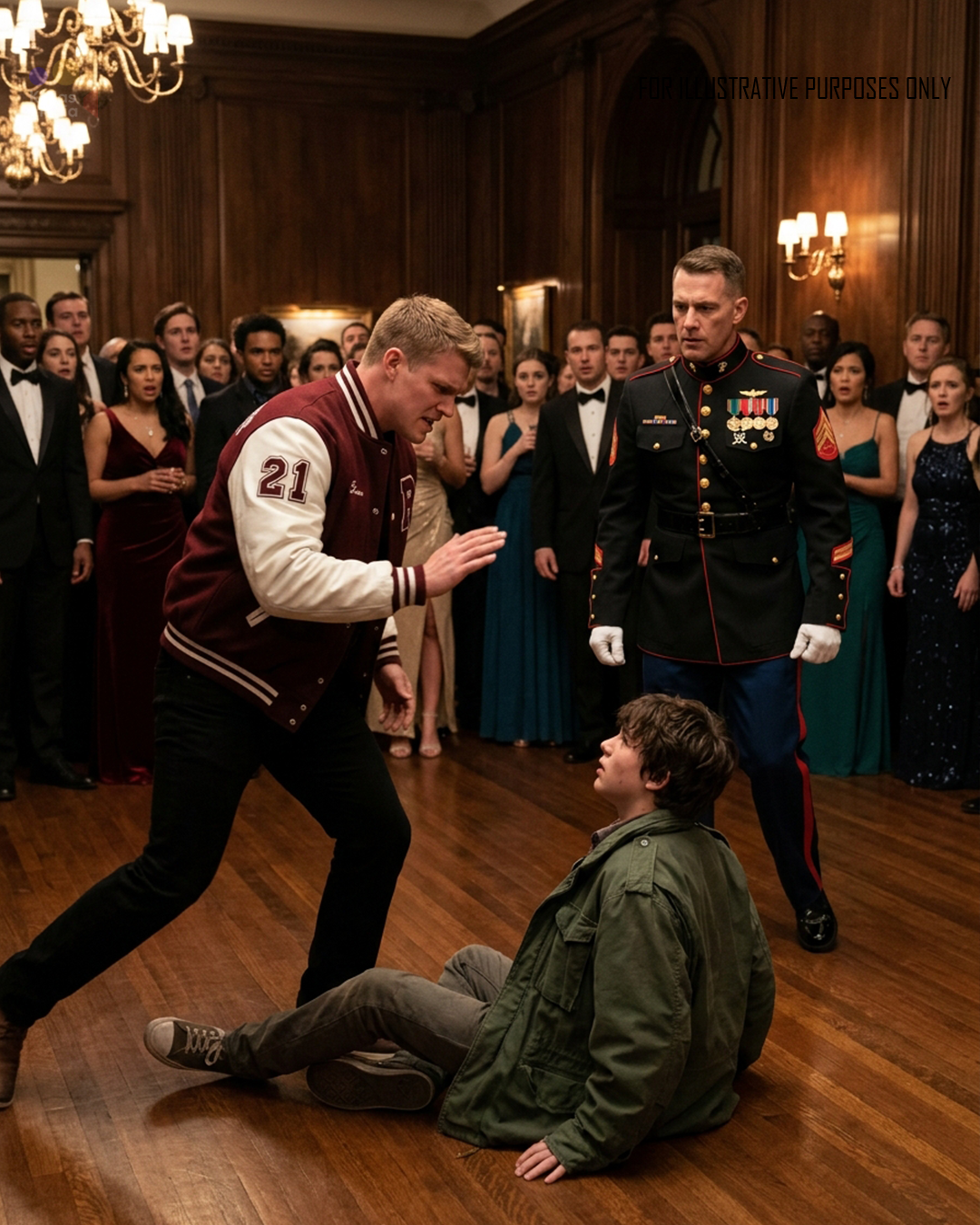
Travis grabbed Noah by the collar and dragged him under the honor wall.
“Look up there,” Travis said. “Those are real men. Generals. Champions. Winners. You think you belong under their names?”
Noah’s eyes flicked upward.
For the first time all night, his face changed.
Not fear.
Pain.
Travis saw it and mistook it for weakness.
Then he slapped Noah.
Hard.
The sound cracked through the auditorium like a dropped board.
The laughter died.
Noah’s head turned with the force of it. The garment bag slipped from his shoulder. A small velvet pouch fell from his pocket and opened on the floor.
The medal slid out.
Old brass.
Dark ribbon.
Carefully preserved.
Travis picked it up before Noah could.
“No,” Noah said.
It was the first time his voice shook.
Travis dangled the medal between two fingers.
“Oh, this matters to you?” he said. “What is it? Some pawn shop trophy?”
Noah took one step forward.
“Give it back.”
Travis laughed.
“Did your homeless dad steal this too?”
At that moment, the principal, Dr. Harold Pierce, turned around.
He had been near the stage reviewing the evening’s program.
When he saw the medal in Travis’s hand, all the color drained from his face.
“Travis,” Dr. Pierce said, his voice thin. “Put that down.”
Travis rolled his eyes.
“Relax. I’m teaching him school pride.”
Then the back doors opened.
The Marine entered.
He was tall, broad-shouldered, and older than most of the parents in the room. His hair was silver at the temples. His face carried the kind of calm that did not need permission.
His uniform was immaculate.
Rows of ribbons lined his chest.
A sword-straight posture made him seem larger than the room itself.
Noah looked at him.
For one second, he was not the mocked boy under the honor wall.
He was just a son trying not to break.
“Dad,” Noah whispered.
The Marine’s eyes moved from Noah’s bruised cheek to Travis’s hand.
Then to the medal.
Then to Brent Keller.
Nobody breathed.
One of the veterans in the front row pushed himself up from his chair.
Then another.
Then all of them stood.
A retired Army colonel removed his cap.
An elderly Marine with a cane whispered, “Dear God.”
Travis looked around, confused.
“Why is everybody standing?”
His father did not answer.
Brent Keller’s face had gone gray.
The Marine reached the center aisle and stopped ten feet from Travis.
“Son,” he said to Noah, “are you hurt?”
Noah shook his head.
“I’m okay.”
The Marine looked at the red mark on his cheek.
“No, you’re not.”
Then he held out his hand toward Travis.
“My medal.”
Travis swallowed.
For the first time, his voice lost its swagger.
“This is yours?”
The Marine did not blink.
“Yes.”
Dr. Pierce stepped forward with the microphone.
“Ladies and gentlemen,” he said, still shaken, “our keynote speaker tonight is Colonel Matthew Hayes, United States Marine Corps, retired.”
A murmur swept through the auditorium.
Dr. Pierce continued.
“Colonel Hayes is one of the most decorated alumni in Whitmore history. He graduated from this school thirty-two years ago. He served multiple tours overseas, saved the lives of twelve men during an evacuation under fire, and later funded the scholarship program that has allowed dozens of military families to send their children here.”
The words hit the room like thunder.
Noah looked down.
He had known his father was invited.
He had known the school wanted him to speak.
But he had not known this part.
Travis stared at Noah.
“The janitor’s kid?” someone whispered.
The retired Marine in the front row turned sharply.
“That boy is Colonel Hayes’s son.”
The whisper died.
Colonel Hayes took the medal from Travis’s hand.
He did not snatch it.
That somehow made the moment worse.
He held it carefully, wiped it once with his thumb, and placed it in Noah’s palm.
“This medal belonged to men who did not come home,” he said. “It was never jewelry.”
Travis’s lips parted.
“I didn’t know.”
Colonel Hayes looked at him.
“That is what respect is for. It protects you from needing to know.”
The room fell silent.
Brent Keller hurried forward, forcing a laugh that sounded like a cough.
“Colonel Hayes, sir, I apologize. Boys get emotional. Travis didn’t mean anything by it. We all respect the military here.”
Colonel Hayes turned to him.
“Do you?”
Brent froze.
Dr. Pierce’s jaw tightened.
The school board chair, Margaret Ellison, stood from the donor section. She was a calm woman with white hair and a navy suit, and everyone at Whitmore knew she controlled the board like a judge controlled a courtroom.
“Mr. Keller,” she said, “why did you not intervene?”
Brent looked around.
“I didn’t see the whole thing.”
A dozen phones were still raised.
A student in the second row said, “I recorded all of it.”
Another said, “Me too.”
Then a teacher stood.
“I saw it,” she said quietly.
Brent glared at her.
She flinched, then looked at Colonel Hayes and stood straighter.
“I saw all of it,” she repeated. “And this is not the first time Travis has done something like this.”
That sentence broke the dam.
A freshman raised his hand.
“He shoved me into the locker room door last month.”
A girl from the debate team stood next.
“He called my brother trash because he’s on financial aid.”
Another football player stared at the floor, then whispered, “Coach told us not to report it because Travis had scouts coming.”
The auditorium began to buzz.
Travis stepped back.
“Everybody’s lying.”
Noah finally spoke.
“No, they’re not.”
Everyone looked at him.
His cheek was still red, but his voice was steady now.
“You hit people because they can’t hit back,” Noah said. “You laugh because your friends are scared not to laugh. And you thought my dad was nobody because I didn’t dress like somebody.”
Travis pointed at him.
“You set me up.”
Noah’s face hardened.
“You slapped me in front of three hundred people. I didn’t make you do that.”
The words landed clean.
Colonel Hayes placed a hand on Noah’s shoulder.
Then he looked toward the honor wall.
The display had a central empty space covered by a navy cloth. It was supposed to be unveiled during his speech.
Dr. Pierce seemed to remember it at the same time.
He nodded to two student volunteers.
They pulled the cloth down.
Behind it was a new bronze plaque.
COLONEL MATTHEW HAYES WHITMORE CLASS OF 1994 UNITED STATES MARINE CORPS FOR COURAGE, SERVICE, AND SACRIFICE
The room rose to its feet.
Not all at once.
Slowly.
Ashamed.
One section after another.
The applause started small, then filled the hall.
Noah looked at the plaque, then at his father.
“Why didn’t you tell me?”
Colonel Hayes looked at him with tired eyes.
“Because medals are not supposed to teach you you’re worth something. You were worth something before I ever wore one.”
Noah’s lip trembled.
He tried to nod.
Travis ruined the moment by muttering, “This is stupid.”
It was quiet.
But the microphone caught it.
The whole auditorium heard him.
Margaret Ellison turned slowly.
“Dr. Pierce,” she said, “please read the athletics code of conduct aloud.”
Brent stepped forward.
“Margaret, that is not necessary.”
She did not look at him.
“Read it.”
Dr. Pierce opened the folder on the podium. His hands shook less now.
“All scholarship athletes representing Whitmore Preparatory Academy are held to standards of conduct on and off campus. Public assault, harassment, intimidation, discriminatory humiliation based on perceived class or family status, and conduct bringing dishonor to the institution may result in immediate suspension, loss of honors, and revocation of scholarship recommendation.”
Travis’s mouth went dry.
“My scholarship is already signed.”
Margaret Ellison looked directly at him.
“Not after tonight.”
His father exploded.
“You can’t do that! Do you know how much money I’ve raised for this school?”
Colonel Hayes looked at him.
“There it is.”
Brent spun toward him.
“What?”
“The truth,” Colonel Hayes said. “You thought money outranked character.”
Several alumni murmured.
Brent’s face reddened.
“You come in here with your uniform and think you own the place?”
The room went deadly still.
Colonel Hayes did not move.
But every veteran in the front row turned toward Brent Keller.
Margaret Ellison’s voice became ice.
“Mr. Keller, you are speaking to an invited honoree, a decorated alumnus, and the primary donor behind the military family scholarship fund you used in last year’s promotional campaign.”
Brent blinked.
“The what?”
Dr. Pierce looked sick.
Margaret continued, “Colonel Hayes did not want his name public. But since your department repeatedly used his fund to attract donors, while your son harassed scholarship students, we will be conducting an immediate review.”
Brent’s eyes darted to the donors.
“Margaret, let’s discuss this privately.”
“No,” she said. “You allowed a child to be assaulted publicly. You dismissed it publicly. You insulted a decorated guest publicly. We will correct it publicly.”
The applause that followed was not loud.
It was harder than applause.
It was agreement.
Travis looked at his father.
“Dad, do something.”
Brent had no answer.
Colonel Hayes turned to Travis.
“You are young,” he said. “Young people can change. But change begins when excuses end.”
Travis’s face twisted.
“I’m not bowing to him.”
Noah frowned.
Nobody had asked him to.
Colonel Hayes looked at Brent.
“Your family does not need to bow to me. You need to bow to the truth.”
Then he pointed to the honor wall.
“To every name on that wall. To every student you made feel small. To every parent who trusted this school. And to the boy you hit because you believed poverty made him safe to humiliate.”
Margaret Ellison stepped in.
“Travis Keller, Brent Keller — you will apologize now. Not as performance. As record.”
Brent’s pride fought him.
His job fought harder.
He turned stiffly toward Noah.
“I apologize.”
Margaret’s eyes narrowed.
“For what?”
Brent swallowed.
“For allowing my son to mistreat you.”
Colonel Hayes said nothing.
Noah looked at Travis.
Travis’s jaw clenched. His friends were watching. His teammates were watching. The students he had bullied were watching.
For once, the crowd did not protect him.
It judged him.
Travis lowered his head.
“I’m sorry I slapped you,” he said. “And I’m sorry I called you a beggar.”
Noah did not smile.
He did not forgive him for the room.
He simply said, “You should be sorry to more people than me.”
That was the first time Travis looked afraid.
By the end of the night, Whitmore’s board had called an emergency session.
Travis was suspended from the football program before he left the building.
By Monday morning, Westbridge State had withdrawn its scholarship offer pending conduct review.
By Wednesday, three more families came forward with complaints.
By Friday, Brent Keller was placed on administrative leave.
Two weeks later, he was terminated for failure to report student harassment, misuse of donor language, and conduct unbecoming of school leadership.
But the part people remembered most was not the punishment.
It was what happened after the auditorium emptied.
Noah stayed behind beneath the honor wall.
The lights were dim. The floor was littered with programs, water cups, and the kind of silence that comes after a room finally tells the truth.
Colonel Hayes stood beside him.
The medal was back in its velvet pouch.
The garment bag lay across a chair.
Inside was Colonel Hayes’s old dress jacket from his early years in service. He had brought it for the ceremony, planning to show students how service begins with responsibility, not glory.
Noah ran his fingers over the sleeve.
“I hated that they thought you were a janitor,” he said softly.
His father looked at him.
“I would never be ashamed to be a janitor.”
“I know.”
“No honest work makes a man small.”
Noah nodded.
“But I hated that they thought small meant worthless.”
Colonel Hayes was quiet for a long moment.
Then he unzipped the garment bag.
“Try it on.”
Noah stared at him.
“What?”
“Try it on.”
“It won’t fit.”
“Not yet,” his father said. “That’s all right.”
Noah slipped his arms into the jacket. It hung too wide on his shoulders and too long at his wrists.
But when he stood beneath the honor wall, something changed.
Not the jacket.
Not the medal.
Noah.
He stood taller.
Dr. Pierce, who had returned to collect his notes, stopped near the aisle.
Margaret Ellison stood beside him.
She looked at Noah under the wall and then at Colonel Hayes.
“We’ve been discussing the student honor program,” she said. “It has been neglected for years. Too much athletics. Too little service.”
Noah started to remove the jacket, embarrassed.
Margaret smiled gently.
“Leave it on.”
Dr. Pierce cleared his throat.
“Noah, the board would like to invite you to help lead the new Honor Wall Student Committee. Not because of what happened to you. Because of how you handled it.”
Noah looked stunned.
“I didn’t do anything.”
Colonel Hayes put a hand on his shoulder.
“You endured without becoming cruel. That is something.”
The next semester, Whitmore changed.
Not perfectly.
No school changes overnight.
But posters went up with new rules about bullying and reporting.
The athletics department was audited.
The scholarship students were given a private reporting line.
Teachers who had been afraid to speak began speaking.
The Honor Wall Committee added a new section, not just for famous alumni, but for quiet service:
custodians, nurses, cafeteria workers, bus drivers, veterans, parents, volunteers, students who stood up for others when no one applauded.
Noah helped install the first plaque himself.
It did not have his name on it.
He refused that.
Instead, it read:
HONOR IS NOT WHAT PEOPLE CALL YOU WHEN YOU ENTER A ROOM. HONOR IS HOW YOU TREAT PEOPLE WHO CANNOT HELP YOU.
On the day the new wall opened, Noah wore his father’s old uniform jacket again.
It still did not fit perfectly.
But nobody laughed.
Students gathered in the auditorium, and this time, the football team sat quietly in the back.
Travis Keller was not there.
He had transferred to another school after losing his captain title and scholarship path. People said he was angry for a long time. Later, one former teammate heard he had joined a community service program as part of his disciplinary record.
Noah did not celebrate that.
His father had taught him that justice was not revenge.
Justice was the door closing on cruelty and opening for someone else to breathe.
When Colonel Hayes stepped onto the stage that day, he did not begin by talking about war.
He talked about a boy in worn shoes.
He talked about silence.
He talked about the danger of rooms where everyone sees wrong and waits for someone more powerful to name it.
Then he turned toward Noah.
“My son taught me something in this very hall,” he said. “Strength is not always loud. Sometimes strength is a boy holding back tears because he refuses to become what hurt him.”
The auditorium stood.
This time, Noah did cry.
Not from shame.
From relief.
After the ceremony, a little freshman approached him near the wall.
The boy wore glasses and carried a backpack with a broken zipper.
He looked nervous.
“Are you Noah Hayes?”
Noah nodded.
The freshman looked at the floor.
“Some guys have been messing with me. I didn’t know who to tell.”
Noah glanced at his father.
Colonel Hayes gave him a small nod.
So Noah turned back to the boy and said the words he wished someone had said to him earlier:
“You can tell me. And this time, nobody’s going to look away.”
That was how Noah Hayes, once mocked as a beggar beneath the old honor wall, became the student who helped rebuild it.
Not with money.
Not with fear.
Not with a famous last name.
With the one thing Travis Keller never understood.
Respect.
