Physical Address
304 North Cardinal St.
Dorchester Center, MA 02124
Physical Address
304 North Cardinal St.
Dorchester Center, MA 02124

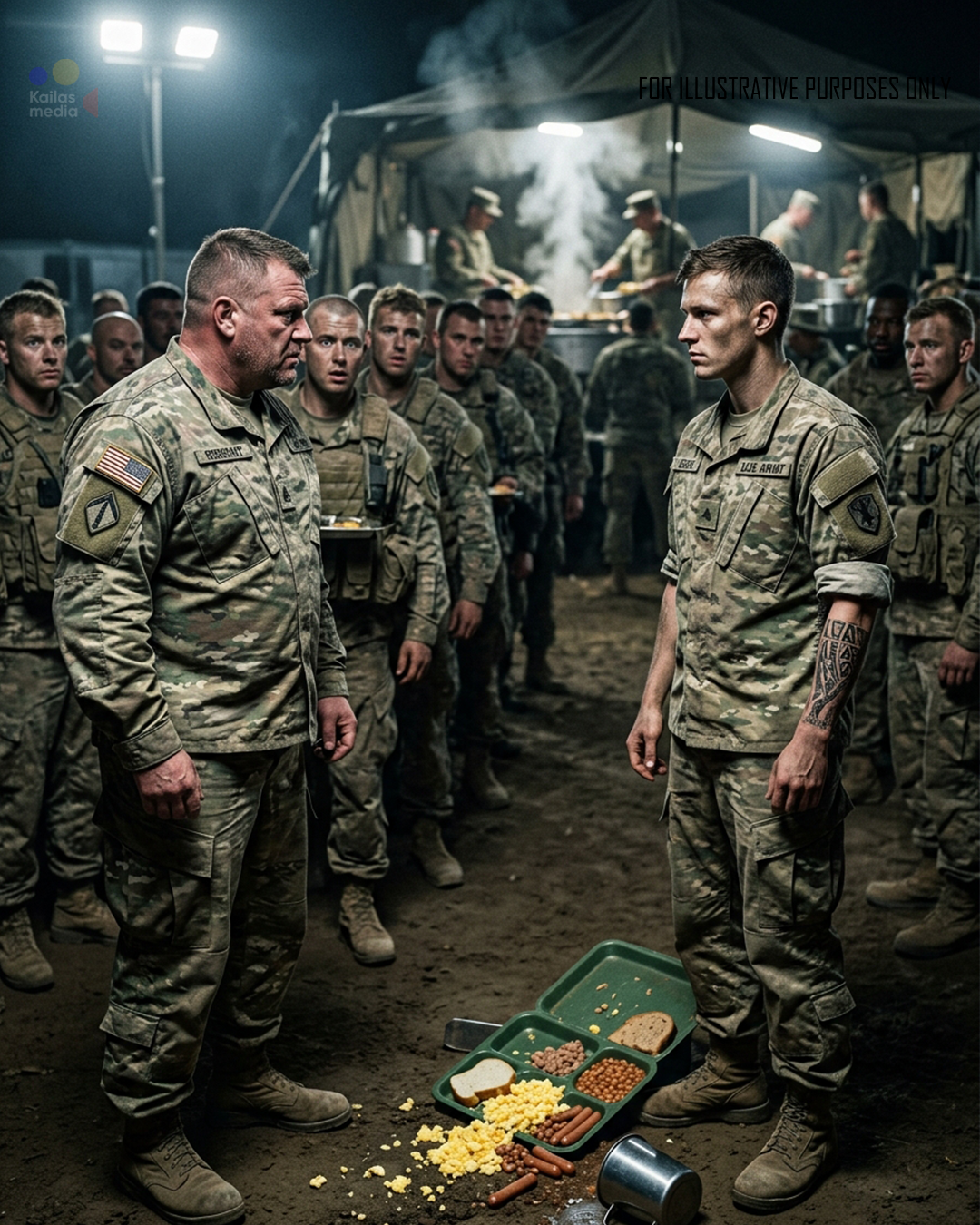
“You eat when I say.”
The tray hit the ground hard enough to snap the whole chow line quiet.
Plastic skidded across packed dirt. Watery eggs, beans, toast, and a scoop of gray sausage slopped into the dust between boot prints. A tin cup rolled in a crooked circle, hit the leg of a folding table, and fell on its side with a hollow metallic clink that somehow sounded louder than Sergeant Nolan Briggs’s voice.
For one strange second, nobody moved.
The field kitchen at Fort Rainer had been loud a heartbeat earlier—generators rattling behind the mobile trailers, cooks shouting over steam, soldiers in fatigues shifting through the breakfast line before first light. Now the entire place seemed to hold itself still. Even the men ladling coffee had stopped mid-pour.
Specialist Mason Vale stood over the wreckage of his breakfast without bending to look at it.
Sergeant Briggs stayed close, squared up, one hand still half-raised from the motion that had sent the tray flying. He was built like a man who’d spent years making sure every room understood he was the hardest person in it. Thick neck. Forearms roped with muscle. A face permanently set in irritation, as if the world had disappointed him from birth and everybody under his rank was now paying for it.
“You got a hearing problem, Vale?” Briggs asked.
Mason didn’t answer right away.
He kept his eyes on the dirt, not the food. Not the tray. Just the dirt.
The camp floodlights threw harsh white over everything—the mud-splashed generators, the canvas-covered tables, the silver steam of the warming pans. The Texas air felt cold in that thin hour before sunrise, but sweat had already started between Mason’s shoulder blades.
Not from fear.
From restraint.
Around them, thirty, maybe forty soldiers watched from the chow line, pretending not to while very clearly doing exactly that. A few lowered their gaze. A few stared openly. One private at the back swallowed hard and looked like he regretted being born in time to witness it.
Briggs tipped his head toward the ground.
“Clean it.”
No one in line spoke. No one laughed. That made it worse.
Humiliation always sounded bigger in silence.
Mason finally lifted his eyes.
He was younger than Briggs by at least fifteen years, leaner, not smaller exactly but harder to read. He had the stillness of somebody used to conserving words. His uniform was dusty from the overnight movement drills, sleeves buttoned, collar open at the throat. He looked like any other tired specialist on a rough training cycle—except for his eyes, which stayed level in a way that didn’t match the scene.
Briggs mistook that calm for hesitation.
“Did I stutter?”
One of the cooks shifted uncomfortably behind the steel serving table. A lieutenant near the coffee urn took half a step forward, then stopped himself. That was how Briggs liked it. He liked witnesses. He liked forcing people to choose between dignity and obedience in public. It made the lesson spread faster.
Mason’s jaw tightened once.
Still, he didn’t bend.
Briggs leaned closer. His breath smelled like burnt coffee and wintergreen dip. “You people only understand one thing. Maybe I’ve been too nice with you.”
There it was.
You people.
A phrase dropped carelessly enough that a dozen soldiers could pretend they hadn’t heard it clearly. But they had. Mason had too.
Somewhere behind them, a metal ladle fell into a pot. Nobody turned.
Briggs’s voice lowered. “I said clean it.”
Mason looked past him for half a second, toward the line of waiting soldiers. He saw every familiar face become strange under pressure. Men he’d trained with. Men who’d borrowed gear from him, eaten beside him, joked with him in the barracks. None of them met his eyes for long. They weren’t cowards, not exactly. They were surviving the chain of command the way everybody survived it—head down, clock running, one meal, one order, one day at a time.
Briggs took Mason’s silence as surrender approaching in slow motion. “That’s what I thought.”
But Mason still didn’t kneel.
Instead, he reached to his left cuff.
The movement was so small at first that Briggs barely registered it.
Mason unbuttoned the sleeve.
Briggs frowned. “What are you doing?”
Mason didn’t answer. He rolled the cuff once, then again, pushing the fabric above his forearm.
That got the line’s attention in a different way.
A corporal near the front narrowed his eyes. Another soldier leaned slightly to see around the man in front of him. The lieutenant by the coffee urn stopped pretending not to watch.
Mason rolled the sleeve higher.
A section of dark ink surfaced above the tendon of his wrist, then more of it, sharp against skin browned by field days and sun. Not random barracks ink. Not some skull or flag or joke from a drunken weekend outside base.
This was clean. Deliberate. Official-looking.
Briggs’s irritation faltered.
“What the hell is that?”
Mason kept folding the sleeve until the full mark was visible on the inside of his forearm.
It wasn’t large. It didn’t need to be.
A black insignia. Precise lines. An old unit crest incorporated into newer symbols. Numbers beneath it. Not decorative—identifying. Recognizable to the right eyes.
Briggs had those eyes.
The blood seemed to leave his face in a visible drain.
No one else understood it yet. The line just felt the shift before they could name it. The kind of shift animals feel before a storm. The air changed. The geometry of the moment changed. Something invisible had just stepped into the space with them.
Briggs stared at the tattoo.
Then he stared harder.
He looked from the ink to Mason’s face and back again, like one might correct the other.
Mason lowered his arm but didn’t cover it.
“What is that?” Briggs asked again, and this time the question didn’t sound like a challenge. It sounded like a man hoping reality might still bend in his favor if he asked the right way.
Mason finally spoke.
“Read it.”
Briggs didn’t move.
The soldiers around them heard the words and went even stiller. A sergeant being told what to do by a specialist in public already felt like a crack running through concrete.
Briggs swallowed. His gaze returned to the tattoo. His mouth twitched, calculating, remembering. Somewhere in that insignia was a history he knew. Somewhere in those numbers was a name he’d heard in command briefings, maybe in warnings, maybe in stories told with doors shut.
Mason’s expression didn’t change.
Then Briggs did something that made the tension worse instead of releasing it.
He stepped back.
Just one step. Barely anything. But it was enough for everybody watching to feel that this was no longer the scene they thought it was.
The lieutenant by the coffee urn moved at last, approaching carefully. “Sergeant?”
Briggs didn’t answer him.
He kept looking at Mason.
His voice, when it came, was lower than before. “Where did you get that?”
Mason let the question sit.
In the distance, beyond the field kitchen, reveille had not yet sounded. The sky over the training grounds was still a bruised navy blue, beginning to pale at the edges. Generator light made everyone look harsher than they were.
“Sergeant,” the lieutenant repeated, quieter now.
Briggs didn’t look away from Mason. “Stand by, sir.”
It was a strange thing to say to an officer. Stranger still was the fact that the lieutenant actually did.
The line had become an audience now. Soldiers in dust-covered uniforms. Kitchen staff with gloves on and spoons frozen in their hands. A medic carrying a crate of bottled water had stopped midway across the gravel and forgotten to keep walking.
Briggs dragged a hand across his mouth.
Mason watched him with the patience of somebody who knew exactly how much rope the other man had left.
Then Briggs tried to reclaim ground the only way men like him knew how.
“I gave you a direct order,” he said, louder again, though the volume didn’t fully recover its old force. “Whatever game you think you’re playing, you’re still standing in my line, on my training field, under my authority.”
Mason tilted his head slightly.
“Your authority?”
Briggs’s jaw flexed. “That’s right.”
It was a bad answer. He knew it as soon as he said it.
Because Mason’s face changed then—not dramatically, not enough for everyone else to understand, but enough for Briggs to see it. A small, tired disappointment. Like a teacher watching a student choose the dumbest possible option with total confidence.
The lieutenant glanced between them. “Specialist Vale, do you want to explain what’s going on?”
Mason looked at him, and for the first time there was something almost sympathetic in his voice.
“No, sir. I think he understands.”
Briggs didn’t.
Or maybe he did, and that was worse.
He looked around suddenly, as if noticing the crowd only now. The witnesses. The public angle of it. His humiliation, should it fully arrive, would not happen in private. Every private he’d barked at, every specialist he’d dressed down, every junior NCO who’d laughed when he humiliated someone else—they were all here.
That realization made him meaner.
His boot nudged the fallen tray.
“I don’t care what tattoo you’ve got. You think that changes what happened?” He pointed at the dirt. “You dropped discipline in front of my whole formation.”
Mason’s eyes moved once to the tray, then back to Briggs.
“You kicked a meal out of my hands,” he said.
Briggs’s nostrils flared. “Careful.”
Something unexpected happened before the midpoint of that standoff, and it had nothing to do with shouting.
A captain appeared from the edge of the field kitchen and stopped dead.
Captain Lena Ortiz had been crossing from the command tent toward the mess trailer with a radio clipped to her vest and a stack of printed movement orders under one arm. She was not a woman easily thrown off balance. But the moment she saw Mason’s uncovered forearm and Briggs standing in front of him, her face changed in exactly the way Briggs’s had—less dramatically, more controlled, but unmistakably.
Oh no.
That was what crossed her features.
Not fear. Recognition.
She walked faster.
“What is going on here?” she asked.
No one answered immediately.
Ortiz’s gaze dropped to the dirt, the ruined food, the tray. Then to Briggs. Then to Mason’s rolled sleeve.
Her lips pressed into a thin line.
Briggs found a piece of himself again when an actual senior officer entered the scene. He turned toward her with visible relief. “Captain, Specialist Vale has chosen to refuse a direct order after causing a disruption in the chow line.”
Ortiz looked at Mason. “Is that what happened?”
Mason met her eyes. “No, ma’am.”
She nodded once, as if that was enough to confirm what she already suspected.
Briggs noticed.
That was the instant the first real crack of panic showed in him.
“Captain—”
“Quiet,” Ortiz said, not loudly, but with enough edge to cut him off clean.
The whole line felt it.
She stepped closer to Mason, just enough to see the tattoo clearly, then looked at his face with sudden professionalism, almost caution.
“You weren’t expected until noon.”
“No,” Mason said. “I got in early.”
Briggs stared at her. The lieutenant stared too. Now others began piecing together that the tattoo was not just some old combat insignia. It meant access. Oversight. Something that stood above the normal training chain. Something that had arrived unannounced.
Ortiz looked down at the tray on the dirt.
Then back up at Briggs.
Her expression was impossible to misread now.
“What exactly did you say to him?” she asked.
Briggs tried to choose carefully, which was new for him. “He was out of line, ma’am. I corrected him.”
Ortiz didn’t blink. “What exactly did you say?”
Briggs hesitated.
Nobody helped him.
The cook behind the serving table looked at the ground. The medic with the water crate stood frozen. The private at the back of the line had gone pale.
Finally Briggs said, “I told him he’d eat when I said.”
Ortiz absorbed that without visible surprise.
“And after you kicked his tray?”
The words landed like a hammer because of how specific they were.
Briggs’s eyes flicked to Mason, then back. “I ordered him to clean it.”
Ortiz gave the smallest nod, as if inventorying a checklist.
Mason remained still through all of it. He did not jump in. Did not enjoy himself visibly. Did not help bury the man. That restraint made the whole scene heavier.
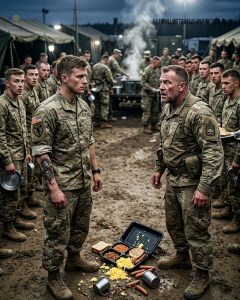
Briggs tried a different angle. “Captain, with respect, I had no reason to know—”
Ortiz cut him off again. “No reason to know what? That basic conduct still applies before sunrise?”
A few soldiers shifted, and Briggs heard it.
He was slipping.
His gaze snapped back to Mason’s forearm. “Why is he even here as a specialist?”
No one answered at first.
Then Mason did.
“Because rank is useful camouflage.”
The sentence moved through the crowd like an electrical current.
Briggs stared.
The lieutenant stared.
Ortiz said nothing, which in some ways confirmed even more.
Fort Rainer was in the middle of a brutal readiness evaluation before a high-level deployment recommendation. Rumors had been circling for weeks that outside assessment teams were being folded into exercises without warning. Inspectors. Operational auditors. Standards and discipline oversight. Men and women who showed up wearing ordinary patches and ordinary ranks, invisible until the wrong person made the wrong choice in front of them.
Most rumors were exaggerated.
This one wasn’t.
Mason finally looked at the tray again.
The plastic had cracked down one side. Egg yolk and grit had fused into a yellow-brown smear. The toast was face down in the dirt. Ants would have found it within minutes once the sun came up.
Briggs saw where he was looking and made the last mistake.
He mistook silence for mercy.
He straightened his back, trying to put command into his voice again, trying to get ahead of the story before it hardened around him. “None of this changes the fact that we maintain standards here. If your people wanted to test discipline, you just got your answer.”
Mason slowly rolled his other sleeve once, then left it there.
When he spoke, the first time, the words were so quiet they almost disappeared under the generators.
“Pick it up.”
Several soldiers heard it. Several didn’t. Briggs definitely did.
And he definitely did nothing.
Maybe he thought pretending not to hear would buy him a different ending. Maybe he couldn’t make his body obey in front of that many people. Maybe the order had come from a place colder than volume, and that frightened him more than yelling would have.
No one moved.
Not Ortiz. Not the lieutenant. Not the line.
Mason took one step forward.
He wasn’t taller than Briggs by much, but the scene rearranged itself around him anyway. The dirt. The tray. The audience. The captain. The kitchen lights bleaching out every excuse.
When he spoke again, the second time, his voice wasn’t raised. It was sharpened.
“Pick it up.”
The sentence cut through the morning like a blade drawn across wire.
It was colder now. Harder. Final.
No one breathed.
Briggs’s face changed in slow, visible stages: resistance, disbelief, calculation, then the realization that there was no version of this where standing still saved him. Every second he delayed made it worse. Every witness made it permanent.
His eyes flickered once to Captain Ortiz, perhaps hoping she would interrupt and spare him. She didn’t.
The lieutenant looked like he wanted to disappear into the steam.
Briggs’s shoulders lost an inch.
Then another.
In front of the whole line, in front of the cooks, in front of the officer he’d just tried to impress with fake discipline, Sergeant Nolan Briggs bent at the waist and reached down for the tray.
The sound of the plastic scraping dirt was indecently loud.
He picked up the cup next. Then the spoon. Then the cracked tray with the food congealed on it. His movements were stiff, furious, careful in the way a man is careful when he knows one wrong gesture might tip humiliation into total collapse.
He stood back up holding the ruined breakfast in both hands.
Nobody spoke.
A drop of egg slid off the side and hit his boot.
Mason let him stand there for two full seconds before saying, “Now look at it.”
Briggs looked.
“Tell me what you see.”
Briggs’s jaw flexed. “A contaminated tray, Specialist.”
Mason’s eyes didn’t change. “Wrong.”
The captain said nothing.
Neither did anyone else.
Mason stepped closer, close enough now that Briggs had to tilt his head slightly downward to avoid eye contact with the line. “You see the exact point where you stopped leading and started performing cruelty because there was an audience. You see a noncommissioned officer who confused fear with respect. You see a man who thought public humiliation counted as standards.”
The words were calm. Measured. Worse than shouting.
Briggs gripped the tray harder. “Sir—”
“Don’t,” Mason said.
That single word shut him down more completely than anything yet.
The soldiers in line were no longer just watching a reversal. They were watching a man stripped of the script he’d used his entire career. Briggs knew how to dominate. He knew how to belittle. He knew how to roar until younger men folded. But he had nothing for this—nothing for being made to stand inside his own conduct and look at it under floodlights.
Captain Ortiz finally spoke.
“Sergeant Briggs, hand the tray to the kitchen and step out of line.”
He turned toward her as though waking from impact. “Ma’am, I—”
“That wasn’t a discussion.”
Briggs walked the tray to the serving table. One of the cooks took it from him without a word. The silence from the kitchen crew was almost reverent. Not because they enjoyed his humiliation. Because they had seen scenes like this build a hundred times without consequence. This time consequence had arrived wearing dusty sleeves and a specialist rank.
Briggs stepped back from the serving table and stood at parade rest automatically, though the posture looked wrong on him now—too formal, too late.
Mason rolled his sleeve back down halfway, not all the way. Enough for the tattoo to remain visible if anyone forgot.
Ortiz exhaled through her nose. “Lieutenant Harris.”
The young officer snapped to attention. “Ma’am.”
“Take over chow operations for the company.”
“Yes, ma’am.”
“Then report to the command tent in fifteen.”
“Yes, ma’am.”
She turned to Briggs. “You, with me.”
Briggs’s mouth opened, then closed. “Ma’am.”
He did not sound like himself anymore.
Mason looked to the line of waiting soldiers. “Everybody else, eat.”
The words were simple. Almost ordinary. But people moved fast, grateful for permission, grateful for a script they understood again. The line restarted with awkward clatter and cautious voices. Boots shifted. Trays lifted. Coffee poured. No one looked directly at Briggs now, which somehow shamed him more than staring would have.
As Ortiz started to walk him away, Briggs stopped.
“Captain.”
She did not turn. “What?”
He glanced back at Mason. “He set me up.”
The accusation came out weaker than intended, but it still made several nearby soldiers freeze again.
Mason answered before Ortiz could.
“No. I showed up hungry.”
Briggs looked like he wanted to argue, but there was nowhere to place it. Because that was the truth. The trap, if there had been one, was only ever the kind cruel men built for themselves.
Ortiz resumed walking. Briggs followed.
Mason picked up a fresh tray when his turn came, as if this were now just another morning. The cook serving eggs met his eyes once.
“Sorry about that,” the man murmured.
Mason shook his head. “Not your fault.”
He moved down the line. Beans. Eggs. Toast. Coffee.
The private who’d gone pale earlier ended up beside him near the utensil bin. He looked young enough to still be startled by the idea that power could ever move backward.
“Specialist—” he began, then stopped. “Sir. I mean…”
Mason took a spoon. “Relax.”
The private swallowed. “Did you know he’d do that?”
Mason glanced toward the command tent in the distance, where Briggs had disappeared behind canvas flaps. Morning light had begun to reach the horizon now, thinning the blue from the sky. Soon all the floodlights would seem excessive and absurd.
“I knew men like him usually do,” Mason said.
The private considered that. “You could’ve stopped him sooner.”
Mason took his coffee. “Could I?”
The kid had no answer.
They carried their trays to separate tables.
Across the field kitchen, conversation resumed in fragments—too soft, too careful, full of soldiers pretending not to discuss the only thing in the world any of them wanted to discuss. Briggs would not be returning to chow as sergeant in charge. That much everyone knew already. Whether he’d be removed entirely, whether it would become official paperwork, whether careers were ending before noon—that part would spread through the barracks by lunch.
Mason sat alone at the end of a folding table and finally started eating.
The eggs were terrible.
The coffee was worse.
He ate anyway.
Two minutes later, Captain Ortiz approached carrying her own untouched tray. “Mind if I sit?”
“You’re a captain,” Mason said.
“That a yes?”
He gave the smallest shrug. She sat.
For a moment they ate in silence, two uniforms under growing daylight, the air between them full of all the things neither needed to explain.
Finally she said, “He’ll say it was stress. Tempo. Field pressure. He’ll say standards got blurred.”
Mason chewed, swallowed, took a sip of coffee that tasted like hot metal. “What will you say?”
Ortiz looked out toward the line. “That stress doesn’t invent character. It reveals it.”
He nodded once.
She studied him. “You all right?”
It was an ordinary question, almost gentle. That made it harder than the confrontation had been.
Mason stared at his tray for a second.
“Yeah,” he said.
Ortiz did not call him on the lie.
Because it was a lie.
Not a large one. Not dramatic. But there was always residue after moments like that. People liked stories about power reversals because they imagined the reveal erased what came before. It never did. Public humiliation did not vanish because justice arrived later. The tray had still hit the dirt. The command had still been spoken. Forty people had still watched a man decide another man’s dignity was expendable.
Vindication could correct the record.
It could not unmake the moment.
Ortiz ate a bite of toast she clearly didn’t want. “For what it’s worth, command’s been getting noise on him for months. This won’t be the first complaint in the file.”
Mason looked toward the command tent again. “Then it should’ve ended earlier.”
She didn’t argue.
That silence said enough about how institutions worked—how long they tolerated ugliness as long as it wore stripes and shouted the right words.
On another table nearby, two soldiers were speaking quietly. One of them glanced at Mason, then away. Not with fear. With something more complicated. Relief, maybe. Or the uneasy realization that they had watched and done nothing. That knowledge would stay with them longer than breakfast.
The sun finally edged over the training grounds, laying a dull gold across the gravel and vehicles and canvas tents. The floodlights clicked off one by one. Everything looked less theatrical in daylight, which somehow made the morning feel more real.
Mason finished half the tray, then stopped.
Ortiz noticed. “You done?”
“Yeah.”
She stood with him. “Command wants you in the tent in twenty.”
He nodded.
As they carried their trays toward the disposal station, a staff sergeant from another company stepped aside to give Mason room without being asked. A tiny gesture. Respect mixed with caution. Word traveled fast on bases. Faster than truth, usually. Today the truth had gotten a head start.
Mason scraped the remains of his breakfast into a waste bin.
The sound reminded him, briefly, of the first tray hitting dirt.
His hand paused.
Ortiz saw it.
“You don’t have to stay for the rest,” she said. “You’ve already got enough.”
Mason looked at the bin, then at the rows of soldiers behind it, still eating under the ordinary machinery of military morning.
“That’s the problem,” he said quietly. “So do they.”
He set the empty tray down.
Across the field, the command tent flaps opened, and Sergeant Briggs emerged under escort from the first sergeant. No cuffs. No scene. Just a man walking very straight while everyone carefully pretended not to see him being taken away.
Mason watched for a moment.
Briggs never looked over.
Maybe he couldn’t.
Maybe that was the last shred of pride he had left.
The private from earlier stood near the coffee urn holding his tray to his chest. He glanced from Briggs to Mason and then down at the dirt where the first tray had fallen, as if memorizing the exact place where the morning turned.
Mason rolled his sleeve back down over the tattoo.
The mark disappeared under fabric like it had never been there.
But the silence it had broken stayed hanging over the field kitchen, heavy as smoke.
Some lessons were shouted.
The ones people carried longest were usually delivered in a voice so quiet they had to stop breathing to hear it.
